2027 Support Planning in Social Work: Collaborative Goals and Social Work Preparation
Audited and Verified:
Our Editorial and Data Verification Process
Research.com uses government datasets, official education statistics and primary institutional information to support its career and degree guides. Our review process checks factual accuracy, occupational definitions, source dates and the requirements associated with the credentials discussed.
How This Article Was Fact-Checked
Our editorial team verifies salary estimates, employment projections, education requirements and program information against original data providers and official organizations. Salary figures are checked against the relevant occupational definitions and reporting periods. Information about licensure, accreditation and required in-person training is reviewed separately.
Fact-checked and verified on:

Co-Founder and Chief Data Scientist
A support plan can turn a client's priorities into coordinated action - or become paperwork that nobody uses. For social work students, new practitioners, and human services professionals, the difference lies in how goals are chosen, responsibilities are shared, and progress is reviewed. This guide explains what belongs in a support plan, how to make goals genuinely collaborative, and which education and supervised learning experiences develop those skills. It also helps you decide whether a BSW, MSW, or targeted workplace training fits the work you want to do.
Key Things You Should Know
- A useful support plan records the client's priorities, agreed actions, responsible people, and a review date - not just an agency's service referrals.
- BSW and MSW field education can develop planning skills, but curricular placement hours are not the same as post-degree hours required for clinical licensure.
- Choose preparation for the role: many service-coordination jobs do not require an MSW, while independent clinical work generally requires state-specific licensure beyond the degree.
What is support planning in social work?
Support planning is the collaborative process of identifying what a person or family wants to change, what resources and barriers affect that goal, and who will take agreed steps. The resulting plan guides service coordination and review. It may be called a service plan, care plan, case plan, or treatment plan, depending on the setting; those names can carry different legal, clinical, or funding requirements.
A social worker considers the person in their environment: housing, benefits, relationships, discrimination, transportation, and service availability may matter as much as individual behavior. In a housing program, planning might coordinate an application and transportation to appointments. In a clinical setting, treatment planning may involve activities reserved for appropriately licensed professionals. Neither the plan's name nor an MSW degree alone establishes clinical authority; social work clinical hour requirements and completion planning concern a separate, board-governed stage of preparation.
What does a social work support plan include?
A usable plan is specific enough that the client and team can tell what happens next, without recording more sensitive information than the setting requires. Agency forms vary, but these components give readers a way to assess whether a plan can guide actual work:
- Client-defined priority and strengths: The outcome the person values, existing supports, and preferences about how to proceed.
- Relevant assessment: Needs, environmental barriers, risks, and service eligibility information within the worker's role.
- Agreed goal and actions: Observable steps, a realistic timeframe, and who is responsible for each task.
- Coordination and consent: Referral contacts, information-sharing permissions, and any required partner involvement.
- Review and contingency: When progress will be checked, how barriers will be addressed, and what will trigger a change in plan.
For example, "secure housing" may be a long-term priority, while "review two eligible housing programs together by the next meeting" is a nearer-term action. A worker should not record a referral as completed merely because it was suggested. Plans also need to reflect the rules of their setting: child welfare, healthcare, and school documentation may have different required elements. The planning duties themselves vary across social work master's roles and employment settings.
How do social workers and clients set collaborative goals?
Collaboration means the client can shape the outcome and the steps, not simply approve a goal selected by the agency. Start by asking what matters most to the person, what has already been tried, and what would make the next step feasible. Then distinguish their priorities from requirements imposed by a court, funder, or service program; do not present a required condition as a free choice.
A practical goal-setting conversation moves through these steps:
- Reflect the client's stated priority and check that you have understood it.
- Discuss strengths, barriers, available services, and any nonnegotiable requirements openly.
- Agree on a manageable action and identify who will do what by when.
- Ask how the client wants progress assessed and set a date to revisit the plan.
Specific goals help, but a rigid "SMART" formula should not override accessibility, cultural context, or changing circumstances. If an appointment depends on transportation that is unavailable, the barrier belongs in the plan rather than being treated as a failure of motivation. Students can learn this distinction by observing and practicing goal conversations with feedback in approved placements. When comparing programs, ask how the field office helps students find settings where they can practice these skills; exploring MSW programs with practicum assistance is a useful starting point for that question.
For a prospective BSW or MSW student, check the exact program's Council on Social Work Education (CSWE) accreditation status and whether it applies to the intended enrollment and graduation period. Institutional accreditation and CSWE programmatic accreditation answer different questions. A state licensing board - not CSWE or the university - determines eligibility for its license categories under current state rules.
If your target job requires a license, work backward from that state's board requirements: qualifying education, any required examination, application, and, for independent clinical practice, eligible post-degree supervised experience. License names and permitted duties differ by state. A clinical concentration, field placement, exam pass, or degree completion does not itself authorize independent psychotherapy. Before enrolling across state lines, confirm program authorization and placement feasibility as well as the intended board pathway. For a closer look at that distinction, see understanding degree and licensing expectations for MSW study.
BSW admission may involve entry to the university followed by a separate application to the social work major. Programs can review grades, prerequisite courses, writing, and readiness for field learning. Traditional MSW programs commonly consider a bachelor's degree, transcripts, statements, references, and relevant experience; specific prerequisites and minimum grades vary.
Advanced-standing MSW admission is a separate decision. Programs generally require a qualifying BSW and may impose accreditation, grade, and degree-recency conditions. A bachelor's in psychology, sociology, or human services can support an application to a traditional MSW but does not automatically qualify its holder for advanced standing. Ask admissions staff to identify the entry track and provide a written review of any disputed prerequisites. Compare social work master's application options by selectivity alongside field capacity and preparation quality; a simpler application is not evidence that a program fits your goal.
What careers involve support planning, and what are their salaries and job outlooks?
Support planning appears in child and family services, healthcare discharge coordination, behavioral health, aging services, housing, and community programs. Duties range from referrals and benefits coordination to clinically informed treatment planning. Before applying, check whether the employer requires a BSW, MSW, state license, school-specific qualification, or another credential - and whether the role provides supervision and a manageable caseload.
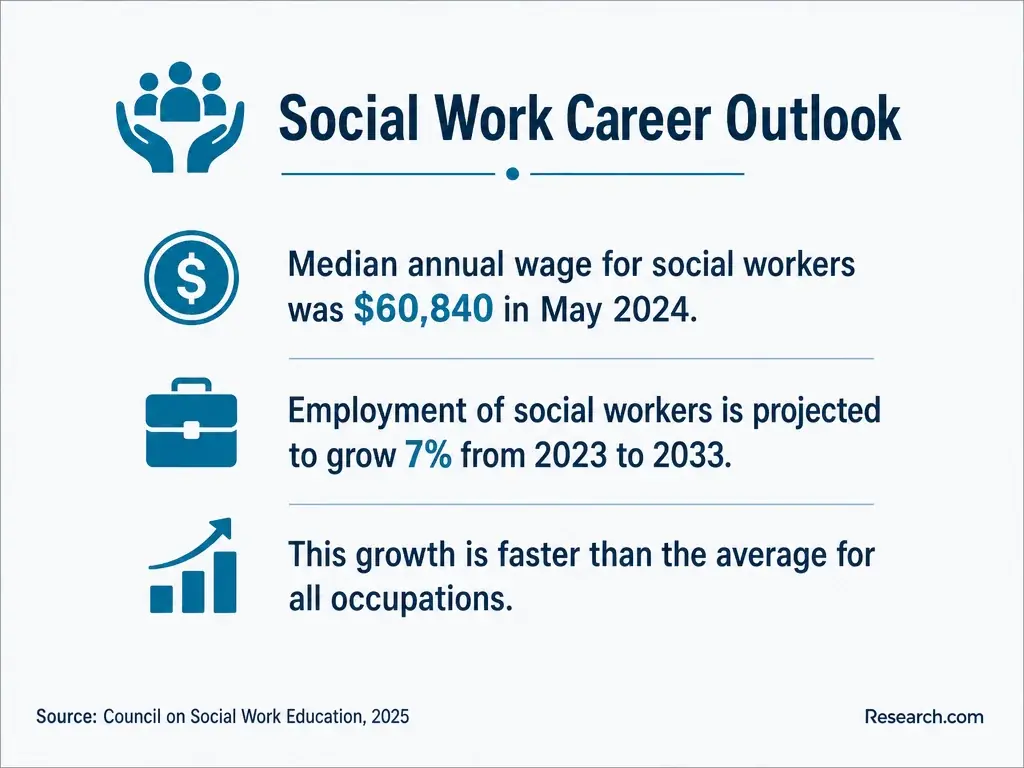
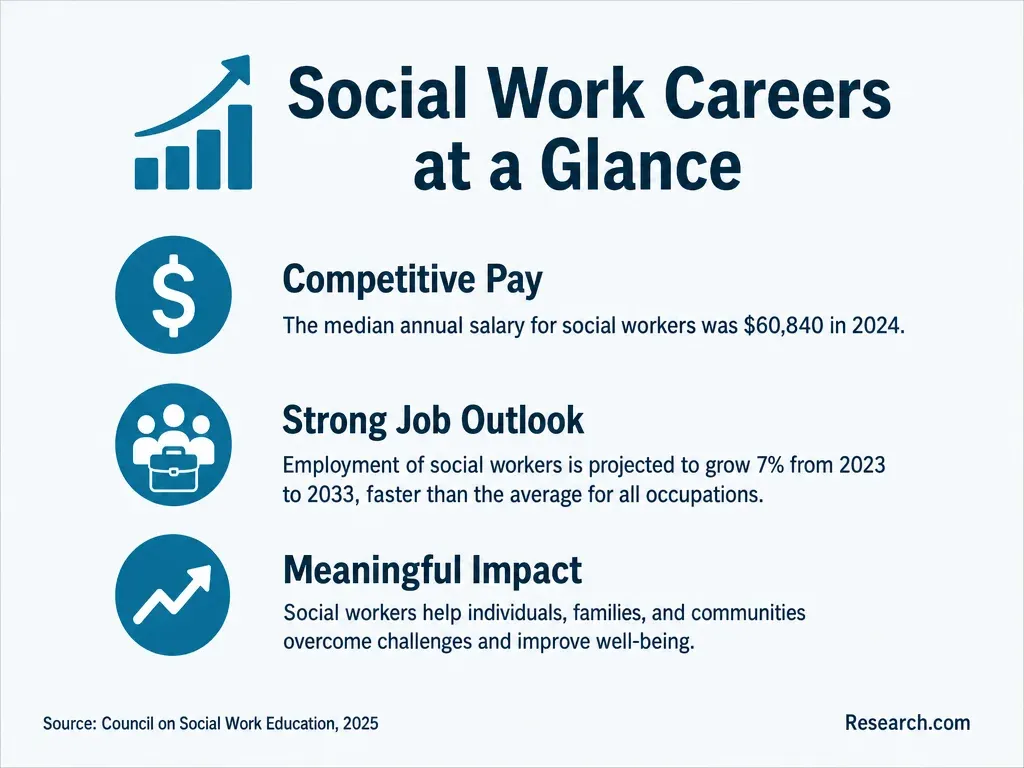
The U.S. Bureau of Labor Statistics figures below describe broad occupations, not salaries for support planners or guaranteed outcomes for degree holders. They can help compare settings; a particular job's pay also depends on location, employer, experience, and duties.
| U.S. occupation | May 2025 median annual pay | Projected employment growth, 2025-2035 |
| Child, family, and school social workers | $59,550 | 4% |
| Healthcare social workers | $67,880 | 8% |
| Mental health and substance abuse social workers | $60,280 | 10% |
A housing case manager or service coordinator may fall under a different occupational category and may not need social work licensure. Use the job posting and state rules to determine qualifications, then compare local compensation rather than applying a national median to an offer. Comparing state salary figures for social work roles can add geographic context, but it cannot resolve whether a particular position is a licensed social work role.
Other Things You Should Know About Social Work
Ask what makes the goal unsuitable and explore alternatives. Explain any mandatory program conditions plainly, document the person's response according to agency policy, and seek supervision when obligations and preferences conflict.
Not automatically. Check the applicable consent, privacy law, and agency rules before sharing, and disclose only information appropriate to the purpose and authorization.
Record the barrier accurately, discuss feasible alternatives with the client, and revise responsibilities or timing. Do not mark an unavailable referral as a completed service.
Review it when goals are met, services change, or involvement ends. Document the outcome and any transition or follow-up arrangements required by the setting rather than leaving an inactive plan open indefinitely.
- Respecting privacy and upholding confidentiality: core ethical duties - PMC https://pmc.ncbi.nlm.nih.gov/articles/PMC12747445/
- Developing Goals and Measurable Objectives | samhsa.gov https://www.samhsa.gov/grants/how-to-apply/forms-and-resources/developing-goals-measurable-objectives
- Planning for the Meeting | utah.gov https://dspdmanuals.hs.utah.gov/Support_Coordination/PCSP/Quality_Enhancement/Quality_Enhancement_Manual/Planning_for_the_Meeting.htm
- Case Management - StatPearls - NCBI Bookshelf https://www.ncbi.nlm.nih.gov/books/NBK562214/
- NASW Standards for Social Work Case Management | nycourts.gov https://www.nycourts.gov/reporter/webdocs/nasw_standards_socialwork_casemgt.htm
- Cultural Humility & Cultural Competence in Social Work | du.edu https://socialwork.du.edu/news/cultural-humility-cultural-competence-social-work
- The Difference Between Case Management vs. Social Work | Virginia Commonwealth University https://onlinesocialwork.vcu.edu/blog/case-management-vs-social-work/
- Guide to Goal Setting and Tracking | umn.edu https://practicetransformation.umn.edu/practice-tools/guide-to-goal-setting-and-tracking/
- 4 social work practice models | Saybrook University https://www.saybrook.edu/unbound/4-social-work-practice-models/
- Emerging Trends in Social Work - Columbia MSSW https://onlinemsw.socialwork.columbia.edu/emerging-trends-in-social-work/