2027 Stepped Care in Social Work: A Service Organization Concept in Behavioral Health
Audited and Verified:
Our Editorial and Data Verification Process
Research.com uses government datasets, official education statistics and primary institutional information to support its career and degree guides. Our review process checks factual accuracy, occupational definitions, source dates and the requirements associated with the credentials discussed.
How This Article Was Fact-Checked
Our editorial team verifies salary estimates, employment projections, education requirements and program information against original data providers and official organizations. Salary figures are checked against the relevant occupational definitions and reporting periods. Information about licensure, accreditation and required in-person training is reviewed separately.
Fact-checked and verified on:

Co-Founder and Chief Data Scientist
A behavioral health agency may offer therapy, brief support, peer services, and community referrals - yet still struggle to connect people with the right help at the right time. Stepped care is a way to organize those services around need, preference, response, and safety rather than sending everyone through the same sequence. This guide is for social work students and practitioners, as well as service leaders evaluating the model. It explains how stepped care works, where social workers contribute, what its limits are, and which education or credentials matter for different roles.
Key Things You Should Know
- Stepped care matches a person to an appropriate level of support, monitors the response, and changes the plan when needs change; it does not require everyone to start with the least intensive service.
- Social workers can contribute across assessment, care coordination, therapy, and program evaluation, but clinical duties depend on the worker's license, supervision, and state scope rules.
- In U.S. Bureau of Labor Statistics data, mental health and substance abuse social workers had a May 2025 median annual wage of $60,280, with employment projected to grow 10% from 2025 to 2035; neither figure predicts an individual stepped-care job offer.
What is stepped care in social work and behavioral health?
Stepped care is a service-organization model that offers interventions of differing intensity and uses continuing assessment to decide whether to maintain, increase, decrease, or change support. A "step" might describe the amount of contact, the type of intervention, the expertise required, or the setting. It is not a diagnosis, a single therapy, or a credential.
For example, an agency might offer supported self-management and brief check-ins, structured outpatient treatment, and access to more intensive specialty services. Which option is appropriate depends on the person's goals, clinical and social needs, preferences, available resources, and safety considerations.
Social work's person-in-environment perspective matters here: a missed appointment may signal transportation, housing, language, or caregiving barriers rather than a need for more intensive therapy.
Understanding the model can inform graduate social work career planning, but working in a stepped-care agency does not, by itself, require an MSW or confer clinical authority.
How does the stepped care model organize behavioral health services?
An agency first defines its available services, entry points, assessment responsibilities, referral routes, and criteria for reviewing a plan. People may enter at different steps. The table illustrates possible service levels, not a universal protocol or instructions for an individual client.
| Possible level | Typical service arrangement | What the team monitors |
| Lower-intensity support | Information, supported self-management, peer or community support, and brief follow-up | Engagement, stated goals, functioning, and whether barriers prevent access |
| Structured outpatient care | Scheduled counseling or other evidence-informed services within qualified staff members' roles | Progress, preferences, changing needs, and coordination with other providers |
| More intensive or specialty care | Higher-frequency services, specialist assessment, or referral to another setting | Continuity, safety, access, and a plan for follow-up or transition |
The operating principle is review and adjustment, not automatic escalation after a fixed number of visits. Teams need a way to document agreed goals, monitor whether support is helping, communicate across providers with appropriate consent, and respond promptly when needs warrant a different level of care. Agencies must establish their own safety procedures and follow applicable law and clinical guidance.
A service "step" is also different from a licensing milestone. Understanding degree and licensing expectations for MSW study helps clarify why an agency's referral pathway cannot substitute for checking who is authorized to provide each service.
What roles do social workers play in stepped care?
Social workers may help people enter services, identify social barriers, coordinate referrals, provide interventions within their scope, and evaluate whether the system reaches the population it intends to serve. The mix of duties depends on the setting and job description, not simply the agency's use of stepped care.
A BSW-prepared worker might perform generalist engagement, resource navigation, or case management where employer and state rules permit. An MSW-prepared worker may qualify for additional assessment, supervisory, or clinical positions, subject to licensing requirements.
Independently providing psychotherapy or exercising other reserved clinical functions requires the applicable state authority. For workers considering an MSW, advanced standing vs standard MSW coursework is an education-pathway question, not a distinction between levels of client care.
Social workers also have a systems role: they can flag when a referral is technically available but practically inaccessible because of insurance, language access, transportation, or a long wait. That feedback helps leaders distinguish an individual's need for another service from a gap in the organization's service network.
Stepped care can give teams a shared language for matching services to needs, make follow-up more deliberate, and reserve scarce specialty capacity for people who need it. It may also make service gaps more visible. These are potential operational benefits, not guaranteed clinical outcomes or proof that a lower-intensity service is appropriate for every person.
The model works poorly if "start low" becomes a rigid rule, if screening misses important needs, or if clients cannot reach the next service when a plan changes. Shortages of clinicians, interpreters, accessible appointments, or community partners can leave a pathway clear on paper but unusable in practice.
Leaders should examine wait times, completed referrals, client-reported experience, and differences in access across groups - not just the number of people assigned to each step.
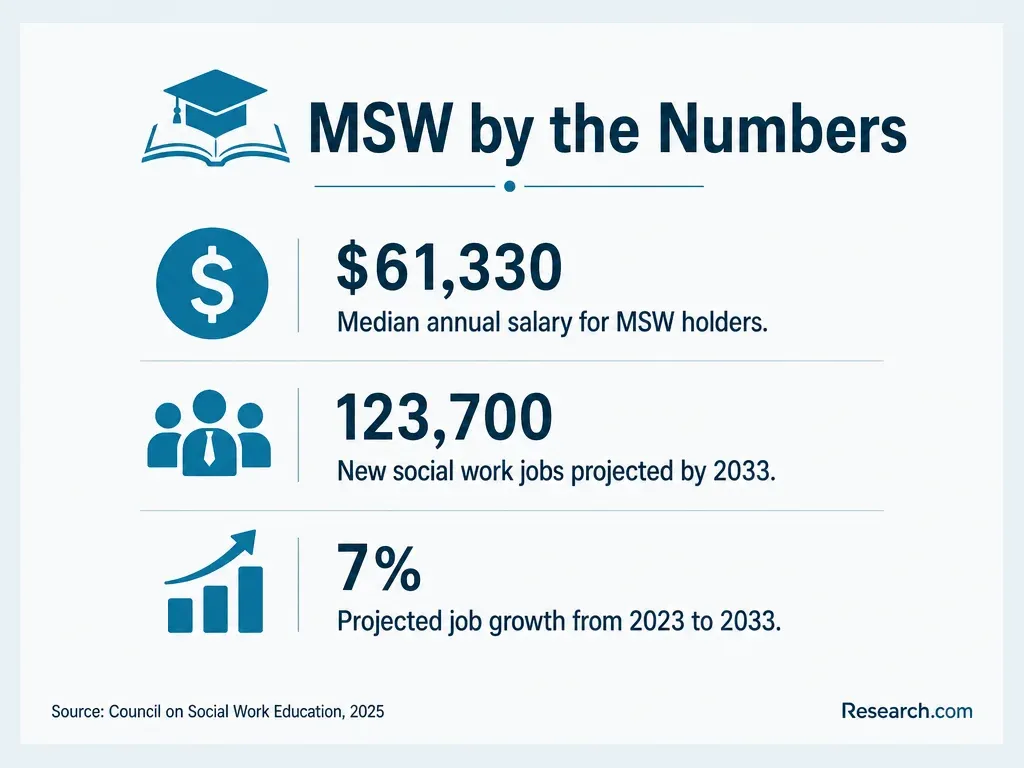
There is a workforce trade-off, too: an agency needs staff with suitable training and supervision at each level, while workers must weigh the cost of further education against the duties it would enable. Social work master's tuition and earnings comparisons can inform that personal decision, but an MSW is not a substitute for adequate staffing or a functioning referral network.
The useful degree depends on the intended function. A BSW provides generalist social work preparation that can support engagement, navigation, and service coordination. A traditional MSW admits eligible students from various undergraduate disciplines and includes foundational and specialized study; an advanced-standing MSW is a shorter route for applicants whose qualifying social work education meets the program's rules. Neither MSW route grants a license on graduation.
Students aiming for clinical work should examine the program's clinical learning opportunities and the licensing rules in the state where they intend to practice. Students interested in designing referral systems may find policy, community practice, administration, or program evaluation coursework more relevant.
A DSW or PhD is generally unnecessary to join or manage a stepped-care team; particular doctoral programs may serve experienced practitioners pursuing practice leadership or researchers studying service delivery.
Before enrolling, compare the jobs you want with actual employer qualifications. If the goal is a nonclinical navigation role, targeted experience or employer training may be more direct than another degree. For those considering a BSW, online undergraduate social work degree choices should be assessed for approved field learning as well as coursework.
What are the salaries and job outlook for behavioral health social workers?
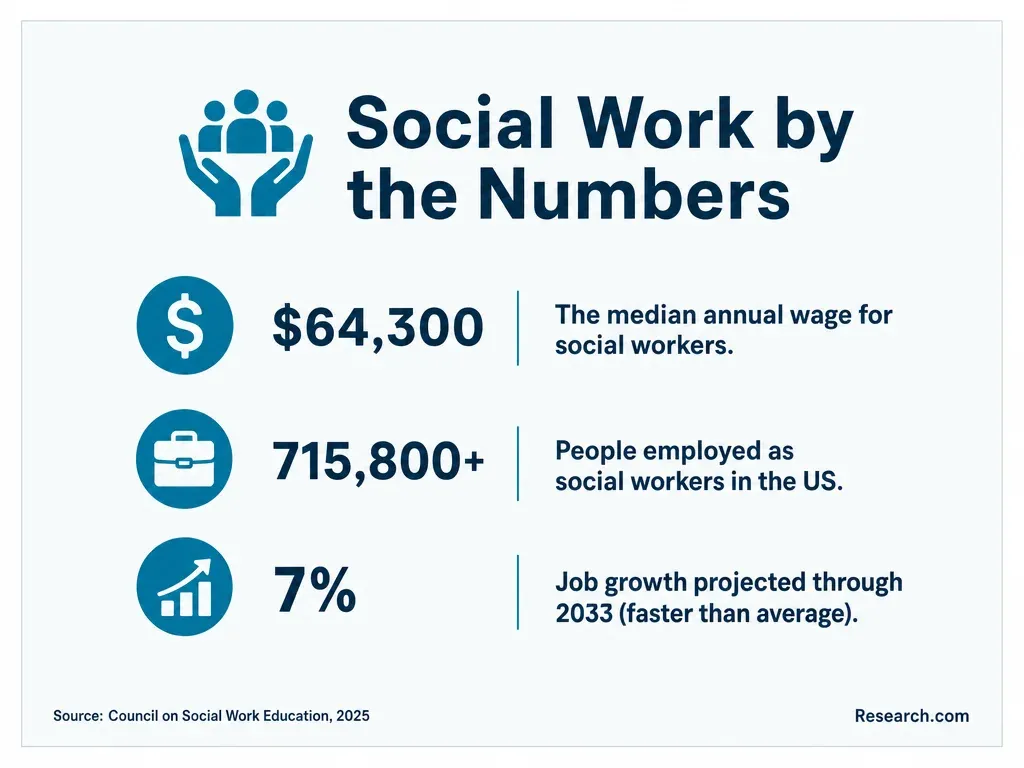
The closest U.S. Bureau of Labor Statistics occupation is mental health and substance abuse social workers. Its May 2025 median annual wage was $60,280, and BLS projects 10% employment growth from 2025 to 2035. This category includes jobs outside stepped-care programs and does not isolate MSW graduates or independently licensed clinicians.
For comparison, the May 2025 median for all social workers was $61,780. A job offer will depend on duties, license, experience, employer, and location. Use understanding location differences in MSW earnings alongside local postings, rather than treating a national occupational median as an expected starting salary or a return on tuition.
Other Things You Should Know About Social Work
Generally, teams should explain options and respect informed choice within applicable law and agency policy. They should document the discussion and make clear how the person can seek help if needs change.
Yes, if the agency defines its purpose, referral process, training, and role boundaries. Peer support is not interchangeable with licensed clinical treatment.
It can review access, waits, completed referrals, and client feedback across groups where lawful and feasible. Aggregate findings should be interpreted carefully and protected under applicable privacy rules.
It can be, but only if referral partners, follow-up responsibility, and access barriers are addressed. A pathway that relies on unavailable specialty services needs a realistic alternative plan.
- NASW Standards for Social Work Case Management | nycourts.gov https://www.nycourts.gov/reporter/webdocs/nasw_standards_socialwork_casemgt.htm
- Access to Health Services - Healthy People 2030 https://odphp.health.gov/healthypeople/priority-areas/social-determinants-health/literature-summaries/access-health-services
- CDC Program Evaluation Framework, 2024 | MMWR https://www.cdc.gov/mmwr/volumes/73/rr/rr7306a1.htm
- Effectiveness of stepped care for mental health disorders | sciencedirect.com https://www.sciencedirect.com/science/article/pii/S2468171724000267
- Social Work Role | Center for Health Interprofessional Practice and Education https://healthipe.utexas.edu/social-work-role
- ASAM Criteria https://www.asam.org/asam-criteria
- NASW Standards for Social Work Practice in Health Care Settings | socialworkers.org https://www.socialworkers.org/Practice/NASW-Practice-Standards-Guidelines/NASW-Standards-for-Social-Work-Practice-in-Health-Care-Settings