2027 Social Workers and School Nurses: Health, Attendance, and Family Resource Coordination
Audited and Verified:
Our Editorial and Data Verification Process
Research.com uses government datasets, official education statistics and primary institutional information to support its career and degree guides. Our review process checks factual accuracy, occupational definitions, source dates and the requirements associated with the credentials discussed.
How This Article Was Fact-Checked
Our editorial team verifies salary estimates, employment projections, education requirements and program information against original data providers and official organizations. Salary figures are checked against the relevant occupational definitions and reporting periods. Information about licensure, accreditation and required in-person training is reviewed separately.
Fact-checked and verified on:

Co-Founder and Chief Data Scientist
A student's repeated absences may reflect an unmanaged health condition, difficulty getting to appointments, or a family under financial strain. School nurses and social workers address different parts of that problem, but their work is most effective when they coordinate. This guide is for prospective school professionals and current school staff who want to understand each role, how the team helps families, and which education or credential - if any - fits their intended work. It also covers program selection, costs, and career outlook so you can choose a realistic next step.
Key Things You Should Know
- School nurses assess and manage school-day health needs; school social workers address psychosocial and environmental barriers. Neither role should substitute for the other's regulated duties.
- Effective attendance coordination pairs a student-specific health plan with family engagement, practical referrals, and follow-up - not an automatic assumption that absence means a family is disengaged.
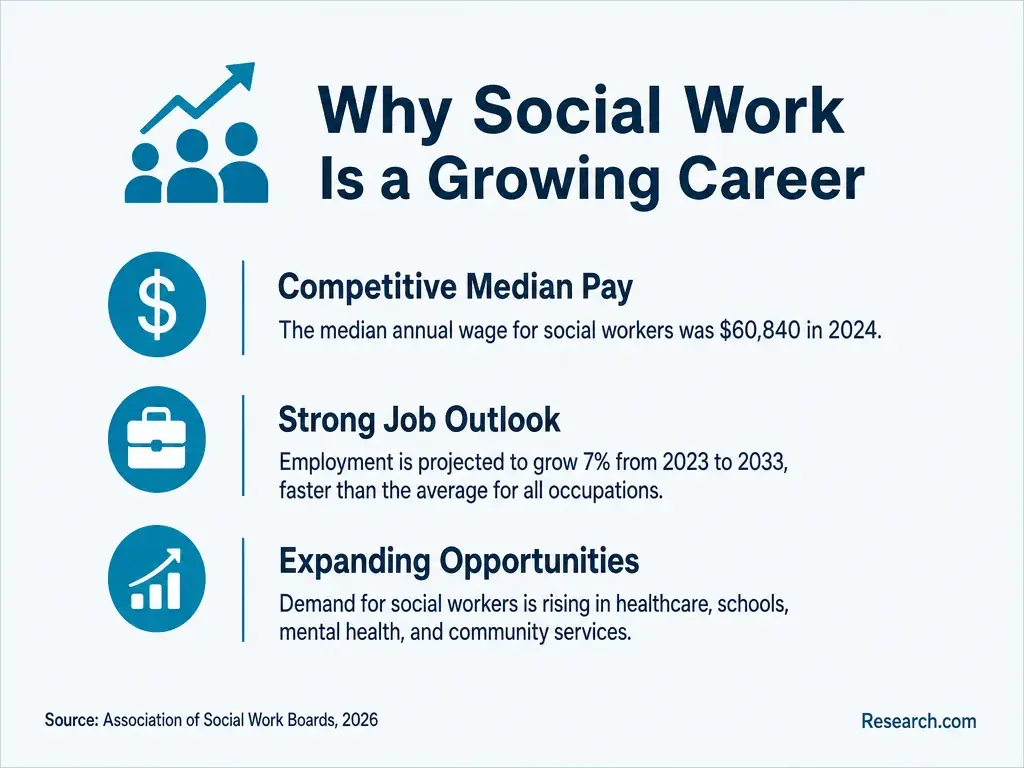
- The U.S. Bureau of Labor Statistics reports a May 2025 median annual wage of $59,550 for child, family, and school social workers and projects 4% employment growth for that occupation from 2025 to 2035; these figures are not school-only salaries.
What do school social workers and school nurses do?
School nurses address students' health needs during the school day. Depending on their authorization and district duties, they assess symptoms, administer medications under applicable orders and policy, support students with chronic conditions, develop health plans, and advise staff on when medical follow-up is needed.
School social workers assess how family circumstances, mental health concerns, housing, transportation, school climate, and access to services affect learning and attendance. They may provide counseling within their permitted scope, coordinate services, respond to crises, and help schools work with families.
The boundary matters: a social worker should not make a nursing assessment, and a nurse should not assume responsibility for social work services outside their training or role. Both may participate in student-support teams, but responsibilities depend on state law, credentials, district policy, and the student's needs. Readers comparing this role with other MSW positions can review social work master's career options.
What degrees do school social workers and school nurses need?
School social work positions commonly call for an MSW, though requirements differ by state and employer. A BSW prepares graduates for generalist social work and some school-adjacent support positions, but it does not automatically qualify someone for a school social worker position.
Applicants without a BSW can seek a traditional or foundation MSW; advanced-standing MSW routes generally require a qualifying BSW and must be confirmed with the program.
School nurses typically enter through nursing education that qualifies them for registered nurse licensure, such as an approved associate or bachelor's nursing program. States and districts may impose additional degree or school-nursing requirements. An MSW does not qualify someone as an RN, and a nursing degree does not confer social work credentials.
For someone already working in a school, the first decision is which duties they want to perform. A family liaison or attendance-support role may have different hiring requirements from either regulated profession. If an MSW is necessary, compare online degree routes into social work careers against local programs rather than assuming an online format changes school credential rules.

What licenses and school credentials are required for each profession?
Requirements come from more than one authority. A state social work board controls social work licensure; a state education agency may separately set school social work certification or endorsement rules.
A state nursing board controls RN licensure, while a state education agency or district may require a school nurse credential. Some school positions have additional experience, examination, supervision, or continuing-education conditions.
Check the intended state and job posting before enrolling. Ask the education agency what qualifies someone for the school position, the relevant professional board what permits practice, and the university whether its degree and school placements support both pathways.
Planning social work study for an intended licensing jurisdiction is especially important when studying online across state lines. Graduation, eligibility to apply, and issuance of a license or school credential are separate steps; an MSW alone does not authorize independent clinical practice.
A useful referral addresses the family's stated barrier, not merely the existence of a service. The nurse might explain what medical documentation a school needs or identify an appropriate health-service referral.
The social worker might help a caregiver navigate transportation, food assistance, housing support, insurance enrollment, or a community mental health intake. Both should check accessibility, language needs, eligibility, cost, and whether the family wants assistance making contact.
Coordination also requires restraint. Share information with school colleagues or outside providers only as permitted by applicable law, consent, and policy; avoid putting unnecessary medical or family details in attendance notes.
When a service has a waitlist, the team should agree on what the school can provide in the meantime and who will follow up. A student's attendance record alone cannot show whether a referral was accessible or effective.
If the intended career is psychotherapy rather than school-based resource coordination, compare social work master's programs emphasizing clinical preparation. Clinical coursework may fit that goal, but it does not replace a state's licensing and supervision requirements.
What are the salary and job outlook for school social workers and nurses?
The closest broad federal category for school social workers is child, family, and school social workers. The U.S. Bureau of Labor Statistics reports a May 2025 median annual wage of $59,550 and projects 4% employment growth from 2025 to 2035 for that combined occupation.
The category includes workers outside schools, so neither figure predicts a district offer. School nurses are generally counted within the broader registered-nurse occupation rather than a separate national school-nurse wage series; a general RN median would not isolate school pay.
Compare actual district salary schedules by location, contract length, education and experience credits, and benefits. When considering a move, salary context for geographically mobile MSW graduates can help frame questions, but verify local vacancies and credential eligibility before treating a higher state-level wage as an attainable offer. Workplace fit also depends on caseload, nursing and social work staffing, supervision, and time available for family follow-up.
Other Things You Should Know About Social Work
Often, staff can initiate appropriate school-related outreach, but what they may disclose or provide depends on their role, district procedures, consent requirements, and applicable law. Check the local protocol before sharing sensitive information.
The designated school team follows the applicable evaluation and accommodation process. A nurse or social worker can contribute relevant information within their role, but neither should promise an accommodation independently.
No. A home visit is one possible form of outreach, not a default response. Its purpose, safety, family preferences, and district policy should guide the decision.
Review local job postings and speak with school professionals about typical caseloads, supervision, and collaboration. An appropriately supervised volunteer or employment opportunity may offer perspective, but it does not replace required professional education or field placement.
- Joint Guidance on the Application of FERPA and HIPAA to Student Health Records | Protecting Student Privacy https://studentprivacy.ed.gov/resources/joint-guidance-application-ferpa-and-hipaa-student-health-records
- School Nurse Perspectives on Addressing Chronic Absenteeism | nih.gov https://pmc.ncbi.nlm.nih.gov/articles/PMC9062998/
- Chronic Absenteeism | U.S. Department of Education http://www.ed.gov/teaching-and-administration/supporting-students/chronic-absenteeism
- Manual For School Health Programs | mo.gov https://health.mo.gov/book/export/html/5316
- How School-Based Health Centers Support Integrated Care | National Council for Mental Wellbeing https://www.thenationalcouncil.org/how-school-based-health-centers-support-integrated-care/
- What School Nurses Do | National Association of School Nurses https://www.nasn.org/advocacy/advocacy-what-school-nurses-do
- NASW Practice Standards for School Social Workers https://www.socialworkers.org/Practice/NASW-Practice-Standards-Guidelines/NASW-Standards-for-School-Social-Work-Services
- Role of School Social Worker | SSWAA https://www.sswaa.org/school-social-work