2027 Social Workers and School Counselors: Teamwork Beyond Comparing Job Titles
Audited and Verified:
Our Editorial and Data Verification Process
Research.com uses government datasets, official education statistics and primary institutional information to support its career and degree guides. Our review process checks factual accuracy, occupational definitions, source dates and the requirements associated with the credentials discussed.
How This Article Was Fact-Checked
Our editorial team verifies salary estimates, employment projections, education requirements and program information against original data providers and official organizations. Salary figures are checked against the relevant occupational definitions and reporting periods. Information about licensure, accreditation and required in-person training is reviewed separately.
Fact-checked and verified on:

Co-Founder and Chief Data Scientist
A student struggling with attendance, family instability, and plans after graduation may need both a school social worker and a school counselor. Their work overlaps, but their training, responsibilities, and school credentials are not interchangeable. For educators and human-services professionals considering a career change - and students choosing a degree - understanding the teamwork matters more than comparing job titles alone. This guide shows how the roles coordinate support, where their boundaries differ, and what to verify before committing to either educational path.
Key Things You Should Know
- School counselors generally lead academic, career, and schoolwide counseling programs; school social workers focus more heavily on barriers involving family, community, mental health, and access to services. Duties vary by district.
- The two roles work best through coordinated referrals, defined responsibilities, and privacy-conscious information sharing - not by treating one professional as a substitute for the other.
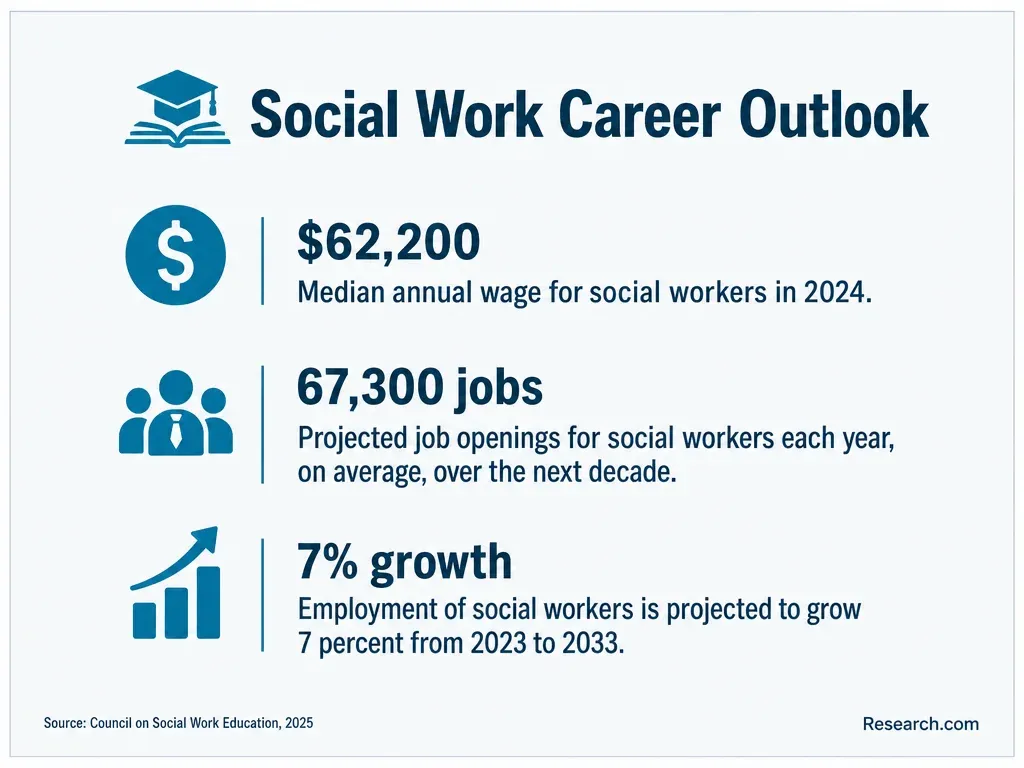
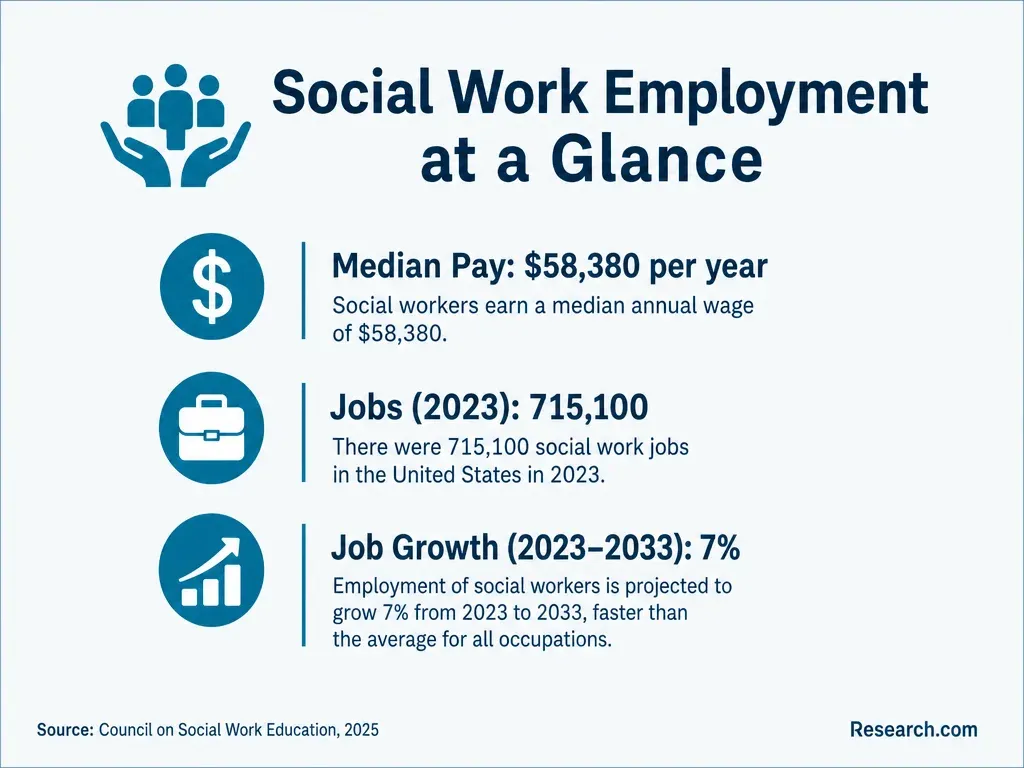
- For child, family, and school social workers, the U.S. Bureau of Labor Statistics reports a May 2025 median annual wage of $59,550 and projects 4% employment growth from 2025 to 2035; that broad category is not a school social worker salary offer.
What is the difference between a school social worker and a school counselor?
School social workers use social work assessment and intervention skills to address obstacles to a student's participation in school. Depending on the assignment, they may work with families on attendance, connect them with housing or food resources, provide approved school-based support, or consult on how community circumstances affect learning. School counselors typically deliver a school counseling program spanning academic planning, career development, and social-emotional support. They may counsel students briefly, coordinate transitions, and help identify when a referral is needed.
This comparison describes common emphases, not exclusive territories. A district may assign either professional crisis-response, group-work, or attendance duties within its policies and the professional's qualifications.
| Decision point | School social worker | School counselor |
| Usual starting lens | Student needs in the context of family, school, and community systems | Student development and progress through a school counseling program |
| Common coordination | Family engagement and connections to community services | Academic planning, school transitions, and career exploration |
| Career fit | Strong fit for someone drawn to service coordination and removing access barriers | Strong fit for someone drawn to advising and supporting students across a school |
If your target is primarily ongoing psychotherapy, investigate that role separately: neither school job title automatically authorizes independent clinical treatment. Exploring clinical social work master's degrees can help clarify the difference between clinical preparation and a school assignment.
How do school social workers and school counselors work together to support students?
Consider a student whose absences are affecting graduation plans. A counselor might review credits, help establish an achievable course plan, and discuss options with the student. A social worker might assess practical barriers with the family and coordinate an appropriate community referral. Either may notice a concern first; neither should assume that handing off a name ends their responsibility under school procedures.
Effective collaboration has three parts: agree on who will follow up, involve the student and family appropriately, and share only information permitted and needed for the work. School policies, applicable privacy law, consent rules, and any required reporting duties govern what can be disclosed. In meetings with teachers or outside providers, the professionals should distinguish a useful support plan from unnecessary disclosure of sensitive details.
For a career changer, the collaboration reveals a practical choice: if your strongest skills are family outreach and navigating service systems, social work may fit better; if they are advising students on academic and postsecondary decisions, counseling may be more direct. A social work graduate career pathway overview can help place school work among other MSW career options.
What degrees do school social workers and school counselors need?
The degree decision should follow the state and district job requirements for the role you want. Many school social worker positions call for an MSW, while some jurisdictions or positions have BSW-level routes. School counselor positions generally require a master's degree in school counseling or a state-accepted equivalent. A counseling master's and an MSW teach overlapping helping skills but are not interchangeable credentials for school employment.
Someone with a non-social-work bachelor's degree can apply to a traditional or foundation MSW program if they meet that program's admission rules. Advanced-standing MSW study is generally reserved for applicants with a qualifying social work bachelor's degree that meets the program's criteria; education or psychology experience alone does not establish eligibility. If time is a concern, compare actual credit and placement sequences rather than assuming an accelerated online MSW education route will satisfy school-specific requirements faster.
A DSW or PhD is ordinarily unnecessary for entry into either school role. Those degrees serve different advanced practice, leadership, or research aims and do not replace an initial state school credential.
Requirements vary by state. A school social worker may need a state-issued school social work credential, a social work license, or both, depending on the position and jurisdiction. A school counselor generally needs the state's school counselor credential. State education agencies often control school credentials; social work licensing boards control social work licenses. A voluntary professional certification is not a substitute for either.
Before enrolling, match a specific district posting to the state education agency's requirements, then check the social work board separately if the posting calls for a license. Ask whether the program meets the educational requirements, what supervised experience or examinations apply, and whether a provisional route exists. For the social work side, verifying social work degree recognition with a state board is especially important if you may practice outside the state where the university is located.
Graduation, eligibility to apply, credential issuance, and permission to perform a particular service are separate steps. An MSW - or a school credential - does not by itself grant independent clinical social work authority.
The closest broad federal category for many school social workers is child, family, and school social workers. The U.S. Bureau of Labor Statistics reports a $59,550 median annual wage in May 2025 and projects 4% employment growth from 2025 to 2035 for that category. It also includes substantial employment outside schools, so neither figure isolates school social worker jobs.
For counselors, BLS groups school counselors with career counselors and advisors. Because these published occupation groups include different workers, comparing their national medians would not establish which professional earns more in a particular district. Compare current postings on the same district salary schedule, including placement for education and experience, contract days, benefits, and any extra-duty pay. A guide to comparing social worker pay by location can add geographic context, but district terms should drive a school-job decision.
Check three distinct questions: Is the institution accredited? Does the specific degree program have the relevant programmatic accreditation or recognition? Will the state accept that program and its school preparation for your intended credential? For social work, verify the BSW or MSW program's Council on Social Work Education status and the status applicable to your cohort. For school counseling, check the state's approved-program rules and whether any counseling accreditation named by the university is required or valued by the state and employers.
Request written confirmation identifying the exact degree, campus or online track, school specialization if applicable, and intended state. Ask what happens if you move before or during placement. Accreditation alone does not establish that a state will issue a school credential or permit a particular placement.
Program delivery matters alongside recognition: social work degree formats and learning expectations can differ even when awards have similar names. Compare the required live instruction, field support, and school-based learning opportunities rather than relying on an "online" label.
Social work students commonly study human behavior in social environments, policy, assessment, ethics, research, and practice with individuals and systems. A school-focused placement can develop family engagement, consultation, documentation, and service-coordination skills under approved supervision. School counseling students commonly study counseling skills, student development, academic and career planning, group work, ethics, and school counseling program delivery, followed by supervised school-based experiences.
For either path, ask the program what school settings are available, who arranges placements, who supervises students, and which activities demonstrate competence. A current school job or volunteer position does not automatically count as curricular field education. Nor is MSW field instruction the same as post-degree supervision toward a clinical license; comparing social work clinical experience expectations can help keep those requirements separate.
Online coursework may reduce commuting, but it does not remove supervised in-person school experiences. Campus-based study may offer more face-to-face practice and nearby placement relationships, yet a campus location does not guarantee a school site. Both formats can include scheduled skills sessions, cohort meetings, and placements during the school day.
If you will keep working while studying, ask for a sample weekly schedule covering classes, live activities, travel, and field days. Also ask whether the school can support placements near your home, what happens if a site falls through, and whether its supervision arrangements meet your state's school-credential rules. Field placement assistance in online MSW education is particularly relevant when you cannot independently secure a suitable school setting.
How long do these programs take, and how much do they cost?
Duration depends on the degree, prior qualifying education, enrollment pace, course sequence, and placement availability. A traditional MSW generally involves more foundational study than an eligible advanced-standing track; a school counseling master's has its own required sequence. A shorter advertised course schedule may not shorten the time needed to complete supervised school experience or obtain a state credential.
Compare written, program-specific estimates rather than a tuition figure alone. Request the total required credits and a term-by-term plan, then account for tuition and fees, books, screening or onboarding, placement travel, and income lost if field days displace paid work. Ask whether employment-based learning is permitted and approved before budgeting around it. Cost-focused online MSW program choices are useful starting points, but the lower-cost option is only valuable if its credential pathway and field schedule work for you.
The best next step is to select a target state and several real school job postings. Compare each posting's duties and credentials with written program answers on approval, placements, total cost, and time to completion. That exercise tests career fit and feasibility more reliably than choosing by title alone.
Other Things You Should Know About Social Work
No. Staffing differs by district, school, and funding. Check the actual team structure and referral resources when evaluating a job.
Families can ask the school about language-access services. The school should explain its available process so families can participate meaningfully without relying on a child to interpret sensitive discussions.
Not necessarily. The governing privacy rules can differ by record holder and setting. Professionals should follow current law and district policy before sharing information.
No. Contract length, summer duties, pay distribution, and benefits vary. Review the specific offer and bargaining agreement, if applicable.
- Characteristics and Outcomes of School Social Work Services | nih.gov https://pmc.ncbi.nlm.nih.gov/articles/PMC10187493/
- Comprehensive School Counseling - Kentucky Department of Education https://education.ky.gov/educational/compschcouns
- Professional Standards and Evaluation | NC DPI https://www.dpi.nc.gov/educators/specialized-instructional-support/school-counseling/professional-standards-and-evaluation
- What Does a School Social Worker Do? | Virginia Commonwealth University https://onlinesocialwork.vcu.edu/blog/school-social-worker/
- NASW Practice Standards for School Social Workers https://www.socialworkers.org/Practice/NASW-Practice-Standards-Guidelines/NASW-Standards-for-School-Social-Work-Services
- Chapter 115C - Article 29 https://www.ncleg.net/EnactedLegislation/Statutes/HTML/ByArticle/Chapter_115c/Article_29.html
- School Counseling Roles Across States: A Content Analysis Using the ASCA National Model - The Professional Counselor https://tpcjournal.nbcc.org/school-counseling-roles-across-states-a-content-analysis-using-the-asca-national-model/
- The School Counselor and Safe Schools and Crisis Response https://www.schoolcounselor.org/Standards-Positions/Position-Statements/ASCA-Position-Statements/The-School-Counselor-and-Safe-Schools-and-Crisis-R
- Role of School Social Worker | SSWAA https://www.sswaa.org/school-social-work