2027 Social Workers and Financial Counselors in Hospitals: Coverage and Resource Roles
Audited and Verified:
Our Editorial and Data Verification Process
Research.com uses government datasets, official education statistics and primary institutional information to support its career and degree guides. Our review process checks factual accuracy, occupational definitions, source dates and the requirements associated with the credentials discussed.
How This Article Was Fact-Checked
Our editorial team verifies salary estimates, employment projections, education requirements and program information against original data providers and official organizations. Salary figures are checked against the relevant occupational definitions and reporting periods. Information about licensure, accreditation and required in-person training is reviewed separately.
Fact-checked and verified on:

Co-Founder and Chief Data Scientist
A patient may be medically ready to leave the hospital but still lack prescription coverage, transportation, or a safe place to recover. Hospital social workers and financial counselors address different parts of that problem, often together.
If you are considering either career - or deciding which qualification a hospital job requires - this guide explains their responsibilities, education and credential paths, and the limits of what each role can promise patients. It also shows what to check before choosing a degree or applying for a position.
Key Things You Should Know
- Hospital social workers coordinate psychosocial support and discharge resources; financial counselors focus on coverage, assistance applications, and patients' financial responsibilities. Duties overlap, but job qualifications may not.
- A BSW or MSW can prepare someone for healthcare social work; financial counseling positions may instead accept experience in insurance, patient access, or billing. An MSW alone does not authorize independent clinical practice.
- The U.S. Bureau of Labor Statistics reports a $67,880 median annual wage for healthcare social workers in May 2025 and projects 8% employment growth from 2025 to 2035; neither figure describes a particular hospital job offer.
What do hospital social workers and financial counselors do for patients?
Hospital social workers assess how illness interacts with a patient's family, housing, safety, support network, and ability to follow a care plan. Depending on their role and qualifications, they may provide brief supportive interventions, coordinate with a discharge team, connect patients to community services, and help families understand care options. They do not personally guarantee a placement, benefit, or safe discharge.
Financial counselors help patients understand insurance information, estimated financial responsibility, hospital assistance policies, and application steps. Some hospitals place these duties in patient access, revenue cycle, or eligibility teams rather than a department called financial counseling. Counselors should explain options without promising that an insurer or public program will approve coverage.
The distinction matters when choosing a career. If you want to assess psychosocial needs and coordinate care, start with social work degree planning for prospective students and compare actual hospital social worker postings. If your experience is in benefits, billing, customer service, or healthcare administration and your goal is coverage assistance, a second social work degree may be unnecessary.
How do hospital staff help patients with insurance coverage and financial resources?
The first task is to separate two questions: Will a payer cover the service? and What help is available for costs or needs that remain? A financial counselor or eligibility specialist may check enrollment information, identify missing documents, explain an insurer's prior-authorization or appeal process, screen for potential Medicaid eligibility, and help a patient request the hospital's financial assistance application. Approval decisions belong to the insurer, public agency, or hospital under its policy.
At tax-exempt hospitals subject to federal financial-assistance rules, staff can direct patients to the hospital's financial assistance policy and plain-language summary. Eligibility, covered services, and application procedures depend on that policy; assistance with a hospital bill does not necessarily pay for outside specialists, transportation, or prescriptions. Social workers may address those separate needs through discharge planning and referrals to community organizations, with patient consent and appropriate privacy safeguards.
For someone learning this work, a hospital placement can reveal how coverage questions affect discharge without turning social work students into billing specialists. When choosing an MSW program with structured field support, ask whether approved healthcare sites offer supervised exposure to both discharge planning and resource coordination.

What degrees prepare you for hospital social work or financial counseling?
Start with the employer's job description, not the shared word "counselor." The following comparison shows which educational route usually aligns with each function; hospitals can set more specific requirements.
| Target role | Relevant preparation | Important limit |
| Hospital social worker | BSW for some generalist roles; MSW for positions requiring graduate-level assessment, specialized practice, or clinical preparation | Degree requirements, license requirements, and clinical duties vary by state and employer |
| Patient financial counselor or eligibility specialist | Often healthcare revenue-cycle, insurance, benefits, patient-access, or related education and experience | A social work degree is not inherently required; verify the posting |
| Independent clinical social worker in a hospital | Qualifying MSW followed by the state's required licensing steps and supervised experience | Graduation alone does not grant independent clinical authority |
A career changer with another bachelor's degree can apply to a traditional or foundation MSW program if they meet its admissions rules. Advanced-standing MSW entry generally requires a qualifying BSW and program-specific approval; a psychology or human services bachelor's degree does not automatically qualify. Use comparing graduate social work entry-track requirements to avoid planning around a shortened route for which you may be ineligible. Neither a DSW nor a PhD is a routine entry requirement for these hospital jobs.
For a prospective BSW or MSW student, check both the institution's recognized institutional accreditation and the exact social work program's status with the Council on Social Work Education (CSWE). Review the program, campus or delivery arrangement, and accreditation information applicable to your intended enrollment and graduating cohort. A university's institutional accreditation alone does not establish CSWE accreditation for its BSW or MSW.
Then ask the relevant state social work board whether the degree satisfies the educational requirement for the license you intend to pursue; the board, not a school advertisement, determines licensing eligibility. When comparing accredited online BSW programs, confirm the exact program status directly with CSWE and ask the school how it arranges approved field education in your location.
BSW students typically enter through undergraduate admission and may later apply separately to the social work major or field sequence. Traditional MSW applicants usually need a bachelor's degree, transcripts, and program-specified application materials; schools may also assess writing, service experience, references, or prerequisite coursework. Advanced-standing applicants face additional requirements tied to a qualifying BSW and the school's policies.
Admissions criteria differ from hospital placement onboarding. A student can be admitted to a program yet still need to meet an agency's screening and scheduling requirements before beginning fieldwork. If your prior degree is outside social work, compare traditional-track requirements rather than assuming you must earn another bachelor's degree. Lists of MSW programs with accessible admissions are a starting point, not a substitute for checking each program's prerequisites, field capacity, and licensing relevance.
What are the salaries and job outlook for these hospital careers?
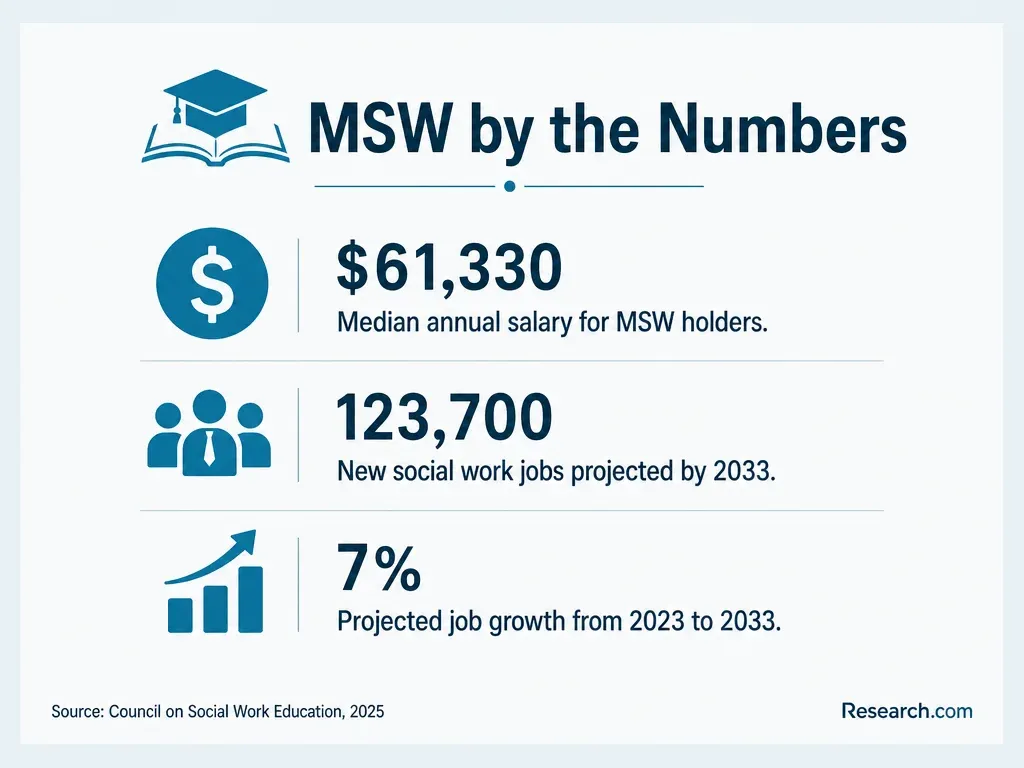
Healthcare social worker is the closest Bureau of Labor Statistics (BLS) category for many hospital social work jobs. Its May 2025 median annual wage was $67,880, and BLS projects 8% employment growth from 2025 to 2035. The category includes healthcare settings beyond hospitals and workers with different qualifications. Neither figure is a starting salary, a hospital-specific forecast, or the expected return on an MSW.
"Hospital financial counselor" does not map cleanly to one BLS occupation: employers distribute its duties among patient access, eligibility, and billing positions. Rather than applying the healthcare social worker median to that role, compare posted pay ranges for jobs with matching duties in your area. For social work, comparing state salary figures for social work roles can add geographic context, but also weigh schedule, caseload, supervision, and advancement opportunities when evaluating an offer.
Other Things You Should Know About Social Work
Often, but what staff may disclose depends on the patient's permission, applicable privacy rules, and hospital procedures. Ask how the patient can authorize a family member to participate.
Hospitals covered by the federal Emergency Medical Treatment and Labor Act must provide an appropriate medical screening examination regardless of ability to pay. That protection does not mean all subsequent care is free.
Tell the care team which unresolved need affects the discharge plan and ask who is responsible for addressing it. The appropriate contact may be a case manager, nurse, or another designated staff member.
Yes. Ask the hospital what interpreter or translated-material options it provides for discussing its financial assistance process. Avoid relying on an untrained companion to interpret complicated eligibility information.
- Recommendations for Hospital Social Work by Clients... - PMC https://pmc.ncbi.nlm.nih.gov/articles/PMC5022556/
- Social Drivers of Health and Health-Related Social Needs | cms.gov https://www.cms.gov/priorities-innovation-key-concepts-social-drivers-health-health-related-social-needs
- Understanding Required Financial Assistance in Medical Care | Consumer Financial Protection Bureau https://www.consumerfinance.gov/data-research/research-reports/understanding-required-financial-assistance-in-medical-care/
- Summary of the HIPAA Privacy Rule | hhs.gov https://www.hhs.gov/hipaa/for-professionals/privacy/laws-regulations/index.html
- How to get help with medical bills | usa.gov https://www.usa.gov/help-with-medical-bills
- Assistance Programs | uillinois.edu https://hospital.uillinois.edu/patients-and-visitors/patient-information/financial-assistance/financial-assistance-programs
- Medical Social Worker - Explore Healthcare Careers | Mayo Clinic College of Medicine and Science https://college.mayo.edu/academics/explore-health-care-careers/careers-a-z/medical-social-worker/
- Case Management: Discharge Planning | Hospital for Special Surgery https://www.hss.edu/patient-care/services/case-management-discharge-planning
- Key Facts About Hospitals | KFF https://www.kff.org/health-costs/key-facts-about-hospitals/
- Empowering Patients Through Financial Counseling | naham.org https://www.naham.org/page/ConnectionsEmpoweringPatientsThroughFinancialCounselingWhyItMatters