2027 Social Work with Kinship Caregivers: Service Navigation and Professional Preparation
Audited and Verified:
Our Editorial and Data Verification Process
Research.com uses government datasets, official education statistics and primary institutional information to support its career and degree guides. Our review process checks factual accuracy, occupational definitions, source dates and the requirements associated with the credentials discussed.
How This Article Was Fact-Checked
Our editorial team verifies salary estimates, employment projections, education requirements and program information against original data providers and official organizations. Salary figures are checked against the relevant occupational definitions and reporting periods. Information about licensure, accreditation and required in-person training is reviewed separately.
Fact-checked and verified on:

Co-Founder and Chief Data Scientist
When a relative or close family friend begins caring for a child, practical needs can arrive before anyone has clarified custody, benefits, or available support. Social workers help caregivers navigate those systems while protecting family relationships and the child's well-being.
This guide is for prospective students, early-career social workers, and human services professionals considering kinship care work. It explains the day-to-day role, a usable approach to service navigation, and how to judge whether a degree, field placement, license, or targeted training is the right next step.
Key Things You Should Know
- Kinship care includes children living with relatives or other adults with a significant family-like relationship; a caregiver's legal authority and access to assistance depend on the arrangement and jurisdiction.
- Effective navigation starts by establishing who can consent and apply, then coordinating benefits, school and health access, referrals, and follow-up - not simply handing over a resource list.
- A BSW can prepare graduates for many generalist roles; an MSW may open specialized positions, while clinical licensure requires separate state-specific steps. The BLS reports a $59,550 median annual wage for child, family, and school social workers in May 2025, not a kinship-care salary.
What do social workers do with kinship caregivers?
Kinship caregivers are relatives or adults with a significant family-like relationship who care for a child whose parents cannot currently provide day-to-day care. Some arrangements are informal; others involve a court or child welfare agency. The social worker's first task is to understand the actual arrangement without assuming that every family wants, needs, or qualifies for the same legal or service pathway.
Depending on the job and setting, a social worker may assess immediate needs, explain options, help a caregiver obtain documents, coordinate with a school or pediatrician, refer the family to legal assistance, and follow up when an application stalls. They may also support contact with parents when appropriate, connect caregivers with respite or peer support, and raise recurring access problems with agency leaders.
This is service coordination, not a promise that the worker can grant custody, approve benefits, or make a clinical decision outside their role.
Good practice accounts for the caregiver's age, income, language, transportation, digital access, and relationship with the child's parents. It also makes room for the child's views and cultural connections. For someone considering this work, observing how an agency handles consent, documentation, and family conflict is more informative than its job title alone.
Online MSW programs with field placement support are worth examining for access to supervised child welfare or family-resource settings, not merely for a convenient course schedule.
What degrees prepare you for kinship care social work?
The appropriate education depends on the position, not the population served. A caregiver navigator employed by a community organization may enter through human services experience and agency training. A position classified as a social worker may require a social work degree, and clinical treatment requires the qualifications permitted by the state. Check actual vacancies before committing to graduate study.
The routes below differ chiefly in the depth and type of preparation they offer.
| Route | Kinship-care relevance | Best fit |
| BSW | Generalist practice, policy, assessment, and supervised field education | Entry-level social work roles when employer and state requirements permit |
| Traditional or foundation MSW | Foundation plus specialized study and field learning; accepts eligible graduates from other disciplines | Applicants seeking advanced practice preparation without a qualifying BSW |
| Advanced-standing MSW | Shorter graduate sequence building on qualifying prior social work education | Applicants whose BSW meets the specific program's eligibility rules |
| Targeted agency training | Benefits systems, child welfare procedures, caregiver engagement, and local referral networks | Experienced navigators whose target roles do not require another degree |
For a BSW graduate considering graduate study, advanced standing vs traditional MSW is an important distinction: advanced standing is not generally a shortcut available to someone with a psychology, sociology, or human services bachelor's degree. DSW and PhD study are usually unnecessary for frontline navigation; they fit leadership, practice improvement, teaching, or research goals rather than routine eligibility work.

Do kinship care social workers need a license or certification?
Not every kinship-support position requires a social work license. Requirements depend on the state, protected professional titles, employer classification, and duties. A nonprofit navigator may have different qualifications from a state child welfare social worker or a clinician providing psychotherapy. Neither a job title nor an MSW concentration establishes legal authority to practice independently.
If a position requires licensure, confirm the relevant state board's education criteria, application process, examination rules where applicable, and permitted scope. Independent clinical practice typically involves additional post-degree, board-approved supervised experience; BSW or MSW field education is not a substitute. A caregiver-support certificate or continuing education course can strengthen specific skills but is not a state license.
For an online degree, checking MSW program authorization and professional eligibility is especially important before enrollment or an interstate move. Ask the program about your intended state, then confirm licensing eligibility with that state's board. The employer, school, and board answer different questions.
Kinship-focused work appears under titles such as caregiver navigator, family support specialist, child welfare social worker, and family resource coordinator. Employers may include public child welfare agencies, community nonprofits, schools, and healthcare organizations. Compare postings by required degree or license, actual caregiver contact, caseload, travel, documentation, supervision, and the agency's authority to resolve - not just refer - service problems.
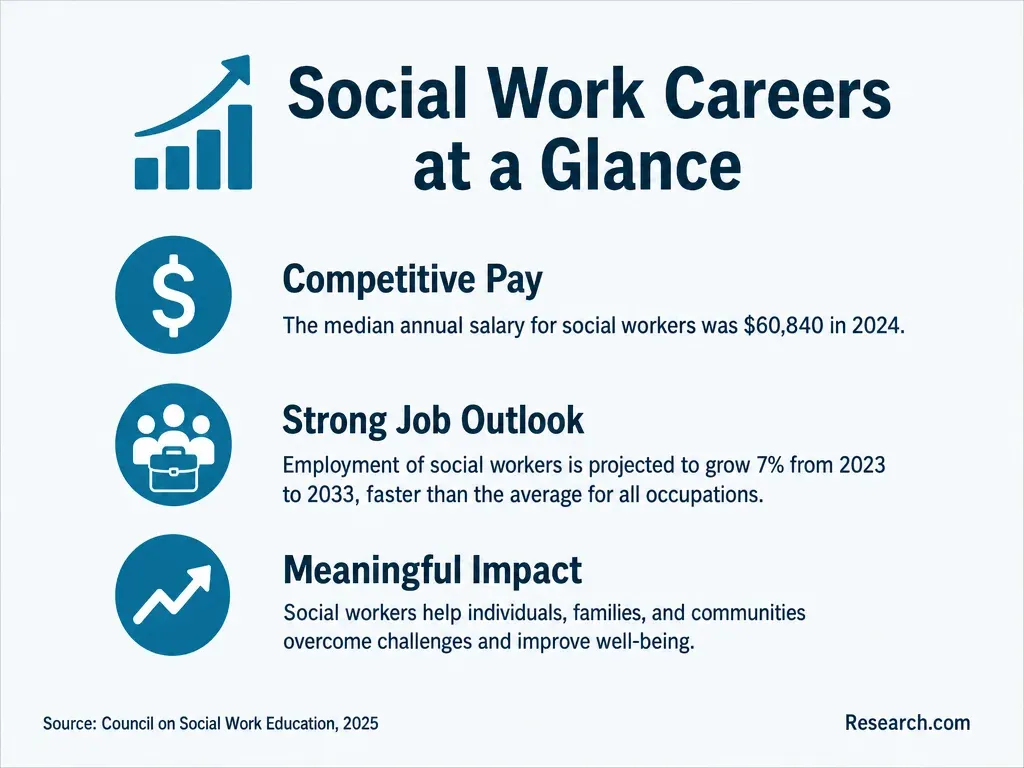
The U.S. Bureau of Labor Statistics does not report a separate kinship-care occupation. Its child, family, and school social workers category is a useful but broad comparison: the May 2025 median annual wage was $59,550, with employment projected to grow 4% from 2025 to 2035. Those figures include jobs outside kinship care and cannot predict an individual offer. A navigator position classified in another occupation may have a different wage profile.
For a career changer, prior experience in benefits administration, education, advocacy, or family support may provide a direct entry route where employers accept it. If vacancies specify a BSW, MSW, or license, compare that requirement against your existing qualifications before exploring academic pathways in online social work.
Useful coursework covers child and family development, social policy, poverty and public benefits, trauma-informed engagement, ethics, research literacy, and work across family, school, and agency systems. The most valuable learning connects those topics to actual decisions: how to discuss options without pressuring a caregiver, document a referral, and recognize when a question belongs to a lawyer, benefits worker, supervisor, or clinician.
A strong field placement offers supervised opportunities to observe caregiver engagement, participate within the student's approved role, and track whether referrals result in access. Ask whether the learning agreement includes assessment, service coordination, ethical documentation, and feedback from a qualified field instructor. Agency orientation and confidentiality rules govern what a student may see or record; placement hours are curricular learning, not post-degree clinical supervision.
Many accelerated online MSW programs may suit a student who can accommodate an intensive schedule, but speed does not replace suitable placement tasks or reflective supervision. For this specialty, the quality and feasibility of field learning matter more than finishing as quickly as possible.
BSW applicants may enter a university before applying separately to its social work major or field sequence. Schools set their own standards for prior coursework, grades, writing, references, and readiness for field learning. Traditional MSW programs generally consider applicants with bachelor's degrees in various subjects; they may assess academic preparation and relevant experience without requiring prior social work employment.
Advanced-standing MSW admission is different: programs examine whether the applicant has a qualifying social work bachelor's degree and meets their additional criteria. Admission to any route does not guarantee a particular placement or eventual licensure. Applicants with a non-social-work degree should ask for a review of prerequisites and the foundation sequence rather than assuming their prior major either qualifies them for advanced standing or rules out an MSW.
If selectivity is a concern, MSW entry options beyond highly selective programs can broaden a search. Compare published requirements, accreditation, field capacity, and total cost rather than treating an easier application as evidence of an easier qualification.
How long do social work programs take, and what do they cost?
A BSW is typically completed within a four-year bachelor's degree, though transfer credit and course sequencing change the remaining time. A traditional MSW commonly takes about two years of full-time study; qualifying advanced-standing routes are shorter, while part-time study takes longer. Confirm each school's credit plan and placement calendar rather than relying on a headline completion time.
Compare total cost to completion, not tuition alone. Include fees, books, screening and onboarding, placement travel and parking, possible campus visits, caregiving, and income lost if field hours reduce paid work. Ask whether a paid or employment-based placement is available and approvable; neither should be assumed.
For families balancing school and household expenses, lower-cost online social work master's programs are a comparison point, but request a personalized cost estimate and aid terms before deciding.
If your intended job accepts human services experience without an MSW, targeted training and supervised work may cost less and get you into caregiver support sooner. A degree becomes a stronger investment when the positions you want actually require it and the program can support the field learning you need.
Other Things You Should Know About Social Work
No. Kinship describes the caregiver's relationship to the child, not one legal status. Adoption, guardianship, foster care placement, and informal care can carry different rights and responsibilities; a qualified local legal professional can explain a family's options.
Possibly, but authority depends on state law, the arrangement, and the institution's rules. A social worker should help identify the applicable process rather than promise that a particular form will be accepted.
The worker can ask the school, benefits agency, or child welfare agency which alternative documents or records-retrieval steps it accepts. Missing paperwork should prompt a specific follow-up plan, not an assumption that help is unavailable.
Sometimes, within the agency's role and conflict-of-interest rules. The worker should explain confidentiality and who their client is, avoid promising incompatible outcomes, and seek supervision when divided responsibilities could undermine trust or safety.
- Report to the Congress on Kinship Foster Care - HHS ASPE https://aspe.hhs.gov/reports/report-congress-kinship-foster-care-0
- The Kinship Navigator Program | The Administration for Children and Families https://acf.gov/cb/grant-funding/kinship-navigator-program
- Kinship Care | Child Welfare Information Gateway https://www.childwelfare.gov/topics/permanency/kinship-care
- Financial assistance for kinship caregivers. | msu.edu https://kinship.msu.edu/financial-support/
- Glossary - Grandfamilies & Kinship Support Network https://www.gksnetwork.org/resources/glossary/
- Enhancing Kinship Care Through State Policy | ncsl.org https://www.ncsl.org/human-services/keeping-families-together-enhancing-kinship-care-through-state-policy