2027 Social Work with International Students: Campus Services and Community Connections
Audited and Verified:
Our Editorial and Data Verification Process
Research.com uses government datasets, official education statistics and primary institutional information to support its career and degree guides. Our review process checks factual accuracy, occupational definitions, source dates and the requirements associated with the credentials discussed.
How This Article Was Fact-Checked
Our editorial team verifies salary estimates, employment projections, education requirements and program information against original data providers and official organizations. Salary figures are checked against the relevant occupational definitions and reporting periods. Information about licensure, accreditation and required in-person training is reviewed separately.
Fact-checked and verified on:

Co-Founder and Chief Data Scientist
International students may need help with isolation, housing, finances, discrimination, or mental health while also navigating unfamiliar US systems. Social workers can connect campus services with community support, but the right response depends on the student's priorities, the worker's role, and the university's resources.
This guide explains what that work looks like, which campus and community partnerships matter, and how to assess the education and credentials needed for different jobs. It is for prospective social workers, current students, and campus staff deciding how best to support international students.
Key Things You Should Know
- Campus social workers may provide counseling, case management, crisis support, or outreach; the duties and required credentials depend on the position.
- Effective referrals account for cost, language access, transportation, eligibility, and the student's consent, not just whether a service exists.
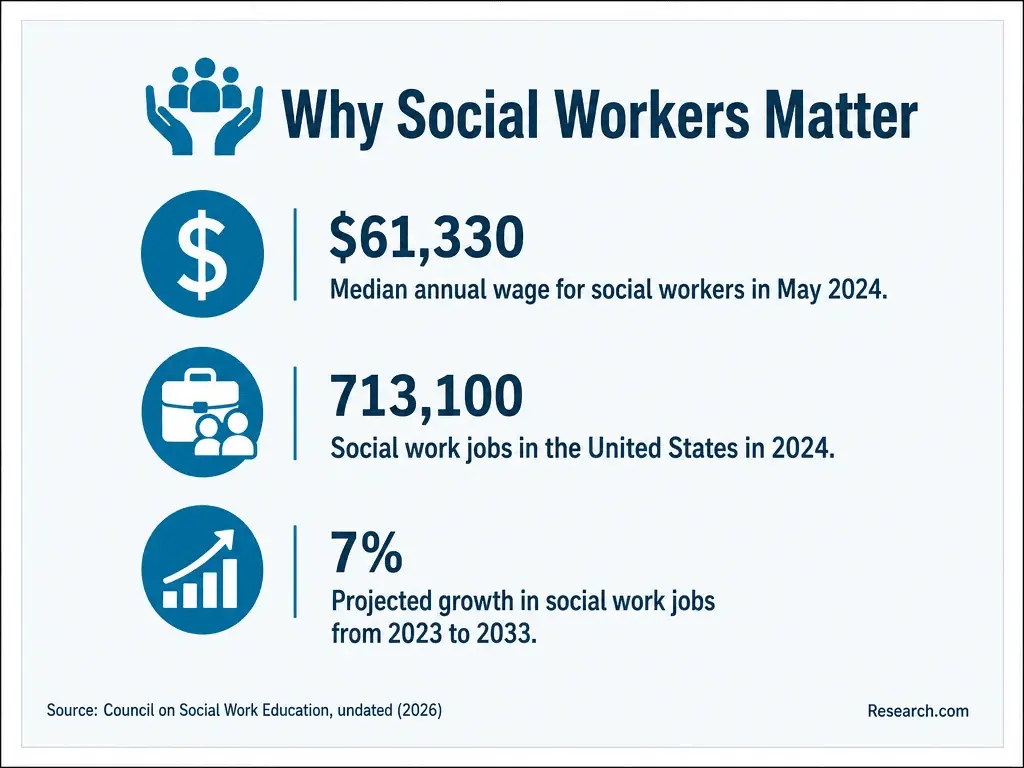
- A BSW or MSW does not itself grant a license. For context, the US median annual wage for child, family, and school social workers was $59,550 in May 2025, but that category does not isolate higher-education jobs.
What do social workers do to support international students?
Social workers assess a student's needs in context: academic pressure may be linked to isolation, housing insecurity, family expectations, racism, or difficulty accessing care. Depending on their position, they may offer brief counseling, coordinate services, respond to a crisis within university procedures, facilitate groups, or identify patterns that call for a campus-wide change.
A social worker should ask what the student wants and explain confidentiality and its limits before sharing information. They should not assume that every international student has the same needs or offer immigration advice outside their competence.
Questions about visa status, enrollment, and work authorization belong with the university's designated school official or a qualified immigration professional.
The distinction between clinical care and service coordination matters when choosing a career path. Someone interested in outreach or case management may find relevant online degree routes into social work careers; someone intending to provide psychotherapy must also check the applicable licensing requirements.
What campus services help international students with mental health and adjustment?
Campus counseling centers can assess mental health concerns and provide services within their staffing and treatment limits. Student-affairs case management may address barriers such as missed classes, food insecurity, or difficulty finding care.
International student offices explain institutional processes and immigration-related referrals; they are not substitutes for mental health providers. Health services, disability services, academic advising, and student-led organizations can provide additional support.
The most useful service is one the student can actually access. Before referring someone, staff should check appointment availability, language or interpretation options, fees and insurance coverage, accessibility, and what happens after hours.
A student who needs ongoing or specialized treatment may require a supported referral beyond campus rather than repeated short-term appointments.
These functions also represent different jobs. Counseling, case management, and student-affairs outreach have different qualifications, as the range of MSW career directions beyond a single job title illustrates. Applicants should compare actual position descriptions rather than assume every campus support role involves therapy.
How do social workers connect international students with community resources?
A community connection is more than handing someone a directory. With the student's permission, a social worker can clarify the need, check whether a provider accepts the student's insurance, confirm eligibility and language access, discuss transportation, and help arrange a first contact. A follow-up can establish whether the connection worked without requiring the student to disclose more than necessary.
Potential partners include community mental health clinics, immigrant-serving nonprofits, legal aid, housing organizations, food programs, and cultural or faith communities chosen by the student.
Eligibility for public benefits or subsidized programs can depend on immigration and other rules; staff should verify requirements with the provider or a qualified adviser rather than promise access. Information shared among campus and community partners must follow applicable privacy law, professional duties, consent, and university policy.
For students preparing to do this work, a placement with real referral partnerships can be more instructive than a concentration label alone. Compare a program's guide to school-supported MSW placements with the agencies and populations available in the area where you expect to train.
There is no single license for every campus support job. A university may employ an unlicensed case manager for coordination and outreach, while a counseling position may require a particular state social work license and clinical experience.
Employers may also set qualifications beyond the legal minimum. License titles, examinations where required, supervised-experience rules, and permitted activities vary by state.
Separate four decisions: whether a degree qualifies you to apply, whether the state issues a license, what work that license permits, and what the employer requires.
MSW field education is not a substitute for any post-degree clinical supervision required for independent practice. A doctorate, including options described as lower-cost online DSW programs, does not replace a required clinical license.
Before accepting a role involving counseling or remote services, check the licensing board for the state where services will be provided and the university's position description. Do not assume that a license from another state authorizes practice there.
Relevant titles include campus social worker, counseling-center clinician, student-affairs case manager, student support coordinator, and community organization case manager.
Titles do not establish scope: one "coordinator" may arrange referrals, while another conducts assessments under a clinical team. Read the duties, credential requirements, supervision arrangements, and after-hours expectations before applying.
For career changers, experience in advising, education, community outreach, language access, or immigrant services can be valuable. If the target job is international student advising or peer-program coordination rather than regulated social work, an additional social work degree may not be necessary.
If the goal is a position requiring an MSW, investigate MSW entry options beyond highly selective programs without treating admission ease as evidence of placement quality or licensing fit.
Ask employers how much of the work involves direct service versus administration, whether interpreters and referral partners are available, and how staff receive supervision. Those conditions can matter as much as a job title when judging whether you can serve students well.
What are the salary and job outlook for social workers in higher education?
The US Bureau of Labor Statistics does not publish a separate occupational median for social workers employed specifically to support international students. The following national figures offer context for related occupations, not a campus salary quote or a prediction for an individual graduate:
| US occupation | May 2025 median annual wage | Projected employment growth, 2025-2035 |
| Child, family, and school social workers | $59,550 | 4% |
| Mental health and substance abuse social workers | $60,280 | 10% |
| Social workers, all specialties | $61,780 | 6% |
A campus counseling clinician and a student-affairs case manager may fall into different occupational categories or pay structures. Compare posted salaries for the exact job, location, license level, and institution; social work master's earnings across states can provide broader geographic context but cannot establish what a particular university will pay. Growth projections describe occupations nationwide, not openings dedicated to international students.
Other Things You Should Know About Social Work
No. Seeking counseling does not by itself change a student's visa status. If treatment may require a change in enrollment, the student should speak with the designated school official before changing their course load.
Not automatically. The worker must follow applicable privacy rules and obtain appropriate permission unless a specific legal exception applies. Family expectations do not override the student's rights.
No. Peer groups can build connection, but they should have clear boundaries and a way to refer members who need professional assessment or treatment.
Not necessarily. The clinician and university must check the rules where the student will be physically located, as well as applicable insurance and employer policies, before providing remote care.
- Food and Housing Insecurity Resources | MN Office of Higher Education https://ohe.mn.gov/student-resources/current-students/food-and-housing-insecurity-resources
- FERPA | Protecting Student Privacy - Department of Education https://studentprivacy.ed.gov/ferpa
- Navigating mental health challenges in international university students: adapting to life transitions - PMC https://pmc.ncbi.nlm.nih.gov/articles/PMC12086143/
- Immigrant Access to Health and Human Services - HHS ASPE https://aspe.hhs.gov/immigrant-access-health-human-services
- Basic Needs Insecurity | Office of the Dean of Students | University of Illinois Chicago https://dos.uic.edu/student-assistance/basic-needs-insecurity/
- Resources for Students and Scholars During a Crisis in their Home Country | ISSS https://isss.umn.edu/resources/home-country-crisis