2027 Social Work with Adoptive Families: Career Settings and Further Training
Audited and Verified:
Our Editorial and Data Verification Process
Research.com uses government datasets, official education statistics and primary institutional information to support its career and degree guides. Our review process checks factual accuracy, occupational definitions, source dates and the requirements associated with the credentials discussed.
How This Article Was Fact-Checked
Our editorial team verifies salary estimates, employment projections, education requirements and program information against original data providers and official organizations. Salary figures are checked against the relevant occupational definitions and reporting periods. Information about licensure, accreditation and required in-person training is reviewed separately.
Fact-checked and verified on:

Co-Founder and Chief Data Scientist
Supporting an adoptive family can mean preparing caregivers before placement, helping a child adjust afterward, or connecting a family with services years later. Those jobs call for different skills—and sometimes different credentials.
This guide is for students, new social workers, and human services professionals considering adoption-related work. It compares career settings, explains when a BSW, MSW, license, or targeted training matters, and shows what to check before committing to a program or job.
Key Things You Should Know
- Adoption-related social workers work in public child welfare, licensed agencies, healthcare, and post-adoption services; the setting determines whether the job emphasizes placement decisions, family support, or therapy.
- A BSW may qualify someone for some generalist roles, while clinical treatment generally requires an MSW and the applicable state license; adoption training alone does not expand legal scope.
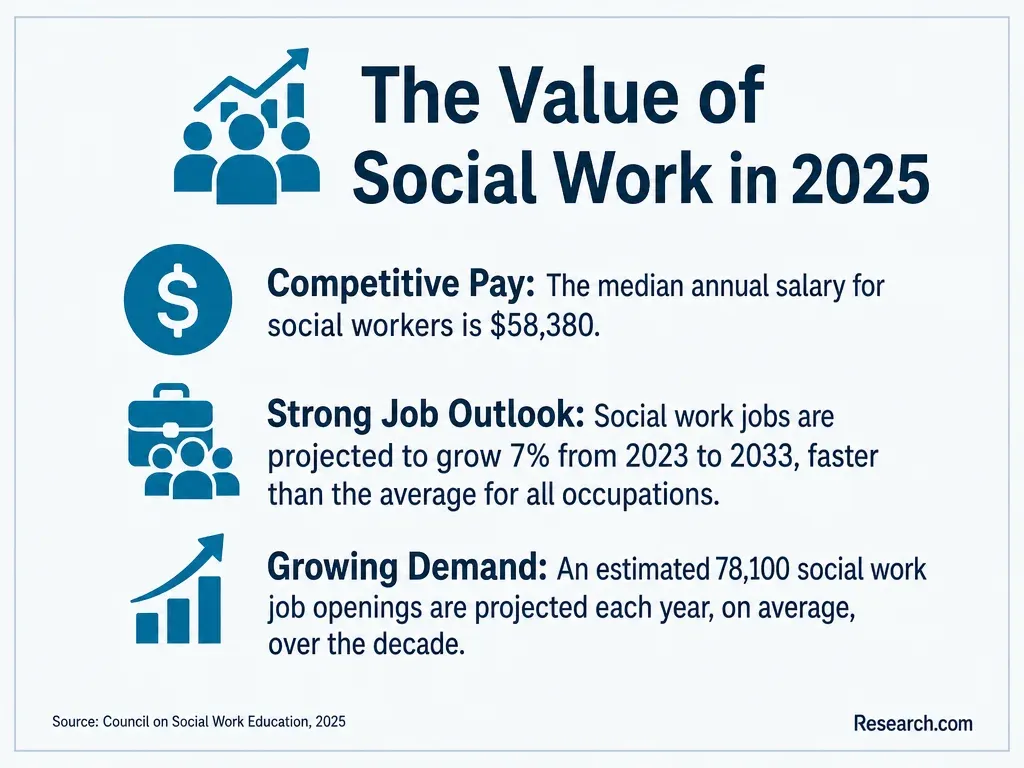
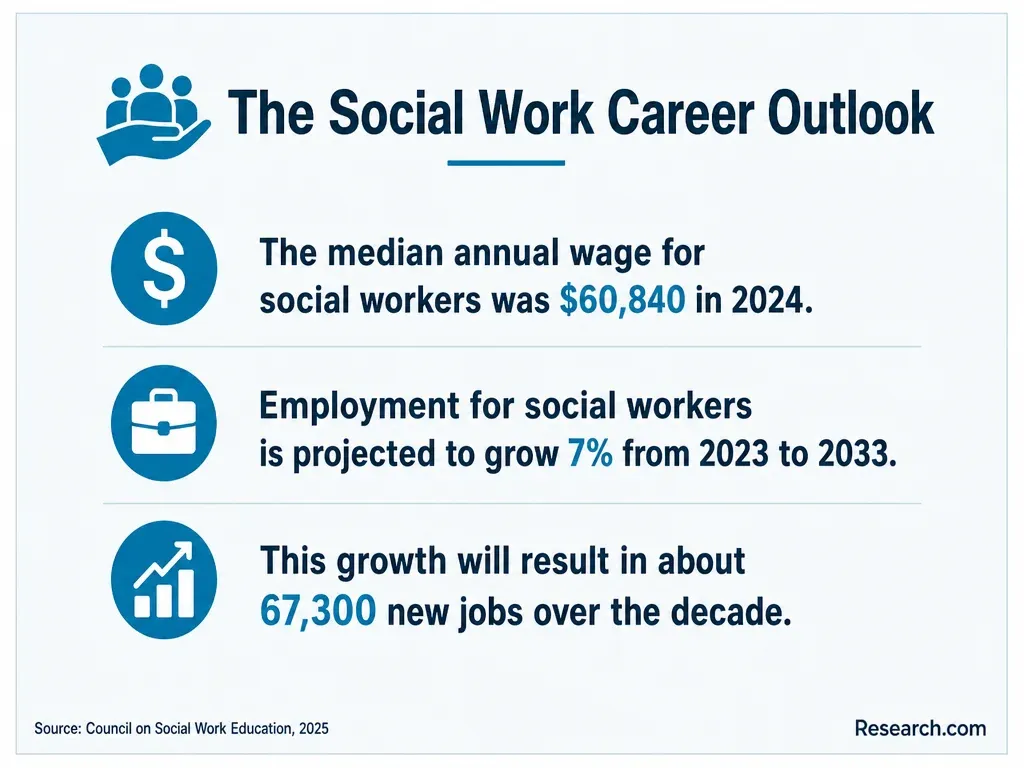
- The U.S. Bureau of Labor Statistics reports a May 2025 median annual wage of $59,550 and projected 2025-2035 growth of 4% for child, family, and school social workers—not a salary or hiring forecast specific to adoption jobs.
What do social workers do with adoptive families?
Adoption social work supports children, birth families, prospective adoptive parents, and adoptive families before or after placement. Duties depend on the worker's authority and agency: they may assess a family's readiness, prepare caregivers for a child's needs, coordinate services, document a child's history, or support family relationships after adoption. A social worker does not make every legal decision in an adoption; courts, agencies, and other authorized professionals have distinct responsibilities.
In foster-care adoption, work may include family finding, supporting relatives and siblings, coordinating with the child's team, and helping caregivers understand trauma, loss, and ongoing connections. Private domestic adoption can involve education, home-study work, and post-placement visits, subject to state law and agency rules. Post-adoption work may focus less on placement and more on school advocacy, benefits navigation, caregiver support, and referrals for appropriate behavioral health care.
Good practice makes room for the adoptee's perspective rather than treating placement as the end of the story. Workers must explain their role and confidentiality limits, document carefully, avoid promises about outcomes, and respect the rights of everyone involved. Readers comparing broader social work master's roles and employment settings should check which positions actually involve ongoing work with adoptive families.
Where do social workers who support adoptive families work?
The best setting depends on whether you want to help arrange permanency, provide continuing family support, or deliver clinical care. Similar job titles can conceal very different caseloads and decision-making authority.
The comparison below shows common settings and the work most likely to distinguish each one. Individual positions and qualification rules still need to be checked with the employer and state.
| Setting | Likely focus | Workplace fit to examine |
| Public child welfare | Permanency planning, family finding, coordination with courts and foster caregivers | Caseload, travel, safety procedures, documentation, and supervision |
| Licensed adoption agency | Family education, assessments, matching support, and post-placement services within agency authority | State approval, ethical policies, and the balance of placement and family-support work |
| Post-adoption nonprofit or family-service program | Resource navigation, support groups, caregiver education, and service coordination | Funding stability, referral capacity, and access to specialized consultation |
| Healthcare or behavioral health provider | Adoption-informed assessment, family support, or treatment when qualified | Clinical license requirements, supervision, referral relationships, and scope |
Ask an employer who handles crises, who approves home studies or reports, and what happens when a family needs a service the organization cannot provide. If you are still a student, an agency's capacity to host interns is a separate question from its hiring needs; a social work master's placement support comparison guide can help frame questions about finding and supervising a relevant placement.
What degree do you need to work in adoption social work?
There is no single degree requirement for every adoption-related job. Some case-management, family-support, and agency positions accept a BSW; others accept related human services degrees and train employees for specific duties. Positions involving advanced social work practice may require an MSW, while psychotherapy requires the education and license specified by the state and employer. A job title alone does not establish permission to use a protected social worker title or perform a regulated function.
For someone entering the field, a CSWE-accredited BSW offers generalist preparation and field education. A person with a bachelor's degree in another subject can apply to a traditional or foundation MSW; that degree does not ordinarily qualify them for advanced standing, which generally requires a qualifying BSW under the program's rules. An MSW is most useful when target postings require graduate-level social work, clinical preparation, or a particular license pathway. Compare online social work bachelor's education pathways against actual local job requirements before paying for more education than the role needs.
A DSW or PhD is not a routine entry requirement for adoption practice. Experienced workers may pursue doctoral study for leadership, teaching, or research, but a doctoral degree is not a substitute for a required practice license or adoption-specific experience.
The most useful training fills a gap in the work you expect to do. For placement and permanency roles, prioritize child-welfare law and agency procedure, family assessment, documentation, and ethical decision-making. For post-adoption support, look for learning on attachment and relationships, trauma and loss, identity development, kinship and sibling connections, and navigating school or community services. Training should address birth-family and adoptee perspectives as well as caregiver needs.
Supervised experience matters as much as course titles. Ask whether training includes observed practice, consultation on difficult decisions, and feedback on culturally responsive communication. A short certificate or continuing education course can strengthen competence, but it does not authorize home studies, independent clinical treatment, or any activity reserved by state law.
Experienced social workers moving into program leadership or adoption research might consider doctoral education; most frontline practitioners will benefit more directly from focused training and strong supervision. A guide to accelerated doctoral social work education is relevant only if doctoral-level work matches that longer-term goal.
What are social work program admission requirements, costs, and completion times?
Requirements vary by school and entry route. BSW applicants generally enter through undergraduate admission and may have separate requirements for the social work major. Traditional MSW programs admit applicants with bachelor's degrees in other disciplines, subject to their academic and application criteria. Advanced-standing MSW admission normally requires a qualifying BSW and may have additional recency or grade rules; relevant employment alone does not establish eligibility. If your prior degree is outside social work, online MSW programs with broader entry criteria can help you identify options, but confirm each program's actual prerequisites and admission standards.
A BSW commonly takes about four years of full-time undergraduate study; a traditional full-time MSW commonly takes about two years, while an advanced-standing route is shorter when a student qualifies. Transfer credit, part-time study, course sequencing, and placement availability can change the calendar. Request a term-by-term plan rather than assuming an advertised completion time fits your circumstances.
For a meaningful cost comparison, add tuition and fees to books, screening or onboarding, placement travel, and any earnings lost while completing field hours. Compare that total with the qualifications in local adoption-related postings. If those jobs accept your present degree plus employer training, targeted experience may be a more direct next step than another degree.
Other Things You Should Know About Social Work
No. Lived experience can inform your perspective, but it does not replace professional preparation, supervision, or attention to each family member's individual experience.
It can create useful insight or difficult boundaries. Discuss potential conflicts and disclosure decisions with a supervisor, and follow agency policy rather than assuming your experience matches a client's.
Ask the employer which state's rules govern each duty and whether you need additional authorization. An agency assignment or license in one state does not automatically permit regulated work in another.
They can improve communication and access when they match the families served. Ask how the agency assesses language proficiency and provides qualified interpretation; bilingual ability alone does not make someone an authorized interpreter for every sensitive discussion.
- Guidelines for Foster and Adoptive Home Studies (TARE) | texas.gov https://www.dfps.texas.gov/Adoption_and_Foster_Care/About_TARE/Foster_Care/home_study_guidelines.asp
- Assessing the Field of Post-Adoption Services: Family Needs, Program Models and Evaluation Issues. Literature Review https://aspe.hhs.gov/reports/assessing-field-post-adoption-services-family-needs-program-models-evaluation-issues-literature
- Postadoption Contact Agreements Between Birth and Adoptive Families - Washington | Child Welfare Information Gateway https://www.childwelfare.gov/resources/postadoption-contact-agreements-between-birth-and-adoptive-families-washington/
- Birth Family Contact from Childhood to Adulthood - PMC - NIH https://pmc.ncbi.nlm.nih.gov/articles/PMC10361248/
- Social Work Licensure & Practice (LCSW) | nysed.gov https://www.op.nysed.gov/professions/licensed-clinical-social-worker/faq-licensure-practice
- Underserved Adoptive Families - Digital Commons@TMC https://digitalcommons.library.tmc.edu/cgi/viewcontent.cgi
- What Does an Adoption Social Worker Do? | Virginia Commonwealth University https://onlinesocialwork.vcu.edu/blog/what-does-an-adoption-social-worker-do/
- CE Corner: Helping adoptive families thrive | apa.org https://www.apa.org/monitor/2024/09/adoptive-families-thrive
- What Social Workers Should Know about Transcultural Adoption | University of Michigan School of Social Work https://ssw.umich.edu/about/news-events-stories/stories/62337-what-social-workers-should-know-about-transcultural
- Social Worker III-Permanency Planning | governmentjobs.com https://www.governmentjobs.com/careers/onslowcountync/jobs/newprint/825829