2027 Social Work Student Research Mentoring: Roles, Boundaries, and Skill Development
Audited and Verified:
Our Editorial and Data Verification Process
Research.com uses government datasets, official education statistics and primary institutional information to support its career and degree guides. Our review process checks factual accuracy, occupational definitions, source dates and the requirements associated with the credentials discussed.
How This Article Was Fact-Checked
Our editorial team verifies salary estimates, employment projections, education requirements and program information against original data providers and official organizations. Salary figures are checked against the relevant occupational definitions and reporting periods. Information about licensure, accreditation and required in-person training is reviewed separately.
Fact-checked and verified on:

Co-Founder and Chief Data Scientist
A promising research project can stall when a student and mentor have different expectations about time, data access, or who will receive credit. For BSW, MSW, and doctoral students, effective mentoring turns a feasible question into ethical, useful work without confusing research guidance with field instruction or clinical supervision. This guide explains how to define responsibilities and boundaries, build research skills, find a suitable mentor, and assess program opportunities. It will help you choose a mentoring arrangement that fits your educational goal and the people or communities the work may affect.
Key Things You Should Know
- Agree early on the project scope, meeting schedule, data permissions, feedback process, and expected credit; revisit the agreement when the work changes.
- A mentor can teach research methods and ethical judgment, but mentorship does not replace required field instruction, institutional review, or post-degree licensing supervision.
- Choose opportunities by the work you can actually do - not just a faculty member's publications. Check time, funding, community access, and whether you can complete a meaningful deliverable.
What is research mentoring for social work students?
Research mentoring is a continuing learning relationship in which an experienced researcher or evaluator helps a student frame questions, select appropriate methods, work responsibly with evidence, interpret limitations, and communicate findings. Unlike a single methods course, it includes feedback on decisions as a project develops. The mentor may be faculty, an agency evaluator, or another qualified professional, depending on program rules.
The work may be an academic study, an MSW capstone, a doctoral dissertation, or an agency program evaluation. These are not interchangeable: an agency's question about service delivery may call for different methods, permissions, and review than a study intended to produce generalizable knowledge. A practice-oriented DSW may emphasize an applied project, while a research-oriented PhD commonly places greater weight on original scholarship; requirements vary by program. Students considering the former can compare accelerated DSW coursework and project expectations before assuming an accelerated schedule leaves ample time for mentoring.
The useful outcome is not necessarily a publication. For a BSW student, it might be a carefully documented literature review; for an MSW student, an approved evaluation plan; for a doctoral student, a defensible study and a clear account of its limitations.
What are the roles of social work research mentors and students?
Both parties contribute to the project, but the student retains responsibility for learning and for work submitted under their name. The table distinguishes typical contributions; a course syllabus, assistantship agreement, agency contract, or dissertation policy may assign additional duties.
| Responsibility | Mentor's contribution | Student's contribution |
| Project direction | Tests whether the question and scope are feasible | Explains the learning goal and drafts a manageable question |
| Methods and feedback | Teaches or directs the student to appropriate methods; gives timely, specific feedback | Prepares drafts, records decisions, and responds to feedback |
| Oversight and access | Identifies required academic, agency, and ethics approvals | Works only within approved permissions and reports problems promptly |
| Completion and credit | Clarifies milestones, contributions, and credit expectations | Documents contributions and communicates capacity or delays |
Preparation changes what support is reasonable. A BSW student may need substantial help reading studies; an MSW student may be ready to connect an agency question to a feasible design; a doctoral student may be expected to lead more decisions. Neither prior employment nor entry through an advanced-standing MSW track guarantees research independence. The MSW entry pathway comparison guide provides context for differences in preparation, but the mentoring plan should reflect the individual student's skills.
What professional boundaries should social work research mentors and students establish?
Start with a short written agreement covering the project's purpose, each person's role, expected weekly time, meeting and response cadence, deadlines, permitted communication channels, and a process for changing scope. Clarify whether the work is paid employment, course credit, an assistantship, or voluntary participation. If a mentor also grades, employs, or supervises the student, name that power difference and identify whom the student can contact about a concern.
Keep research guidance separate from other professional relationships. A faculty research mentor is not automatically the student's field instructor or clinical supervisor, even if the project examines clinical services. Students considering comparing clinical Master of Social Work pathways should ask programs who separately oversees research, field learning, and any later supervised practice.
Boundaries also protect participants and community partners. Do not use a mentor's authority to pressure agency staff or clients to participate, promise access to records the agency has not approved, or share identifiable stories in informal meetings. Agree on a route for raising disagreements and, if needed, changing mentors without treating a student's academic progress as leverage.
Before collecting or receiving data, determine who controls it, what the student is permitted to access, how it will be stored, and what may be shared outside the agency. A supervisor's verbal encouragement is not a substitute for required institutional or agency permission. Ask the appropriate institutional review board or designated office to determine whether a project needs review; students and mentors should not make an unsupported exemption claim themselves. Evaluation, quality improvement, and academic research can involve different oversight requirements, and labels alone do not settle them.
Plan for informed consent where required, accessible participation, potential coercion, confidentiality, and the effect of reporting on communities served. Remove identifiers from drafts when possible, but recognize that combinations of details can still reveal someone's identity. Follow applicable law, institutional rules, agency agreements, and approved data-retention procedures.
Discuss authorship before substantial work begins and revisit it as contributions change. A useful agreement identifies who will lead each proposed output, how substantive intellectual contributions will be recognized, who can approve release of agency information, and how disagreements will be resolved under the institution's and intended publication's policies. Neither a student's labor alone nor a mentor's seniority alone should determine authorship. When comparing affordable social work practice doctorates, ask whether project support includes time and guidance for approvals, secure data handling, and dissemination; low tuition does not remove those obligations.
Begin with the question you want to investigate and the kind of help you need. BSW students can ask methods instructors about manageable literature reviews or approved faculty projects. MSW students can approach capstone faculty, field offices, and agency evaluation staff, while checking whether an agency project meets academic requirements. Doctoral applicants should examine faculty interests, advising capacity, community partnerships, funding arrangements, and the program's process for assigning or changing advisers.
Make an initial request specific: briefly describe your question, relevant coursework or practice experience, available time, and a proposed first task. Ask whether the person is taking students and whether the project offers appropriate data access and oversight. If you are applying rather than enrolled, comparing social work graduate applicant requirements can help distinguish an admissions conversation from an actual commitment to supervise your research.
Choose for fit and follow-through, not reputation alone. A mentor with relevant methods expertise and time for regular feedback may be more useful than a prominent researcher who cannot review your work during its critical stages.
What careers, salaries, and job prospects can social work research experience support?
Research experience can strengthen applications for program evaluator, research assistant, policy analyst, quality-improvement, community-engagement, and some agency leadership roles. The strongest evidence is a specific contribution - such as developing a measure, analyzing approved data, or explaining findings to stakeholders - rather than simply listing "research" on a résumé. Some roles accept adjacent degrees; licensed clinical roles have separate education and state requirements.
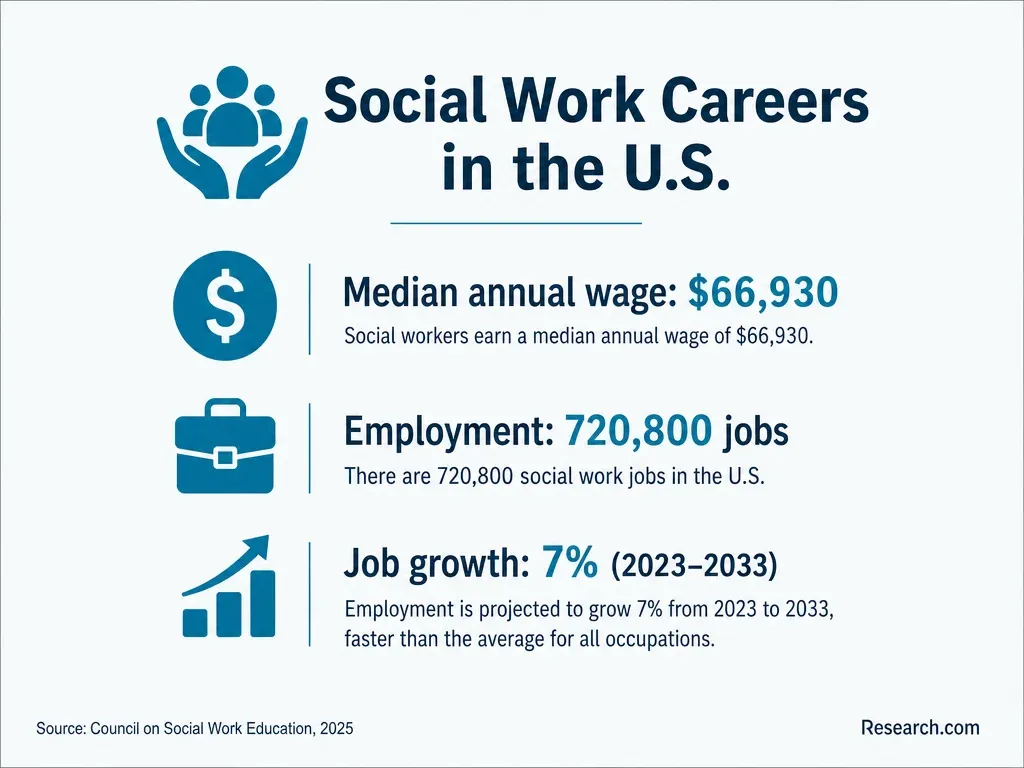
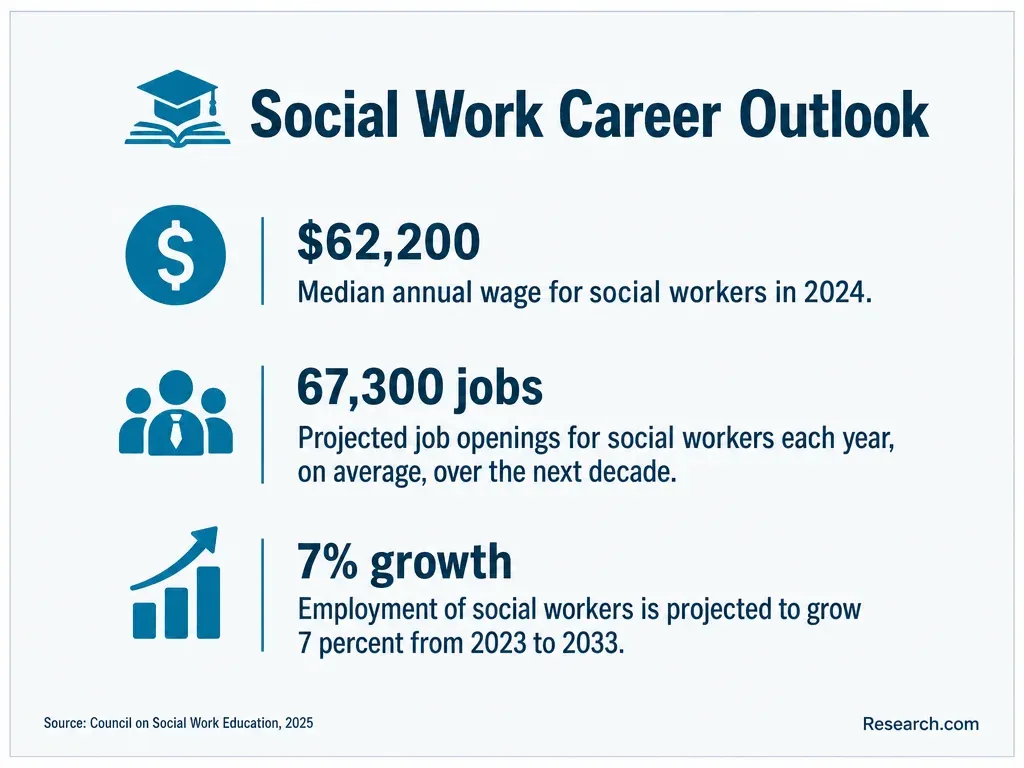
Pay depends on the occupation, employer, location, and qualifications. For context, the U.S. Bureau of Labor Statistics reports a May 2025 median annual wage of $61,780 for social workers overall and projects 6% employment growth from 2025 to 2035. Its healthcare social worker category has a $67,880 median and projected 8% growth. These are occupation-wide figures, not salaries or job-growth forecasts for research mentees or program evaluators. Use the guide to comparing social worker pay by location alongside current postings for the specific job you want.
If your goal is primarily evaluation or policy analysis rather than regulated social work practice, compare job requirements before pursuing another social work degree. Targeted methods training and documented project experience may be the more direct route; a doctoral degree is most compelling when the intended work genuinely requires its depth of research or practice scholarship.
Other Things You Should Know About Social Work
Often, yes, especially for specialized methods or community-based work. Ask your program whether an outside mentor can serve formally or must work alongside an approved faculty adviser.
Contact your program director or graduate office promptly. Request a written transition plan covering supervision, project materials, milestones, and any committee requirements.
Yes, if you describe your actual responsibilities and label the project as ongoing. Do not present preliminary analysis as a published finding or disclose restricted information.
That depends on whether it is optional, a required course component, or part of a funded appointment. Check the written terms and ask your program about alternatives before declining.
- Responsible Conduct Research: Mentoring | The Office of Research Integrity https://ori.hhs.gov/education/products/columbia_wbt/rcr_mentoring/foundation/index.html
- Building and sustaining mentor interactions as a mentee - PMC https://pmc.ncbi.nlm.nih.gov/articles/PMC8490489/
- Principles and Best Practices for Protecting Participant Privacy | Grants & Funding https://grants.nih.gov/policy-and-compliance/policy-topics/sharing-policies/dms/privacy/best-practices
- Data Security Guidelines | Research Ethics & Compliance https://research-compliance.umich.edu/data-security-guidelines%20
- Data Security Guidance for Human Subjects Research | University of Connecticut https://ovpr.uconn.edu/services/rics/irb/data-security-guidance-for-human-subjects-research/
- Introduction to mentoring: A guide for mentors and mentees | apa.org https://www.apa.org/education-career/grad/mentoring
- Supervision & Mentoring Skills | mit.edu https://urop.mit.edu/mentors/resources/supervision-skills/
- Cultivate Mentoring Relationships | harvard.edu https://catalyst.harvard.edu/mentorship-in-clinical-and-translational-research/access-the-guide/cultivate-mentoring-relationships/
- Mentors and Mentoring for Graduate Students | umd.edu https://faculty.umd.edu/media/246/download
- Guidance: Data Security and Privacy | lehigh.edu https://research.lehigh.edu/policies-guidance-forms/guidance-data-security-and-privacy