2027 Social Work Professional Identity Across Clinical, Community, and Policy Roles
Audited and Verified:
Our Editorial and Data Verification Process
Research.com uses government datasets, official education statistics and primary institutional information to support its career and degree guides. Our review process checks factual accuracy, occupational definitions, source dates and the requirements associated with the credentials discussed.
How This Article Was Fact-Checked
Our editorial team verifies salary estimates, employment projections, education requirements and program information against original data providers and official organizations. Salary figures are checked against the relevant occupational definitions and reporting periods. Information about licensure, accreditation and required in-person training is reviewed separately.
Fact-checked and verified on:

Co-Founder and Chief Data Scientist
A social worker's professional identity is not defined by a job title or a clinical license alone. It is the way social work values, skills, and accountability guide decisions whether someone provides therapy, organizes community services, or shapes policy. For students, new graduates, and professionals considering a change in direction, that distinction matters: these roles share a foundation but require different preparation and authority. This guide explains what carries across settings, what changes, and how to choose education and experience that fit the work you want to do.
Key Things You Should Know
- Clinical, community, and policy social workers share a person-in-environment perspective, ethical obligations, and attention to structural barriers; their day-to-day duties and required credentials differ.
- An MSW does not grant independent clinical authority. State boards determine license categories and supervised-practice requirements, while many community and policy jobs do not require a clinical license.
- For career comparisons, U.S. Bureau of Labor Statistics figures put May 2025 median pay at $67,880 for healthcare social workers and $60,280 for mental health and substance abuse social workers; neither figure predicts an individual graduate's salary.
What is professional identity in social work?
Professional identity in social work is an understanding of what social workers contribute, whom they are accountable to, and where their competence and authority end. It combines a person-in-environment perspective with skills in engagement, assessment, intervention, advocacy, and evaluation. It also requires reflection: a worker must be able to explain why a course of action serves a person or community, not merely say that an agency routinely does it.
That identity can remain recognizable across different jobs. A clinical worker considers housing insecurity when planning care; a community organizer listens to residents rather than assuming an agency knows their priorities; a policy analyst examines who can actually access a benefit.
These are different tasks informed by a shared concern for individual well-being and social conditions. Readers exploring roles for master's-prepared social workers should therefore compare responsibilities, not just titles.
Identity is developed through education, observed field performance, supervision, and experience. Calling oneself a social worker does not establish a protected-title right, license, or competence to provide a particular service; those questions depend on state law and the role.
How do clinical, community, and policy social work roles differ?
The clearest comparison is the primary level of change each role pursues. The table describes common work, not exclusive boundaries: a clinician may advocate for better housing access, and a policy worker may use direct-service experience to identify a failing system.
| Practice emphasis | Typical work | Questions to ask about fit |
| Clinical | Assessment, treatment planning, psychotherapy when authorized, care coordination, and documentation | Do you want sustained direct work with clients, and can the employer provide appropriate supervision and support? |
| Community | Outreach, organizing, service coordination, coalition work, and program implementation | Do you prefer building relationships across groups and adapting services with community input? |
| Policy | Policy analysis, advocacy, implementation, budget review, and evaluation | Do you want to change rules or resource allocation, often on a longer timeline than direct service? |
Workplace conditions may matter as much as the practice label. Compare caseload or project load, time spent on records and reporting, travel, safety procedures, community partnerships, supervision, and the agency's funding stability.
A policy position in government may also be governed by civil-service classifications, while a community role may be open to applicants with public health, organizing, or human services experience. If relocation is part of your decision, salary context for geographically mobile MSW graduates can help frame questions about local pay and cost of living; it does not establish license portability.
What degrees prepare social workers for clinical, community, and policy careers?
A BSW provides generalist social work preparation and field education. It can fit entry-level social work positions where employers and state rules accept it. An MSW adds graduate-level generalist and specialized learning and is commonly the educational starting point for a clinical licensure pathway.
Clinical authority still requires the applicable state's further steps. Community and policy employers may value an MSW, but a different degree or relevant experience may be a more direct route when the target job does not require social work credentials.
Applicants without a qualifying BSW can consider a traditional or foundation MSW. Advanced-standing MSW tracks are for applicants whose prior social work education meets the program's criteria; a psychology, sociology, or human services degree does not automatically qualify. Comparing MSW credits across entry tracks is useful because a shorter track changes the academic sequence, not the need to demonstrate required competencies.
For experienced practitioners, a practice-oriented DSW may suit leadership or practice-improvement goals, while a research-oriented PhD may better serve a goal of producing original scholarship. Neither is a substitute for a required clinical license.
Social work values become professional identity when they affect routine choices. Respect for self-determination means making room for a client's informed priorities, not simply securing agreement with an agency plan.
Attention to social justice means examining how eligibility rules, language access, transportation, or discrimination affect an intervention's usefulness. Cultural responsiveness requires asking and learning rather than presuming that shared characteristics produce identical needs.
Ethical commitments also set limits. Confidentiality, informed consent, professional boundaries, conflicts of interest, and honest documentation apply across practice levels, though the records and stakeholders differ.
The NASW Code of Ethics provides professional guidance; it does not replace law, licensing rules, or agency policy. Reporting duties, record sharing, and clinical scope require jurisdiction- and setting-specific checks.
Field learning is an early test of these commitments. Students should know who supervises their work, what client information they may access, and how concerns are escalated. That makes online MSW placement responsibilities before enrollment an ethical question as well as a scheduling question: a placement must support safe, supervised learning, not merely offer available hours.
What are social worker salaries and job outlooks across practice areas?
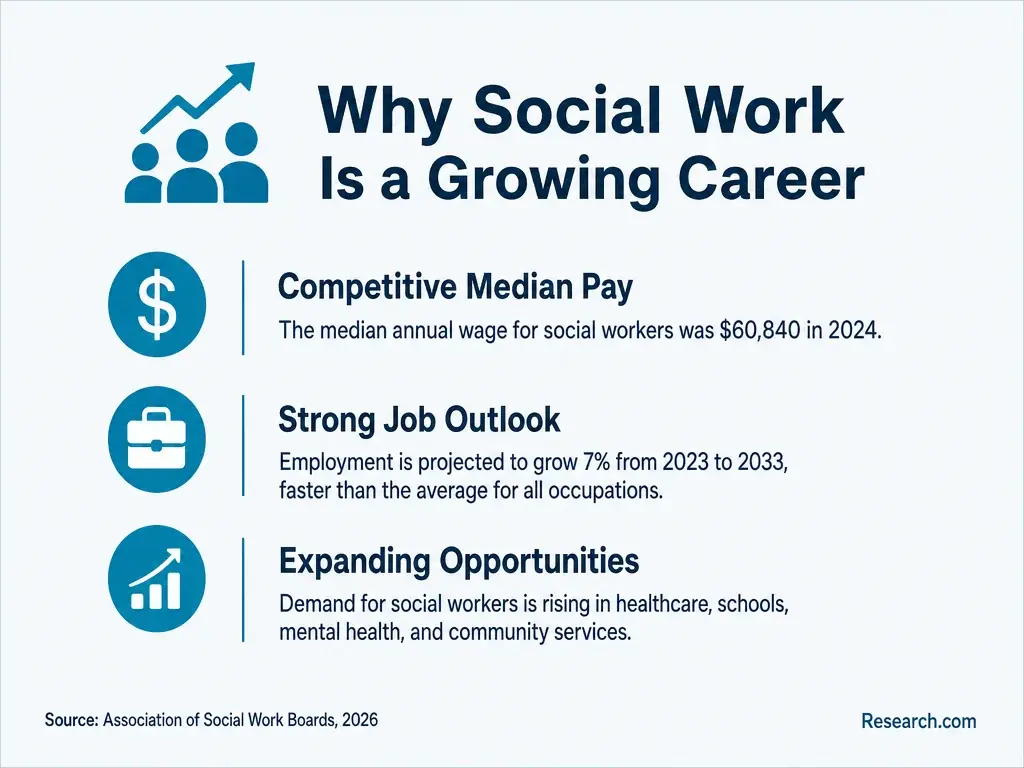
The U.S. Bureau of Labor Statistics groups workers by occupation, not by MSW concentration or license. Its May 2025 median annual pay and 2025-2035 employment projections provide a comparison point for several common practice areas.
| BLS occupation | May 2025 median annual pay | Projected employment growth, 2025-2035 |
| Social workers, all specialties | $61,780 | 6% |
| Child, family, and school social workers | $59,550 | 4% |
| Healthcare social workers | $67,880 | 8% |
| Mental health and substance abuse social workers | $60,280 | 10% |
These figures suggest different labor-market conditions across specialties, but they do not compare clinical, community, and policy jobs perfectly. Policy analysts and community organizers may be classified under other occupations, and an occupational median is not an entry-level offer or a return promised by an MSW.
For a sound decision, compare actual job postings in your location, their credential requirements, likely pay, supervision, and advancement against the full cost of any education you are considering. Salary context for geographically mobile MSW graduates is particularly useful when locations differ, provided you also verify each state's practice rules.
Before applying, compare the actual curriculum and outcomes with the cost of targeted training, mentorship, or a role change; planning the cost of a social work doctorate is especially important if the desired advancement does not require one.
Other Things You Should Know About Social Work
Yes. Many service, outreach, and policy jobs welcome people from adjacent fields. Use the job description and applicable state title rules to distinguish the work you can do from a title or function reserved for licensed social workers.
Connect one social work value to a specific, appropriately anonymized example of your work or field learning. State your contribution, how you used supervision or feedback, and what remains within your current scope of practice.
Clarify each person's responsibilities and share the relevant social and environmental context without exceeding consent or privacy limits. Agree on the immediate decision, and seek supervision when professional duties conflict.
Yes, but transferable perspective is not the same as transferable authorization or specialized skill. Compare the new role's required credentials and experience, then seek targeted training, supervision, or project experience to address gaps.
- A Social Work Approach to Policy: Implications for Population Health - PMC https://pmc.ncbi.nlm.nih.gov/articles/PMC5731070/
- Social Work Field Education and Supervision - ScholarWorks https://scholarworks.waldenu.edu/cgi/viewcontent.cgi
- Social Work Advocacy: Towards a Trauma-Informed Model | springer.com https://link.springer.com/article/10.1007/s10615-024-00942-1
- Social work graduates' professional socialisation and identity | sagepub.com https://journals.sagepub.com/doi/10.1177/00208728251319494
- How Do Social Work Field Placements Work? | Virginia Commonwealth University https://onlinesocialwork.vcu.edu/blog/social-work-field-placement/
- Clinical social workers and social justice: Advocacy | iu.edu https://journals.indianapolis.iu.edu/index.php/advancesinsocialwork/article/download/209/212/0
- The Nine CSWE Social Work Competencies | texascollege.edu https://www.texascollege.edu/the-nine-cswe-social-work-competencies