2027 Social Work Policy Briefs: Structure, Evidence, and Audience
Audited and Verified:
Our Editorial and Data Verification Process
Research.com uses government datasets, official education statistics and primary institutional information to support its career and degree guides. Our review process checks factual accuracy, occupational definitions, source dates and the requirements associated with the credentials discussed.
How This Article Was Fact-Checked
Our editorial team verifies salary estimates, employment projections, education requirements and program information against original data providers and official organizations. Salary figures are checked against the relevant occupational definitions and reporting periods. Information about licensure, accreditation and required in-person training is reviewed separately.
Fact-checked and verified on:

Co-Founder and Chief Data Scientist
A useful social work policy brief does more than describe a problem: it helps someone with decision-making authority choose a feasible response. That matters when agencies and public officials must weigh service needs against budgets, legal duties, and uneven effects on communities.
This guide is for social work students and practitioners, nonprofit staff, and public-sector professionals preparing a brief for class or work. It explains what to include, how to judge evidence, and how to turn an equity concern into a recommendation an audience can act on.
Key Things You Should Know
- A social work policy brief connects a defined service problem to a specific decision, using concise evidence, realistic options, and a clear recommendation.
- Evidence should establish both the scale of a problem and who experiences it; agency data, research, costs, and community perspectives answer different questions and have different limitations.
- Policy work does not automatically require a clinical license. The Bureau of Labor Statistics reports a $61,780 May 2025 median annual wage and 6% projected 2025-2035 employment growth for social workers overall, but those figures do not describe policy jobs specifically.
What is a social work policy brief?
A social work policy brief is a short, decision-oriented analysis of a rule, funding choice, service gap, or proposed change affecting people and communities. It identifies who can act, explains the consequences of available options, and recommends a course of action. Unlike a research paper, it does not aim to review every study. Unlike an advocacy flyer, it should make its evidence, assumptions, trade-offs, and uncertainties visible.
Social work adds a person-in-environment lens: a brief about missed appointments, for example, should consider transportation, eligibility rules, staffing, accessibility, and client preferences - not simply label clients "noncompliant." Brief writing is one task within a wider set of policy, advocacy, and program roles; comparing jobs that use a social work master's degree can help distinguish those roles from clinical and case-management work.
How should a social work policy brief be structured?
Start with the decision the reader must make, then supply only the background needed to evaluate it. A one- or two-page brief may work for a narrow agency choice; a complex legislative proposal may need more space. Follow the recipient's required format if one exists.
This sequence gives a busy reader the answer early without hiding the reasoning behind it:
- Title and decision summary: Name the population, policy choice, and recommended action in plain language.
- Problem and scope: State what is happening, where, to whom, and which organization has authority to respond.
- Evidence and options: Present the strongest relevant findings and compare the status quo with feasible alternatives.
- Recommendation and implementation: Identify the action, responsible office, likely resource needs, timeline, and measures of progress.
- Sources and limitations: Cite traceable evidence and disclose material gaps or assumptions.
Keep background subordinate to the decision. A brief about access to advanced-standing MSW study, for instance, should distinguish actual program eligibility rules from a general discussion of advanced standing and traditional field education differences. The policy question might be whether an agency should offer placement support - not whether every applicant qualifies for a shortened program.
What evidence should a social work policy brief include?
Use evidence that tests the decision, not merely evidence that makes the problem sound urgent. Depending on the brief, that may include government administrative data, peer-reviewed evaluations, local agency records, statutory or budget documents, and accounts from people affected by the policy. Record the source, date, population, geography, and denominator behind each important figure.
Different evidence answers different questions. A statewide rate can show scale but conceal neighborhood differences; agency counts can show workload but exclude people who never reached the agency; interviews can reveal access barriers but cannot establish their prevalence on their own. Separate observed results from projected benefits, and avoid claiming that a program caused an outcome when the evidence only shows an association.
For a workforce or education-funding brief, social work master's tuition and earnings comparisons can illustrate a useful distinction: published tuition, total attendance costs, and occupational earnings are not interchangeable measures. State whose costs and benefits your estimates represent, and include foregone work time or placement expenses if they materially affect the choice.
Identify the reader's authority before choosing the argument. A school administrator may control referral procedures but not state eligibility law; a legislator may change appropriations but not an agency's day-to-day staffing plan. The brief should ask for an action that reader can actually take.
The following comparison shows how the same service-access issue calls for different evidence and decisions.
| Audience | Likely decision | Evidence to emphasize |
| Agency leadership | Change intake or staffing | Wait times, staff capacity, implementation cost, and client feedback |
| Legislative staff | Change funding or statutory rules | Constituency reach, fiscal implications, legal authority, and distributional effects |
| Community coalition | Choose an advocacy priority | Lived experience, local disparities, partner capacity, and risks of the proposal |
If the issue is recruitment, a state official may need geographic workforce evidence, while an agency director needs evidence about vacancies and retention. MSW career compensation by state can provide context, but state-level pay comparisons cannot establish what a particular agency must offer or what will resolve its vacancies.
A recommendation is actionable when it names an authorized decision-maker, a change that can be implemented, and a way to check whether it worked. "Improve access" is a goal; "pilot evening intake appointments at two sites for six months, track completed referrals, and review client feedback" is a proposal that can be evaluated. Specify a funding source or acknowledge when one has not been identified.
Before settling on a proposal, test it against these questions:
- Can the intended reader approve the change, or does another body control it?
- What staff time, training, technology, or partner agreement would implementation require?
- What could go wrong, including increased workload, exclusion, or loss of privacy?
- Which outcome would show progress, and what comparison or baseline is available?
For example, a brief on access to clinical supervision should not assume that every experienced staff member can supervise hours toward licensure. A proposal to fund supervision must account for the applicable board's rules; clinical hour planning for future social workers is useful context, while the current state board remains the authority on qualifying experience.
Ask who benefits, who bears costs, and who may be missing from the data. Break out results by relevant geography or population where the data support it, while protecting people from identification in small groups. Avoid framing a disparity as a trait of the affected community when eligibility rules, language access, transportation, or institutional practices may help explain it.
Community participation should inform the problem definition as well as the proposed solution. Describe how input was gathered, whose voices were absent, and whether participants could safely disagree.
Obtain required permissions before using agency information or quotations; remove identifying details, and do not present a student exercise as an approved agency position. Professional ethical guidance informs the work, but confidentiality law, consent rules, and agency data policies may impose separate requirements.
In an education-access brief, for example, comparing social work graduate applicant requirements may help identify questions about prerequisites and admission processes. It would not, by itself, prove that a particular requirement causes inequity. That claim needs program-specific data and affected applicants' perspectives.
What are the career opportunities, salaries, and outlook in social work policy?
Policy-related work appears in government social-service agencies, nonprofits, advocacy organizations, health systems, and research or evaluation teams. Duties may include analyzing proposed rules, reviewing program data, consulting communities, drafting testimony or briefs, coordinating implementation, and tracking outcomes. Entry-level openings may emphasize writing and data skills; leadership roles often add budget, stakeholder, and management responsibilities.
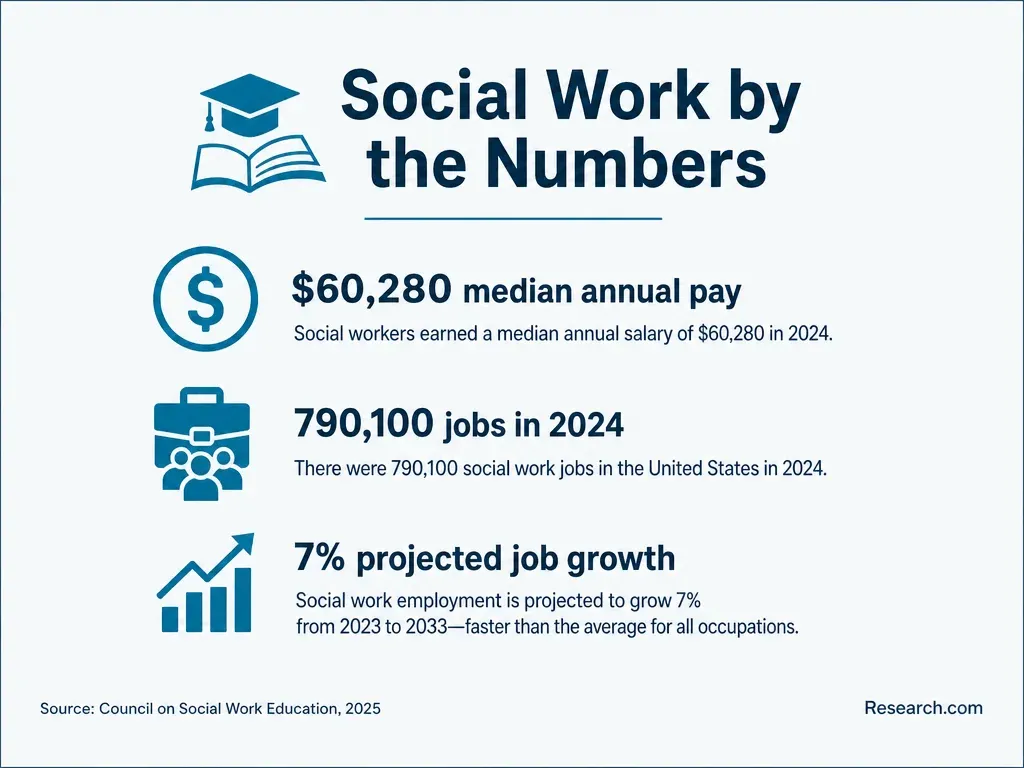
The U.S. Bureau of Labor Statistics reports a $61,780 median annual wage in May 2025 and 6% projected employment growth from 2025 to 2035 for social workers overall. That occupation-wide category is not a wage or growth forecast for policy analysts, and it does not predict a particular graduate's pay. Government pay grades, location, employer funding, experience, and job classification can matter more than a degree title alone.
To assess fit, compare postings for the policy work you want: note required degrees, whether licensure is actually required, writing samples, data tools, community-engagement experience, and salary ranges.
If you need social work coursework to build those skills, online social work degree programs are one option to investigate - but verify policy coursework, field opportunities, scheduling, and total cost before enrolling. If your existing qualifications meet the postings, a policy project, targeted methods training, or relevant agency experience may be the better next step.
Other Things You Should Know About Social Work
Only if the agency and program permit it. Remove confidential information, obtain any required review, and state your own contribution without implying the agency adopted your proposal.
Yes. Use concise citations or source notes that let readers check material claims, dates, estimates, and quotations. Follow the recipient's required style if one exists.
Say so. Use the best relevant evidence available, explain why it may not represent the local population, and recommend a feasible way to collect better information.
No. Testimony is prepared for a hearing and its rules and time limits; a policy brief is a stand-alone decision document. A brief can inform testimony, but it may need substantial adaptation.
- Standards of Evidence for Efficacy, Effectiveness, and Scale-up... - PMC https://pmc.ncbi.nlm.nih.gov/articles/PMC4579256/
- Public Participation Guide: Introduction to Public Participation | US EPA https://www.epa.gov/international-cooperation/public-participation-guide-introduction-public-participation
- Managed care's effect on outcomes | MACPAC https://www.macpac.gov/subtopic/managed-cares-effect-on-outcomes/
- Policy Briefs - The Writing Center https://writingcenter.unc.edu/tips-and-tools/policy-briefs/
- A Framework to Assess Equity in Policymaking - RRAPP https://rrapp.spia.princeton.edu/a-framework-to-assess-equity-in-policymaking/
- Main Section | Community Tool Box https://ctb.ku.edu/en/book/export/html/1137
- Advocacy & Policy | Council on Social Work Education https://www.cswe.org/advocacy-policy
- How to write a policy brief | International Development Research Centre https://idrc-crdi.ca/en/funding/resources-idrc-grantees/how-write-policy-brief
- Combine qualitative and quantitative data | betterevaluation.org https://www.betterevaluation.org/frameworks-guides/rainbow-framework/describe/combine-qualitative-quantitative-data