2027 Social Work Job Shadowing: Questions About Access, Privacy, and Learning Value
Audited and Verified:
Our Editorial and Data Verification Process
Research.com uses government datasets, official education statistics and primary institutional information to support its career and degree guides. Our review process checks factual accuracy, occupational definitions, source dates and the requirements associated with the credentials discussed.
How This Article Was Fact-Checked
Our editorial team verifies salary estimates, employment projections, education requirements and program information against original data providers and official organizations. Salary figures are checked against the relevant occupational definitions and reporting periods. Information about licensure, accreditation and required in-person training is reviewed separately.
Fact-checked and verified on:

Co-Founder and Chief Data Scientist
Watching a social worker at work can help you test a career interest before committing to a degree or a job change. But access is limited: clients have privacy rights, agencies have safety rules, and an observer may see only a small part of the role.
This guide is for prospective students, career changers, and early-career learners who want to arrange a worthwhile visit. It explains what you may observe, how to seek permission, which questions reveal the most, and how to use what you learn without mistaking shadowing for supervised training.
Key Things You Should Know
- Social work job shadowing is observation, not client service; an agency may permit staff discussions while excluding you from client meetings and records.
- Ask about consent, confidentiality training, screening, and permitted activities before visiting. A client's decision not to have an observer present must be respected.
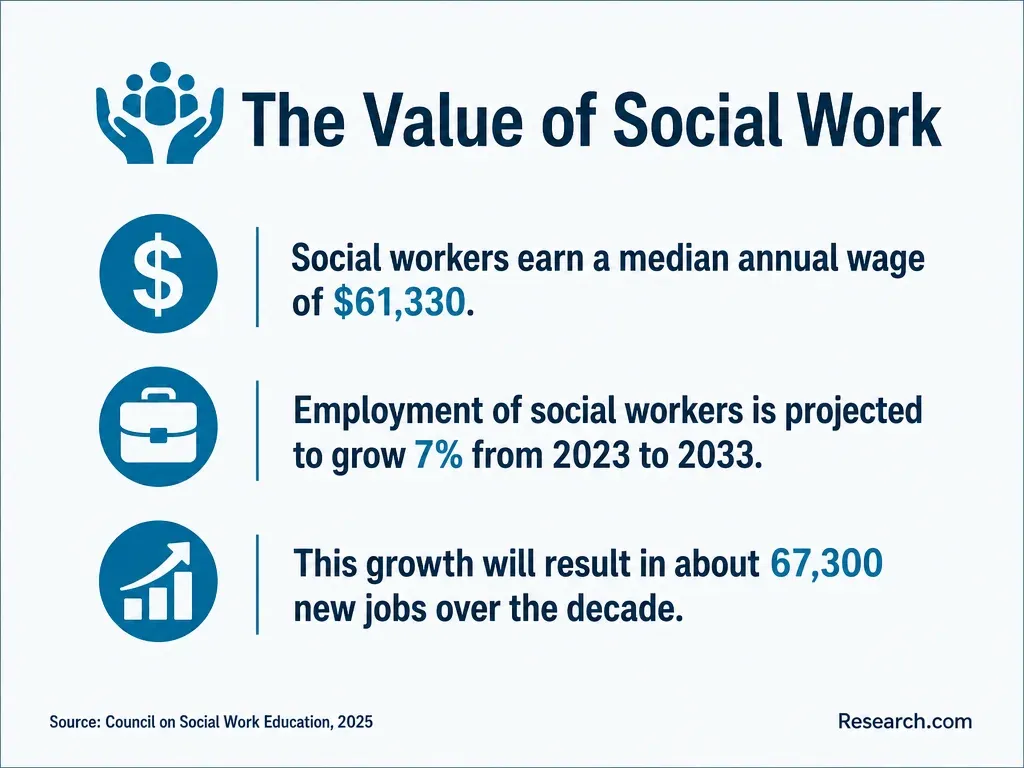
- Use the visit to compare actual duties and qualifications. For context, the U.S. Bureau of Labor Statistics reports a May 2025 median annual wage of $61,780 for social workers overall, not a promised starting salary.
What is social work job shadowing, and what can you expect to observe?
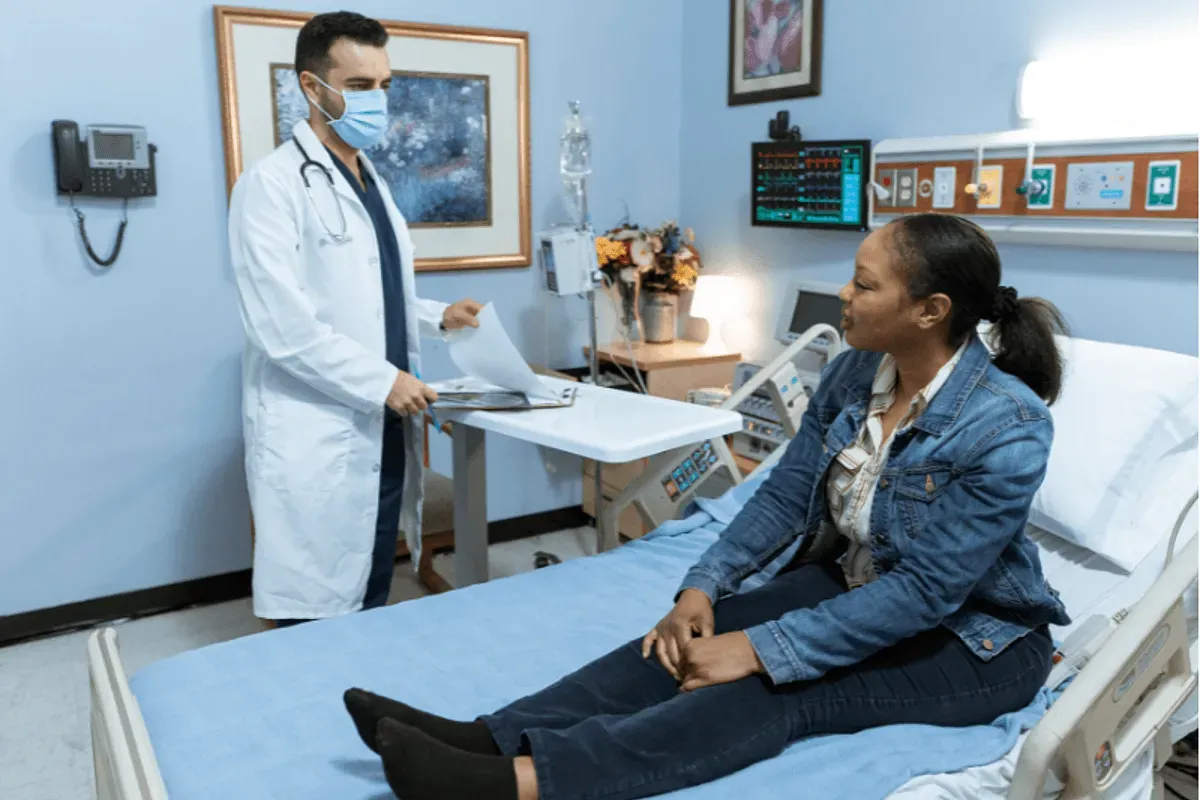
Social work job shadowing is a short, agency-approved opportunity to observe a professional's work and ask about it. Depending on the setting, you might see a team meeting, resource coordination, outreach planning, a public presentation, or a demonstration using fictional information.
You may instead spend most of the visit discussing the role with a social worker. Neither format guarantees access to client encounters.
Work varies substantially by setting. A hospital social worker may coordinate discharge resources with a care team; a school social worker may collaborate with educators and families; a community organizer may spend the day building partnerships. Documentation, consultation, and navigating service barriers are often less visible than a client meeting but just as important to understanding the job.
Observation can show you the workplace; it cannot demonstrate that you can perform its duties. If you want to see how supervised learning develops those skills, use accredited BSW coursework and placement comparisons to examine the difference between a brief visit and a program's field education.
How can you find and arrange a social work shadowing opportunity?
Start with a university career office or social work department, a volunteer coordinator, or a professional contact at an agency serving a population that interests you. Ask for an informational interview first if the organization does not advertise observation opportunities. An agency may be willing to explain its work even when it cannot host an observer.
A specific request is easier to evaluate than an open-ended appeal. Before contacting an agency, prepare to explain:
- Your background, career interest, and the type of role you hope to learn about.
- Whether a staff conversation, meeting observation, or other agency-approved activity would meet your goal.
- Your availability and willingness to complete screening, orientation, or confidentiality requirements.
- That you understand client access is optional and may be withdrawn at any time.
Send a brief thank-you afterward and record what you learned without client details. A short visit does not entitle you to an application reference; if graduate study becomes your goal, MSW applications when academic referees are unavailable is a separate issue to resolve with each program's admissions office.
How are client privacy and consent handled during social work shadowing?
Agency permission is not a substitute for client permission. If an observer might be present during a service encounter, staff must follow applicable law and agency policy for explaining the observer's role and seeking any required consent. Clients should be able to decline without jeopardizing services. Sensitive settings may prohibit observers altogether.
Expect boundaries around records, screens, names, photographs, recordings, and conversations outside the agency. A confidentiality agreement or orientation may be required, but signing one does not create a right to see protected information.
HIPAA may apply in a healthcare setting; schools, public agencies, and other organizations can operate under different legal and policy requirements. The host organization decides what access is lawful and appropriate.
Ask the host where you should wait if a client declines, whether you may take notes, and how to respond if confidential information appears unexpectedly. Notes should focus on workflow and career observations, not identifiable cases. If you later compare degree programs, comparing MSW practicum placement assistance can help you ask how schools and agencies prepare students for privacy obligations during actual placements.
Save questions about identifiable clients for another setting: the goal is to understand decisions, responsibilities, and working conditions without soliciting private information. Ask the host when questions are welcome so you do not interrupt service or team communication.
These questions can reveal whether the role matches your interests and what preparation it actually requires:
- What does a typical week involve beyond direct client contact, including documentation and coordination?
- Which decisions can you make in this role, and when do you consult a supervisor or another professional?
- What degree, license, school qualification, or agency training did this position require?
- How do caseload, travel, safety procedures, and available community resources affect the work?
- What helps new staff learn the role, and which parts are hardest to learn from coursework alone?
- What other roles in this agency work toward the same mission but require different qualifications?
Ask about the host's specific job rather than treating one answer as a rule for the profession. If they mention an MSW route, comparing graduate social work entry-track requirements can help you investigate which track fits your prior education; the host's career history cannot determine your admission eligibility.
What education, licensing, salary, and job outlook should aspiring social workers consider?
Match the qualification to the job you observed. A BSW generally prepares students for generalist practice; a traditional MSW admits eligible students from varied academic backgrounds, while advanced standing depends on qualifying prior social work education and program rules.
Some case-management or community roles accept other degrees. Clinical work may require an MSW, a state license, and additional board-approved supervised experience before independent practice. State boards, not a shadowing host or degree title, determine license eligibility and permitted scope.
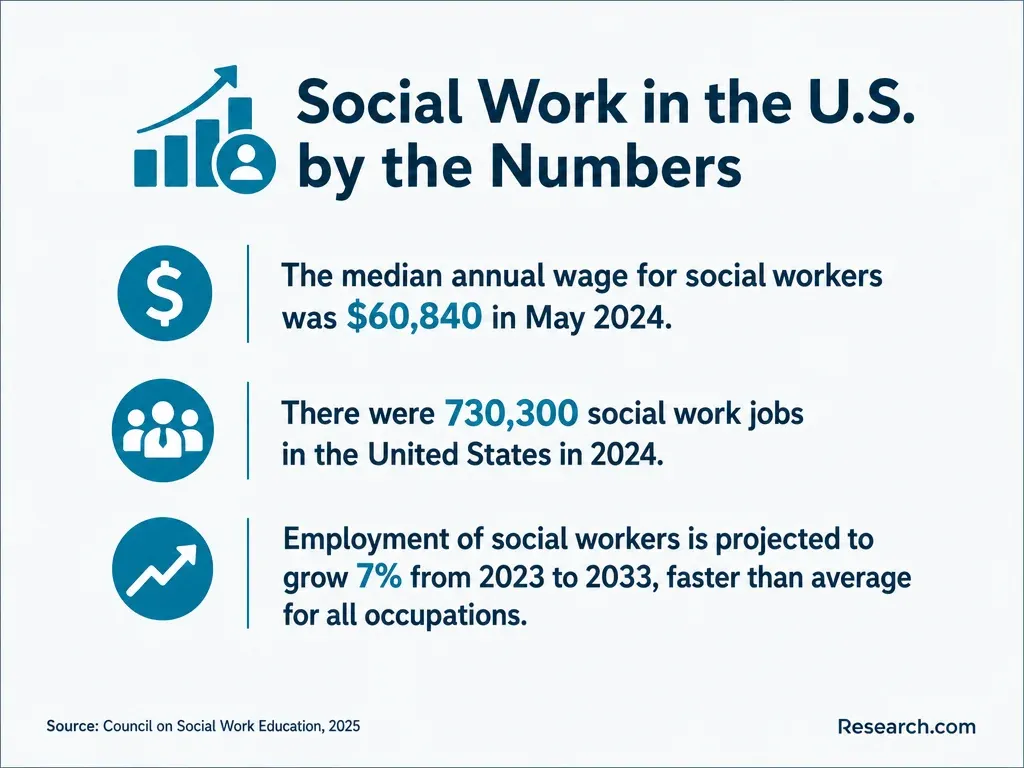
National wage figures provide context, not an offer or a return-on-tuition estimate. The U.S. Bureau of Labor Statistics reports the following May 2025 median annual wages and 2025-2035 employment projections for distinct social work occupations:
| BLS occupation | Median annual wage, May 2025 | Projected employment growth, 2025-2035 |
| Child, family, and school social workers | $59,550 | 4% |
| Healthcare social workers | $67,880 | 8% |
| Mental health and substance abuse social workers | $60,280 | 10% |
These occupation-wide medians combine workers with different experience, credentials, locations, and employers; growth projections do not guarantee a local opening. Compare the category closest to the work you want, then review local postings for license requirements and pay.
If relocation matters, salary context for geographically mobile MSW graduates can add perspective, but verify current state licensing rules before assuming you can practice there.
Other Things You Should Know About Social Work Programs
Yes, if you describe it accurately as observation and name only activities you were permitted to observe. Do not present it as field education, direct service, or clinical experience.
Possibly. A remote staff conversation or approved meeting may work, but access to client calls or digital records requires separate agency authorization and applicable privacy safeguards.
There is no standard duration. Agree on a time the host can support and prepare a few focused questions; even a short conversation can be useful if client observation is unavailable.
Do not intervene beyond your visitor role or discuss identifiable details elsewhere. Raise the concern privately with your designated host or the agency contact and follow its safety and reporting instructions.
- SB 25 Text | wvlegislature.gov http://www.wvlegislature.gov/bill_status/bills_text.cfm
- Frequently Asked Questions for Social Work | nysed.gov https://www.op.nysed.gov/professions/social-work/faqs
- Confidentiality at IU School of Social Work https://socialwork.iu.edu/professional-standards/confidentiality.html
- Shadowing & Informational Interviewing | wisc.edu https://prehealth.wisc.edu/shadowing-informational-interviewing/
- Job Shadowing Resource | Career Services | Nebraska https://careers.unl.edu/job-shadowing-resource/
- Prepare For Your Education | Council on Social Work Education https://www.cswe.org/prepare-your-education
- Types of Social Work | socialworkers.org https://www.socialworkers.org/News/Facts/Types-of-Social-Work