2027 Social Work in City Government: Policy, Services, and Community Partnerships
Audited and Verified:
Our Editorial and Data Verification Process
Research.com uses government datasets, official education statistics and primary institutional information to support its career and degree guides. Our review process checks factual accuracy, occupational definitions, source dates and the requirements associated with the credentials discussed.
How This Article Was Fact-Checked
Our editorial team verifies salary estimates, employment projections, education requirements and program information against original data providers and official organizations. Salary figures are checked against the relevant occupational definitions and reporting periods. Information about licensure, accreditation and required in-person training is reviewed separately.
Fact-checked and verified on:

Co-Founder and Chief Data Scientist
City governments need people who can help residents navigate housing instability, behavioral health needs, family crises, and barriers to public services. But a city job labeled "social worker" can differ substantially from a policy or outreach position, and some services commonly associated with city government are actually run by counties.
This guide is for students, career changers, and public-sector professionals deciding where they fit. It explains the work, qualifications, pay context, and program features to examine before investing in a degree or applying for a position.
Key Things You Should Know
- City social work spans direct services, program administration, and policy; the hiring agency and civil-service classification determine the actual duties and qualifications.
- A BSW can prepare you for many generalist roles, while some positions require an MSW or a state license. Neither degree alone authorizes independent clinical practice.
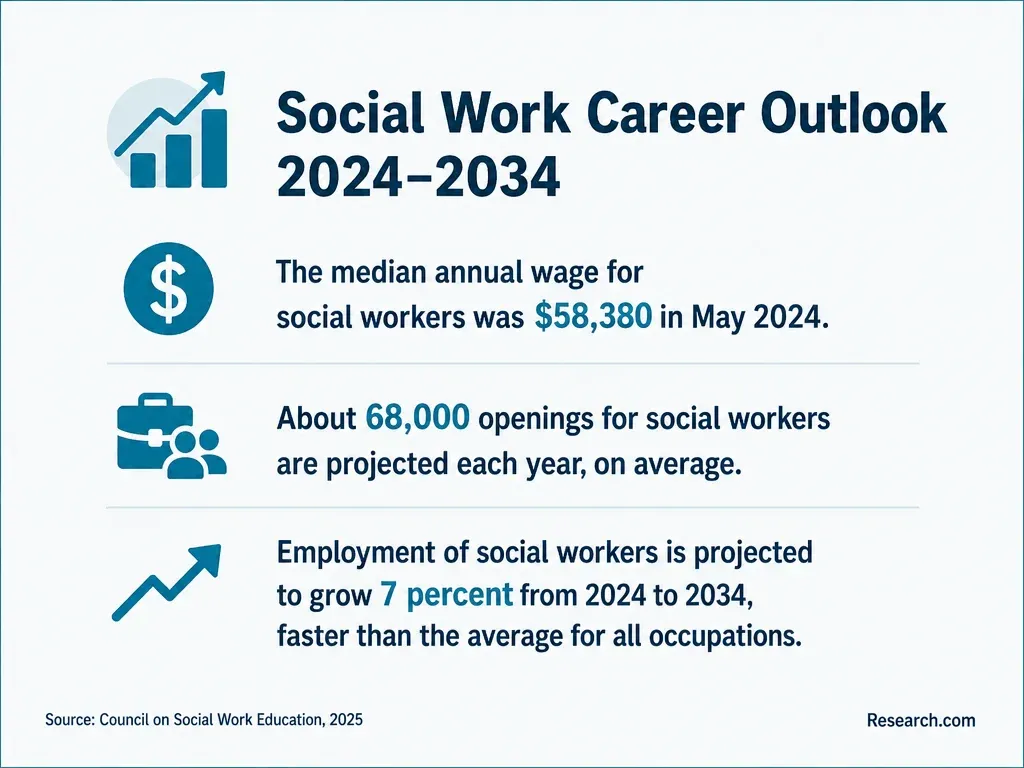
- The U.S. Bureau of Labor Statistics reports a May 2025 median annual wage of $61,780 for social workers overall and projects 6% employment growth from 2025 to 2035; neither figure predicts pay or hiring in a particular city.
What do social workers do in city government?
City government social workers connect individual needs with public systems. Depending on the department, they may assess service needs, coordinate referrals, help residents complete applications, respond alongside other professionals to crises, or improve how a program reaches its intended population.
The work may sit in housing, public health, aging, youth services, or a city-run behavioral health program.
Check who actually operates the service. In many places, county or state agencies, not city hall, administer child protection, Medicaid-related services, or major public benefits. A city may instead fund a nonprofit, convene providers, operate a referral team, or set local priorities. That distinction changes the job's authority, reporting lines, and opportunities to work directly with residents.
Service coordination calls for careful documentation, accessible communication, and knowledge of eligibility rules. Policy and administrative work adds budgeting, contract oversight, and evaluation.
If you are exploring the range of qualifications behind these duties, compare online social work qualifications and career directions against actual city job postings rather than assuming every public-service position requires the same degree.
What degree do you need for a city government social work career?
There is no single degree requirement for city government work. A BSW is a practical route into generalist social work roles; an MSW may be required or preferred for advanced practice, supervision, or some program-leadership positions.
Policy analyst, outreach, and administrative jobs may accept public health, public administration, human services, or other relevant education instead. A civil-service classification can be more decisive than a department's informal job title.
For a career changer, start with postings for the function you want. Prior experience in service coordination, healthcare, education, organizing, research, or government operations may qualify you for an adjacent role without another degree.
If the target job specifically requires an MSW, applicants with a non-social-work bachelor's degree generally examine traditional or foundation MSW routes. Advanced-standing routes usually require a qualifying BSW and additional program-specific conditions; use MSW track selection based on educational background to frame that comparison.
A DSW or PhD is rarely the entry credential for city service delivery. Advanced study might fit a later goal in practice leadership or research, but experience with municipal systems may be more valuable for many policy and management vacancies.
Do city government social workers need a license?
Sometimes. Licensing depends on state law, the position's duties, and the employer's requirements, not simply on working for a city. A city clinician or a position using a protected social work title may require a specified state license.
Some case-management, outreach, policy, and program roles do not. Read the posting for the exact license category and whether it must be held at application, appointment, or a later date.
Graduation, eligibility to apply for a license, and license issuance are separate steps. Independent clinical practice typically requires additional state-defined supervised experience and other board requirements after the MSW.
Academic field placements do not automatically count as post-degree clinical supervision. For a role with clinical duties, compare understanding degree and licensing expectations for MSW study with the current rules of the state board where you intend to work.
Ask the hiring agency whether the job involves diagnosis, psychotherapy, clinical supervision, or another regulated activity. Neither a macro-practice concentration nor a city job title grants authority to perform those functions.
Job titles vary by municipality, so compare posted duties and minimum qualifications before treating two openings as equivalent. The table shows common functions, not universal degree or license rules:
| City role or function | Typical work | Qualification to verify |
| Housing or homelessness services worker | Outreach, service coordination, referrals, and housing-system navigation | Whether the role requires a BSW, MSW, related degree, or specified experience |
| Public health or aging-services coordinator | Resident engagement, resource navigation, and provider coordination | Program-specific education, language skills, and eligibility-system experience |
| Behavioral health or crisis-response social worker | Assessment and coordinated response within an authorized team | Exact license, supervision, safety training, and permitted scope |
| Program analyst or community partnerships manager | Contract monitoring, needs assessment, budgets, and partner coordination | Whether social work education is required or an MPA, MPH, or relevant experience is accepted |
For early-career applicants, supervision quality, caseload, documentation expectations, field travel, and safety procedures can matter as much as title. A clinical vacancy calls for a different preparation plan from an outreach job; clinical practice preparation through an MSW is relevant only if the intended duties and state licensing pathway warrant it.
BSW applicants generally follow university admission rules and may face a separate application to the social work major or field sequence. MSW applicants typically submit a qualifying bachelor's transcript and program-specific materials such as an essay, references, or a résumé.
Prerequisites, minimum grades, and service-experience expectations vary; relevant public-service work can strengthen an application but does not replace a required academic credential.
A non-BSW applicant can pursue a traditional or foundation MSW if admitted under the program's rules. Advanced-standing applicants must document the qualifying social work education the program accepts, along with any recency or grade conditions.
When comparing admission criteria across online MSW programs, check the specific track rather than treating a school's general acceptance standard as an advanced-standing decision.
Before applying, request written confirmation of your intended track, remaining prerequisites, jurisdictional enrollment eligibility, and field-placement onboarding requirements. Admission to the university does not guarantee admission to a field site or eligibility for a later state license.
How long do social work degrees take, and what do they cost?
A bachelor's degree commonly follows a four-year full-time plan, though transfer credit and course sequencing change individual timelines.
A traditional MSW often spans about two academic years of full-time study; an advanced-standing route may be shorter for an eligible BSW graduate. Part-time schedules extend elapsed time, and field availability can affect either format.
To compare programs, calculate the credits you must actually complete at each school and add required fees, books, travel, screening, campus visits, and likely reductions in paid work during field education.
Ask whether a proposed employment-based placement is permitted and how the program approves it. A lower tuition rate may not yield a lower total cost if attendance or placement arrangements are more expensive.
Explore employer education assistance and aid before borrowing, but verify eligibility and any service commitments. For graduate study, MSW graduate funding and assistantship eligibility questions can help you ask whether awards are open to your track and schedule.
Compare the resulting cost with the credentials required by your target city position; a shorter job-specific training route may be preferable when an additional degree is not required.
Other Things You Should Know About Social Work
Some do; others use applications, interviews, or a combination. Check the municipality's hiring notice for exam dates, eligibility rules, and whether a job application is separate from an exam registration.
It depends on the position. Policy work may allow hybrid schedules, while outreach, resident appointments, and crisis response often require in-person availability. Confirm the schedule and any field-travel expectations in the posting.
Not necessarily. Some municipalities have residency requirements or deadlines for establishing residency, while others do not. Verify the rule for the specific employer and position before accepting an offer.
Describe a specific collaboration, your responsibilities, and how you handled communication or competing priorities. Protect client and partner confidentiality, and distinguish your contribution from results achieved by the whole team.
- State Careers - CalCareers https://calcareers.ca.gov/CalHRPublic/Landing/StateCareerLevel2.aspx
- Human Services | Bucks County, PA https://www.buckscounty.gov/224/Human-Services
- Classrooms, Counselors, Clinics - Office of the New York City Comptroller Mark Levine https://comptroller.nyc.gov/reports/classrooms-counselors-clinics/
- Disability Barriers to Inclusion | cdc.gov https://www.cdc.gov/disability-inclusion/barriers/index.html
- OVC Model Standards - Office for Victims of Crime https://ovc.ojp.gov/sites/ovc/files/model-standards/6/pfv.html
- Housing Resources | Department of Human Services https://www.pa.gov/agencies/dhs/resources/for-residents/housing-resources
- Social Work Examiners Licensing Information | sd.gov https://dss.sd.gov/licensingboards/socialwork/licensing.aspx
- NASW Standards for Social Work Case Management | nycourts.gov https://www.nycourts.gov/reporter/webdocs/nasw_standards_socialwork_casemgt.htm
- Issues in Law Enforcement Reform: Responding to Mental Health Crises | Congress.gov | Library of Congress https://www.congress.gov/crs-product/R47285