2027 Social Work Governance Boards: Management vs Oversight Roles
Audited and Verified:
Our Editorial and Data Verification Process
Research.com uses government datasets, official education statistics and primary institutional information to support its career and degree guides. Our review process checks factual accuracy, occupational definitions, source dates and the requirements associated with the credentials discussed.
How This Article Was Fact-Checked
Our editorial team verifies salary estimates, employment projections, education requirements and program information against original data providers and official organizations. Salary figures are checked against the relevant occupational definitions and reporting periods. Information about licensure, accreditation and required in-person training is reviewed separately.
Fact-checked and verified on:

Co-Founder and Chief Data Scientist
A social service board may approve a budget and question service outcomes, but it should not assign a caseworker's daily tasks. Confusing oversight with management can weaken accountability and create risks for clients and staff. This guide is for social workers, nonprofit leaders, and prospective board members deciding where their authority begins and ends. It explains board duties, executive responsibilities, qualifications, education, and practical ways to gain governance experience—so you can pursue the right role without assuming another degree is required.
Key Things You Should Know
- A governance board sets organizational direction and holds the chief executive accountable; executives manage staff, services, and daily decisions.
- Directors oversee finances, legal compliance, and mission-related risks, but a nonprofit board cannot issue social work licenses or authorize clinical practice.
- Board service generally has no universal BSW, MSW, or license requirement; qualifications depend on the organization's bylaws, appointing authority, and the work involved.
What is a social work governance board?
A social work governance board is the group authorized to oversee an organization that provides social services. In a nonprofit, it is commonly a board of directors or trustees. Its authority comes from the organization's governing documents and applicable law, not from the members' social work credentials. Government agencies may instead have appointed commissions or advisory bodies whose powers differ substantially.
A governing board approves broad priorities, oversees financial stewardship, selects and evaluates the chief executive, and asks whether services advance the mission. An advisory board may offer expertise or community perspectives without legal authority to govern. Before accepting a seat, ask which kind of body it is, what decisions it can make, and whether its members bear fiduciary duties.
Social workers can bring knowledge of service access and client needs to either body. That contribution is distinct from earning a credential; a social work degree pathway overview can help explain educational routes, but no degree alone confers a board seat.
How do board oversight and executive management differ in social service organizations?
Oversight asks whether the organization is meeting its mission safely and sustainably; management decides how to run it day to day. The board normally acts collectively through meetings and authorized committees. An individual director generally cannot instruct employees simply because they sit on the board.
The comparison below separates common decisions. Bylaws, contracts, and public-sector rules may assign particular powers differently.
| Decision area | Board oversight | Executive management |
| Strategy | Approves mission-level goals and monitors progress | Develops implementation plans and manages programs |
| People | Hires, supports, and evaluates the chief executive | Hires, supervises, and evaluates staff |
| Finances | Approves budgets and reviews financial and risk reports | Manages spending and internal controls within approved authority |
| Service quality | Reviews aggregate outcomes, complaints, and safeguarding systems | Supervises practice, investigates operational issues, and follows response protocols |
A board may require the executive to explain rising wait times or a pattern of unresolved complaints. It should ordinarily not request identifiable client files to decide individual interventions. Social workers considering an executive position rather than a board seat can use social work master's employment pathway comparisons to examine how management duties differ across settings.
What are a social service board's fiduciary and ethical responsibilities?
Nonprofit directors commonly owe duties of care (making informed decisions), loyalty (putting the organization's interests ahead of personal interests), and obedience (acting consistently with its lawful mission). The precise legal standards depend on state law and organizational form. A director should read financial statements, question significant variances, disclose conflicts, and follow the organization's recusal process rather than approving decisions automatically.
In social services, responsible oversight also means checking whether leadership has workable systems for confidentiality, safeguarding, accessibility, staff supervision, and responding to complaints. The board should seek useful, appropriately de-identified reporting—not routine access to client records. Professional ethics, including the NASW Code of Ethics when applicable to a member's social work practice, do not replace privacy law, reporting requirements, or agency policy.
Budget scrutiny should connect spending to service capacity. For example, when considering staff tuition assistance, directors can compare benefits against retention goals and the agency's resources. Online MSW programs organized by cost offer one starting point for cost comparisons, but management should administer individual benefits under board-approved policy.
There is no universal social work degree or license requirement for a nonprofit governance seat. Eligibility depends on bylaws, appointment rules, and any laws governing the organization. Boards may value a mix of lived experience, community relationships, financial literacy, legal expertise, fundraising ability, and knowledge of services. A social worker's practice experience is valuable, but it does not substitute for understanding budgets or conflicts of interest.
Before joining, review the organization's mission, bylaws, recent financial reports, meeting expectations, conflict policy, and director orientation. If you work for the organization or receive its services, ask how that relationship affects eligibility and participation in decisions. A BSW can provide useful grounding in policy and community practice; planning undergraduate study in social work is relevant if you also seek professional practice roles, not simply board membership.
What are the salary and job outlook for social work managers?
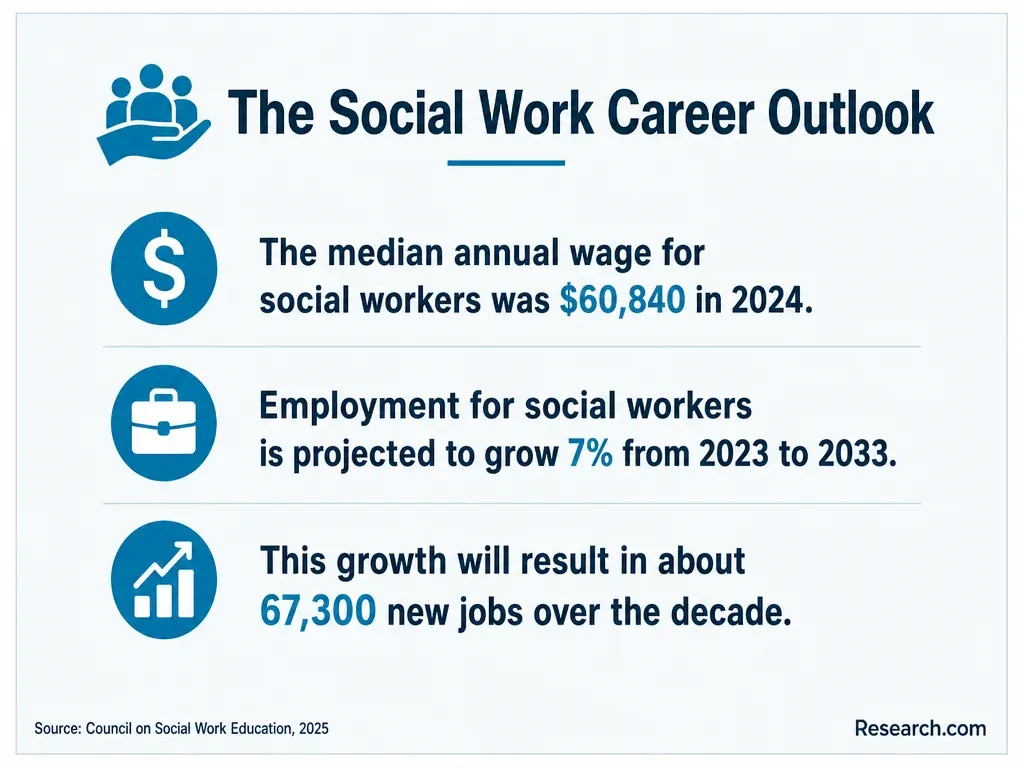
There is no single salary category for "social work manager." Executive directors, program managers, clinical supervisors, and government administrators have different duties and may fall into different labor-market occupations. Compensation also varies by employer size, funding, location, and whether the position requires a license. A volunteer governance seat should not be evaluated as though it were a salaried management job.
For context—not as a manager pay estimate—the U.S. Bureau of Labor Statistics reports a May 2025 median annual wage of $61,780 for social workers across specialties and projects 6% employment growth from 2025 to 2035. Those figures describe social workers, not nonprofit directors or every social service manager.
For a management decision, compare local postings with matching duties and qualifications, and consider social worker earnings and location considerations only as additional context. Request the position's actual pay range rather than treating an occupation-wide median as an offer.
Other Things You Should Know About Social Work
Many nonprofit directors serve without pay, but practices vary. Ask for the organization's compensation and expense-reimbursement policies before accepting a seat.
Often, yes, if governing rules allow it. The organization should support meaningful participation and address confidentiality and conflicts without assuming a service recipient cannot contribute.
A committee examines a defined issue, such as finance or governance, and makes recommendations or exercises authority expressly delegated to it. Check the committee charter before assuming it can make final decisions.
No. Coverage has terms and exclusions and does not replace careful decision-making. Prospective directors can request the policy summary and seek independent legal advice about concerns.
- G1.1 Ethical Practice | ky.gov https://manuals-sp-chfs.ky.gov/G1/Pages/1-1.aspx
- Effective governance: the roles and responsibilities of board members - PMC https://pmc.ncbi.nlm.nih.gov/articles/PMC1276331/
- Nonprofit Board Governance: Definition & Best Practices | University of San Diego Online Degrees https://onlinedegrees.sandiego.edu/nonprofit-board-governance/
- Board Fiduciary Duties: A Legal Responsibilities Overview | Wiss https://wiss.com/board-fiduciary-duties-legal-responsibilities/
- CHAPTER 877 Board of Licensed Social Workers | state.or.us https://secure.sos.state.or.us/oard/viewCompDocument.action%3BJSESSIONID_OARD=jiHA73kpDg5JaU9dmLUCx4RtH_hfcNKwMLDRQyxnVDW2onX0pdWv!1733704917
- Code of Ethics: English | socialworkers.org https://www.socialworkers.org/about/ethics/code-of-ethics/code-of-ethics-english
- Board Member Roles & Responsibilities: A Practical Governance Overview | nasdaq.com https://www.nasdaq.com/articles/governance/board-member-roles-responsibilities