2027 Social Work Employee Development Plans: Connecting Career Goals and Agency Needs
Audited and Verified:
Our Editorial and Data Verification Process
Research.com uses government datasets, official education statistics and primary institutional information to support its career and degree guides. Our review process checks factual accuracy, occupational definitions, source dates and the requirements associated with the credentials discussed.
How This Article Was Fact-Checked
Our editorial team verifies salary estimates, employment projections, education requirements and program information against original data providers and official organizations. Salary figures are checked against the relevant occupational definitions and reporting periods. Information about licensure, accreditation and required in-person training is reviewed separately.
Fact-checked and verified on:

Co-Founder and Chief Data Scientist
A development plan works only when a social worker's next career step also helps the agency serve people well. A case manager may want clinical training, for example, while the agency needs stronger referral coordination now.
For social workers, supervisors, and human services staff, this guide shows how to identify shared priorities, write measurable goals, choose appropriate training, and review progress. It also explains when a degree or license is necessary - and when supervised practice or a shorter course is the better investment.
Key Things You Should Know
- Start with one or two agency priorities and the employee's target role; agree on observable skills, protected learning time, and a review date.
- Measure both learning and practice: course completion alone does not show better documentation, safer decisions, or improved service access.
- Check credential requirements before funding education. A BSW or MSW does not itself grant a license or independent clinical authority; state rules and job duties determine the next step.
What is a social work employee development plan?
A social work employee development plan is a written agreement between an employee and supervisor about skills to build, opportunities to practice them, support the agency will provide, and evidence of progress. It should connect a realistic career direction - such as senior case management, school services, clinical practice, or program leadership - to duties the employee can perform within their present role and authority.
Unlike an annual performance rating, the plan looks forward. It can address a performance gap, but it should not disguise a disciplinary process or promise a promotion. An employee considering career paths with an MSW can use the plan to test which responsibilities they actually enjoy before committing to graduate study.
The most useful plans fit on one or two pages: a target role, a small number of goals, learning activities, supervision arrangements, observable measures, resources, and dates for review. Client confidentiality, workload, and agency capacity are constraints - not details to resolve after the plan is approved.
How do social workers align career goals with agency needs?
Compare the employee's intended work with the agency's service priorities and staffing gaps. Look for a task that benefits both parties without assigning duties beyond the employee's qualifications. A worker interested in leadership might coordinate a referral-process review; a worker interested in clinical practice might first strengthen assessment and consultation skills under appropriate supervision, rather than assume psychotherapy duties.
Separate immediate agency value from long-term career value. Better referral documentation may help clients and the team this quarter, while the employee builds skills relevant to a future care-coordination role. If the desired role does not exist at the agency, be candid: transferable experience and mentoring may still be worthwhile, but a promotion should not be implied.
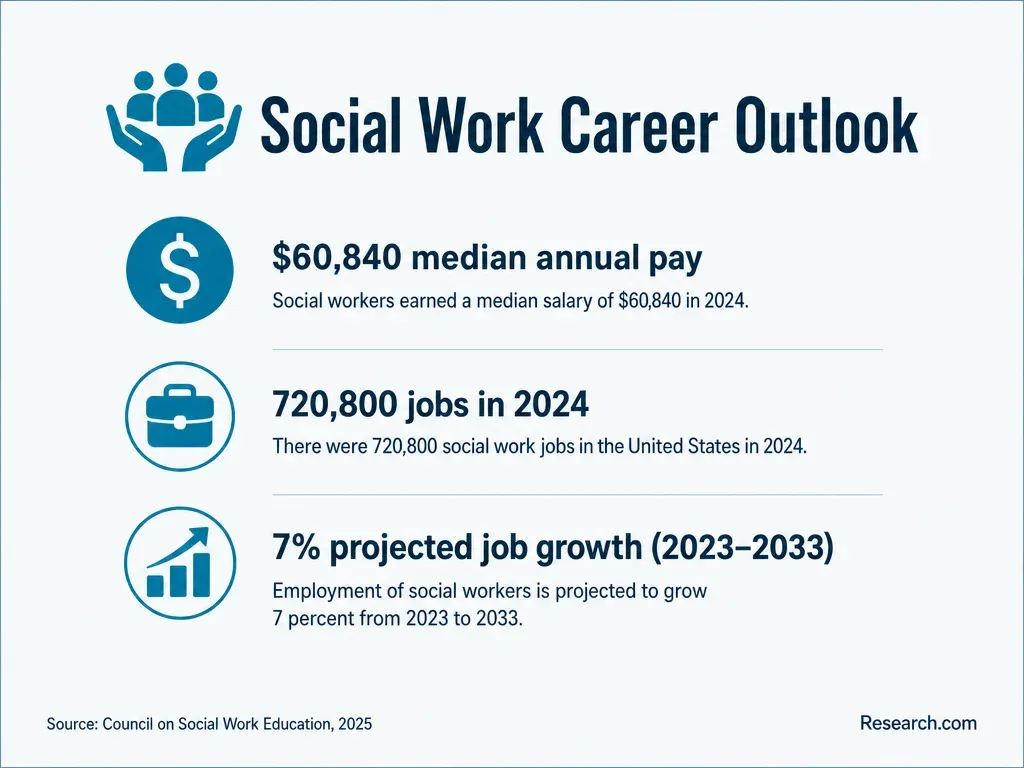
Compensation also matters when choosing a target role. Planning an MSW career with regional salary context can inform that discussion, but local job postings, civil-service classifications, union agreements, and the agency's budget are more useful for assessing a specific opportunity.
How do you create a social work employee development plan?
Draft the plan together during supervision or a dedicated meeting. Keep required job performance, optional career development, and any licensing supervision agreement distinct so each has a clear decision-maker.
- Define the destination: Name the desired role or responsibility and check its actual degree, license, experience, and employer requirements.
- Establish a baseline: Review current duties, observed strengths, documentation quality, feedback, and skills the employee has not yet demonstrated.
- Choose one or two shared goals: Match employee interests to a service need, then define what successful work would look like.
- Agree on support: Specify supervision time, training budget, coverage, approved practice opportunities, accessibility needs, and who will provide feedback.
- Set checkpoints: Record a start date, an interim review, evidence to examine, and a date to revise or close each goal.
For example, an employee aiming for an MSW might set a goal to compare program eligibility and field-placement schedules while taking on a supervised service-coordination project. Admission is controlled by the school, not the supervisor; planning applications to accessible MSW programs should therefore remain a research task, not a guaranteed outcome of the plan.
Use evidence proportionate to the goal. Attendance shows exposure to training; observed work, reflective discussion, and appropriately reviewed records show whether the employee can apply it. A supervisor might compare an initial and later sample of approved documentation against the same agency rubric, while considering caseload complexity and available resources.
Discuss both process and impact. Did the employee follow the referral protocol and recognize when to seek consultation? Did the change make access easier to navigate, without claiming that one worker caused a client outcome? Use aggregate or de-identified information where appropriate, and follow agency rules for records, consent, and quality-improvement review.
At each checkpoint, record what was demonstrated, what still needs observation, and whether the agency supplied the promised support. For an education goal, verify eligibility rather than score the employee on an admission decision: choosing between two MSW study pathways depends partly on the applicant's qualifying BSW background and each program's rules, not supervisor preference.
For a degree goal, confirm the institution's accreditation, the social work program's applicable Council on Social Work Education accreditation status, and the requirements of the state where the employee intends to practice. These are different checks. A university's institutional accreditation alone does not establish that its social work program meets a particular board's educational rules.
For a licensed role, ask the state board which education, application steps, examinations if applicable, and supervised experience it requires. License titles, permitted duties, qualified-supervisor rules, and documentation differ by state. BSW or MSW field education is not automatically post-degree clinical-license supervision; an MSW, clinical concentration, or passed examination does not itself authorize independent practice.
Before paying for a program, compare its curriculum and placement arrangements with the intended board pathway. A resource on social work master's education requirements for licensing can help frame questions, but the current board and program must confirm eligibility for the employee's jurisdiction and entry cohort.
How do social work career paths compare in salary and job outlook?
Career planning should compare the work itself as well as earnings. Child and family roles can involve home visits and protective-service systems; healthcare roles emphasize care transitions and interdisciplinary coordination; mental health and substance use roles may require additional clinical qualifications for particular duties. The U.S. Bureau of Labor Statistics (BLS) figures below describe occupations, not agency job titles or pay guaranteed by a degree.
| BLS occupation | May 2025 median annual pay | Projected employment growth, 2025-2035 |
| Child, family, and school social workers | $59,550 | 4% |
| Healthcare social workers | $67,880 | 8% |
| Mental health and substance abuse social workers | $60,280 | 10% |
| Social workers, all specialties | $61,780 | 6% |
These national medians include workers at different career stages and do not predict the return on a BSW, MSW, or doctorate. Compare local postings, credential requirements, workload, supervision, and advancement policies before naming a salary target in the plan. A guide to choosing an online social work degree is most useful only after the target role and its requirements are clear.
Other Things You Should Know About Social Work
The employee and supervisor should each have access to the approved version. Follow agency policy on personnel records, and keep client-identifying material out of the plan.
Revisit the plan together. Document which goal is paused, whether the employee can still obtain the promised learning opportunity, and when the revised goal will be reviewed.
No. It can document preparation and demonstrated skills, but hiring rules, vacancies, funding, and required credentials govern promotion decisions.
Be explicit about the limit. Identify transferable work the agency can reasonably supervise, and let the employee pursue external mentoring or education without implying that an internal role will become available.
- Continuing Education Information | North Carolina Social Work Certification and Licensure Board https://www.ncswboard.gov/continuing-education-information/
- Career Development | U.S. Office of Personnel Management https://www.opm.gov/policy-data-oversight/training-and-development/career-development/
- Barriers and strategies for primary health care workforce development: synthesis of evidence - PMC https://pmc.ncbi.nlm.nih.gov/articles/PMC10967164/
- Virginia Board of Social Work - Continuing Education https://www.dhp.virginia.gov/Boards/SocialWork/PractitionerResources/ContinuingEducation/
- Employer Best Practices for Workers with Caregiving Responsibilities | U.S. Equal Employment Opportunity Commission https://www.eeoc.gov/laws/guidance/employer-best-practices-workers-caregiving-responsibilities
- Employee Development Plans - CareerForce Minnesota https://careerforce.mn.gov/employee-development-plans
- Mental health at work | who.int https://www.who.int/news-room/fact-sheets/detail/mental-health-at-work
- Emerging Trends in Social Work - Columbia MSSW https://onlinemsw.socialwork.columbia.edu/emerging-trends-in-social-work/
- Individual Development Planning | It's Your Yale https://your.yale.edu/working-at-yale/learn-grow/learning-resources/individual-development-planning
- The Vital Role of Supervisors in Performance Success | gmu.edu https://hr.gmu.edu/elevate-your-impact-the-vital-role-of-supervisors-in-performance-success/