2027 Social Work Change Management: Staff Participation and Implementation Planning
Audited and Verified:
Our Editorial and Data Verification Process
Research.com uses government datasets, official education statistics and primary institutional information to support its career and degree guides. Our review process checks factual accuracy, occupational definitions, source dates and the requirements associated with the credentials discussed.
How This Article Was Fact-Checked
Our editorial team verifies salary estimates, employment projections, education requirements and program information against original data providers and official organizations. Salary figures are checked against the relevant occupational definitions and reporting periods. Information about licensure, accreditation and required in-person training is reviewed separately.
Fact-checked and verified on:

Co-Founder and Chief Data Scientist
A new referral system, documentation rule, or service model can fail even when its purpose is sound. Frontline staff may see risks that leadership missed, while clients experience the consequences of a difficult rollout.
This guide is for social work supervisors, agency leaders, and professionals preparing for those roles. It explains how to give staff a meaningful voice, turn their feedback into an implementation plan, and measure whether the change improves service without compromising safety, access, or trust. It also helps you decide whether targeted training or a degree is worth pursuing.
Key Things You Should Know
- Give staff influence over decisions they can realistically shape: workflow design, training, pilot feedback, and revisions. Explain separately which legal, funding, or safety requirements are fixed.
- Write an implementation plan with an owner, resources, training, client-safety safeguards, and measures of both adoption and service quality. A pilot followed by 30-, 60-, and 90-day reviews is one practical schedule, not a universal standard.
- Investigate resistance before treating it as an attitude problem. Unmanageable caseloads, inaccessible tools, unclear authority, and confidentiality concerns may require changes to the plan rather than more persuasion.
What is change management in social work?
Change management is the coordinated work of preparing people, workflows, and resources for a new way of operating, then checking whether it works in practice. In social work, the change might involve a referral process, electronic record, supervision model, eligibility policy, or community partnership. Success means more than staff using a new form: clients must still be able to obtain appropriate, timely, confidential services.
Social work leaders must account for the systems around a change. A shorter intake form may reduce staff time but omit information needed for a safe handoff; a digital-only referral route may exclude people with limited internet access.
Implementation therefore requires input from workers, supervisors, administrative staff, community partners, and, when appropriate, clients. It also requires a clear distinction between a funder or legal requirement that cannot be negotiated and a local workflow that can.
Agency change leadership is learned partly through supervised work, not simply through a degree format. Readers considering formal preparation can compare social work degree formats and learning expectations, but should judge any program by its opportunities to practice organizational assessment and implementation.
How can social work leaders involve staff in organizational change?
Participation works best when leaders define its scope before asking for ideas. Staff can help redesign a scheduling workflow, for example, even if they cannot change a state reporting deadline. Invite perspectives from intake, direct service, supervision, records, and outreach; relying only on volunteers may miss employees who have the least time to attend meetings.
A manageable participation process gives staff several ways to contribute and shows what happened to their input:
- Describe the problem, the nonnegotiable requirements, and the decisions still open.
- Ask staff to map the existing workflow, including delays, workarounds, accessibility barriers, and effects on clients.
- Test a proposed process with a small group, including workers who handle high-volume or complex cases.
- Record suggestions, name who decides, and explain which changes were accepted, deferred, or declined.
- Keep a feedback route open after launch so workers can flag unintended consequences without blaming individuals.
Protect time for participation: asking overloaded staff to attend design meetings on top of a full caseload undermines the invitation. Social work students can encounter similar participation challenges in agency placements; those comparing programs may want to explore exploring MSW programs with practicum assistance and ask whether placements offer supervised organizational or program-improvement tasks.
How do social work agencies create and evaluate implementation plans?
Start with a specific service problem and a baseline. "Improve access" is too broad to guide a rollout; "reduce the time between a completed referral and first contact without increasing missed high-priority referrals" identifies both an aim and a safeguard. Use records the agency is authorized to examine, and establish who may access them.
A usable plan should identify the following before launch:
- Scope and ownership: Which teams and clients are affected, who approves the change, and who resolves problems.
- Workflow and capacity: What staff will do differently, the training and coverage required, and which older tasks will stop.
- Safeguards: How clients will receive accessible alternatives, how confidential information will be protected, and when staff should escalate safety concerns under agency policy.
- Pilot and review: Where to test the change, how feedback will be collected, and what conditions would trigger revision or a pause.
- Measures: At least one adoption measure, one service outcome, and one measure that could reveal an unintended burden.
For a referral pilot, those measures might be the share of eligible referrals handled through the new process, time to first contact, and staff time spent correcting records. Compare results with the baseline and examine whether any client group faces new barriers. A rising adoption rate does not establish better outcomes if access or safety worsens.
Leaders who want deeper evaluation training may consider an applied doctorate, but should examine the actual curriculum and total cost before enrolling. A comparison of affordable online social work doctorates is a starting point; an agency evaluation course or experienced evaluator may be more proportionate for one implementation project.
Treat resistance as information to investigate, not proof that employees oppose clients or innovation. Ask what staff believe will become harder and check those concerns against the proposed workflow. A worker who worries that a new intake script leaves too little time to assess urgent needs is raising a different issue from someone who needs software practice.
Respond to the cause. Revise unsafe steps; arrange hands-on training for skills gaps; clarify decision authority where instructions conflict; and provide temporary coverage if the rollout adds work. Use supervision to hear concerns without asking employees to disclose sensitive client details in a group meeting. Then state the expectations that remain in force and offer a route to report problems after launch.
Clinical teams may need to consider how a workflow change affects continuity, documentation, and supervision, rather than describing all concerns as reluctance. Formal study of those practice obligations is one reason to review clinical social work master's curriculum options. An MSW concentration, however, is not a substitute for fixing an understaffed or poorly designed rollout.
The right preparation depends on the role. A BSW develops generalist practice and systems awareness; an MSW may add specialized study in administration, community practice, policy, or evaluation. Neither degree automatically makes someone an effective manager. Supervising staff, managing a budget, negotiating with partners, and implementing a new process also require supported experience.
For an experienced practitioner moving into an internal improvement role, employer training in project management, facilitation, budgeting, data interpretation, or supervision may be more direct and less costly than another degree.
An MPA or MPH may fit a role centered on public administration or population-level systems. A practice-oriented DSW may suit experienced leaders pursuing advanced applied work; a research-oriented PhD generally makes more sense when original scholarship or a research career is the goal. Program emphases vary.
Before enrolling, compare the duties in actual job descriptions with your existing degree, license, management experience, and skill gaps. A guide to professional pathways after an MSW can help distinguish agency leadership from clinical and other social work roles. If the gap is leading meetings and tracking a rollout, targeted training plus a supervised project may be enough.
What jobs, salaries, and outlook can social work leaders expect?
Possible roles include program coordinator, social work supervisor, agency manager, quality-improvement lead, and public-sector administrator. Duties may center on caseload oversight, staff development, contracts, budgets, or service evaluation. Employers can require different combinations of a social work degree, license, supervisory experience, and public-administration skills; a manager's job title does not establish clinical authority.
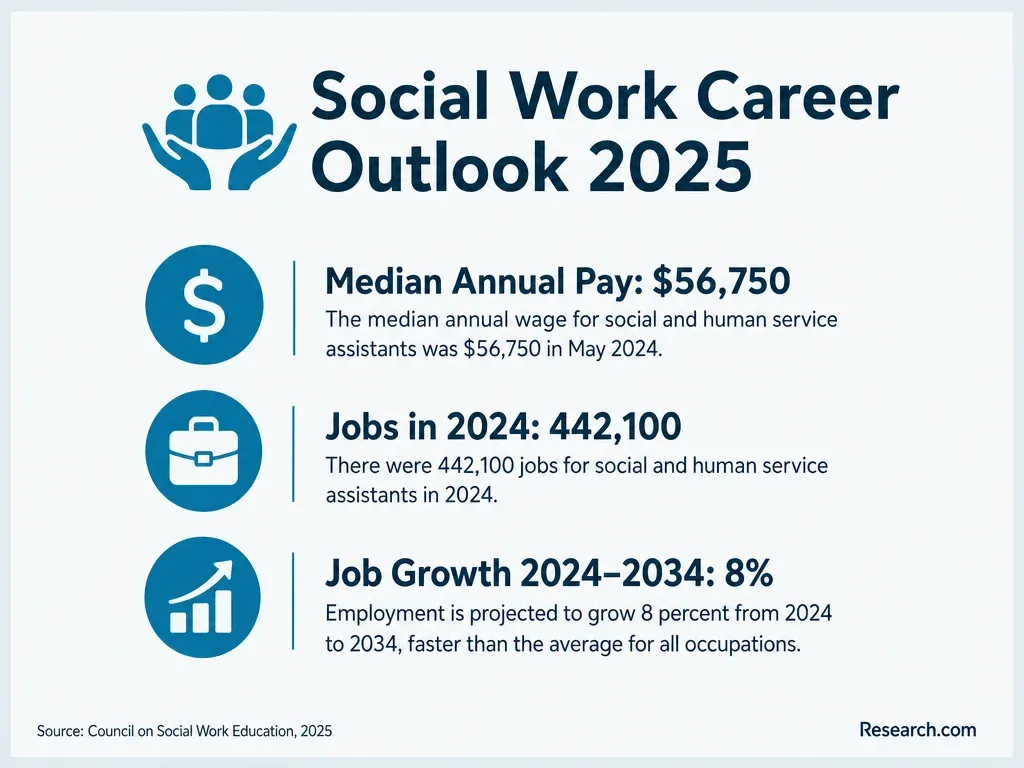
The U.S. Bureau of Labor Statistics (BLS) reports wages for occupations, not for everyone who leads change. These social worker figures provide context for practitioners considering advancement, but they should not be read as manager pay or a return on a particular degree:
| US occupation | May 2025 median annual wage | Projected employment growth, 2025-2035 |
| Social workers, all specialties | $61,780 | 6% |
| Child, family, and school social workers | $59,550 | 4% |
| Healthcare social workers | $67,880 | 8% |
| Mental health and substance abuse social workers | $60,280 | 10% |
Growth across these occupations signals demand for social work services, not a forecast for agency leadership openings. For a realistic decision, compare local postings by duties, qualifications, pay range, caseload or budget responsibility, and advancement rules. Geography matters as well; social work salary differences across states can help frame a local comparison without promising any individual offer.
Other Things You Should Know About Social Work
When the change affects their access or experience, client input can reveal barriers staff do not see. Offer accessible, voluntary ways to contribute, explain how feedback will be used, and follow agency requirements for consent and privacy.
Follow the agency's governance process. Depending on the change, approval may involve a program director, clinical leadership, privacy or compliance staff, a public agency, or a funder. Staff participation does not replace required authorization.
Use the escalation and pause conditions set before launch. Protect urgent service routes, document the problem through approved channels, and have the responsible leader decide whether to revise or stop the pilot.
Sometimes, but internal access to records does not automatically permit public disclosure. Check agency data-governance rules, confidentiality obligations, partner agreements, and whether additional review is required before collecting or publishing information.
- Change Management In Health Care - StatPearls - NCBI - NIH https://www.ncbi.nlm.nih.gov/books/NBK459380/
- Improve | Co-design toolkit https://aci.health.nsw.gov.au/projects/co-design/step-by-step/improve
- Implementation Planning | Agency for Healthcare Research and Quality https://www.ahrq.gov/teamstepps-program/curriculum/implement/activity/plan.html
- Change Management: From Theory to Practice - PMC https://pmc.ncbi.nlm.nih.gov/articles/PMC9462626/
- Change Management and Implementation Science | Child Welfare Information Gateway https://www.childwelfare.gov/topics/workforce/change-management-and-implementation-science
- Section 5. Developing an Action Plan - Community Tool Box https://ctb.ku.edu/en/table-of-contents/structure/strategic-planning/develop-action-plans/main
- How Experts Without Authority Create Change in Their Organizations | Yale Insights https://insights.som.yale.edu/insights/how-experts-without-authority-create-change-in-their-organizations
- Evidence-based change management | sciencedirect.com https://www.sciencedirect.com/science/article/pii/S0090261622000067
- Participation: its impact on services and the people who use them - Iriss https://iriss.org.uk/resource/participation-its-impact-services-and-people-who-use-them/
- NASW Standards for Social Work Case Management | socialworkers.org https://www.socialworkers.org/Practice/NASW-Practice-Standards-Guidelines/NASW-Standards-for-Social-Work-Case-Management