2027 Social Work Academic Advising vs Field Liaison Work: Different Faculty Functions
Audited and Verified:
Our Editorial and Data Verification Process
Research.com uses government datasets, official education statistics and primary institutional information to support its career and degree guides. Our review process checks factual accuracy, occupational definitions, source dates and the requirements associated with the credentials discussed.
How This Article Was Fact-Checked
Our editorial team verifies salary estimates, employment projections, education requirements and program information against original data providers and official organizations. Salary figures are checked against the relevant occupational definitions and reporting periods. Information about licensure, accreditation and required in-person training is reviewed separately.
Fact-checked and verified on:

Co-Founder and Chief Data Scientist
A missed course can delay graduation; an unresolved practicum concern can affect both learning and client safety. Social work students need to know which university contact handles each problem. This guide distinguishes academic advisors from field liaisons - and from agency field instructors - so BSW and MSW students can get the right help without losing time. It also explains what to check in an online program and what these roles mean for professionals considering an education-focused career.
Key Things You Should Know
- Academic advisor: helps students plan courses, track degree requirements, and navigate academic policies; the advisor does not ordinarily approve a practicum site alone.
- Field liaison: connects the university, student, and agency to support and assess field learning; the agency field instructor provides day-to-day practice instruction and supervision.
- Start with the problem, not the title: take course-sequencing questions to advising, placement-learning concerns to the liaison, and immediate client-safety concerns through the agency's required procedures.
How do social work academic advisors and field liaisons differ?
An academic advisor focuses on progress through the degree plan. A field liaison focuses on progress through an approved field placement. Both may be faculty members, but schools also employ professional advisors or field staff. A person's job title does not, by itself, establish authority to waive a course, approve a site, or change a field grade.
The comparison below shows where students should usually begin. The program's handbook determines who makes final decisions.
| Question | Academic advisor | Field liaison |
| Primary focus | Courses, degree requirements, and academic progression | Learning, supervision, and evaluation in an approved practicum |
| Works most closely with | Student, program staff, registrar, and other academic offices | Student, agency field instructor, and university field office |
| Typical concern | Whether a course choice keeps graduation on schedule | Whether assigned agency tasks support the learning agreement |
| Limit of authority | Cannot independently count unapproved agency work as field education | Cannot independently waive degree or licensing requirements |
The distinction matters in both traditional and advanced-standing MSW sequences: an advisor can explain the approved course path, while the liaison addresses learning within the placement attached to that path. Students weighing advanced standing and traditional MSW completion planning should confirm both the academic sequence and its field requirements with the program.
What does a social work academic advisor do?
A social work academic advisor helps a student interpret the degree audit, choose courses in the right order, understand prerequisites, and identify the offices that decide exceptions. Depending on the school, the advisor may discuss academic standing, concentration changes, leave and reentry, graduation applications, or referrals for accessibility and financial-aid questions.
Advice is not approval. The registrar, social work program, field office, or another designated authority may have to authorize a substitution or schedule change. Before dropping a required class, ask how the change affects the next field course and expected graduation term. That check is especially important in faster graduate social work study routes, where courses and placements may follow a tightly sequenced calendar.
Bring a current degree audit, your proposed schedule, and the specific policy or requirement you want clarified. Ask the advisor to identify who can give a binding answer when the issue falls outside advising.
What does a social work field liaison do?
A field liaison is the university's point of connection to the student's approved placement. Duties vary, but commonly include reviewing learning goals, communicating with the agency field instructor, monitoring whether assignments offer appropriate competency development, and participating in progress reviews or evaluations. Some liaisons also teach the linked field seminar.
For example, a student assigned only routine administrative tasks could ask the liaison whether the placement still supports the approved learning agreement. The liaison can consult the agency and field office about changes; the student should not assume that switching tasks or sites independently will preserve credit for hours already completed. When comparing MSW practicum placement assistance, ask who secures sites, who approves them, when the liaison is assigned, and how quickly placement problems are reviewed.
A liaison's oversight does not replace agency orientation, supervision, or the student's obligation to follow site safety and confidentiality rules.
The field instructor is generally the qualified agency-based professional who guides the student's practice learning, provides scheduled supervision, observes or reviews work, and contributes to evaluation. The field liaison represents the educational program and checks that the placement remains aligned with its requirements. If an agency uses a separate task supervisor for daily assignments, the school should explain how that person works with the designated field instructor.
Ask the field instructor about routine casework feedback and agency procedures. Bring persistent supervision gaps or a mismatch between assignments and learning goals to the liaison and field office. Neither role should be confused with a qualified supervisor overseeing post-degree experience for clinical licensure. Students planning that later step need to check separate board rules on clinical hours and social work professional preparation; curricular field hours do not automatically count toward them.
Start with the person responsible for the issue, but do not wait for a routine appointment when safety or a serious placement disruption is involved. These routes help distinguish ordinary questions from concerns that require escalation.
- Course sequence, transfer credit, or graduation: contact the academic advisor; request a written decision from the authorized program or university office when an exception is needed.
- Daily placement tasks or feedback: speak with the agency field instructor when appropriate; involve the field liaison if the issue persists or affects learning goals.
- Missing supervision, discrimination, or placement breakdown: notify the field liaison and follow the field office's reporting process; use any applicable university reporting channel.
- Immediate client safety or urgent agency incident: follow the site's required response and reporting procedures promptly, then notify the university contacts required by program policy.
Keep a factual record of dates, communications, and requested remedies without copying identifiable client information into personal email or notes. Returning students should also verify how an academic change affects their approved field sequence; resources on online bachelor's social work options for returning learners cannot substitute for an individual degree audit.
There is no single nationwide hiring standard for either job. Academic advising positions may call for a bachelor's or master's degree, experience with student support and university policies, and familiarity with social work curriculum. Faculty advisors may instead qualify through their faculty appointment. A field liaison generally needs enough social work education and practice knowledge to assess field learning, work with agencies, and recognize when a concern requires the field office's attention; schools set specific appointment criteria.
For an experienced social worker considering a move into education, the best preparation depends on the target work. Advising emphasizes degree rules, student communication, and institutional systems. Liaison work places more weight on field instruction, competency assessment, agency partnerships, and constructive resolution of placement concerns. Review actual postings rather than assuming that a DSW, PhD, clinical license, or another degree is universally required. Comparing jobs that use a social work master's degree can help put these education roles alongside practice-based alternatives.
What are the salary and job outlook for these roles?
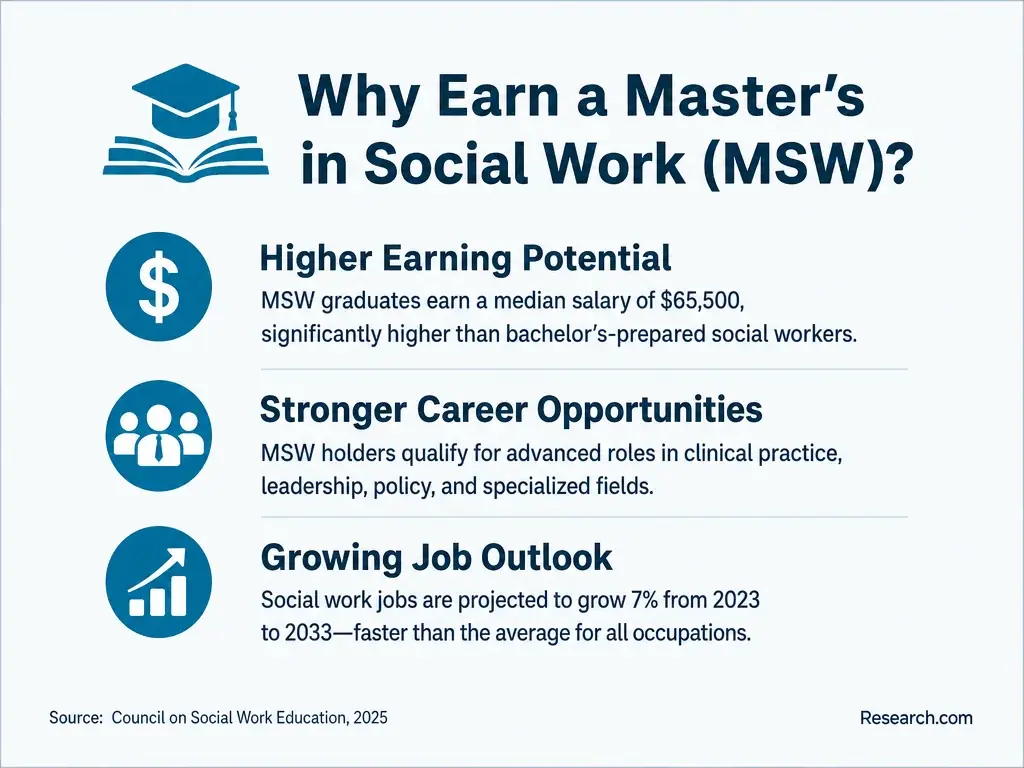
There is no reliable single U.S. wage or growth figure for "social work academic advisor" or "social work field liaison." Schools may classify advisors as student-services staff and liaisons as faculty, field-office employees, or part-time appointees. Broad social worker salary figures describe a different workforce and should not be presented as pay for either university role.
Compare postings using the actual appointment terms: full-time versus per-course or per-placement pay, contract length, benefits, travel, expected student or agency caseload, and whether teaching is included. For a social worker deciding between university work and agency practice, MSW earnings and geographic career planning provides practice-career context, not a salary prediction for advising or liaison work. Request the institution's posted salary range and ask how field travel and summer work are compensated before accepting an offer.
Other Things You Should Know About Social Work
Yes. Some programs assign both functions to one faculty member. Ask which decisions that person can make in each role and which require field-office or program approval.
That depends on staffing and program policy. Students can ask the field office how assignments are made and whether a change is possible if a conflict arises.
Usually, yes, by describing duties and skills accurately. Do not disclose identifiable client information or confidential agency material, and do not claim duties outside your supervised role.
Keep copies you are permitted to retain, such as approved learning agreements and evaluations, according to school and agency rules. Ask the program how long it retains official records and how to request them later.
- Advising | Department of Social Work | Graduate Program (MSW) https://socialwork.appstate.edu/students/advising
- MSW Academic Advising | University of Connecticut https://socialwork.uconn.edu/msw-academic-advising/
- Role of field instructors - VCU Social Work https://socialwork.vcu.edu/information-for/field-agencies-and-partners/role-of-field-instructors/
- School of Education - Answers - Syracuse University https://answers.atlassian.syr.edu/wiki/spaces/SOE/pages/157225487/Field+Instruction+Manual+Social+Work
- Master of Social Work Field Education Manual | Academics at Walden University https://academicguides.waldenu.edu/msw-field-education-manual/field-education
- Faculty Field Liaisons: Ambassadors of Implicit Curriculum | Applied Learning in Social Work Education Journal https://alswe.simmons.edu/article/faculty-field-liaisons-ambassadors-of-implicit-curriculum/
- Educational Policy and Accreditation Standards | Norfolk State University https://www.nsu.edu/social-work/Educational-Policy-and-Accreditation-Standards.aspx
- Professional & Academic Advising | School of Social Work | One-Stop Student Services Center https://www.adelphi.edu/social-work/practicum/professional-and-academic-advising/
- 2029 EPAS | Council on Social Work Education https://www.cswe.org/2029-epas