2027 Reentry Social Worker: Responsibilities, Education, and Career Fit
Audited and Verified:
Our Editorial and Data Verification Process
Research.com uses government datasets, official education statistics and primary institutional information to support its career and degree guides. Our review process checks factual accuracy, occupational definitions, source dates and the requirements associated with the credentials discussed.
How This Article Was Fact-Checked
Our editorial team verifies salary estimates, employment projections, education requirements and program information against original data providers and official organizations. Salary figures are checked against the relevant occupational definitions and reporting periods. Information about licensure, accreditation and required in-person training is reviewed separately.
Fact-checked and verified on:

Co-Founder and Chief Data Scientist
Helping someone leave jail or prison involves more than finding a service directory. Housing restrictions, interrupted healthcare, employment barriers, and supervision conditions can collide in the first weeks after release. Reentry social workers help people navigate those systems while respecting their goals and rights. If you are considering this career - whether you are studying social work or moving from another human services role - this guide explains the work, the qualifications employers may seek, and the demands worth investigating before you commit to a degree or job.
Key Things You Should Know
- Reentry social workers coordinate support before and after release, including housing, benefits, healthcare, family connections, and referrals; their responsibilities depend on the agency and position.
- A BSW or MSW can prepare you for social work positions, but some reentry case-management jobs accept other degrees. Clinical treatment requires the license and supervision specified by the state and employer.
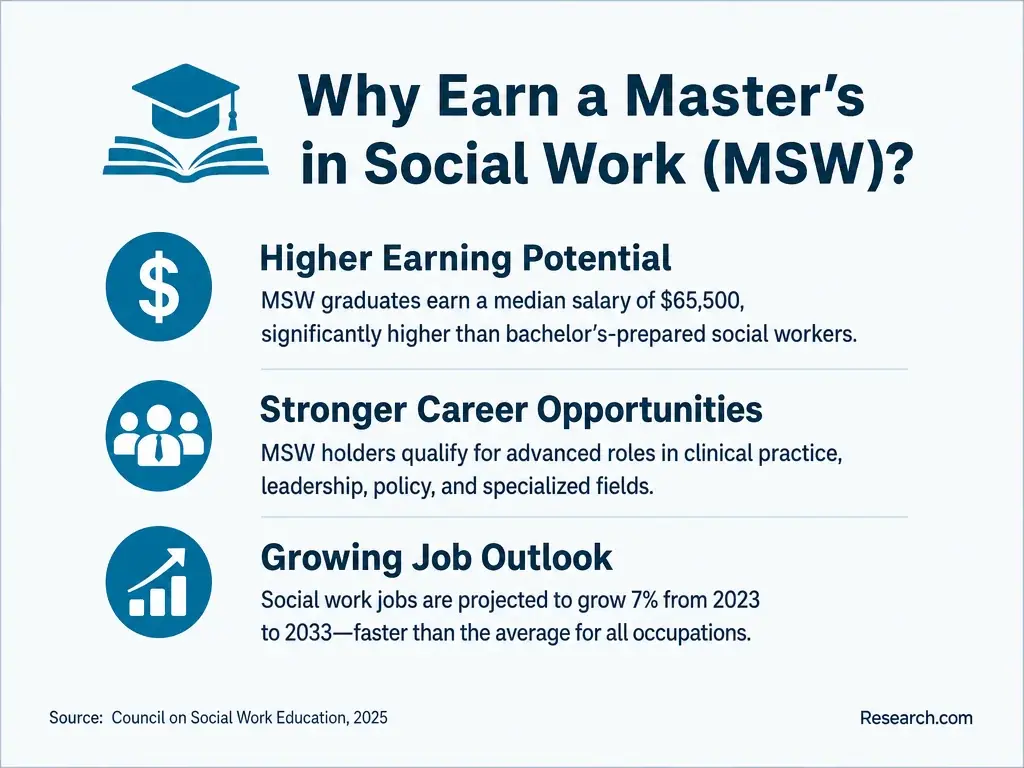
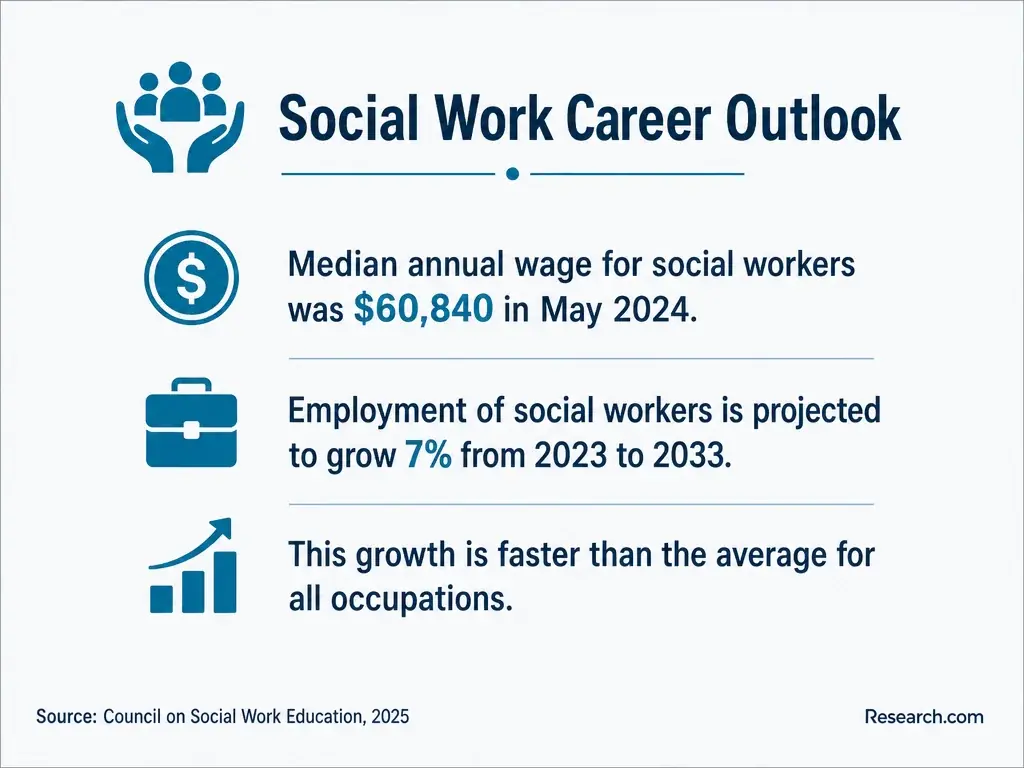
- The Bureau of Labor Statistics reports a May 2025 median annual wage of $61,780 for social workers overall and projects 6% employment growth from 2025 to 2035; neither figure describes reentry jobs specifically.
What does a reentry social worker do?
A reentry social worker helps people transition from incarceration to community life. The job may begin before release with a needs assessment and discharge plan, then continue through referrals, follow-up, and problem-solving after release. Some positions also serve people leaving detention or community supervision, so the population and point of contact vary by agency.
Typical work includes discussing a person's priorities; coordinating identification documents, benefits, medication continuity, housing and employment referrals; connecting them with behavioral health or substance use services; and documenting progress. The worker may collaborate with corrections staff, probation or parole officers, healthcare teams, families, and community organizations. Effective planning accounts for practical constraints: a referral is not useful if a provider has a waitlist, the person lacks transportation, or an eligibility rule prevents enrollment.
Reentry work is not automatically psychotherapy. A case coordinator may arrange behavioral health care without diagnosing or treating a condition. Someone whose goal is to provide treatment should investigate choosing a clinically focused social work master's program alongside the separate requirements for clinical licensure.
What degree do you need to become a reentry social worker?
There is no single degree requirement for every job called "reentry worker." Start with actual postings in your intended state and setting: compare the duties, required credential, accepted majors, and whether the employer uses a protected social work title.
The routes below serve different career goals; a more advanced degree is not necessarily the most direct route into service coordination.
| Preparation | Potential fit in reentry work | Important limit |
| Human services or related bachelor's degree | Some outreach, navigation, and case-management positions | Does not substitute for a required social work degree or license |
| CSWE-accredited BSW | Generalist social work and positions specifying a BSW | Does not independently authorize clinical practice |
| CSWE-accredited MSW | Positions requiring graduate social work preparation; possible pathway toward clinical licensure | Clinical authority requires additional state-specific steps |
A traditional or foundation MSW route can admit applicants whose bachelor's degree is in another discipline. Advanced-standing MSW tracks generally require a qualifying BSW and have additional program-specific criteria; relevant work alone does not establish eligibility. Career changers can use prior experience in advocacy, healthcare, education, or corrections, but should identify gaps in social work ethics, assessment, policy, and supervised field learning. Before applying, ask programs about their entry route and comparing MSW GPA and prerequisite policies.
Do reentry social workers need a license or certification?
It depends on the duties, job title, state, and employer. Some reentry outreach and case-management positions do not require a social work license. Other positions require a state-issued license, particularly when they use a regulated social work title or include activities reserved for licensed practitioners. Independent clinical treatment has requirements beyond earning an MSW.
State boards determine license categories, education and examination requirements where applicable, supervised experience, and permitted scope. Employers may set stricter hiring standards. A university certificate or voluntary specialty training can strengthen preparation but does not replace a state license. Likewise, BSW or MSW field education is not automatically creditable as post-degree clinical supervision; readers pursuing treatment roles should distinguish those experiences when checking social work clinical hour categories.
Read the posting's actual task list, then check the relevant licensing board's current rules before assuming you can use a particular title, provide therapy, or practice across state lines.
Employers include correctional agencies, community-based nonprofits, behavioral health providers, healthcare systems, housing organizations, and government contractors. A facility-based position may emphasize prerelease planning and coordination with custody staff; a community role may involve home or agency visits, service follow-up, and partnerships with providers. Ask whether the job serves people before release, after release, or both.
Career progression can lead from outreach or case coordination to specialized behavioral health work, supervision, program management, or policy and evaluation roles. Those moves call for different qualifications: treatment work may require clinical licensure, while program leadership may depend more on budgeting, contracts, staff supervision, and measurable service delivery. A DSW or PhD is not a standard prerequisite for reentry management. Consider doctoral study only when a specific practice-leadership or research goal warrants it, including the time and expense described in a social work doctoral program cost guide.
What skills and challenges determine whether reentry social work is a good fit?
Strong reentry workers can build trust without promising services they cannot deliver. They listen to clients' priorities, explain options plainly, coordinate across agencies, document accurately, and adapt plans when housing, benefits, or treatment access falls through. Cultural responsiveness, boundaries, confidentiality, and the ability to work with people who may distrust institutions are central to the role.
The difficult parts are structural as well as interpersonal: scarce housing, restrictive eligibility rules, heavy caseloads, travel, safety procedures, and pressure to document outcomes that a worker cannot control alone. Before accepting a position, ask about caseload size, supervision frequency, facility and community safety protocols, after-hours duties, referral capacity, and how the agency measures success. These answers may matter more to day-to-day fit than the job title.
If you prefer long-term therapy, policy work, or program operations to intensive service coordination, compare those functions before choosing a degree or placement. An overview of MSW career options for prospective graduate students can help you test whether reentry practice - or another social work path - best matches your strengths.
Other Things You Should Know About Social Work
Yes. Many organizations value lived expertise, particularly in peer-support roles. Hiring rules vary, and a specific position may have education, background-check, or facility-access requirements. Lived experience does not by itself confer a social work license.
No. They can explain available options, help with applications, and follow up, but eligibility decisions, vacancies, and waitlists are controlled by providers and programs. Clear expectations protect clients' ability to make informed plans.
No blanket rule applies. Information-sharing depends on the worker's role, consent, applicable law, contracts, and agency policy. Ask an employer how it explains confidentiality and its limits to clients before services begin.
No. Parole officers have supervision and enforcement responsibilities defined by their agency and jurisdiction. Reentry social workers generally focus on assessment, support, referrals, and service coordination, although the roles may collaborate.
- Societal Reentry of Prison Inmates With Mental Illness - PMC https://pmc.ncbi.nlm.nih.gov/articles/PMC9041384/
- Models of Care for People Re-Entering the Community After Incarceration - NCBI Bookshelf https://www.ncbi.nlm.nih.gov/books/NBK603370/
- Chapter 14. Reentry Programs and Initiatives | United States Department of Justice https://www.justice.gov/file/1115291/dl
- Re-Entry Services | ny.gov https://doccs.ny.gov/re-entry-services
- Division of Reentry | Homepage | City of Philadelphia https://www.phila.gov/departments/division-of-reentry/
- Five Things About Reentry | National Institute of Justice https://nij.ojp.gov/topics/articles/five-things-about-reentry
- Reentry | Overview | Office of Justice Programs https://www.ojp.gov/feature/reentry/overview
- Bureau of Reentry Coordination | Department of Corrections https://www.pa.gov/agencies/cor/about-us/offices-and-bureaus/bureau-of-reentry-coordination
- How Residential Reentry Centers Operate and When to Impose | United States Courts https://www.uscourts.gov/about-federal-courts/probation-and-pretrial-services/evidence-based-practices/residential-reentry-centers-reference-guide/how-residential-reentry-centers-operate-and-when-impose
- What Skills Do Social Workers Need? | Columbia MSSW https://onlinemsw.socialwork.columbia.edu/what-skills-do-social-workers-need/