2027 Questions to Ask Before Accepting a Juvenile Justice Social Worker Position
Audited and Verified:
Our Editorial and Data Verification Process
Research.com uses government datasets, official education statistics and primary institutional information to support its career and degree guides. Our review process checks factual accuracy, occupational definitions, source dates and the requirements associated with the credentials discussed.
How This Article Was Fact-Checked
Our editorial team verifies salary estimates, employment projections, education requirements and program information against original data providers and official organizations. Salary figures are checked against the relevant occupational definitions and reporting periods. Information about licensure, accreditation and required in-person training is reviewed separately.
Fact-checked and verified on:

Co-Founder and Chief Data Scientist
A juvenile justice job offer can sound like a chance to help young people while leaving important details unresolved. The same title may mean counseling in detention, coordinating services for probation, or supporting families in the community.
For students, new graduates, and social workers considering a move into this field, those differences affect safety, supervision, schedule, pay, and professional scope. Use the questions below to test the offer against your qualifications and priorities - and to identify terms worth getting in writing before you accept.
Key Things You Should Know
- Ask which agency employs you, where you will work, who makes court recommendations, and whether your role includes clinical treatment or primarily case coordination.
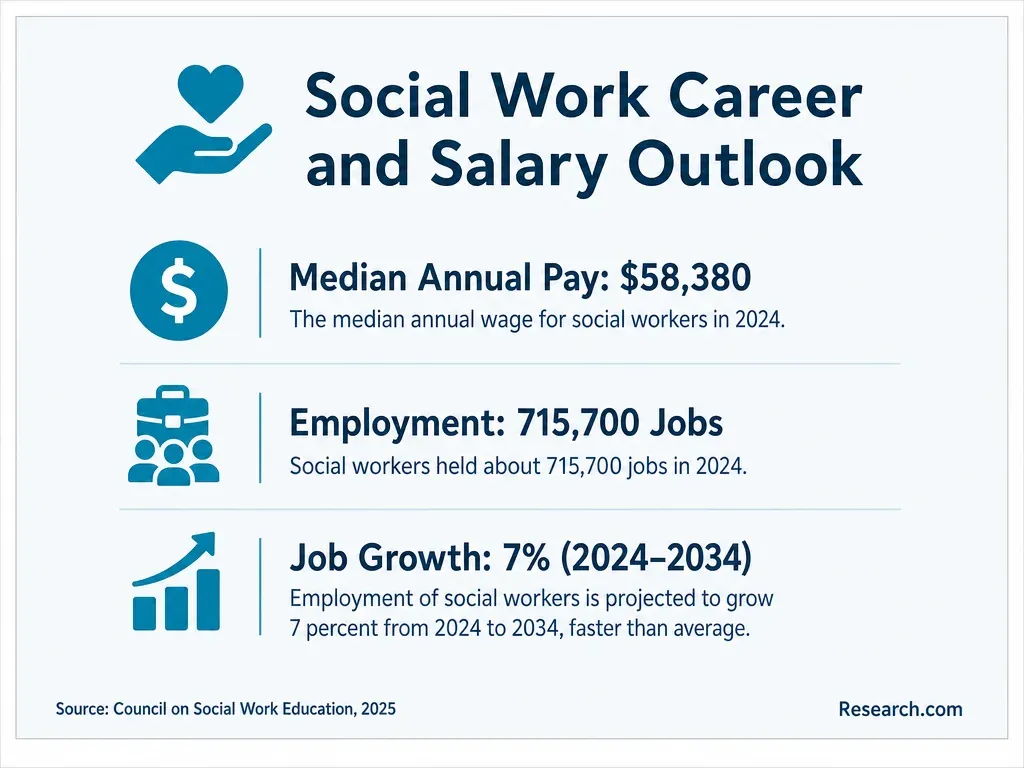
- Request the actual pay range, benefits, on-call rules, caseload expectations, safety procedures, and supervision arrangement; the U.S. Bureau of Labor Statistics reports a $59,550 May 2025 median for child, family, and school social workers, not a juvenile justice starting salary.
- Confirm degree, license, background-screening, and training requirements for the specific position before accepting; a BSW or MSW does not itself authorize independent clinical practice.
What does a juvenile justice social worker do?
A juvenile justice social worker supports young people involved with a juvenile court, detention facility, probation department, or diversion program. Depending on the employer, the work may include assessing service needs, engaging families, coordinating behavioral health and school referrals, documenting progress, planning reentry, or providing treatment within an authorized clinical role.
Start by asking for a sample week and the written job description. Specifically, find out whether you will conduct assessments, deliver therapy, write reports used in court, monitor compliance, or arrange services that another agency provides. Those tasks carry different training, confidentiality, and licensing implications. Ask how youth and family perspectives enter decisions and who has final authority over placement or detention recommendations.
Many positions require skill in trauma-informed engagement without granting the worker control over housing, school access, or court orders. If you are preparing to enter the field, compare the advertised duties with your current competencies before choosing among online social work education options for career planning; a degree format cannot substitute for supervised experience with the population.
What degree and experience do juvenile justice social workers need?
There is no single national credential for every job with this title. An employer may accept a BSW for generalist case management, require an MSW for a specialized social work position, or hire graduates in related fields for a differently classified youth-services role. Clinical treatment positions can require a state social work license and additional supervised experience. Ask the hiring manager which qualifications are required at hire, which can be completed during onboarding, and which duties remain restricted until licensure.
Relevant experience might include youth engagement, family work, school coordination, crisis response, or collaboration with courts. For a career changer, those skills can support an application but do not replace a required degree or license. New graduates should ask whether supervised field work counts toward the employer's experience requirement; it is not automatically equivalent to paid practice.
If an MSW is necessary, distinguish a traditional MSW, which can admit graduates from other disciplines, from an advanced-standing track generally designed for applicants with a qualifying BSW. This advanced standing vs traditional MSW comparison can help you evaluate the route, but the school decides eligibility and the employer decides whether the resulting qualification meets its job specification.
Do juvenile justice social workers need a state license?
Not always. A state or employer may permit an unlicensed worker to coordinate services while reserving protected social work titles, clinical assessment, diagnosis, psychotherapy, or independent practice for appropriately licensed professionals. Rules vary by jurisdiction and duties - not merely by the words "social worker" in an advertisement.
Ask the employer for the job classification, required license title and status, permitted activities before licensure, and whether the agency pays for required supervision or licensing expenses. Then check those answers against the licensing board in the state where you will practice. An MSW, a passed examination, and an issued license are separate milestones; independent clinical authority may also require qualifying post-degree supervision.
If you are selecting a degree with this job in mind, planning social work study for an intended licensing jurisdiction is more reliable than assuming an online program or clinical concentration qualifies you everywhere.
Request the written salary range and placement rule for your degree, license, and experience - not just the top of the advertised band. Also ask how raises work in the relevant civil-service classification or nonprofit pay structure. The U.S. Bureau of Labor Statistics reports a May 2025 median annual wage of $59,550 for child, family, and school social workers. Some juvenile justice roles may fall in another occupation, so that national median is context, not an offer benchmark or a predicted salary.
Compare total compensation, particularly if you are weighing a public agency against a contracted provider. The following terms can materially change the value of an offer:
- Health coverage, retirement contributions, vesting, paid leave, and holiday rules.
- Overtime eligibility, on-call or shift differentials, and whether court appearances outside scheduled hours are compensated.
- Mileage reimbursement, required vehicle use, parking, licensing fees, and paid training time.
- Support for continuing education or clinical supervision, including any repayment obligation if you leave.
For geographic context, comparing pay locations for master's-prepared social workers can help frame a negotiation, but local agency ranges, living costs, and benefits matter more to this decision.
A caseload number alone can be misleading. Ten young people needing intensive family contact, travel, and court reports may require more time than a larger, lower-intensity caseload. Ask for the typical active caseload, recent vacancy coverage, expected contacts per case, documentation deadlines, and who takes over when someone is absent. Request an example of how work is prioritized when a crisis and a court deadline collide.
Clarify whether the schedule includes detention shifts, evenings with families, weekend visits, on-call response, or travel between sites. Ask who prepares court reports, whether you testify, how testimony is reviewed, and whether your professional assessment can differ from an agency recommendation. These answers reveal both workload and the boundaries of your judgment.
If you plan to study while working, compare required shifts and court dates with actual live-class and field schedules. MSW completion time and program format comparisons are useful only after you know whether this job leaves sufficient time for coursework and a school-approved placement; an accelerated or online schedule does not remove those obligations.
Ask who provides day-to-day consultation, how often cases are reviewed, and what support is available during evenings or emergencies. For an early-career worker, "open-door supervision" is less informative than a scheduled meeting, a named backup, and a process for reviewing high-stakes decisions. If you need clinical-license hours, verify separately whether the supervisor, duties, setting, and records meet your state board's rules; ordinary managerial supervision may not count. A guide to social work clinical experience requirements can help you prepare questions for the board and employer.
Safety practices should match the setting. Ask how the agency handles home visits, facility entry, threats, transport, after-hours calls, and incidents involving staff. Find out whether you receive orientation in de-escalation, confidentiality, mandated reporting, local court procedures, and electronic records before carrying cases independently. Ask how the team responds to secondary trauma and whether staff can seek consultation without being penalized for raising concerns.
These settings offer different access to young people and different limits on the work. Ask where most of your hours will be spent, which organization employs you, and how information moves among courts, schools, families, and treatment providers.
The comparison below shows why the setting should shape your decision; individual agencies may combine these functions.
| Primary setting | Common focus | Potential trade-off to clarify |
| Detention | Immediate needs, crisis support, family contact, and discharge planning | Shift coverage, facility security rules, and short periods for engagement |
| Probation | Case monitoring, referrals, court reporting, and coordination with families | How supportive services and compliance-related duties interact |
| Community-based program | Diversion, family engagement, ongoing services, and reentry support | Travel, funding stability, referral capacity, and evening availability |
A community role may suit someone who wants sustained family engagement; detention may suit someone prepared for structured, high-acuity work. Neither setting guarantees clinical duties or a particular level of autonomy. To consider how this experience might connect to other roles, see exploring professional opportunities after MSW study - then compare those possibilities with the actual position description.
If you need a degree to qualify for the offer or advance later, verify the exact BSW or MSW program in the Council on Social Work Education's accreditation directory. Check its status and whether that status applies to your intended enrollment and graduation period. Confirm institutional accreditation separately; it does not establish CSWE programmatic accreditation. Ask the school and your state licensing board how the program's status affects the license pathway you intend to pursue.
Do not assume that an employer's willingness to hire you resolves future licensing eligibility. Likewise, a university's general accreditation claim does not answer whether its social work program meets a particular employer's degree requirement. When comparing bachelor's routes, use social work bachelor's quality and career preparation to develop questions about coursework and field support, while confirming each program's status directly with the accreditor.
What are the job outlook and advancement opportunities in juvenile justice social work?
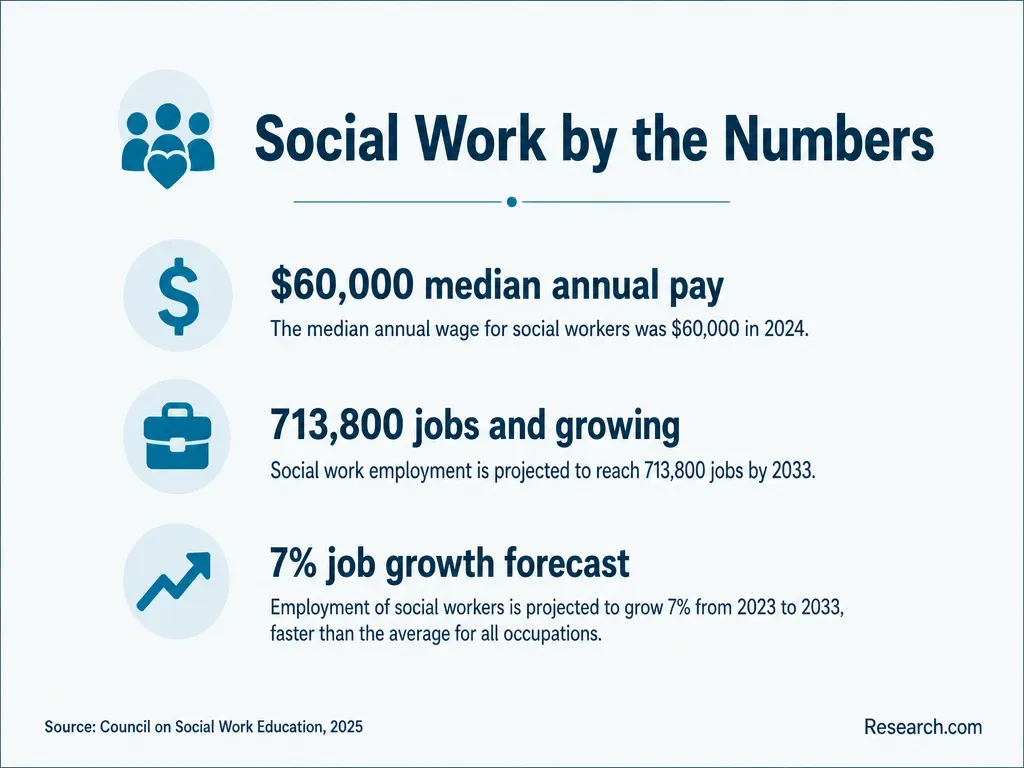
The Bureau of Labor Statistics projects 4% employment growth from 2025 to 2035 for child, family, and school social workers. That category includes many jobs outside juvenile justice; it does not predict openings at a particular court, agency, or contracted program. Ask about recent turnover, funding for the position, vacancies on the team, and whether promotions require a civil-service exam, license, supervisory experience, or transfer to another unit.
Possible next steps include senior casework, clinical practice where licensed, program supervision, diversion-program management, and policy or evaluation work. The best preparation depends on the target job. An MSW or license may be necessary for some moves, while agency leadership experience or targeted training may be more direct for others. A DSW is not a standard prerequisite for juvenile justice advancement; consider online DSW programs organized by tuition only if a practice-leadership or advanced professional goal justifies the time and cost.
Before signing, compare the written offer with the duties, support, and advancement path you discussed. If the agency cannot clarify caseload coverage, supervision, safety, or what you are legally expected to do, seek those answers before accepting - not after your first court deadline.
Other Things You Should Know About Social Work
Not necessarily. Screening rules depend on the state, employer, facility, and position. Ask which checks apply and how the employer evaluates findings; disclose information as required by the application.
Typically, social work duties are distinct from armed law enforcement duties, but job classifications vary. If the posting mentions enforcement, restraints, or transport, ask for the written policy and required training.
It can inform engagement and advocacy, but it does not replace required qualifications or professional boundaries. Ask how the employer supports staff who draw on lived experience without expecting personal disclosure.
Yes, some programs use restorative approaches, but their availability and the worker's responsibilities vary. Ask whether participation is voluntary, who facilitates the process, and what training and safeguards the agency requires.
- Case Management Operational Guidelines | virginia.gov https://www.townhall.virginia.gov/l/GetFile.cfm
- The role of secondary traumatic stress breakthrough... - PMC https://pmc.ncbi.nlm.nih.gov/articles/PMC10061637/
- Fact Sheet 42 CFR Part 2 Final Rule | hhs.gov https://www.hhs.gov/hipaa/for-professionals/regulatory-initiatives/fact-sheet-42-cfr-part-2-final-rule/index.html
- Criminal Justice Social Work: Roles, Salary & Career Guide | MSW Online https://mastersinsocialworkonline.org/topics/criminal-justice-social-work-roles-settings-career-guide/
- Social Work Careers: Types, Settings and Degree Paths | Social Work License Map https://socialworklicensemap.com/social-work-careers/
- Types of Social Work | socialworkers.org https://www.socialworkers.org/News/Facts/Types-of-Social-Work
- Human Services Careers: Jobs, Degrees & Education | allcriminaljusticeschools.com https://www.allcriminaljusticeschools.com/specialties/human-services/
- Social Worker III (PO/DL) - Honolulu/Wahiawa, Oahu https://www.governmentjobs.com/careers/hawaiijud/jobs/newprint/5079722