2027 Quasi-Experimental Designs in Social Work Research: Evaluating Programs Without Random Assignment
Audited and Verified:
Our Editorial and Data Verification Process
Research.com uses government datasets, official education statistics and primary institutional information to support its career and degree guides. Our review process checks factual accuracy, occupational definitions, source dates and the requirements associated with the credentials discussed.
How This Article Was Fact-Checked
Our editorial team verifies salary estimates, employment projections, education requirements and program information against original data providers and official organizations. Salary figures are checked against the relevant occupational definitions and reporting periods. Information about licensure, accreditation and required in-person training is reviewed separately.
Fact-checked and verified on:

Co-Founder and Chief Data Scientist
Social work agencies often need to know whether a service helped clients, but cannot randomly decide who receives housing support, counseling, or case management. Quasi-experimental designs offer a way to estimate program effects using eligibility rules, implementation dates, or comparable groups instead. For students, practitioners, and agency evaluators, the challenge is choosing a design that fits available data without overstating what it proves. This guide explains the main options, their assumptions, ethical safeguards, and the research training worth seeking if program evaluation is part of your career plan.
Key Things You Should Know
- Quasi-experimental studies estimate program effects without random assignment; common designs include matched comparisons, difference-in-differences, interrupted time series, and regression discontinuity.
- The strongest design is the one whose comparison matches how services were actually assigned. Baseline differences, changing referral patterns, and missing follow-up data can otherwise produce misleading results.
- An agency can begin with a focused outcome and ethically accessible records, but credible causal claims require enough observations, a defensible comparison, and transparent reporting of limitations.
What is a quasi-experimental design in social work research?
A quasi-experimental design compares outcomes under different levels of program exposure when researchers do not randomly assign people or sites to services. Its aim is to estimate a counterfactual: what would likely have happened to participating clients, families, or communities without the program.
Suppose an agency adds intensive housing navigation for clients at one office while another office continues usual services. Comparing later housing outcomes could be informative, but only if the offices and their clients are sufficiently comparable - or their important differences can be addressed. A simple before-and-after improvement does not establish that navigation caused the change; housing availability, eligibility rules, or client mix may also have changed.
Students planning undergraduate study in social work can look for courses that connect research literacy with practice decisions: defining outcomes, reading evidence, and recognizing when an appealing result is not a credible effect estimate.
How do quasi-experimental designs differ from randomized experiments?
In a randomized experiment, chance determines who is offered a service. When implemented well, assignment tends to balance measured and unmeasured characteristics across groups. In a quasi-experiment, assignment follows a real-world process - such as referral, geography, eligibility, or a rollout date - so researchers must investigate whether that process created meaningful differences unrelated to the service.
Neither approach automatically answers every practical question. A randomized trial may be infeasible or inappropriate when an agency must serve everyone who qualifies. A quasi-experiment may better reflect ordinary operations, but its causal claim depends more heavily on design-specific assumptions. Random assignment also does not cure poor outcome measurement, substantial missing data, or failure to deliver the intended service.
The same distinction matters when studying educational outcomes. Students entering through different routes may differ before instruction begins, so comparing their later skills is not equivalent to randomizing their coursework. Readers considering advanced standing vs standard MSW coursework should distinguish a pathway comparison from evidence that one sequence itself caused an outcome.
What types of quasi-experimental designs evaluate social work programs?
The service assignment rule and available records should determine the design - not the method that sounds most sophisticated. This comparison shows what each option needs and where its central credibility test lies.
| Design | Useful when | Key assumption or limitation |
| Matched comparison or statistical adjustment | Participants and nonparticipants have comparable records from before service began. | Measured characteristics can be balanced; unrecorded motivation or need may still differ. |
| Difference-in-differences | Exposed and comparison groups have outcomes measured before and after implementation. | Without the program, their outcome trends would have moved similarly. |
| Interrupted time series | An agency has repeated outcome measurements before and after a clear implementation date. | Other changes at that date, seasonality, and shifting measurement practices must be examined. |
| Regression discontinuity | A documented score or threshold determines eligibility. | People near the cutoff are comparable, and the score cannot be manipulated around it. |
A threshold study may produce a strong estimate near the cutoff, not necessarily for every client. An interrupted time series without an unaffected comparison series is particularly vulnerable to simultaneous policy changes. Admission cutoffs can illustrate regression discontinuity, but applicants researching attainable entry requirements for MSW applicants should not mistake a methodological example for a universal admissions rule.
Start with a plain-language account of why some people received the service and others did not. A waitlist created by staff capacity suggests different biases from a referral process based on severity. That account determines which baseline measures matter and which comparison is credible.
Researchers can then check balance between groups, examine trends before implementation, use matching or regression to adjust for recorded differences, and test whether results change under reasonable alternative definitions. For difference-in-differences, similar preprogram trends support - but cannot prove - the assumption about what would have happened afterward. For regression discontinuity, inspect whether scores cluster suspiciously around the cutoff and whether client characteristics change abruptly there.
Three cautions are especially important in social services. Selection bias remains if unmeasured needs influence both referral and outcomes. Attrition can distort results if clients with worse outcomes disappear from follow-up unevenly. Spillover can blur a comparison if staff apply new practices to clients outside the program. Confidence intervals, sample size, and - in studies assigning services by office or school - clustering also affect how precisely an effect can be estimated. A statistically precise answer does not rescue an implausible comparison.
Clinical training offers a parallel lesson: differences in client acuity and field setting matter when interpreting outcomes. Students comparing clinical MSW training and field education should look for opportunities to assess these real-world sources of bias rather than only practice statistical techniques.
Compare what students can actually study and do: courses in causal inference or applied statistics, faculty who evaluate social services, access to suitable agency partnerships, and supervision for an ethically feasible project. Online delivery may expand course access, but live sessions, campus visits, data restrictions, and field schedules can still constrain participation.
For BSW or MSW study, verify the program's applicable Council on Social Work Education accreditation status, the cohort it covers, and relevant state licensing-board education rules. Institutional accreditation, programmatic accreditation, permission to enroll from a location, placement feasibility, and eventual licensure eligibility are distinct. A degree does not issue a license; independent clinical practice may require additional state-specific steps. Doctoral applicants should verify the recognition and requirements appropriate to the specific award rather than assume BSW/MSW accreditation rules apply unchanged.
Published speed is not a substitute for research depth. When viewing online social work master's programs by duration, ask whether the timetable leaves room for the methods electives, faculty guidance, and approved data access your intended project needs.
What careers, salaries, and job prospects are available in social work program evaluation?
Program evaluation can be part of a social worker's agency role or a dedicated job in a nonprofit, government department, health system, university, or consulting team. Work may include defining measures with community partners, assessing data quality, analyzing outcomes, explaining uncertainty, and helping decision-makers improve services. Evaluation analyst roles may also welcome backgrounds in public health, statistics, public administration, or related fields; a clinical license is not inherently required for data analysis, although particular employers and social work positions can set different qualifications.
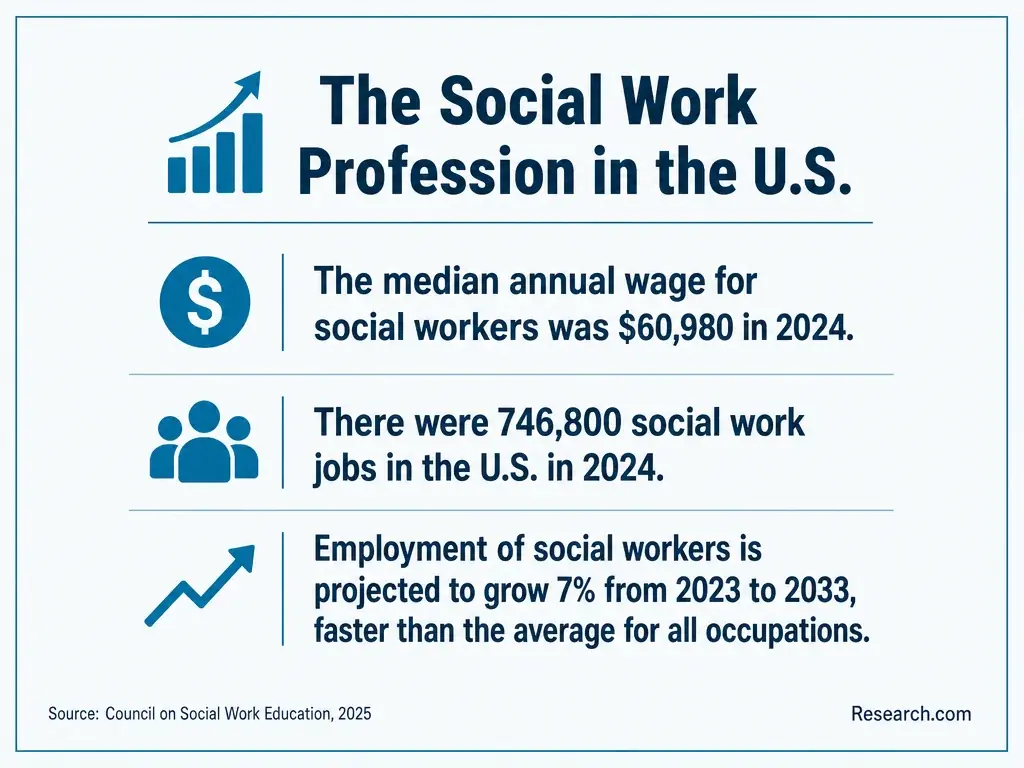
The U.S. Bureau of Labor Statistics reports a May 2025 median annual wage of $61,780 for social workers across specialties and projects 6% employment growth from 2025 to 2035. These occupation-wide figures are context for social work employment, not an evaluator salary or a prediction for a particular graduate. Dedicated evaluation jobs have varied titles and may fall into other occupational categories. Location, employer, methods skills, and job classification matter; social work earnings across different state markets can provide additional geographic context without substituting for local evaluator job postings.
Before pursuing another degree, review actual openings for their required methods, software, community engagement, and reporting skills. If the target roles accept your existing qualification, a supervised evaluation project or targeted methods training may be the faster route. If you want to lead original research, compare doctoral mentoring and research opportunities instead of relying on the degree label alone.
Other Things You Should Know About Social Work
Yes, if it has the necessary permissions and protects confidential information. Explain what was measured, why the result is uncertain, and what evidence would help answer the question.
Record when and how it changed. The original and revised services may need separate descriptions or analyses; combining them without explanation can make the findings hard to interpret.
When appropriate, share an accessible summary that respects privacy and explains limitations. Invite feedback on whether the measures reflect outcomes that matter to the people served.
Only with the agency's and school's permission. Use an approved, nonidentifying description of your methods and contribution rather than client records or confidential findings.
- Selecting and Improving Quasi-Experimental Designs in Effectiveness and Implementation Research - PMC https://pmc.ncbi.nlm.nih.gov/articles/PMC8011057/
- Quasi-experimental study: comparative studies | GOV. UK https://www.gov.uk/guidance/quasi-experimental-study-comparative-studies
- Read the Belmont Report | hhs.gov https://www.hhs.gov/ohrp/regulations-and-policy/belmont-report/read-the-belmont-report/index.html
- CDC Program Evaluation Framework, 2024 | MMWR https://www.cdc.gov/mmwr/volumes/73/rr/rr7306a1.htm
- Chapter 36., Section 1. A Framework for Program Evaluation | ku.edu https://ctb.ku.edu/en/table-of-contents/evaluate/evaluation/framework-for-evaluation/main
- 17. Designs with Comparison Groups | University of Kansas https://opentext.ku.edu/assessmentevaluationhighered/chapter/chapter-14-designs-involving-comparison-groups/
- Difference-in-Difference Estimation | Columbia University Mailman School of Public Health https://www.publichealth.columbia.edu/research/population-health-methods/difference-difference-estimation
- 13.3: Quasi-experimental designs | Social Sci LibreTexts https://socialsci.libretexts.org/Under_Construction/Graduate_research_methods_in_social_work_(DeCarlo_Cummings_and_Agnelli)/13%3A_Using_quantitative_methods_-_Experimental_design/13.03%3A_New_Page
- 8.2 Quasi-experimental and pre-experimental designs | Foundations of Social Work Research https://uta.pressbooks.pub/foundationsofsocialworkresearch/chapter/8-2-quasi-experimental-and-pre-experimental-designs/
- Quasi-experimental design and methods - Resource https://www.betterevaluation.org/tools-resources/quasi-experimental-design-methods