
2027 Post-MSW Clinical Supervision in Idaho: Supervisor Approval, Records, and Work Settings
Audited and Verified:
Our Editorial and Data Verification Process
Research.com uses government datasets, official education statistics and primary institutional information to support its career and degree guides. Our review process checks factual accuracy, occupational definitions, source dates and the requirements associated with the credentials discussed.
How This Article Was Fact-Checked
Our editorial team verifies salary estimates, employment projections, education requirements and program information against original data providers and official organizations. Salary figures are checked against the relevant occupational definitions and reporting periods. Information about licensure, accreditation and required in-person training is reviewed separately.
Fact-checked and verified on:

Co-Founder and Chief Data Scientist
An Idaho MSW graduate can hold an LMSW license and still need substantial supervised practice before qualifying for independent clinical licensure. The consequential decisions come early: whether a supervisor qualifies, whether the job provides clinical work, and whether the records will support an LCSW application.
This guide helps new and early-career social workers evaluate those decisions, arrange supervision, track experience, and identify questions to resolve with the Idaho Board of Social Work Examiners before counting hours.
Key Things You Should Know
- Idaho's LCSW pathway is commonly described as requiring 3,000 hours of supervised clinical experience over at least two years, including 100 hours of supervision; confirm the applicable rule and any hour-category requirements before starting.
- An MSW field placement is not post-degree clinical experience. Hold the required Idaho license, verify supervisor eligibility, and clarify any board approval or registration requirement before relying on work hours.
- Choose a job for its clinical duties and reliable supervision - not its "therapist" title alone - and keep contemporaneous records that a supervisor can verify.
What are Idaho's post-MSW clinical supervision requirements for LCSW licensure?
Idaho distinguishes the Licensed Master Social Worker (LMSW) from the Licensed Clinical Social Worker (LCSW). An MSW and an LMSW do not, by themselves, authorize independent clinical practice. The LCSW route requires qualifying post-degree supervised clinical experience in addition to the education, examination, and application requirements for that license.
Idaho's pathway is commonly summarized as 3,000 hours of supervised clinical experience accumulated over at least two years, with 100 hours of supervision. Those headline numbers are not a substitute for the governing rule: confirm the current requirements for clinical work, supervision frequency and format, eligible supervisors, and the start date from which hours may count. A 3,000-hour generalist case-management job is not necessarily 3,000 hours of qualifying clinical experience.
Before accepting a position, compare its duties with Idaho's clinical-experience rules and the supervision you can actually receive. Students still selecting a degree can use MSW curriculum and licensing preparation questions to separate educational preparation from the post-graduation requirements imposed by the licensing board.
Who qualifies to supervise Idaho LMSWs, and is board approval required?
Do not assume that a manager, clinical director, or experienced counselor qualifies to supervise hours toward an Idaho social work license. Verify the prospective supervisor's license type, active status, required clinical experience, and any other qualifications under the Idaho Board of Social Work Examiners' current rules. Confirm whether Idaho requires advance approval, supervisor registration, or a filed supervision arrangement for your circumstances; obtain a board determination when the answer is unclear rather than relying on an employer's assurance.
The administrative supervisor who assigns cases may differ from the clinical supervisor responsible for reviewing assessment, treatment, ethics, and your developing competence. If they are different people, establish who can observe the work, access records lawfully, address safety concerns, and verify experience at the end of employment. Put any employer and outside-supervisor responsibilities in writing.
MSW field instructors serve an educational role that is separate from post-MSW license supervision. That distinction matters even if a graduate returns to the same agency. Readers still choosing a program may find field placement assistance in online MSW education useful, but placement support does not establish that an agency will provide an eligible post-degree supervisor.
How should Idaho LMSWs document and report supervised clinical hours?
Keep records as experience occurs, not when an LCSW application is due. Use the Idaho board's current forms and instructions as the controlling standard; a personal spreadsheet can support, but may not replace, required supervisor attestations. Preserve copies according to employer confidentiality rules, and never put identifiable client information in a personal hours log.
A workable record should let both you and your supervisor reconcile the following information before signing any board form:
- Employment dates, worksite, position, license status, and each supervisor's name and credentials.
- Dated clinical-experience hours, separated into any categories the board requires, rather than an undifferentiated weekly total.
- Dated supervision sessions, duration, format, individual or group status, and supervisor identity.
- Changes in duties, leave, interruptions, or supervisor assignments that may affect eligibility.
Review totals with your supervisor regularly and request the required verification promptly when changing jobs. Graduate assistantship work and MSW field records are useful evidence of education, not automatic substitutes for post-degree hours; university-funded assistant roles for MSW students should be evaluated separately from an eventual Idaho LCSW experience log.
The starting point is a qualifying master's degree in social work and the Idaho license appropriate to supervised post-MSW practice. Confirm the board's current educational recognition rules, application requirements, examination requirements, and license-issuance date. Graduating, passing an exam, and applying for an LMSW are separate events; none should be assumed to confer an active license.
Ask the board how it treats experience gained between graduation and initial licensure, while an application is pending, or under a license issued elsewhere. Do not count those periods without a clear basis in Idaho's rules. Prior BSW or MSW field hours also remain part of degree education rather than becoming post-degree hours after graduation.
For readers earlier in the pipeline, undergraduate social work program quality comparisons can inform BSW selection. They cannot establish that a later MSW, an Idaho license, or a particular supervision arrangement will be approved.
Qualifying work should fit Idaho's definition of supervised clinical social work, not merely occur in a healthcare or behavioral health organization. Depending on the current rule and the LMSW's authorized role, relevant duties may include clinical assessment, treatment planning, psychotherapy or other clinical intervention, and clinical evaluation under appropriate supervision. The board - not an employer's job title - determines which experience meets its LCSW standard.
Mixed positions deserve particular scrutiny. A hospital worker might spend part of a week on clinical assessment and intervention and the rest arranging transportation or benefits. A behavioral health worker might provide treatment while also performing intake scheduling and administrative reporting. Track the work in the categories Idaho requires; do not label all paid hours "clinical" simply because clients have mental health needs.
Clinical licensure may be unnecessary for someone whose target work is primarily policy, administration, or nonclinical service coordination. Compare the duties you want with connecting a social work master's degree to career goals before committing to a clinical-hours job that fits poorly.

Idaho LMSWs may encounter clinical opportunities in community mental health, substance-use treatment, hospitals, integrated care, private group practices, and some public or nonprofit programs. No setting qualifies automatically. The position must provide eligible clinical duties, lawful practice within the LMSW's scope, access to a qualified supervisor, and records sufficient for board verification.
The comparison below shows why the job description and supervision arrangement matter more than the organization's name.
| Potential setting | Clinical opportunity to examine | Common limitation to check |
| Behavioral health agency | Assessment, treatment, and ongoing clinical intervention | Whether a qualifying supervisor is available consistently |
| Hospital or integrated care | Behavioral health assessment and clinical care | How much of the role is discharge coordination or other nonclinical work |
| Group practice | Supervised outpatient clinical services | LMSW scope, payer rules, documentation access, and supervision coverage |
| School or community program | Possible clinical services within a broader service role | Whether duties and supervision satisfy Idaho's clinical standard |
Before accepting an offer, request a duty breakdown and meet the proposed clinical supervisor. An online degree's geographic reach does not solve local employment and supervision requirements; online social work degree programs and qualifying Idaho work settings are separate decisions.
Do not assume that a video meeting, phone call, or group conference satisfies Idaho's supervision rules simply because it provides valuable consultation. Check the board's current definitions of acceptable supervision, any individual-supervision minimum, limits on group supervision, and whether the supervisor must be physically present or licensed in a particular jurisdiction. Employer privacy and telehealth policies may add restrictions.
If remote or group meetings are permitted for your arrangement, record their format and duration distinctly. Ensure the supervisor has enough information to evaluate your actual clinical work, not just attendance at a staff meeting. A schedule built around remote supervision also needs a plan for urgent consultation, absences, and secure case discussion.
Graduates of condensed social work master's program schedules should make the same distinction as other LMSWs: an accelerated academic timeline does not shorten Idaho's required period of post-degree clinical experience.
Start with employers that offer clinical supervision as part of the job, then verify the proposed supervisor's eligibility independently. If supervision is not included, ask whether the employer permits an outside supervisor, allows that person appropriate case access, and will reimburse the expense. A privately arranged supervisor cannot fix a position that lacks qualifying clinical work.
Compare written arrangements, not just an advertised hourly rate. Ask how often sessions occur, who pays for missed sessions, whether group time is billed differently, how records and final forms are handled, and what happens if the supervisor leaves. There is no dependable statewide price to apply to every arrangement: employer-provided supervision may have no separate invoice, while outside supervision can add a recurring out-of-pocket cost over a multi-year pathway.
If you are weighing MSW borrowing against the later cost of supervision, MSW program affordability comparisons are one part of the calculation. Add any expected outside-supervision expense rather than assuming tuition is the last major training cost.
Finishing the hours makes an LMSW a potential applicant; it does not issue an LCSW license. Check the Idaho board's current LCSW application instructions for the required experience verification, supervisor signatures, clinical examination and authorization process, fees, and any additional disclosures. Resolve discrepancies in dates or hour totals with supervisors before submission.
Keep practicing within the authority of your current license while the application or examination is pending. Do not advertise independent clinical authority, change an employer's billing designation, or begin unsupervised work on the assumption that approval is inevitable. Confirm issuance and any conditions directly through the board before changing practice arrangements.
Schools and employers may request recommendations for their own purposes, but those are not interchangeable with board-required supervisor verification. Likewise, social work master's reference requirements compared concern admission to an MSW program, not proof of completed Idaho clinical supervision.
What are the salary and job outlook for clinical social workers in Idaho?
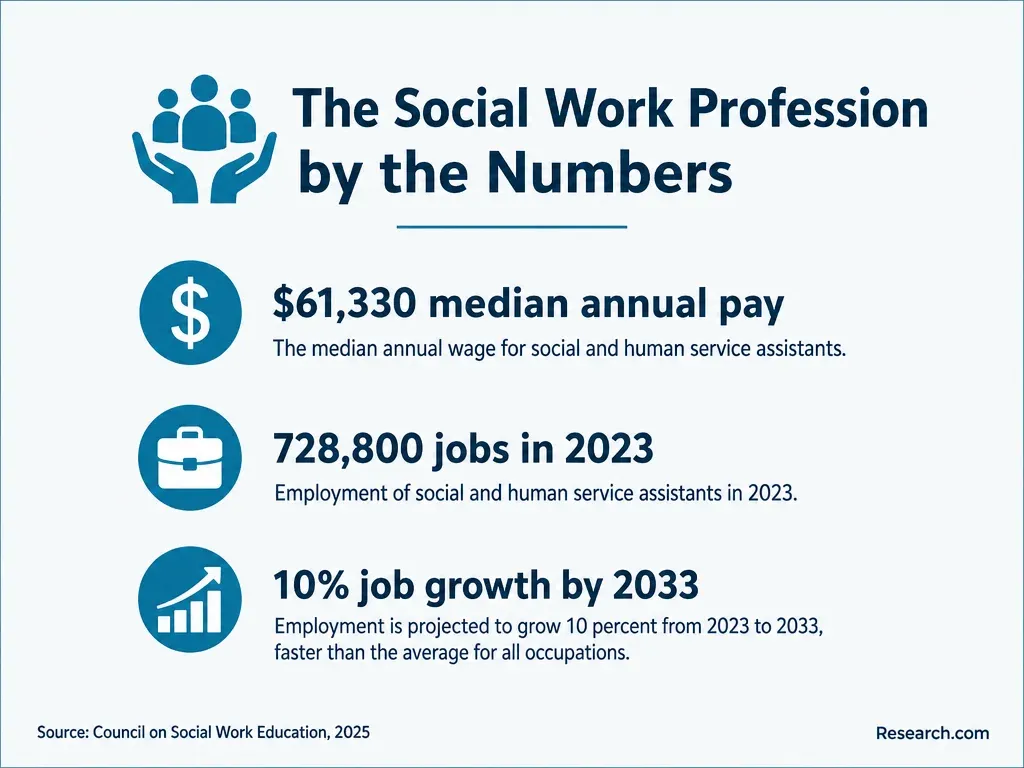
A reliable Idaho-wide wage for LCSWs specifically is difficult to infer from occupation data: the U.S. Bureau of Labor Statistics (BLS) reports jobs by occupational duties, not Idaho social work license category. The relevant national comparison is mental health and substance abuse social workers, for whom the supplied BLS figures show a May 2025 median annual wage of $60,280 and 10% projected employment growth from 2025 to 2035. These are U.S. occupation figures, not Idaho LCSW salaries or a forecast for an individual applicant.
For an Idaho decision, compare actual local offers by base pay, paid supervision, benefits, clinical caseload, travel, and whether the role produces qualifying experience. A higher-paying position with no eligible supervisor may delay an LCSW application; a lower-paying one may impose unacceptable financial strain. Use MSW compensation and relocation considerations as context, then rely on current Idaho postings and written offers for the decision in front of you.
Other Things You Should Know About Social Work
Check the employer's coverage, exclusions, and any contract requirement for individual professional liability insurance. Supervision does not, by itself, establish that every claim is covered.
No doctoral degree should be assumed necessary for the Idaho LCSW pathway. A DSW or PhD serves different professional or research goals and does not replace board-required licensing steps.
Not on the strength of an Idaho license alone. Check the client's location, that jurisdiction's licensing and telepractice rules, and applicable employer and payer requirements before providing services.
No. After licensure, check the Idaho board's current renewal cycle and continuing-education rules, including any subject-specific requirements, and retain completion records.
- Supervision FAQs | Texas Behavioral Health Executive Council https://bhec.texas.gov/tbhec/supervision-faqs/
- Supervision and Supervisor Information - Idaho DOPL https://dopl.idaho.gov/swo/swo-supervision/
- Rule 4757-23-01 | Social work supervision. https://codes.ohio.gov/ohio-administrative-code/rule-4757-23-01
- Social Worker and Social Worker Associate - Licensing Requirements | Washington State Department of Health https://doh.wa.gov/licenses-permits-and-certificates/professions-new-renew-or-update/social-worker-and-social-worker-associate/licensing-requirements
- LCSW Career Roadmap: Steps to Licensure & Salary | New Mexico Highlands University https://online.nmhu.edu/resources/article/how-to-become-a-lcsw/
- Idaho Admin. Code r. 16.07.39.200 | State Regulations | US Law | LII / Legal Information Institute https://www.law.cornell.edu/regulations/idaho/IDAPA-16.07.39.200
- Best Practice Standards in Social Work Supervision | socialworkers.org https://www.socialworkers.org/Practice/NASW-Practice-Standards-Guidelines/Best-Practice-Standards-in-Social-Work-Supervision


