2027 MSW Students Who Receive an Unsatisfactory Field Evaluation: Questions About Next Steps
Audited and Verified:
Our Editorial and Data Verification Process
Research.com uses government datasets, official education statistics and primary institutional information to support its career and degree guides. Our review process checks factual accuracy, occupational definitions, source dates and the requirements associated with the credentials discussed.
How This Article Was Fact-Checked
Our editorial team verifies salary estimates, employment projections, education requirements and program information against original data providers and official organizations. Salary figures are checked against the relevant occupational definitions and reporting periods. Information about licensure, accreditation and required in-person training is reviewed separately.
Fact-checked and verified on:

Co-Founder and Chief Data Scientist
An unsatisfactory field evaluation can put an MSW student's placement, grade, and graduation date in question. It may identify a skill that can be improved, or it may signal a serious concern requiring immediate action. The next step is to find out which decision has actually been made - and who has authority to make the next one. This guide explains how to respond, assess remediation or appeal options, protect records of completed work, and plan for possible delays without assuming that one evaluation determines your future in social work.
Key Things You Should Know
- An unsatisfactory evaluation is not necessarily a failing practicum grade; the program applies its published grading and progression rules.
- Contact your faculty liaison and field office promptly, obtain the written evaluation, and ask whether a safety restriction, remediation deadline, or grade decision is already in effect.
- Completed hours, a new placement, and graduation on schedule are three separate decisions; get each determination in writing before changing sites or assuming hours will count.
What does an unsatisfactory MSW field evaluation mean?
It means the evaluator has identified performance that does not meet an expected standard at that point in the placement. The concern might involve documentation, engagement, professional boundaries, use of supervision, attendance, or another competency in the learning agreement. A midpoint evaluation may call for improvement before the final assessment; a final evaluation may inform the practicum grade. Neither has exactly the same consequence at every MSW program.
Read the rating alongside its narrative examples, the approved learning agreement, and the program's field manual. A low rating for a skill the student has had little opportunity to demonstrate raises a different question from a documented concern about client safety. Likewise, foundation and advanced-standing MSW sequences may have different schedules for demonstrating competencies; an MSW entry pathway comparison guide can clarify those educational differences, but the student's own field policy controls the evaluation.
Distinguish the people involved: an agency field instructor evaluates observed learning, a faculty liaison connects the agency and school, and the university assigns grades and decides academic progression under its policies. Ask which document records feedback and which document constitutes an official decision.
What should MSW students do after an unsatisfactory field evaluation?
Respond quickly, but do not assume you must agree with every finding to participate constructively. First establish whether you may continue client-facing work while the concern is reviewed. Agency safety directions and program instructions take priority over independently trying to demonstrate improvement with clients.
Use the following sequence to clarify the decision and preserve an accurate record:
- Request the signed evaluation, relevant learning agreement, grading rubric, field manual provisions, and any written notice of restrictions or deadlines.
- Arrange a meeting with the field instructor and faculty liaison; ask for specific observed examples, dates, applicable expectations, and opportunities previously provided to practice the skill.
- Write a factual response that acknowledges supported concerns, identifies disputed facts separately, and proposes supervised ways to demonstrate improvement.
- Ask the field office who approves a remediation plan, who assigns the grade, and when an appeal or placement-change request must be filed.
- Keep a dated record of meetings, approved hours, supervision, and agreed next steps without copying client-identifying or agency-confidential material into personal files.
If the difficulty reflects insufficient supervision, inaccessible duties, or an unsuitable site, tell the liaison rather than trying to negotiate a new arrangement alone. Students considering another program because placement support broke down can examine MSW programs with practicum assistance, but transferring is a separate admissions and credit-review decision - not an immediate remedy for a current grade.
Can an unsatisfactory field evaluation cause a student to fail practicum?
Yes, but an unsatisfactory rating does not automatically equal a failing practicum grade. Check whether the evaluation is formative or final, whether the concern can be remediated, and whether the program requires satisfactory performance across specified competencies. Hours completed do not necessarily offset unmet competencies or serious professionalism concerns.
The distinction matters because a student might receive a low midpoint rating and later pass after documented improvement, while another might fail or be removed from a site because a serious concern cannot safely wait. The university's published procedures - not the agency's preferred outcome alone - determine the academic result. Request a written explanation connecting any final grade to the applicable rubric and policy.
Students in accelerated or advanced-standing schedules should check when the next field course is offered before assuming a repeat can fit into the same graduation term. Even programs advertised as flexible-paced social work master's programs may require fixed agency hours, supervised learning, and sequenced field courses.
A remediation plan is a written, time-limited opportunity to address identified learning or performance gaps when the program determines that doing so is appropriate. It is not guaranteed, and a plan does not override an agency's decision to restrict duties or end a placement. The field office should identify who approves the plan and what happens if the placement cannot provide the needed learning opportunities.
A useful plan ties each concern to observable evidence rather than a vague instruction to "be more professional." For example, a documentation concern could be assessed through timely, de-identified work samples reviewed in approved supervision - not by sharing client records outside agency systems. The plan should specify the learning task, available supervision, assessment method, review date, and consequence if the standard is not met.
Ask whether a task supervisor, field instructor, and faculty liaison each have distinct responsibilities. In a clinical-focus placement, the student's learning objectives should match permitted duties and available instruction; descriptions of online MSW programs with a clinical focus are no substitute for an approved, site-specific plan. Academic field instruction also does not replace post-degree supervision required for clinical licensure.
Start by identifying the decision you can challenge. A request to correct an evaluation's factual errors, an appeal of a final practicum grade, and a complaint about discrimination or retaliation may follow different university procedures and deadlines. Obtain the applicable policy immediately; do not wait for an informal discussion if a formal filing deadline is approaching.
An effective appeal identifies a reviewable issue - such as a material factual error, a departure from the published grading procedure, or evidence that was not considered - and requests a specific remedy. Attach permitted records: the learning agreement, dated feedback, supervision notes you are authorized to retain, emails, and the grading rubric. Describe client work without identifying clients. A disagreement with professional judgment alone may not meet the school's appeal standard.
Ask who reviews the appeal, whether the grade remains in effect during review, and whether you must continue field or seminar attendance. If you are worried about future licensing disclosures, review social work master's licensure disclosure questions separately from the academic appeal: only the relevant licensing board can determine what its application requires you to report.

Sometimes. A change may be appropriate if the agency cannot provide safe, suitable learning or required supervision, or if the working relationship cannot be repaired. It is not automatic simply because a student disputes a rating. The school may first review the concern, attempt a supported plan, or determine that reassignment is not available during the current term.
Ask the field office whether it will approve a new site, what concerns must be addressed before reassignment, and whether a new learning agreement, onboarding, screening, or instructor is required. Do not begin counting hours at a self-arranged site without approval. A placement change can also affect transportation, work schedules, and access to the particular competencies still outstanding.
If a student must consider changing programs rather than sites, the search should focus on actual placement responsibilities and geography - not just lists of online social work qualifications and career directions. A receiving MSW program decides whether prior coursework or field learning applies to its requirements.
They may, but recorded time is not the same as accepted field credit. The program must determine whether the hours were completed at an approved site, under the required arrangement, with adequate documentation and relevant learning. It must also decide whether unmet competencies, an incomplete course, or a failed practicum require additional or repeated field work.
Before leaving the site, ask the field office how to obtain an approved hour log, supervision record, learning agreement, and evaluation. Request a written determination of hours accepted toward the current course and hours, if any, that can carry into a new placement. Do not remove client records to prove what you did.
Prior undergraduate field learning is a separate matter. Information about online BSW curriculum and field education options may help explain how BSW preparation differs, but BSW hours do not automatically replace an interrupted MSW placement. Neither BSW nor MSW curricular hours should be assumed to count as post-degree clinical supervision.
Yes, if the program's published progression, repeat, or professional-conduct policies allow it and the school follows the applicable process. Other possible outcomes include repeating a course, probation, a leave, or a new placement. The result depends on the nature of the concern, prior academic standing, available remediation, and program rules - not on a universal MSW dismissal standard.
Request the written decision and the specific policy supporting it. Ask whether you may repeat field, when you could return, whether readmission is required, and which appeal deadline applies. If returning to the same program is not possible, another school may review your transcript and field documentation, but it need not accept a failed course or interrupted hours.
Skipping ahead to another credential does not erase an unfinished MSW. Even comparing lower-tuition social work doctorates would not resolve MSW degree requirements, an academic record, or licensing eligibility; doctoral admission has its own criteria. Clarify whether completing the MSW remains your goal before paying to apply elsewhere.
A remediation review may fit within the current term, but a failed course or placement change can delay graduation if the next field sequence or suitable site is unavailable. The cost is not limited to repeat tuition: consider fees, transportation, screening, reduced paid work, and any additional caregiving or housing expense. Aid eligibility may change if enrollment drops, a course is repeated, or satisfactory academic progress rules apply.
Ask the program for two written scenarios: the earliest approved completion date if remediation succeeds, and the earliest date if field must be repeated. For each, obtain the credits and charges from the registrar or bursar and an aid review from the financial aid office. Comparing those scenarios is more useful than assuming a delayed MSW will quickly pay for itself.
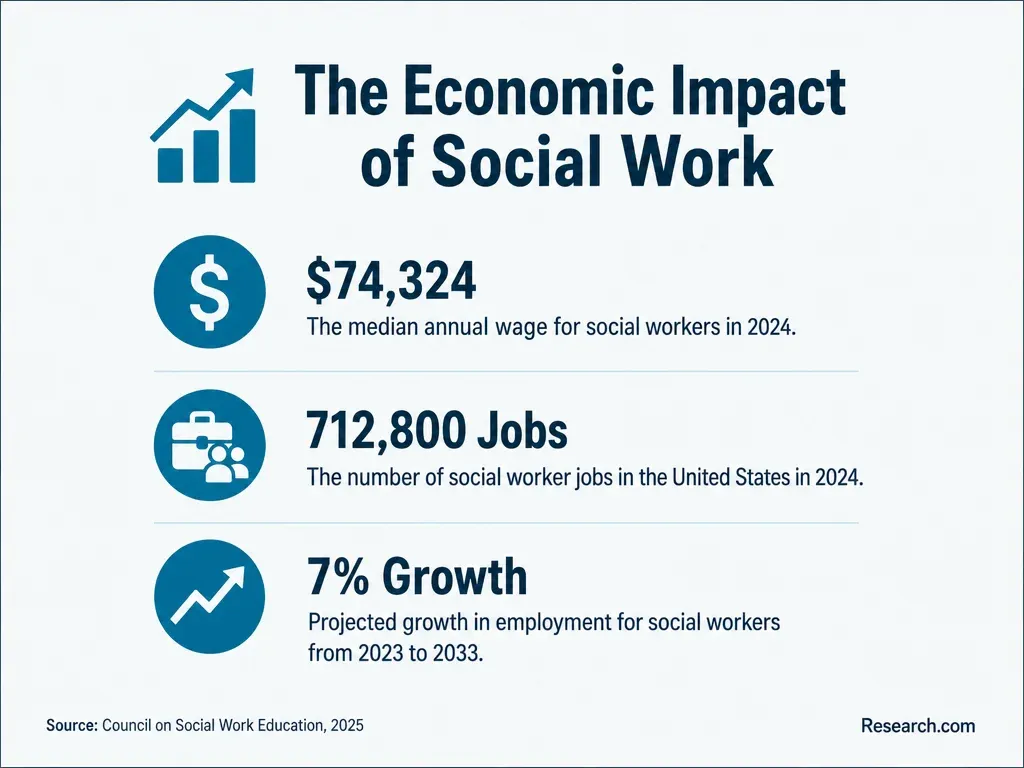
Future income is uncertain and depends on the role, region, employer, and eventual license. Social work earnings across different state markets can provide career context, but broad wage figures cannot establish the financial return on a particular repeat term or predict an individual graduate's salary.
Can an unsatisfactory MSW field evaluation affect social work licensure or employment?
It can affect the route to licensure indirectly if it delays graduation or prevents completion of required education. Whether a licensing application asks about academic discipline, program dismissal, or other conduct depends on the state board's current questions. Answer those questions accurately; do not assume every unfavorable evaluation is reportable, or that a successful academic appeal settles a separate board determination.
Employers may care most about whether you completed the degree, meet the role's licensing requirements, and can demonstrate relevant skills and sound judgment. If asked about a placement disruption, give a truthful, concise account of what happened, what you changed, and what later supervision or work demonstrates. Do not disclose confidential client or agency information to explain yourself.
An MSW, a practicum, and post-degree licensed practice are distinct milestones. As you assess roles using social work master's skills across career settings, verify each employer's requirements and the applicable board's rules. An unsatisfactory evaluation does not itself grant or revoke a license, and completing the degree does not by itself authorize independent clinical practice.
Other Things You Should Know About Social Work
Check what your program says a signature means. If it acknowledges receipt rather than agreement, you may be able to sign and submit a separate written response. Ask before refusing or adding language to the form.
Yes. Contact the university's disability or accessibility office about the applicable process. An approved accommodation may change how you access learning or demonstrate competence, but it does not eliminate essential requirements or agency safety rules.
Follow the program's reassignment process and answer required questions honestly. Ask the field office what information it will share so the new instructor can support learning without relying on an incomplete account.
Ask the seminar instructor and field office whether attendance and assignments continue while placement status is resolved. Do not assume leaving the agency automatically withdraws you from the academic course.
- Student Formal Grade Appeal Process | St. Clair County Community College https://sc4.edu/policy/student-formal-grade-appeal-process/
- Satisfactory Academic Progress - One Stop Student Services https://onestop.umn.edu/finances/financial-aid/satisfactory-academic-progress
- Social Work MSW Program Assessment | Rhode Island College https://www.ric.edu/about/accreditation/school-social-work-accreditation/social-work-msw-program-assessment
- Satisfactory Academic Progress - Financial Aid https://finaid.umich.edu/managing-your-aid/satisfactory-academic-progress
- Assessing Student Performance in Field Education | Applied Learning in Social Work Education Journal https://alswe.simmons.edu/article/assessing-student-performance-in-field-education/
- IV. Field Instruction Policies and Procedures | West Virginia University https://socialwork.wvu.edu/field-education-handbook/iv-field-instruction-policies-and-procedures
- Graduate Academic Standing | Florida International University Catalog https://catalog.fiu.edu/policiesandprocesses/courses-credit/grading/academicstanding/graduate
- BSW FIELD EDUCATION MANUAL | our.ric.edu https://our.ric.edu/documents/bsw-field-education-manualpdf
- Student Resource: Satisfactory Academic Progress (SAP) | University of Missouri School of Medicine https://medicine.missouri.edu/offices-programs/education/student-resources/satisfactory-academic-progress