2027 Mobile Crisis vs Community Mental Health Social Work: Schedule, Support, and Preparation
Audited and Verified:
Our Editorial and Data Verification Process
Research.com uses government datasets, official education statistics and primary institutional information to support its career and degree guides. Our review process checks factual accuracy, occupational definitions, source dates and the requirements associated with the credentials discussed.
How This Article Was Fact-Checked
Our editorial team verifies salary estimates, employment projections, education requirements and program information against original data providers and official organizations. Salary figures are checked against the relevant occupational definitions and reporting periods. Information about licensure, accreditation and required in-person training is reviewed separately.
Fact-checked and verified on:

Co-Founder and Chief Data Scientist
A mobile crisis job and a community mental health job can serve the same population while demanding very different workdays. One may involve urgent responses at unpredictable locations; the other may offer scheduled appointments but a continuing caseload. For students, new graduates, and social workers considering a move, the distinction affects safety, supervision, work-life fit, and training needs. This guide compares the roles and shows what to verify in a job offer or social work program before committing to either path.
Key Things You Should Know
- Mobile crisis centers on time-sensitive assessment, de-escalation, and connection to care; community mental health more often involves ongoing treatment or service coordination. Job titles alone do not establish clinical authority.
- Crisis coverage may include nights, weekends, travel, and on-call shifts. A community clinic may offer steadier hours, but its caseload, documentation deadlines, and after-hours duties still need checking.
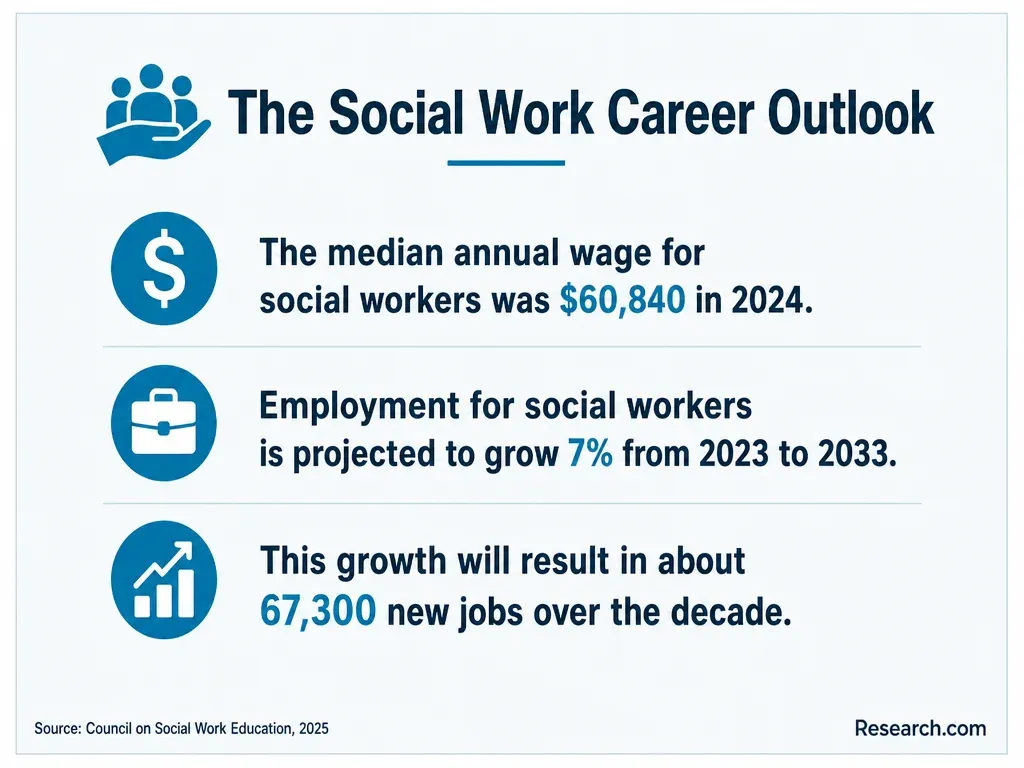
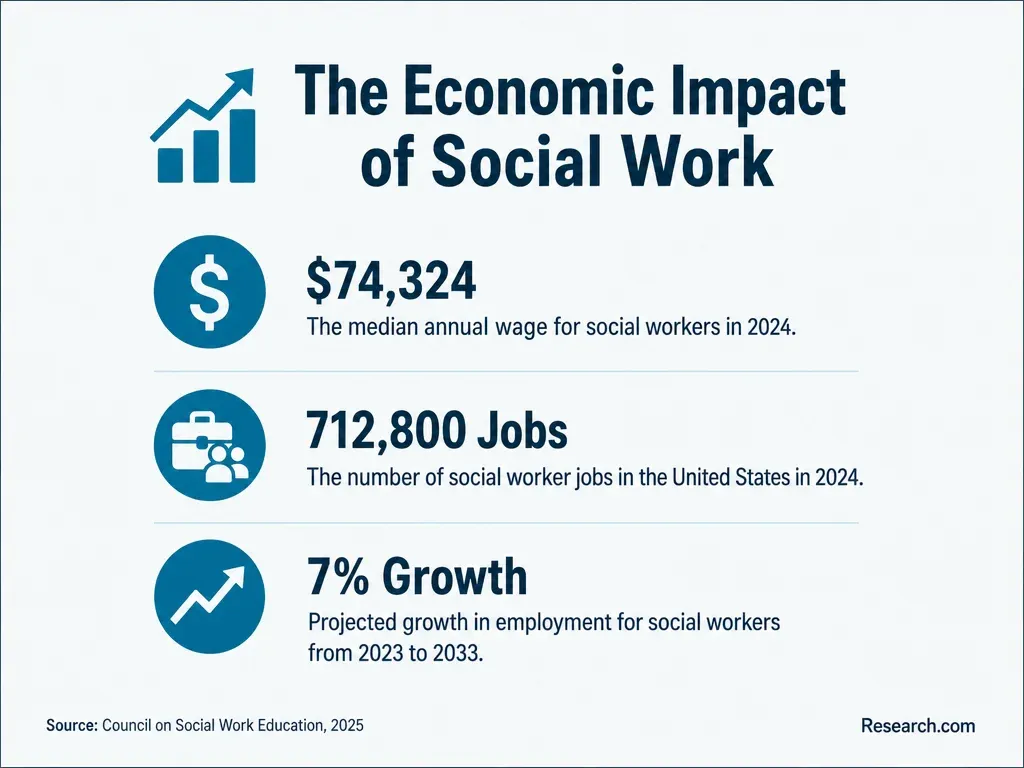
- The U.S. Bureau of Labor Statistics reports a $60,280 median annual wage for mental health and substance abuse social workers in May 2025 and projects 10% employment growth from 2025 to 2035; neither figure predicts pay or demand for either specific job.
How do mobile crisis and community mental health social work differ?
Mobile crisis social work generally means responding to an immediate behavioral health concern where the person is - or at another designated community location. Depending on the team and jurisdiction, the work can include engagement, safety and needs assessment, de-escalation, consultation, a disposition or referral plan, and follow-up coordination.
Community mental health social work usually takes place through an outpatient clinic or community agency, with more sustained relationships, scheduled services, and coordination across treatment and social-service systems.
This comparison describes common arrangements, not universal job descriptions. A crisis worker may provide follow-up, while a community clinician may handle urgent walk-ins. The clearest distinction is whether the position is organized around immediate response or continuity of care.
The two settings also offer different ways to use social work skills. Crisis work emphasizes rapid engagement and sound decisions with limited information. Ongoing community work allows more time to revisit goals and address barriers such as housing, transportation, and access to care. For a wider view of MSW careers across different practice settings, compare actual duties rather than relying on agency or job titles.
How do schedules and on-call hours compare between these social work roles?
Mobile crisis services may operate beyond business hours, so a posting can involve assigned evening or overnight shifts, rotating weekends, holidays, or on-call coverage. Ask whether "on-call" means waiting to be dispatched, providing phone consultation, or both - and how response time, travel, overtime, and compensatory time work. A nominal eight-hour shift can feel longer when a late dispatch or required documentation extends the day.
Community mental health appointments are often more predictable, but evening clinics, urgent coverage, outreach visits, and notes completed after appointments can erode that advantage. Compare actual weekly schedules, not just advertised office hours.
If you are studying while employed, ask about fixed field-placement days and live classes before choosing among short-format MSW program comparisons; a faster academic calendar does not make rotating crisis shifts easier to accommodate.
What supervision, safety, and team support do social workers receive in each setting?
In mobile crisis, meaningful support includes a clear dispatch process, information about a scene before arrival when available, a defined partner or backup arrangement, a way to reach a supervisor during a response, and policies for leaving or requesting additional help.
Community mental health support is more likely to center on case consultation, clinical supervision where appropriate, manageable caseloads, and access to colleagues when a client's needs escalate. Neither setting is inherently well supported simply because it employs licensed staff.
During an interview, request a concrete walkthrough of an ordinary shift and a difficult one. Ask who decides whether a worker goes alone, who can authorize a change in response plan, how incidents are reviewed, and when supervision occurs - not merely whether it is "available."
If independent clinical licensure is a goal, confirm separately whether the supervisor, work, and documentation meet your state board's rules. An MSW focused on clinical practice preparation can build relevant skills, but it cannot substitute for safe onboarding or qualifying post-degree supervision.
Both paths benefit from supervised practice in engagement, person-in-environment assessment, documentation, referrals, confidentiality, and culturally responsive care. A crisis-oriented placement or onboarding plan should additionally provide observed practice in de-escalation, working with incomplete information, team communication, and agency-specific response procedures.
A community mental health placement may provide more opportunities to follow clients over time, coordinate services, and - when the student's role permits - develop ongoing treatment skills.
When evaluating a placement, ask what tasks students actually observe and perform, how feedback is delivered, and whether the site can meet the school's learning objectives. Do not assume that a crisis placement alone establishes crisis competence or that employment hours automatically count as academic field education.
Likewise, field hours and later clinical-license supervision are separate requirements. If licensure is part of your plan, use checking social work clinical hour categories as a starting point, then confirm acceptable work and supervisors with your state board.
BSW entry may involve admission to the university followed by a separate application to the social work major or field sequence. Traditional MSW programs generally consider applicants with a bachelor's degree in another subject, while advanced-standing routes typically require an eligible BSW.
Programs may review transcripts, grades, writing, references, relevant experience, and prerequisites, but exact requirements vary; admission also does not guarantee approval for every field site.
If you are changing careers, explain transferable experience without presenting it as a substitute for social work field learning. Request a written review of prerequisites and track eligibility before planning your schedule. Published attainable entry requirements for MSW applicants can help you identify options, but check each school's current criteria rather than assuming that a less selective program offers automatic admission or the placement support you need.
How can students verify social work program accreditation and licensure eligibility?
Check the exact BSW or MSW program and your expected graduation cohort in the Council on Social Work Education's accreditation directory; institutional accreditation alone answers a different question.
Then check your intended state licensing board's current education, examination, and supervised-experience rules. Finally, ask the program whether it enrolls and supports field placements in your location and whether its disclosures address the license category you seek.
Keep those confirmations in writing. A school determines admission, graduation, and approved field education; the state board determines license eligibility and practice authority. For a structured way to frame questions, see checking professional eligibility when choosing an MSW. No school's general statement that graduates "may pursue licensure" guarantees your individual eligibility or an employer's approval for a particular crisis or clinical role.
Other Things You Should Know About Social Work
No. The 988 Suicide & Crisis Lifeline provides call, text, and chat support. A mobile response, where available and appropriate, is a separate service coordinated under local procedures.
Do not assume so. Transport responsibilities depend on the team's model, local resources, and agency policy. Ask who arranges transportation and what role staff have during a handoff.
Yes, if the worker meets the new position's qualifications. Expect training in the new setting's workflow; crisis-response experience does not automatically establish competence in ongoing psychotherapy, or vice versa.
Not necessarily. Peer specialists bring lived experience and role-specific training to behavioral health teams. They may work alongside social workers, but the titles, qualifications, and permitted duties are distinct.
- Field Visit Contact Rate by Mobile Crisis Teams as a... - PMC https://pmc.ncbi.nlm.nih.gov/articles/PMC10261499/
- Risk Factors for Stress and Burnout | Healthcare Workers https://www.cdc.gov/niosh/healthcare/risk-factors/stress-burnout.html
- National Behavioral Health Crisis Care Guidance | samhsa.gov https://www.samhsa.gov/mental-health/national-behavioral-health-crisis-care
- Mobile Crisis Mental Health Services - Minnesota.gov https://mn.gov/dhs/mental-health/adult-services/programs-services/mobile-crisis-mental-health-services/
- Medi-Cal Mobile Crisis Services Benefit - DHCS - CA.gov https://www.dhcs.ca.gov/file/mobile-crisis-faq-pdf/
- Crisis Intervention Strategies for Mental Health Careers | UMass Global https://www.umassglobal.edu/blog-news/crisis-intervention-strategies-assessing-de-escalating-supporting-clients-and-practicing
- Evaluation of a Mobile Crisis Program: Effectiveness, Efficiency, and Consumer Satisfaction | Psychiatric Services https://psychiatryonline.org/doi/10.1176/appi.ps.51.9.1153