2027 Hospital Social Worker vs RN Case Manager: Team Responsibilities and Career Preparation
Audited and Verified:
Our Editorial and Data Verification Process
Research.com uses government datasets, official education statistics and primary institutional information to support its career and degree guides. Our review process checks factual accuracy, occupational definitions, source dates and the requirements associated with the credentials discussed.
How This Article Was Fact-Checked
Our editorial team verifies salary estimates, employment projections, education requirements and program information against original data providers and official organizations. Salary figures are checked against the relevant occupational definitions and reporting periods. Information about licensure, accreditation and required in-person training is reviewed separately.
Fact-checked and verified on:

Co-Founder and Chief Data Scientist
Hospital social workers and RN case managers often work on the same discharge, but they bring different training and responsibilities to the team. That distinction matters if you are choosing a degree, changing careers, or applying for a hospital role: the right preparation depends on whether you want to address social and psychosocial barriers, coordinate clinical care, or both within your profession's scope.
This guide compares their work, credentials, experience, pay data, and education costs so you can identify a realistic next step.
Key Things You Should Know
- Hospital social workers generally focus on psychosocial needs, resources, and complex discharge barriers; RN case managers generally focus on clinical care coordination, medical necessity, and transitions. Hospital assignments overlap and vary.
- Social work roles may require a BSW or MSW and a state-specific license; RN case management requires an active RN license, usually followed by clinical nursing experience.
- The supplied U.S. Bureau of Labor Statistics figures put healthcare social workers' May 2025 median annual pay at $67,880, with 8% projected employment growth from 2025 to 2035. Neither figure describes a particular hospital job offer.
What is the difference between a hospital social worker and an RN case manager?
A hospital social worker assesses psychosocial concerns and helps patients and families navigate barriers such as unsafe housing, limited caregiver support, financial strain, or difficulty accessing services.
An RN case manager uses nursing judgment to coordinate the clinical plan across the hospital stay and next care setting. Depending on the hospital, the RN may also work on utilization review, medical-necessity documentation, or payer communication.
The comparison below describes common assignments, not exclusive legal scopes. Hospitals may combine case management and social work departments or distribute discharge tasks differently.
| Decision point | Hospital social worker | RN case manager |
| Primary lens | Psychosocial needs, person-in-environment assessment, and access to support | Clinical needs, care progression, and coordination across settings |
| Typical discharge contribution | Addresses caregiver, housing, safety, benefits, and community-service barriers | Coordinates clinical services, post-acute care needs, and information for the next provider |
| Professional foundation | Social work education and any required state license | Nursing education and an active RN license |
Choose based on the work you want to do, not the shared word case management. If your strongest interest is nursing assessment and clinical transitions, social work education is not a substitute for RN preparation. For a closer look at work available after an MSW, compare social work master's employment pathway comparisons.
What degrees are needed for hospital social work and RN case management?
Hospital social work postings may accept a BSW for some positions but require an MSW for others, particularly roles involving more complex assessment or specialized services. An MSW is not automatically necessary for every discharge-planning job.
A traditional MSW can admit graduates from other disciplines; advanced-standing MSW entry generally requires a qualifying BSW and satisfaction of the program's additional criteria. A DSW or PhD is not a standard entry requirement for hospital social work.
RN case managers first qualify as registered nurses through an approved nursing education pathway and state RN licensure. An associate degree in nursing or a BSN can lead toward RN eligibility, although individual hospitals may prefer or require a BSN for case management.
A non-nursing bachelor's degree does not confer RN eligibility; an accelerated BSN may be an option for a career changer who meets its prerequisites.
Before committing to an MSW, compare the actual hiring requirements of nearby hospitals and your eligibility for MSW pathway differences by prior degree. Previous healthcare or human-services experience can strengthen an application, but it does not replace a required professional degree.
What licenses and certifications do these careers require?
RN case managers need an active RN license in the jurisdiction where they practice. Nursing graduates must meet their state board's requirements, including the applicable licensing examination, before practicing as RNs. Case management certification may be valued by an employer, but it is separate from RN licensure and does not expand nursing scope.
Hospital social work licensing depends on the state and job. Employers may specify a social work license category, while some positions have different requirements. An MSW does not itself issue a license or authorize independent clinical practice.
Where independent clinical licensure is required, post-degree supervised experience and other state-board conditions may apply. Specialty credentials are distinct from a state license.
Read the job posting's exact credential language, then check it against the relevant state board before enrolling. Resources on MSW programs and state licensure education requirements can help frame the questions, but the board decides whether an applicant meets its rules.
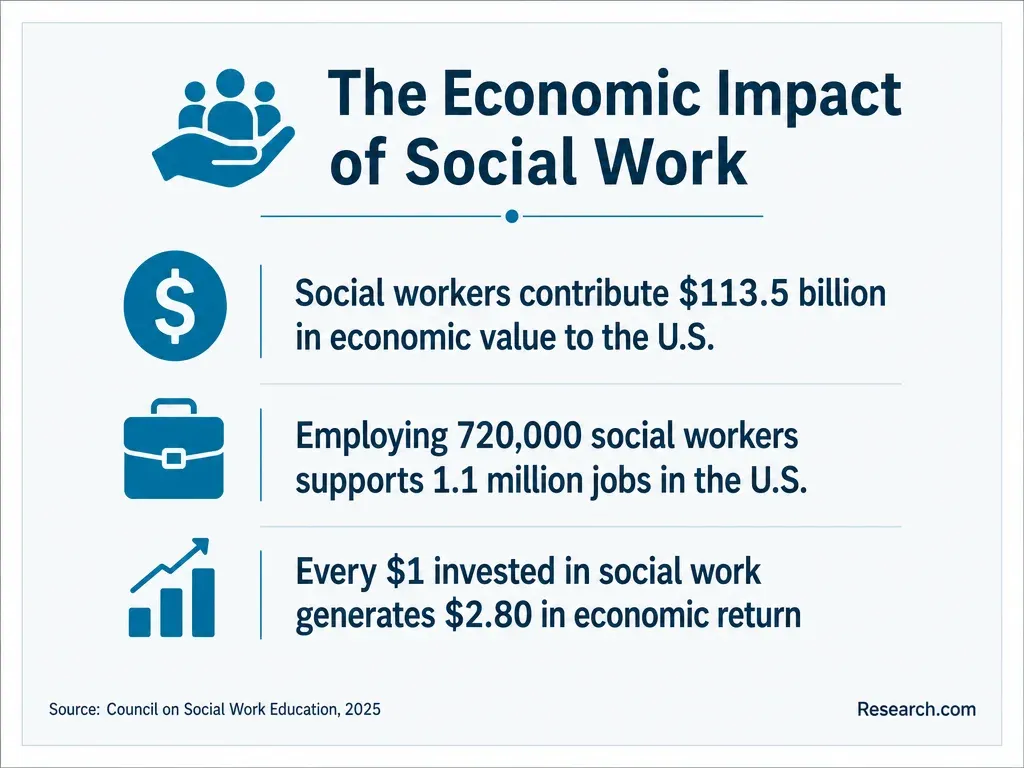
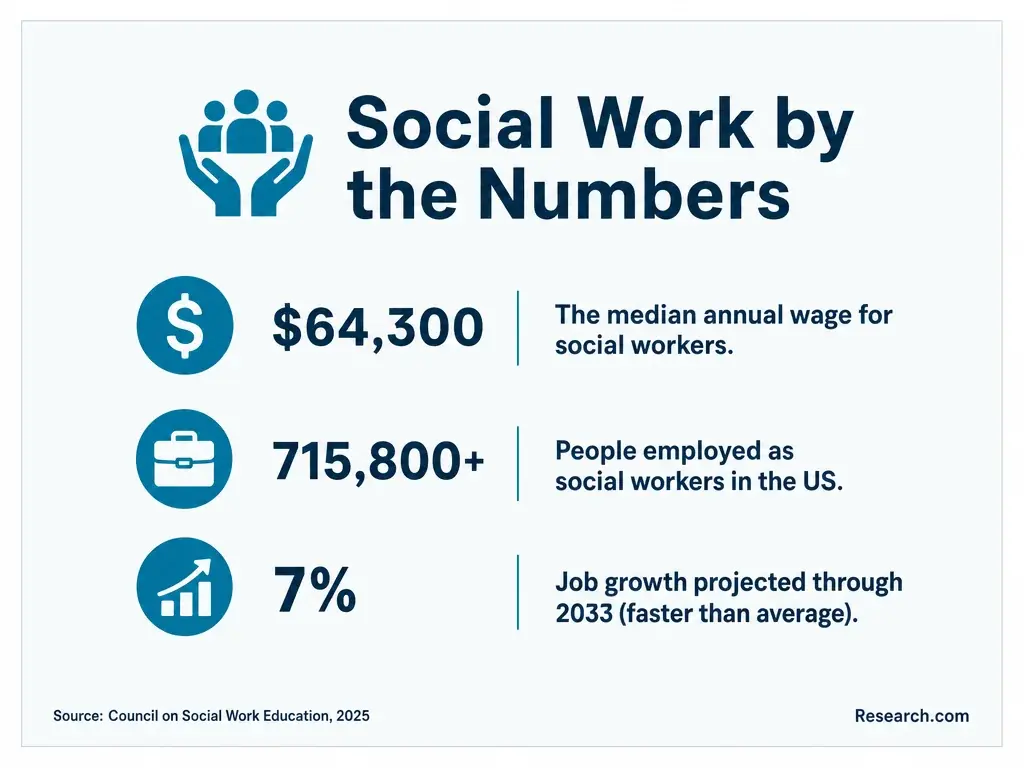
Use occupation-level figures as context, not as a prediction for a hospital case management offer. The U.S. Bureau of Labor Statistics figures supplied for healthcare social workers show median annual pay of $67,880 in May 2025 and 8% projected employment growth from 2025 to 2035. The healthcare social worker category is closer to hospital social work than an all-social-workers average, but it also includes workers outside hospitals.
BLS reported $93,600 in May 2024 median annual pay for registered nurses. That category includes bedside nurses and many other RN jobs; it is not an RN case manager salary. The figures also come from different reference years, so their difference should not be treated as the pay gap between two comparable hospital positions.
For an actionable comparison, collect local postings for both titles and compare base pay alongside shifts, on-call expectations, benefits, caseloads, and required experience. Geography also matters; social worker earnings and location considerations can help you investigate that variation without assuming a statewide figure matches one employer.
Hospitals may look for social workers who can conduct psychosocial assessments, work with families, document clearly, and navigate community resources under supervision appropriate to their role. A healthcare or hospital field placement can provide relevant exposure, but it is not a job guarantee. New graduates should ask about orientation, consultation, caseload expectations, and support for complex discharge decisions.
RN case management positions commonly seek nursing experience because the work depends on recognizing clinical needs and communicating with treating teams. Bedside, emergency, rehabilitation, or other relevant nursing work may be useful, but employers set their own experience thresholds. Prior non-nursing care coordination can be transferable without replacing RN licensure or clinical nursing experience.
If you already hold an MSW and want a hospital role with clinical responsibilities, distinguish the posting's requirements from a longer-term clinical licensing goal. MSW pathways for future clinical social workers may be relevant to an applicant still choosing a degree, but no concentration alone grants independent practice authority.
Social work preparation relevant to hospitals includes assessment, human behavior and social environments, policy and benefits, ethics, crisis response, documentation, and interprofessional practice.
Approved BSW or MSW field education lets students demonstrate those competencies with supervision. A placement's learning tasks and instructor must meet the program's rules; paid work or volunteering does not automatically count.
Nursing education builds assessment, clinical reasoning, pharmacology, patient education, and supervised clinical skills. Later RN case management preparation often comes through employer orientation and practice with care transitions, documentation systems, and payer processes. Nursing student clinical training is not the same as independent RN practice.
Compressed schedules deserve particular scrutiny. If you are considering fast-track social work master's study options, ask how the program sequences classes, live skills work, and field days. Finishing coursework faster does not eliminate approved field learning or create more placement availability.
A BSW or BSN commonly takes about four years of full-time undergraduate study. An associate nursing pathway is often shorter; an MSW after a non-BSW bachelor's degree commonly takes about two years of full-time study, while qualifying advanced-standing routes can be shorter. Accelerated nursing and part-time options change the calendar, and prerequisites, placement timing, and course availability can add time.
Compare total cost to qualify for the target job, not tuition alone. Include tuition and fees, books, required travel or campus visits, field or clinical placement expenses, reduced earnings during supervised training, and applicable exam and licensing costs.
As a simple illustration 60 credits at $600 per credit equal $36,000 in tuition, while 36 credits at the same rate equal $21,600. Eligibility for the shorter sequence and the credits actually charged determine whether that difference is available to you.
Ask each school for a written, track-specific cost and time estimate, including aid conditions and placement scheduling. Lower-tuition Master of Social Work pathways can help build a comparison list, but lower tuition will not necessarily mean lower overall cost if field scheduling substantially reduces paid hours.
How can you choose an accredited social work or nursing program?
Start with the job you want and the state where you expect to work. For social work, verify institutional accreditation, the specific BSW or MSW program's CSWE accreditation status, and the state board's education rules for any license you plan to seek.
For nursing, verify institutional and program accreditation as relevant to your goals, state board approval, and whether graduates can pursue RN licensure in your jurisdiction. Accreditation, board approval, admission, and eventual licensure are separate decisions.
Then ask the program for its current curriculum, placement or clinical-site policy, total-cost estimate, and requirements that apply to your entry term. Compare those answers with several local hospital postings. If a hospital role is your immediate goal, prioritize qualifying education and supervised preparation over an additional credential the employer does not request.
A doctorate is not ordinarily needed for either role. If your eventual objective changes to advanced leadership, education, or research, social work doctorate affordability comparisons belong in that separate decision, not in the entry-level cost calculation for hospital work.
Other Things You Should Know About Social Work Programs
Hospitals assign meeting leadership differently. The social worker or RN case manager may coordinate it, while the treating clinician explains medical decisions. Ask who will address each concern and how patient preferences will be documented.
Not simply by holding the social work role. A social worker can raise safety or access concerns and use the hospital's escalation process; medical decisions and patient rights must be handled under applicable law and policy.
The team can clarify the denial, communicate with the treating clinician, examine available review or appeal processes, and discuss feasible alternatives with the patient. Responsibilities depend on the hospital, payer, and circumstances.
Request informational interviews with both professionals and ask about a typical day, documentation, supervision, and difficult transitions. If a hospital permits observation, follow its privacy and onboarding rules.
- Rural Emergency Hospitals | cms.gov https://www.cms.gov/medicare/health-safety-standards/certification-compliance/rural-emergency-hospitals
- Case Management - StatPearls - NCBI Bookshelf https://www.ncbi.nlm.nih.gov/books/NBK562214/
- NASW Standards for Social Work Case Management | nycourts.gov https://www.nycourts.gov/reporter/webdocs/nasw_standards_socialwork_casemgt.htm
- Varying Estimates of Social Workers in the United States - PMC https://pmc.ncbi.nlm.nih.gov/articles/PMC11389054/
- Case Management: Discharge Planning | Hospital for Special Surgery https://www.hss.edu/patient-care/services/case-management-discharge-planning
- Case Manager vs Social Worker: What's the Difference? | Rehab Care Coordination https://rehabcarecoord.com/whats-the-difference-between-a-case-manager-and-a-social-worker/
- The Critical Role of Social Workers in Care Coordination | Patient Safety & Quality Healthcare https://www.psqh.com/analysis/bridging-hospital-and-home-the-critical-role-of-social-workers-in-care-coordination/
- What is scope of practice? | American Medical Association https://www.ama-assn.org/practice-management/scope-practice/what-scope-practice
- Health Professions Regulation in the US | HWTAC https://www.healthworkforceta.org/health-professions-regulation-in-the-us/
- NASW Standards for Social Work Case Management | socialworkers.org https://www.socialworkers.org/Practice/NASW-Practice-Standards-Guidelines/NASW-Standards-for-Social-Work-Case-Management