2027 Health Belief Model in Social Work: Perceptions, Barriers, and Service Engagement
Audited and Verified:
Our Editorial and Data Verification Process
Research.com uses government datasets, official education statistics and primary institutional information to support its career and degree guides. Our review process checks factual accuracy, occupational definitions, source dates and the requirements associated with the credentials discussed.
How This Article Was Fact-Checked
Our editorial team verifies salary estimates, employment projections, education requirements and program information against original data providers and official organizations. Salary figures are checked against the relevant occupational definitions and reporting periods. Information about licensure, accreditation and required in-person training is reviewed separately.
Fact-checked and verified on:

Co-Founder and Chief Data Scientist
A client can recognize a health concern and still miss an appointment, decline a referral, or stop using a service. The Health Belief Model helps social workers explore how people understand a potential problem, what they expect from taking action, and what makes that action difficult. For BSW and MSW students and early-career practitioners, it offers a way to ask better questions without labeling someone "noncompliant."
This article explains the model's components, shows how to apply them within social work's person-in-environment approach, and identifies when practical support or another framework matters more.
Key Things You Should Know
- The Health Belief Model examines six influences on health-related action: perceived susceptibility, severity, benefits, barriers, cues to action, and self-efficacy. It is a guide to inquiry, not a way to predict an individual's behavior.
- A missed service may reflect transportation, cost, discrimination, or limited appointment availability - not simply a belief that care is unnecessary. Social workers must check whether a barrier is real and changeable.
- Students can use the model to structure supervised assessment and outreach, but knowing it does not confer clinical competence or licensure. Program choice should turn on accredited preparation, field support, and the intended role.
What is the Health Belief Model in social work?
The Health Belief Model (HBM) is a framework for understanding decisions about health-related action. It considers how a person perceives a potential health problem, the likely value and difficulty of acting, what prompts action, and their confidence in carrying it out. In social work, it can inform conversations about preventive care, behavioral health referrals, treatment follow-through, or participation in supportive services.
The model is most useful as a set of questions, not a checklist of beliefs a worker assigns to a client. A person-in-environment assessment also considers housing, income, family responsibilities, service availability, discrimination, and institutional trust. That distinction matters across the settings described in graduate social work career planning: a hospital social worker and a community outreach worker may encounter the same expressed concern but have different resources and responsibilities for responding to it.
How do the Health Belief Model's components influence service engagement?
Each HBM component suggests a different reason someone might engage with - or avoid - a service. The examples below are hypothetical; a worker would ask rather than assume which, if any, applies.
| Component | Question it raises | Possible implication for engagement |
| Perceived susceptibility | Does the person believe the concern could affect them? | A referral may feel irrelevant if the concern seems unlikely. |
| Perceived severity | What consequences does the person expect? | They may prioritize other urgent needs if the concern seems less pressing. |
| Perceived benefits | What useful result do they expect from the service? | A clear, client-valued benefit may make participation more worthwhile. |
| Perceived barriers | What makes action difficult or undesirable? | Fees, travel, stigma, past harm, or scheduling can prevent access. |
| Cues to action | What might prompt a next step? | A reminder or trusted referral may help when a service is accessible. |
| Self-efficacy | Does the person feel able to complete the step? | Help with forms or a first call may make a plan more manageable. |
These components interact: a reminder will do little if the clinic has no available appointments. Students should practice testing such explanations in supervised field learning rather than treating the table as a prediction tool. When comparing placements, ask how the program develops these skills; MSW programs with organized practicum resources offer one starting point for questions about placement support.
How do social workers use the Health Belief Model in practice?
Social workers can use the HBM to shape a collaborative conversation: ask what the client understands, what outcome matters to them, what has made access difficult, and whether they want help with a next step. A worker might then coordinate a referral, clarify eligibility, arrange an interpreter, or - with permission - follow up. The chosen response depends on the worker's role, the client's wishes, and agency policy.
In a hypothetical hospital discharge conversation, a client who wants follow-up care might say that past appointments felt unhelpful and that the bus does not reach the clinic early enough. The worker should not reduce those concerns to "low perceived benefit." They could explore a more accessible appointment or transport option while documenting the client's stated priorities and the options offered. This is an example of assessment and service coordination, not a clinical treatment protocol.
Students learn to make and explain these judgments through coursework, observed practice, and feedback. Academic field instruction is separate from post-degree clinical supervision; graduates pursuing an independent clinical role should address planning supervised experience in a social work career under their state board's rules.
The HBM focuses on an individual's perceptions of health-related action. That makes it less complete as an explanation of behavior shaped by racism, immigration-related concerns, unsafe housing, caregiving demands, inaccessible services, or a justified lack of trust in institutions. Even when it identifies a perceived benefit, it cannot make an unavailable service available.
It also does not establish that changing a belief will change behavior for a particular client. Social workers should combine it with person-in-environment assessment, client-defined goals, and attention to policy and service design. Avoid using it to assign blame, infer a diagnosis, or override an informed refusal.
Learning the framework does not necessarily require another degree. Someone in a permitted outreach or service-coordination role may benefit more from supervised practice and focused training; someone seeking a regulated social work role must meet its education and licensing requirements. Applicants exploring MSW programs with flexible admission criteria should make that decision based on their target job, not on access to a single theory.
BSW and MSW programs may introduce the HBM in human behavior, health practice, research, or practice-methods coursework; coverage varies by program. A BSW student might compare HBM questions with a broader person-in-environment assessment. An MSW student might examine whether an outreach plan addresses both client concerns and agency access barriers.
Simulations can help students practice open-ended questions, but supervised field education tests whether they can engage respectfully, respond to feedback, document appropriately, and stay within their role. A useful learning objective is not "apply the HBM to every client." It is to identify when the model clarifies a service-engagement problem - and when structural analysis or another approach is more useful.
A DSW or PhD is not needed to learn this framework. Experienced practitioners considering DSW programs with condensed study schedules should evaluate the degree against a separate leadership or practice-improvement goal, not treat doctoral study as routine preparation for HBM-informed service work.
What careers, salaries, and job prospects involve the Health Belief Model?
The HBM is a skill used within jobs, not a job title or specialty license. Healthcare social workers may use it in discharge planning and referral conversations; mental health and substance use social workers may use it to explore service engagement; community outreach staff may use its questions in prevention work. Duties and credential requirements vary by employer and state, and some outreach roles do not require a social work degree.
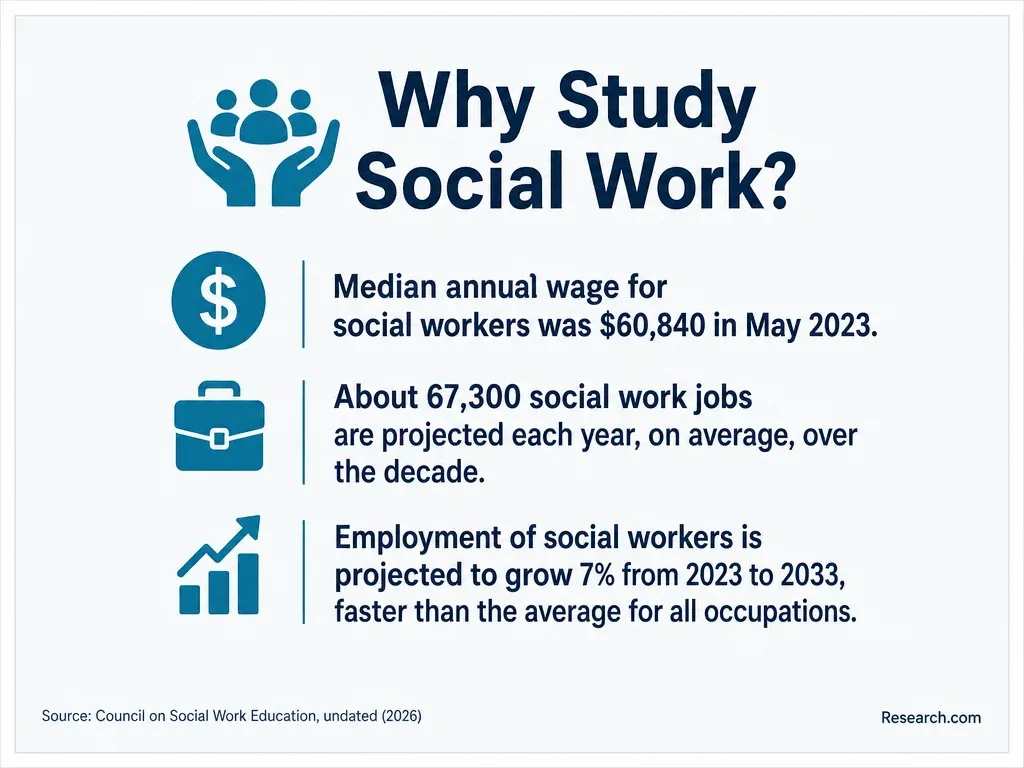
For US labor-market context, Bureau of Labor Statistics figures supplied for May 2025 place median annual pay at $67,880 for healthcare social workers and $60,280 for mental health and substance abuse social workers, with projected employment growth of 8% and 10%, respectively, from 2025 to 2035. These occupation-wide figures are not pay forecasts for an HBM-focused position or a new MSW graduate. Use them alongside local job postings to assess required licenses, supervision, caseloads, and the agency's ability to resolve access barriers.
For students planning MSW study with career outcomes in mind, the strongest test is whether the program's field experiences and graduates' likely roles match the work they want to do - not whether its description names a particular model.
Other Things You Should Know About Social Work
No. The HBM examines beliefs and conditions surrounding a health-related action. Stages-of-change approaches describe readiness to change over time. Neither should be used to assign a fixed label to a client.
Yes, its questions can help explore the family member's concerns and access needs. The worker must still respect each person's rights, consent, and applicable confidentiality rules.
No. A worker can use open-ended questions. A formal measure, if used, needs to fit its purpose, population, setting, and agency requirements.
It can examine appropriately collected measures such as completed referrals and client feedback, while also tracking service availability. A change in participation alone does not prove that the model caused it.
- Social and Cultural Meanings of Self-Efficacy - PMC - NIH https://pmc.ncbi.nlm.nih.gov/articles/PMC2921833/
- The Health Belief Model of Behavior Change - StatPearls - NCBI https://www.ncbi.nlm.nih.gov/books/NBK606120/
- Self-efficacy: The theory at the heart of human agency | apa.org https://www.apa.org/research-practice/conduct-research/self-efficacy-human-agency
- Psychiatry.org - Stigma, Prejudice and Discrimination Against People with Mental Illness https://www.psychiatry.org/patients-families/stigma-and-discrimination/
- NASW Standards for Social Work Case Management | socialworkers.org https://www.socialworkers.org/Practice/NASW-Practice-Standards-Guidelines/NASW-Standards-for-Social-Work-Case-Management
- The Health Belief Model | Rural Health Information Hub https://www.ruralhealthinfo.org/toolkits/health-promotion/2/theories-and-models/health-belief