2027 Ethical Decision-Making Models for Social Work Students: Comparing Frameworks
Audited and Verified:
Our Editorial and Data Verification Process
Research.com uses government datasets, official education statistics and primary institutional information to support its career and degree guides. Our review process checks factual accuracy, occupational definitions, source dates and the requirements associated with the credentials discussed.
How This Article Was Fact-Checked
Our editorial team verifies salary estimates, employment projections, education requirements and program information against original data providers and official organizations. Salary figures are checked against the relevant occupational definitions and reporting periods. Information about licensure, accreditation and required in-person training is reviewed separately.
Fact-checked and verified on:

Co-Founder and Chief Data Scientist
A social work student may recognize a conflict between client choice, confidentiality, safety, and agency rules without knowing how to reach a defensible decision. Ethical decision-making models turn that uncertainty into a process for gathering facts, comparing duties, consulting others, and explaining a choice.
This guide compares three widely taught frameworks and shows how to use them in coursework and supervised field education. It also clarifies where a model ends and the NASW Code of Ethics, law, agency policy, and professional supervision begin.
Key Things You Should Know
- Choose a model for the task: Reamer's process supports a thorough case analysis; ETHIC offers a memorable sequence; the Ethical Principles Screen helps compare competing principles.
- No model supplies legal authority: Check applicable law, agency rules, the NASW Code of Ethics, and supervision before acting on a real case.
- Show your reasoning: Identify affected people, missing facts, feasible options, likely harms, consultation, and a plan to review the decision.
What are ethical decision-making models in social work?
Ethical decision-making models are structured ways to reason through situations in which social work values, professional duties, or legitimate interests pull in different directions. They are process tools, not rules that produce an automatic answer. A model helps a student distinguish a genuine conflict - such as respecting a client's wishes while addressing a possible safety concern - from a question that can be settled by finding the applicable policy.
Most models ask practitioners to establish the facts, identify everyone affected, consider professional standards and legal duties, develop options, consult appropriately, weigh consequences, act within their role, and revisit the result. Those habits matter in clinical, school, child welfare, healthcare, and community settings, although the governing rules and available options differ. They are among the transferable social work master's skills across career settings; knowing the steps in class does not establish competence to make an unsupervised practice decision.
What ethical decision-making models do social workers use?
Social workers use several teaching and practice frameworks rather than one profession-wide required model. Three commonly discussed options are Frederic Reamer's deliberative approach, Elaine Congress's ETHIC model, and the Ethical Principles Screen associated with Frank Loewenberg, Ralph Dolgoff, and Donna Harrington. Instructors may teach different versions or additional approaches; students should use the formulation assigned in their course and check the original source when citing it.
Reamer's approach emphasizes identifying conflicting obligations, reviewing standards and laws, consulting, considering possible actions and consequences, documenting the rationale, and evaluating the outcome. ETHIC provides a sequence: Examine values; Think about ethical standards and laws; Hypothesize consequences; Identify who benefits and who may be harmed; and Consult. The Ethical Principles Screen compares competing duties using a proposed ordering of principles, beginning with protection of life and also addressing equality, autonomy, least harm, quality of life, privacy, and truthfulness.
These are ethical reasoning tools, not clinical treatments. Students considering clinical MSW education and professional development should expect to practice ethical reasoning alongside clinical skills and supervision, not assume that learning a model grants authority to provide independent treatment.
How do Reamer's model, the ETHIC model, and the Ethical Principles Screen compare?
The best starting point depends on what the assignment or practice situation requires. This comparison shows each framework's most useful contribution and the limitation a student should address explicitly.
| Framework | Best fit | Strength | Watch for |
| Reamer's approach | A complex case needing a documented, consultative analysis | Makes room for facts, alternatives, duties, consequences, and review | Its thoroughness does not replace a timely response to an urgent issue |
| ETHIC model | A first pass through a case or a structured class discussion | Memorable prompts expose values, harms, and the need to consult | Completing the acronym can become superficial if facts or options remain unexamined |
| Ethical Principles Screen | A disagreement about which ethical principle deserves priority | Makes the proposed ordering of competing principles visible | Its ordering is not a universal legal rule or a substitute for context |
For a substantial case paper, Reamer's approach can organize the full analysis, while ETHIC checks whether the student has considered affected people and consultation. The Principles Screen can sharpen one disputed trade-off within that analysis. Using more than one model is useful only if each adds reasoning; citing three names is not evidence of a sound decision. Likewise, program selectivity does not show how well students learn to apply a framework. When reviewing MSW entry options beyond highly selective programs, ask how instructors assess case analysis, consultation, and field performance.
The NASW Code of Ethics supplies professional values, principles, and standards that a student can bring into a model-based analysis. Relevant standards may address commitment to clients, self-determination, informed consent, privacy and confidentiality, competence, supervision, colleagues, or responsibilities to the broader society. A useful case analysis identifies the specific standards at issue and explains why they apply rather than referring vaguely to "the Code."
The Code acknowledges that ethical duties can conflict; it does not provide a mechanical answer to every dilemma. Nor does NASW issue licenses, decide what a state reporting law requires, or override a binding legal obligation. Students should check the Code's applicable text, then separately verify law and agency requirements with qualified supervisors or other designated resources.
Ethics instruction should build from foundation knowledge into supervised application, whether a student enters a traditional MSW sequence or qualifies for advanced standing. When comparing advanced standing and standard MSW pathways, examine how each sequence teaches and assesses ethical judgment rather than assuming that a shorter sequence omits it.
Use a hypothetical classroom example: an adult receiving services asks a student not to share a concern with the agency team, while the student believes the concern may affect safety. The description alone is insufficient to determine a disclosure or reporting duty. The student's job is to identify what must be learned and involve the field instructor before taking action outside the approved role.
A case analysis should move through these steps, recording uncertainties rather than filling them with assumptions:
- State the dilemma: Identify the competing duties and separate confirmed facts from the student's interpretations.
- Check authority: Locate relevant Code standards, jurisdiction-specific requirements, agency procedures, and the student's role boundaries.
- Map options: Consider what can be discussed with the client, what consultation is needed, and which responses are permitted.
- Compare effects: Use a chosen model to assess likely benefits, harms, client voice, privacy, and the consequences of inaction.
- Consult, document, and review: Seek field instruction through approved channels; record the rationale as required and revisit it when facts change.
In an assignment, students can demonstrate reasoning with a fictional or properly de-identified case. In field education, the agency and field program determine what a student may do and how a real case may be discussed. When evaluating field placement assistance in online MSW education, ask who provides qualified field instruction and how students can obtain timely consultation when ethical concerns arise.
What careers, salaries, and job prospects are available to social work graduates?
Ethical reasoning matters in child and family services, schools, healthcare, behavioral health, and other social work settings. Duties and entry qualifications differ: some roles require a BSW or MSW, some require a state license or school-specific qualification, and independent clinical work generally requires additional state-defined steps. For an early-career student, accessible supervision, manageable responsibilities, and clear reporting procedures may be more important to ethical practice than a particular job title.
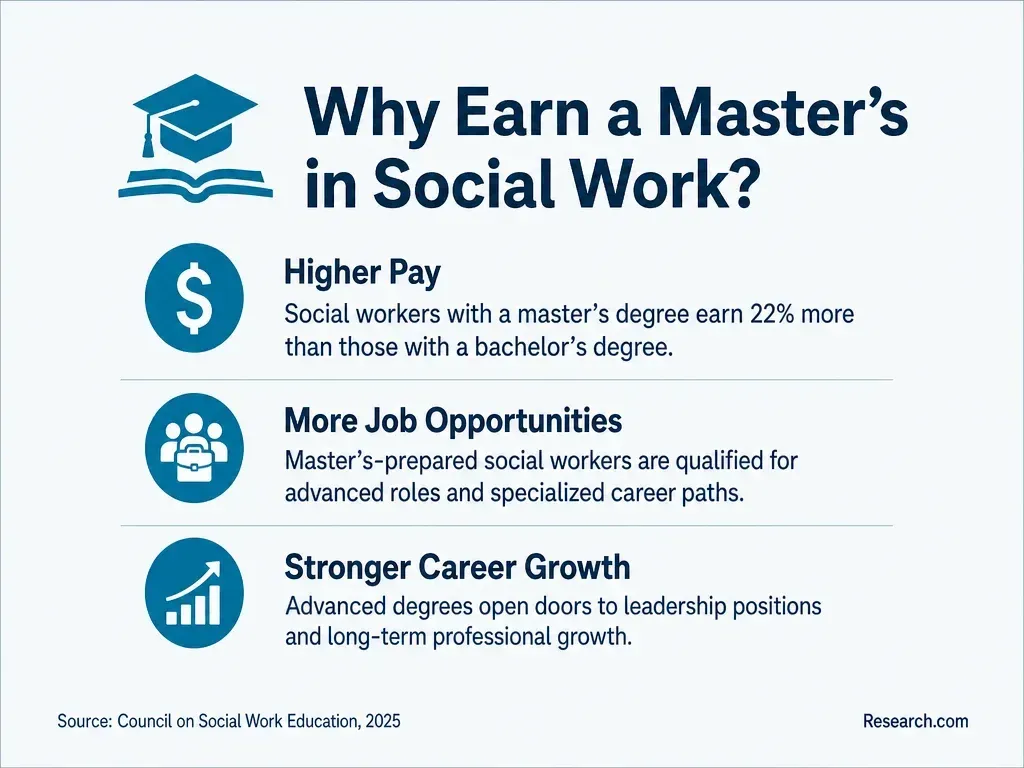
The following U.S. Bureau of Labor Statistics figures provide occupational context, not promised pay for a degree, a new graduate, or a specific license. Median annual wages are for May 2025; growth projections cover 2025-2035.
| BLS occupation | Median annual wage | Projected employment growth |
| Child, family, and school social workers | $59,550 | 4% |
| Healthcare social workers | $67,880 | 8% |
| Mental health and substance abuse social workers | $60,280 | 10% |
| Social workers, all specialties | $61,780 | 6% |
These categories encompass workers with different experience, credentials, employers, and locations. Use the figures to compare occupational directions, then examine local postings for the actual duties, qualifications, supervision, and pay. MSW career compensation by state can add geographic context, but it cannot predict an individual offer or justify choosing a practice setting solely by its median wage.
Other Things You Should Know About Social Work
Learn the logic well enough to use it, but follow your instructor's expectations for exams and assignments. In practice, accurate facts, consultation, and a defensible rationale matter more than reciting an acronym.
Cite the specific author and version you used, using your course's required citation style. Check the original publication or assigned reading rather than attributing every model to NASW.
Do not enter identifiable or agency-confidential information without explicit authorization under applicable school and agency rules. If AI use is permitted, follow disclosure requirements and verify its claims against governing sources.
Tell the instructor what support or adjustment you need without feeling obliged to disclose private details to classmates. Student support services and supervision can help you participate while maintaining appropriate boundaries.
- Respecting privacy and upholding confidentiality: core ethical duties - PMC https://pmc.ncbi.nlm.nih.gov/articles/PMC12747445/
- Disability Barriers to Inclusion | cdc.gov https://www.cdc.gov/disability-inclusion/barriers/index.html
- A Framework for Ethical Decision Making | SCU https://www.scu.edu/ethics/ethics-resources/a-framework-for-ethical-decision-making/
- The Mezzo-Informed Ethical Decision-Making Model | iupui.edu https://advancesinsocialwork.iupui.edu/index.php/advancesinsocialwork/article/download/28829/26611
- Case Method Teaching and Learning | columbia.edu https://ctl.columbia.edu/resources-and-technology/resources/case-method/
- NASW Standards for Social Work Case Management | socialworkers.org https://www.socialworkers.org/Practice/NASW-Practice-Standards-Guidelines/NASW-Standards-for-Social-Work-Case-Management
- ETHICS→A: Ethical Decision-Making Tool - OCSWSSW https://www.ocswssw.org/ocswssw-resources/ethics-a-ethical-decision-making-tool/
- Essential Steps for Ethical Problem-Solving - National Association of Social Workers https://www.naswma.org/page/100/Essential-Steps-for-Ethical-Problem-Solving.htm
- Ethical Decision Making Meets the Real World of Field Work | SocialWorker.com https://www.socialworker.com/feature-articles/ethics-articles/Ethical_Decision_Making_Meets_the_Real_World_of_Field_Work/
- Ethical Humility in Social Work | International Journal of Social Work Values and Ethics https://jswve.org/volume-19/issue-3/item-10/