2027 Distributive Justice in Social Work: Resource Allocation and Social Policy
Audited and Verified:
Our Editorial and Data Verification Process
Research.com uses government datasets, official education statistics and primary institutional information to support its career and degree guides. Our review process checks factual accuracy, occupational definitions, source dates and the requirements associated with the credentials discussed.
How This Article Was Fact-Checked
Our editorial team verifies salary estimates, employment projections, education requirements and program information against original data providers and official organizations. Salary figures are checked against the relevant occupational definitions and reporting periods. Information about licensure, accreditation and required in-person training is reviewed separately.
Fact-checked and verified on:

Co-Founder and Chief Data Scientist
When housing assistance, benefits, or agency appointments cannot meet everyone's needs, social workers must help make allocation decisions that are fair, explainable, and consistent with clients' rights. Those decisions are also shaped by policies that determine who qualifies in the first place.
This guide explains distributive justice in day-to-day practice and social welfare policy, then shows students and early-career professionals how to evaluate education, field placements, licensing needs, and careers that put the principle to work.
Key Things You Should Know
- Distributive justice concerns how benefits, burdens, and opportunities are shared; fair allocation requires more than treating every applicant identically.
- Social workers can examine need, eligibility rules, barriers to access, and the effects of decisions on different groups, while following law and agency policy.
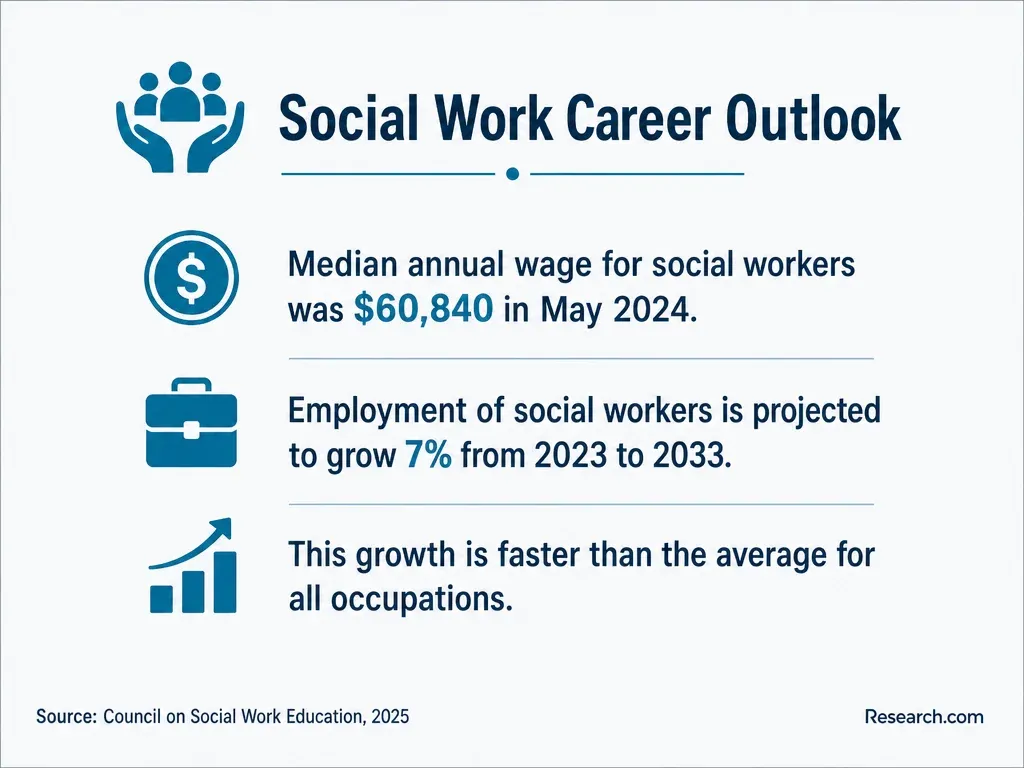
- Policy roles do not uniformly require a social work license. For context, the U.S. Bureau of Labor Statistics reports a $61,780 median annual wage for social workers overall in May 2025, not a salary specific to policy jobs.
What is distributive justice in social work?
Distributive justice is the question of how a society or institution shares resources, risks, and opportunities. In social work, the resources might be rental assistance, treatment appointments, school supports, or public benefits. The burdens might include long waits, complex applications, travel, or requirements that fall unevenly on people with fewer resources.
Equal treatment is not always equitable treatment. Offering everyone the same appointment time, for example, may disadvantage people who cannot leave work or reach the office. Distributive justice asks who receives help, who cannot access it, and whether the reasons are defensible. It differs from procedural justice, which concerns whether the decision-making process is consistent, transparent, and open to appropriate review. Agencies need both: a fair-sounding priority rule is of little use if people cannot learn about or challenge its application.
The principle is a lens for ethical reasoning, not a formula that overrides eligibility law, funder restrictions, or client choice. Students considering choosing an accredited BSW program can look for instruction that connects this ethical lens to policy, human behavior, and supervised generalist practice.
How do social workers apply distributive justice when allocating resources?
In direct service, social workers often cannot decide how much funding exists or rewrite eligibility rules. They can still make access more equitable within their authority: explain criteria accurately, identify avoidable barriers, document unmet need, coordinate referrals, and bring patterns of exclusion to supervisors or policy teams. A referral is not the same as confirmed access; a service may have a waitlist, transportation barrier, or eligibility condition.
When an agency has discretion over a scarce resource, a defensible process should make its priorities explicit before individual decisions create pressure for exceptions. The following sequence helps staff examine both the allocation rule and its effects:
- Identify the resource, governing eligibility requirements, available capacity, and who has authority to decide.
- Agree on relevant priority factors, such as urgency, risk, or barriers to accessing alternatives; avoid relying on who applies first if that rewards better-connected applicants.
- Explain criteria in accessible language, apply them consistently, and document reasons without collecting unnecessary personal information.
- Provide any available review or appeal route, track unmet need, and examine whether outcomes differ across groups.
Consider a hypothetical agency with a limited number of transportation vouchers. Prioritizing clients with time-sensitive appointments and no workable transit option may be more defensible than distributing vouchers solely by arrival order. Staff must still check funding rules, accessibility needs, client preferences, and agency procedures rather than treating this example as an approved allocation policy. Students can seek MSW programs offering help finding practicum sites where supervised work includes referral systems, benefits access, or program evaluation.
How does distributive justice influence social welfare policy?
Social welfare policy turns allocation choices into rules: who is eligible, how much support is available, how applications are processed, and what happens when funding runs short. A policy can expand access while still leaving gaps. For example, an online-only application might simplify administration for some households but exclude people without reliable internet, accessible technology, or language support.
Social workers contribute by combining service experience with evidence. A policy analysis can compare the stated goal with take-up, denial, waitlist, and geographic data; consult affected communities; identify administrative barriers; and estimate how a proposed change would affect staff capacity and funding. It should distinguish an inequitable outcome from its possible causes rather than assuming one statistic proves discrimination. Privacy safeguards and appropriate approval matter when using client or agency records.
Advocacy can seek clearer notices, accessible applications, different eligibility criteria, or a larger appropriation. Implementation matters as much as legislation: a better-funded program may still be hard to use if offices lack staff or transportation is unavailable. Working professionals studying these systems may consider flexible graduate social work course formats, but should verify live policy seminars, group work, and field schedules rather than assuming every online requirement is self-paced.
Useful coursework connects ethics and social welfare policy to research methods, program evaluation, public budgeting, community practice, and the administration of benefits. The strongest learning task is not simply arguing that a policy is unfair; it is identifying an allocation rule, examining who it reaches, assessing feasible alternatives, and explaining trade-offs with evidence.
Field education can make those questions concrete through supervised work at a benefits agency, housing nonprofit, community organization, or policy office. Ask whether students can observe eligibility decisions, support outreach, analyze appropriately accessible aggregate data, or participate in a policy project. An agency's mission alone does not guarantee those learning opportunities. The school must approve the placement and its learning agreement; employment or volunteering does not automatically count as field education.
Shorter schedules may intensify rather than remove placement demands. When comparing short-format MSW program comparisons, ask the field office how placement days align with policy courses and whether the agency can provide qualified instruction. A portfolio-ready project should use approved, nonidentifying information and accurately describe the student's contribution, not imply access to confidential records or claim unmeasured outcomes.
What are the salary and job outlook prospects for social work policy careers?
There is no single national wage category for "distributive justice" or "social work policy" jobs. The U.S. Bureau of Labor Statistics reports a May 2025 median annual wage of $61,780 for social workers overall and projects 6% employment growth from 2025 to 2035. Those figures describe the broad social worker occupation, not policy analysts specifically, and should not be treated as an expected salary or growth rate for an MSW graduate entering advocacy.
Pay for a policy role depends on its occupational classification, location, employer, experience requirements, and - in government - civil-service grade. Compare posted local salary ranges and advancement criteria with the cost of any additional education. Information on understanding location differences in MSW earnings can add context, but a state-level figure cannot substitute for the range attached to the job you want.
Other Things You Should Know About Social Work
Possibly, when eligible applicants have equally strong claims and the governing rules permit it. An agency should first consider whether urgency or barriers to alternatives justify priority, then document and explain any lottery process.
Not without addressing confidentiality, consent, agency rules, and applicable law. Deidentified examples can still reveal someone's identity through context; use approved information and seek appropriate review before sharing.
Apply current rules within the worker's authority, clarify any permissible exceptions or appeals, and document patterns of unmet need. Raise concerns through supervision and appropriate policy or advocacy channels rather than promising an unauthorized exception.
Yes. If a screening tool relies on incomplete data or criteria that disadvantage certain applicants, its decisions may be inconsistent with equitable access. Agencies should examine accessibility, error correction, human review, and outcome differences before relying on it.
- CDC Program Evaluation Framework, 2024 | MMWR https://www.cdc.gov/mmwr/volumes/73/rr/rr7306a1.htm
- The Root Causes of Health Inequity - Communities in Action https://www.ncbi.nlm.nih.gov/books/NBK425845/
- Addressing Social Needs in Health Care Settings - PMC - NIH https://pmc.ncbi.nlm.nih.gov/articles/PMC8240195/
- NASW Standards for Social Work Case Management | nycourts.gov https://www.nycourts.gov/reporter/webdocs/nasw_standards_socialwork_casemgt.htm
- Social Worker Decision-Making (Chapter 42) | Cambridge Core https://www.cambridge.org/core/books/cambridge-handbook-of-psychology-and-legal-decisionmaking/social-worker-decisionmaking/E4BB01A61694D0FA0316EEE2F38D9164
- Distributive Justice - an overview https://www.sciencedirect.com/topics/social-sciences/distributive-justice
- Distributive Justice - Stanford Encyclopedia of Philosophy https://plato.stanford.edu/entries/justice-distributive/
- Educational Outcomes | syr.edu https://answers.atlassian.syr.edu/wiki/spaces/SOE/pages/166036364/Educational+Outcomes
- Disparities in Health and Health Care: 5 Key Questions and Answers | KFF https://www.kff.org/racial-equity-and-health-policy/disparities-in-health-and-health-care-5-key-question-and-answers/
- 2029 EPAS | Council on Social Work Education https://www.cswe.org/2029-epas