2027 Disenfranchised Grief in Social Work: Recognizing Loss That Lacks Social Acknowledgment
Audited and Verified:
Our Editorial and Data Verification Process
Research.com uses government datasets, official education statistics and primary institutional information to support its career and degree guides. Our review process checks factual accuracy, occupational definitions, source dates and the requirements associated with the credentials discussed.
How This Article Was Fact-Checked
Our editorial team verifies salary estimates, employment projections, education requirements and program information against original data providers and official organizations. Salary figures are checked against the relevant occupational definitions and reporting periods. Information about licensure, accreditation and required in-person training is reviewed separately.
Fact-checked and verified on:

Co-Founder and Chief Data Scientist
A person may be grieving deeply while family, employers, or service systems treat the loss as insignificant - or refuse to recognize the relationship at all. Social workers need to notice that gap without deciding whose grief is legitimate.
This guide is for students, new practitioners, and social services professionals who want to understand disenfranchised grief, respond within their roles, and decide whether grief-focused coursework, field experience, or clinical training fits their goals.
Key Things You Should Know
- Disenfranchised grief is grief that lacks social acknowledgment; the loss, relationship, or mourner may be dismissed even when the distress is substantial.
- Useful support starts by asking what the loss means to the person, identifying barriers to recognition, and offering choices - not imposing a diagnosis or a prescribed way to mourn.
- BSW-level support and MSW-level clinical preparation serve different roles; independent grief psychotherapy depends on state-specific licensure and, typically, post-degree supervised experience.
What is disenfranchised grief in social work?
Disenfranchised grief describes grief that a person's social world does not fully recognize, permit, or support. Social work scholar Kenneth Doka introduced the concept to explain why some mourners have less access to sympathy, rituals, leave, and practical help. The term describes a social response to loss; it is not, by itself, a mental health diagnosis.
Recognition may fail because others dismiss the relationship, regard the loss as minor, stigmatize its circumstances, or believe the person should not be grieving. A person-in-environment perspective helps social workers look beyond individual symptoms to family expectations, workplace rules, discrimination, and access to services.
This distinction matters when considering choosing among online social work programs: a program's grief content is more useful when students can also learn to assess the social conditions shaping a client's loss. Recognizing disenfranchisement does not determine whether someone needs counseling; that decision requires an assessment appropriate to the worker's role.
What are examples of disenfranchised grief?
These examples show different ways acknowledgment can be withheld. None means every person in the situation will grieve in the same way.
| Loss or relationship | How recognition may be withheld |
| Death of a former partner, close friend, or nontraditional family member | Others treat the mourner as less important than legally recognized relatives or exclude them from decisions and rituals. |
| Pregnancy loss, infertility, or an adoption that does not proceed | People minimize the loss because there was no publicly recognized death or shared ceremony. |
| Death involving overdose, suicide, or incarceration | Stigma limits what mourners feel safe disclosing or the support others offer. |
| Loss of a pet, housing, health, identity, or a hoped-for future | Others insist that grief is inappropriate because the loss does not fit a conventional bereavement category. |
| Death of a client or care recipient | A worker's professional role leaves little room to acknowledge a meaningful relationship while maintaining boundaries. |
The same loss may be recognized in one community and dismissed in another. For a student connecting a social work master's degree to career goals, these differences are a reason to examine the populations and settings in which they hope to work, rather than assuming every grief-focused role involves psychotherapy.
How do social workers recognize and support disenfranchised grief?
Begin with the person's account, not a checklist of supposedly valid losses. A social worker can ask what has changed, who knows about the loss, what support is welcome, and whether disclosure could create risks. The response should match the worker's training, setting, and authority.
A practical sequence helps keep recognition from turning into assumptions:
- Make space: Use open language such as "What has this loss meant for you?" without requiring the person to identify as bereaved.
- Assess context and needs: Ask about available support, cultural or spiritual practices, immediate practical concerns, and any safety issues within the worker's role.
- Offer choices: Collaborate on options such as a personally meaningful ritual, peer support, benefits assistance, or a referral for clinical assessment.
- Document carefully: Record relevant needs and agreed actions without unnecessarily exposing a relationship, identity, or circumstance the person has not consented to share.
Validation is not a promise to keep information secret in every circumstance. Explain confidentiality and its limits, follow applicable reporting and agency rules, and seek supervision when safety or scope is unclear. Students should look for MSW field placement support and student responsibilities that allow them to practice these skills with feedback, rather than treating classroom familiarity as clinical competence.
Requirements depend on the state and what "grief counseling" means in the job description. Supportive conversations, case management, and referrals may fall within a generalist or agency role; diagnosis and psychotherapy involve a different scope. State law and employer policy - not the topic of grief alone - determine what a worker may do.
For independent clinical social work, states generally require qualifying social work education, an application and any required examination, and documented post-degree supervised clinical experience before issuing the relevant license. License titles, supervisor qualifications, and permitted activities vary. An MSW, a clinical concentration, or completed field placement does not independently confer clinical practice authority.
Before accepting a counseling position, compare its actual duties with the state board's current requirements and your license status. The distinction between academic placements and post-degree practice is particularly important when reviewing clinical experience expectations across social work pathways. If the role crosses state lines or uses telehealth, verify authorization in each relevant jurisdiction rather than assuming one license covers it.

Grief support appears across jobs, not only in positions labeled "bereavement counselor." Hospice and healthcare social workers help families navigate serious illness and death; school and family social workers may support young people through losses others overlook; behavioral health clinicians may assess and treat distress when clinical care is appropriate. Community and nonprofit staff can coordinate groups, benefits, outreach, and referrals without necessarily providing psychotherapy.
For each opening, read the duties before relying on its title. Check whether it requires a BSW, MSW, active license, independent clinical license, or another credential; whether supervision is provided; and how much time is allotted for follow-up and documentation. A well-supported generalist role may fit someone interested in access and advocacy better than a counseling track.
If speed to an eligible MSW-level role matters, compare field sequencing alongside MSW completion time and program format comparisons. Faster graduation does not shorten a state's separate post-degree clinical supervision requirement.
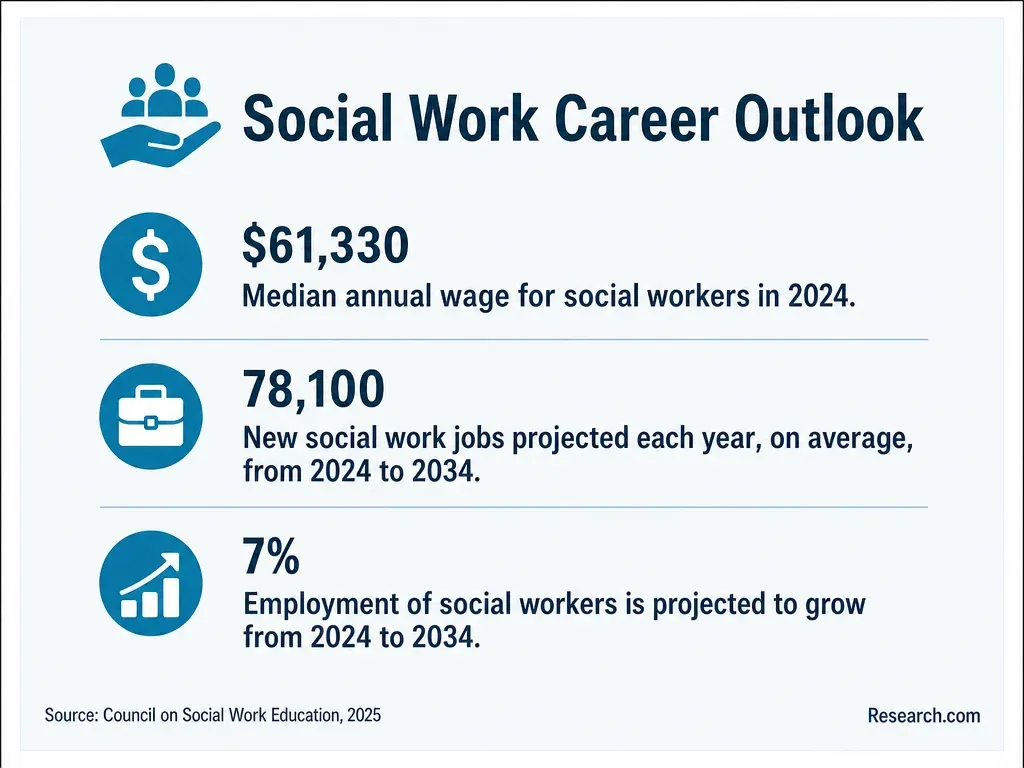
What are the salary and job outlook for social workers in bereavement settings?
The U.S. Bureau of Labor Statistics does not publish a separate occupation for disenfranchised-grief or bereavement social workers. Its broader occupations provide context for comparing settings, not a predicted wage for a particular graduate, license, or hospice job.
| U.S. occupation | Median annual pay, May 2025 | Projected employment growth, 2025-2035 |
| Healthcare social workers | $67,880 | 8% |
| Mental health and substance abuse social workers | $60,280 | 10% |
| Child, family, and school social workers | $59,550 | 4% |
| Social workers, all specialties | $61,780 | 6% |
Use the category that matches a prospective job's work, then compare local postings by license requirement, supervision, schedule, and benefits. MSW earnings and geographic career planning can add location context, but occupation-wide medians cannot establish the financial payoff of a specific program.
Other Things You Should Know About Social Work
Not necessarily. Disclosure is a personal decision, although obtaining a particular leave or accommodation may require information under the employer's policy or applicable law. A social worker can help the person review options without urging disclosure that feels unsafe.
Yes. People may grieve anticipated changes while someone is seriously ill or a relationship, home, or ability is at risk. The worker should ask what the person is experiencing rather than assume a particular course of grief.
No. A group can provide recognition, but privacy concerns, accessibility, safety, and personal preference matter. Offer it as an option, alongside individual support or practical assistance when available.
Review who can access services, the language used on forms and in outreach, and confidential feedback from participants. Avoid assuming that only legally recognized relatives - or only people grieving a death - need support.
- Bereavement issues and prolonged grief disorder - PMC - NIH https://pmc.ncbi.nlm.nih.gov/articles/PMC10579660/
- Grief and Prolonged Grief Disorder - StatPearls - NCBI - NIH https://www.ncbi.nlm.nih.gov/books/NBK507832/
- Ethical Dilemmas in Social Work | VCU Online https://onlinesocialwork.vcu.edu/blog/ethical-dilemmas-in-social-work/
- Health Inequities, Social Determinants, and Intersectionality | NAM https://nam.edu/perspectives/health-inequities-social-determinants-and-intersectionality/
- Ethical Challenges in Social Work: Navigating Complex Cases | Indiana Wesleyan University https://www.indwes.edu/articles/2024/12/ethical-challenges-in-social-work-navigating-complex-cases
- Cultural considerations around death and grief | The Grief-Sensitive Healthcare Project https://griefsensitivehealthcare.org/cultural-considerations-around-death-and-grief
- Exploring the concept of disenfranchised grief | scielo.org.za https://www.scielo.org.za/scielo.php
- Which Types of Death May Lead to Disenfranchised Grief in Patients? - The Loss Foundation https://thelossfoundation.org/which-types-of-death-may-lead-to-disenfranchised-grief-in-patients/