2027 CSWE Accreditation vs State Licensure: Separate Questions for MSW Applicants
Audited and Verified:
Our Editorial and Data Verification Process
Research.com uses government datasets, official education statistics and primary institutional information to support its career and degree guides. Our review process checks factual accuracy, occupational definitions, source dates and the requirements associated with the credentials discussed.
How This Article Was Fact-Checked
Our editorial team verifies salary estimates, employment projections, education requirements and program information against original data providers and official organizations. Salary figures are checked against the relevant occupational definitions and reporting periods. Information about licensure, accreditation and required in-person training is reviewed separately.
Fact-checked and verified on:

Co-Founder and Chief Data Scientist
A CSWE-accredited MSW can satisfy an important education requirement without making its graduate a licensed social worker. That distinction matters when you compare programs, arrange field placements, and plan where you intend to practice. This guide is for prospective MSW students and new graduates who need to separate a program's accreditation status from a state board's licensing decision. It explains how to check both, what may be required after graduation, and which questions to resolve before committing to a program.
Key Things You Should Know
- CSWE accredits social work programs; state boards license individuals. Graduation, exam eligibility, license issuance, and independent clinical authority are separate milestones.
- Check the exact MSW program and your intended state. Verify accreditation status for your entry cohort, then confirm that state's education, examination, supervision, and application rules with its licensing board.
- MSW field education generally does not replace post-degree clinical supervision. Online delivery or a license from another state does not remove the need to verify local practice requirements.
What is the difference between CSWE accreditation and state social work licensure?
CSWE accreditation evaluates a social work degree program; state licensure determines whether an individual may use a licensed title or perform regulated work in a particular jurisdiction. The Council on Social Work Education (CSWE) does not issue practice licenses. A state licensing board does not accredit an MSW program, though it may require a degree from a program with a specified accreditation status.
The distinction is easiest to see by separating the decision makers:
| Question | Who decides? | What the answer establishes |
| Is this MSW program accredited? | CSWE | The program's accreditation status, subject to the status and dates shown in CSWE's official records |
| Does my degree meet a state's education rule? | The applicable state licensing board | Whether the applicant's education qualifies for a particular license category |
| May I practice under a licensed title? | The applicable state licensing board | Whether a license has been issued and what its scope permits |
A university's institutional accreditation is another, separate consideration: it does not establish that its MSW has CSWE programmatic accreditation. Likewise, a clinical concentration describes educational emphasis, not a license. For a broader look at how educational credentials relate to work, see online social work qualifications and career directions.
Is a CSWE-accredited MSW required for state licensure?
Often, but the controlling rule is the rule for the specific state and license sought. State boards commonly use graduation from a CSWE-accredited social work program as an MSW-level education standard. Some rules address substantially equivalent education or other limited circumstances differently. Applicants should not assume that an exception exists - or that a school's assurance settles the question - without confirmation from the board.
Check the exact degree program, not just the university or an associated BSW. If you are considering advanced standing, also check whether your prior BSW meets the MSW program's entry rules; a psychology, sociology, or human services bachelor's degree does not automatically qualify. Students comparing earlier routes into social work can use a guide to comparing accredited social work bachelor's degrees, while confirming each school's and board's requirements independently.
Before paying an enrollment deposit, ask the intended licensing board whether it accepts the program's accreditation status for your anticipated graduation cohort and desired license category. Get clarification in writing when the program has a pending status, a recent accreditation change, or an unusual degree arrangement. Accreditation should not be presumed to apply retroactively.
What are the state licensing requirements after earning an MSW?
An MSW is an educational qualification, not an issued license. Depending on the state and category, a graduate may need to submit transcripts and an application, meet background or other eligibility requirements, obtain authorization for and pass an examination, and pay fees. Independent clinical licensure generally involves additional, board-accepted post-degree supervised experience. The order of these steps, available license levels, exam requirements, and permitted work while an application is pending vary by state.
Use the intended board's current application materials to map your route before selecting a program. Record these checkpoints in order:
- Identify the state's exact entry-level and clinical license titles, including which one matches your intended duties.
- Confirm its qualifying-degree and examination rules, including when you may apply or sit for an exam.
- If pursuing a clinical license, confirm required post-degree experience, supervisor qualifications, approved settings, and documentation before accepting a position.
- Confirm that the board has issued the appropriate license before using a protected title or undertaking activities reserved for that license.
An MSW with clinical coursework may help prepare you for clinical work, but it does not waive the board's licensing steps. When comparing clinical Master of Social Work pathways, evaluate preparation and placement support separately from eventual licensing eligibility.
Start with CSWE's official directory of accredited programs and look up the specific MSW program. Record its listed status and relevant dates rather than relying only on an advertisement or the university's institutional accreditation. Then ask the program how that status applies to your expected entry and graduation dates, and confirm the education rule with the state board where you intend to seek licensure.
A short verification record makes conflicting answers easier to resolve:
- Save the program name, campus or delivery arrangement as described by the school, CSWE status, and the date you checked it.
- Ask admissions or the program director to explain any candidacy, pending decision, recent change, or uncertainty affecting your cohort.
- Ask the intended licensing board whether a graduate of that program and cohort would meet its education requirement; retain its written response.
If you first need a BSW for advanced-standing admission, verify that degree on its own terms. A BSW progression after community college may involve transfer decisions, but accepted credits and BSW accreditation are different questions.
Yes, they can, but neither online delivery nor an out-of-state address establishes eligibility by itself. The relevant checks are the program's accreditation status, the intended board's education rule, and the school's ability to enroll and place you where you live. An online course sequence may still require live sessions, skills activities, and in-person field education.
Ask the school whether it accepts students in your state, can support an approved field placement there, and has identified any state-specific professional-licensure disclosures. Ask the licensing board about its own requirements rather than treating the school's disclosure as a licensing decision. The guide to checking MSW program authorization and professional eligibility can help organize those separate checks.
If you expect to move during school, discuss placement continuity before enrolling. A program that can deliver coursework across state lines may not be able to arrange an acceptable field site wherever you relocate.
Generally, no. MSW field education is supervised learning completed as part of the degree. Post-degree clinical experience is a separate licensing requirement where a state imposes one. Even a clinically focused placement involving direct service should not be counted twice without an explicit rule from the licensing board.
The practical distinction affects job planning: ask a prospective employer whether it offers work, a qualified supervisor, and documentation that satisfy the board's rules after graduation. Ask the MSW field office a different question - whether it can arrange an appropriate educational placement, with approved learning activities and field instruction, during the degree. For distance study, compare field education support for distance MSW learners rather than assuming that a nearby agency will be approved.
Accreditation is an essential check, not a sign that two MSW programs have identical admissions rules or total costs. A traditional or foundation MSW generally accepts applicants from a range of bachelor's disciplines and includes foundational study. Advanced-standing entry is designed for applicants with qualifying prior social work education and is subject to each program's criteria.
These route-level differences are useful for an initial comparison; obtain each school's actual credit plan and charges before estimating a graduation date or budget.
| MSW route | Admission distinction | Main time and cost consideration |
| Traditional or foundation | May admit applicants without a BSW, subject to program-specific prerequisites | Includes foundational and specialized study; compare the full sequence and field schedule |
| Advanced standing | Requires a qualifying BSW or specifically accepted equivalent under program rules | Usually omits some foundational study; eligibility, pacing, and remaining field requirements vary |
Compare tuition by the credits you must complete, then add fees, books, placement travel, screening costs, and any reduction in paid work during field education. An advertised fast finish may require a demanding course and placement schedule. Use accelerated online MSW programs as options to investigate, not evidence that a shorter route will be affordable or feasible for your circumstances.
An MSW can support applications for roles in behavioral health, healthcare, schools, child and family services, aging services, community programs, policy, and administration. The duties you may perform depend on the state's practice rules, your license status, your competence, and the employer's requirements - not the degree title alone.
Without a license, graduates may find positions that do not require one, such as certain program, advocacy, or service-coordination roles; protected titles and regulated activities remain subject to state law. An initial or non-independent license may support supervised work within its defined scope. Independent clinical roles, including psychotherapy where authorized, generally require the applicable clinical license. School positions may also involve separate state education-agency qualifications.
Choose the credential that matches the job rather than assuming more education substitutes for licensure. A doctorate may serve a distinct leadership, teaching, or research goal, but it is not a shortcut past clinical licensing rules; consider planning the cost of a social work doctorate only if that additional qualification advances a specific goal.
What are social worker salaries and the job outlook?
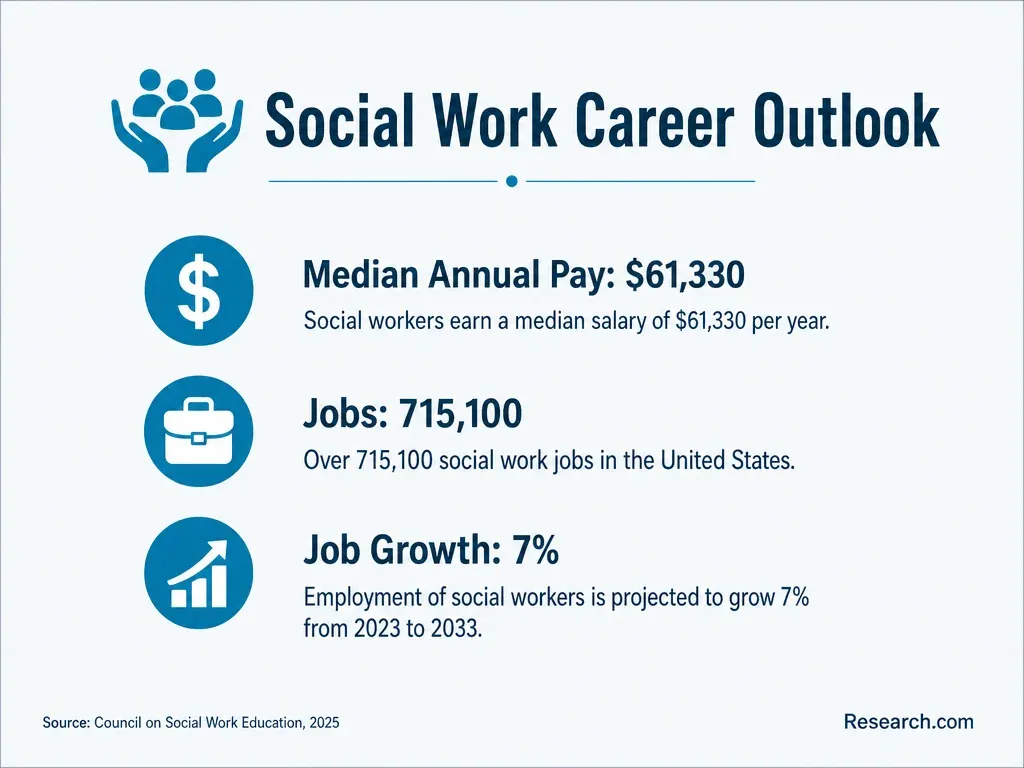
U.S. Bureau of Labor Statistics figures describe occupations, not the earnings of every MSW graduate or license holder. The supplied BLS estimates report the following May 2025 median annual wages and projected employment changes for 2025-2035:
| BLS occupation | Median annual wage, May 2025 | Projected employment change, 2025-2035 |
| Social workers, all specialties | $61,780 | +6% |
| Child, family, and school social workers | $59,550 | +4% |
| Healthcare social workers | $67,880 | +8% |
| Mental health and substance abuse social workers | $60,280 | +10% |
These categories mix workers with different degrees, experience, employers, locations, and licensing statuses. Use the closest occupational category as context, then compare actual job postings and pay in your intended market. For an education budget, pair that research with MSW tuition planning alongside career expectations; a national median cannot establish the return on a particular program.
Other Things You Should Know About Social Work
No. The National Association of Social Workers is a professional association. Membership does not replace a license issued by a state board.
Possibly, for duties the state permits an unlicensed employee to perform. Confirm the position's duties, title, supervision, and the employer's licensing deadline before accepting it.
Use the issuing state board's license-verification service, and check for status or restrictions. For clinical-hour credit, separately confirm that the supervisor meets that board's supervision rules.
It may. A state education agency or school employer can impose qualifications distinct from social work licensure. Check the requirements for the specific school position and state.
- 34 CFR 600.2 -- Definitions. | ecfr.gov https://www.ecfr.gov/current/title-34/subtitle-B/chapter-VI/part-600/subpart-A/section-600.2
- Accreditation in the U.S. | ed.gov https://www.ed.gov/laws-and-policy/higher-education-laws-and-policy/college-accreditation/accreditation-in-the-us
- Colorado Social Work Applications and Forms https://dpo.colorado.gov/SocialWork/Applications
- Levels and Eligibility Requirements | North Carolina Social Work Certification and Licensure Board https://www.ncswboard.gov/levels-and-eligibility-requirements/
- Licensed Clinical Social Worker | floridasmentalhealthprofessions.gov https://floridasmentalhealthprofessions.gov/licensed-clinical-social-worker/
- Social Work Licensure & Practice (LCSW) | nysed.gov https://www.op.nysed.gov/professions/licensed-clinical-social-worker/faq-licensure-practice
- State Licensure - UK Online - University of Kentucky https://online.uky.edu/faculty-resources/state-licensure
- Professional Licensure & Location | College of St. Scholastica https://services.css.edu/TDClient/354/Portal/KB/Article/11783/Professional-Licensure-Location
- Professional Licensure - State Authorization Network https://wcetsan.wiche.edu/resources/professional-licensure
- Licensure | Crown Family School of Social Work, Policy, and Practice https://crownschool.uchicago.edu/student-life/licensure