2027 Cohort Studies in Social Work Research: Groups, Follow-Up, and Interpretation
Audited and Verified:
Our Editorial and Data Verification Process
Research.com uses government datasets, official education statistics and primary institutional information to support its career and degree guides. Our review process checks factual accuracy, occupational definitions, source dates and the requirements associated with the credentials discussed.
How This Article Was Fact-Checked
Our editorial team verifies salary estimates, employment projections, education requirements and program information against original data providers and official organizations. Salary figures are checked against the relevant occupational definitions and reporting periods. Information about licensure, accreditation and required in-person training is reviewed separately.
Fact-checked and verified on:

Co-Founder and Chief Data Scientist
A social service agency may know how many clients enrolled in a program but not what happened after they left. A cohort study can follow a defined group over time to examine outcomes such as housing stability, service use, or school attendance. For social work students, practitioners, and prospective researchers, the challenge is deciding whether those findings reflect a useful pattern or a misleading comparison.
This guide explains group selection, follow-up, interpretation, and ethics, then shows how to judge the education and career paths that support this work.
Key Things You Should Know
- A cohort study defines a group at a clear starting point and measures later outcomes; an observed difference between groups does not, by itself, prove that a service caused it.
- Credible comparisons require comparable starting groups, consistent outcome measures, and an account of who was lost to follow-up - not just a large initial sample.
- Choose research training for the work you intend to do: MSW-level evaluation may suffice for agency roles, while independent scholarly research often calls for more intensive doctoral preparation.
What is a cohort study in social work research?
A cohort study identifies people who share a defined starting condition or experience, then examines outcomes over a specified period. The starting point might be entry into a housing program, discharge from foster care, or enrollment in an MSW field sequence. Researchers establish who qualifies, when follow-up begins, what exposure or service is being examined, and which outcomes matter.
For example, a hypothetical agency could identify adults entering its housing program during one enrollment period and examine housing status at later intervals. It might compare participants who received different levels of support. That design describes associations over time; it cannot assume the support caused any difference, because participants may have had different needs at entry.
"Cohort" describes how a group is defined and observed, not a particular degree, statistical test, or type of service. Cohort findings can inform program improvement and the social work master's skills across career settings, especially the ability to connect evidence with responsible practice decisions.
How are groups selected and compared in social work cohort studies?
Selection begins with an inclusion rule that another researcher could apply consistently: for example, all eligible clients entering a program at specified sites during a specified window. Researchers then define the comparison - different services, levels of exposure, or time periods - and record characteristics measured before the outcome occurs.
The most important question is whether the groups were comparable at the start. Clients offered intensive case management may have greater initial needs than clients offered standard services. Comparing their later outcomes without accounting for those differences can make an effective service look ineffective, or the reverse.
A useful design records baseline factors tied to both service assignment and outcomes, such as prior housing instability or referral source, then explains how the analysis addresses them. Statistical adjustment can reduce measured differences but cannot remove unmeasured ones. Researchers should also avoid choosing comparison groups based on something learned only after follow-up began.
The same caution applies to educational research. Comparing graduates of different formats among online social work education options for career planning requires attention to differences in students' work schedules, prior experience, and reasons for choosing each format.
How do researchers follow cohorts over time?
Follow-up needs a schedule and an outcome definition before results are examined. A study might measure an outcome at enrollment, six months, and one year, using the same eligibility rules and measurement method at each point. Researchers should specify whether they are counting an event, measuring a change in status, or examining how long it takes for an event to occur.
Data may come from participant interviews, surveys, approved administrative records, or a combination. Each has limits: interviews can capture experiences records miss, while records may cover longer periods but reflect inconsistent documentation. Changes in agency systems or definitions during follow-up can create apparent trends that are really measurement changes.
For a student project, feasibility matters as much as statistical ambition. Before promising repeated interviews or record linkage, establish who can recruit participants, maintain secure contact information, and access each data source. An research and teaching assistantships in MSW study opportunity may offer mentored research experience, but it does not independently authorize access to client records or participant contact information.
Both designs define a cohort and relate an earlier exposure to a later outcome. The difference is when the study is planned relative to data collection. Prospective researchers define the approach and gather future observations; retrospective researchers examine records or other information that already exists.
This comparison helps determine whether a proposed social work project has the time, data access, and measurement quality it needs.
| Design | How it works | Principal advantage | Principal limitation |
| Prospective cohort | Enrolls an eligible group and collects later outcomes according to a planned schedule | Can define measures and follow-up procedures in advance | Requires time and resources; participants may become unreachable |
| Retrospective cohort | Defines a past eligible group and examines previously recorded exposures and outcomes | Can study an elapsed period without waiting for future outcomes | Depends on the completeness, consistency, and lawful availability of existing data |
A retrospective study is not automatically quicker: negotiating data access, reconciling changed record systems, and assessing missing fields can take substantial work. For example, a researcher comparing graduates of condensed social work master's program schedules with other graduates would need comparable outcome records and a defensible way to address differences present before enrollment.
Start with the outcome and its practical size, not just whether a reported difference is statistically significant. Ask who was included, what each group received, how the outcome was measured, how long participants were observed, and whether the analysis addressed important baseline differences. A finding from one agency or population may not transfer to another with different eligibility rules or resources.
Association is not causation. If one cohort has better outcomes, the service may have helped, but selection into the service, concurrent policy changes, or differences in available supports may also explain the result. Confidence intervals, when reported, show the range of estimates compatible with the analysis; a narrow interval does not fix a biased design.
Pay particular attention to the denominator. A percentage based only on people reached at the final interview answers a different question from one based on everyone originally enrolled. Before changing practice, weigh the finding against other evidence, client priorities, implementation costs, and the possibility of harm.
This discipline also applies to education-and-earnings claims. When comparing lower-cost MSW degrees and career pathways, a graduate earnings difference should not be attributed to a program without considering who enrolled, which jobs they entered, and where they worked.
Attrition occurs when people in the original cohort cannot be observed at later points. The concern is not merely how many are missing, but whether missingness relates to the outcome. If people who lose housing are harder to contact, a follow-up survey of reachable participants could overstate housing stability.
Researchers should report how many people entered each group, how many contributed data at each follow-up point, and why observations are missing when known. They should compare baseline characteristics of those retained and lost, and test whether reasonable assumptions about missing outcomes change the conclusion. Statistical techniques can help, but they do not recover facts that were never observed.
Other biases can enter earlier: a nonrepresentative referral process affects selection, inconsistent case notes affect measurement, and a policy change during follow-up can affect outcomes independently of the service. These concerns matter when reviewing agency evidence and when evaluating claims about affordable graduate social work education: published outcomes may describe respondents or graduates rather than everyone who enrolled.
What careers, salaries, and job prospects are available in social work research?
Cohort-methods skills support agency program evaluation, public-sector analysis, nonprofit research, health and social service quality improvement, and university research. Duties may include defining measures, negotiating ethical data access, maintaining follow-up systems, analyzing results, and explaining limitations to decision-makers.
Some analyst and research-assistant jobs accept statistics, public health, or other relevant preparation; jobs requiring social work practice or a protected professional title may require a social work degree and state license.
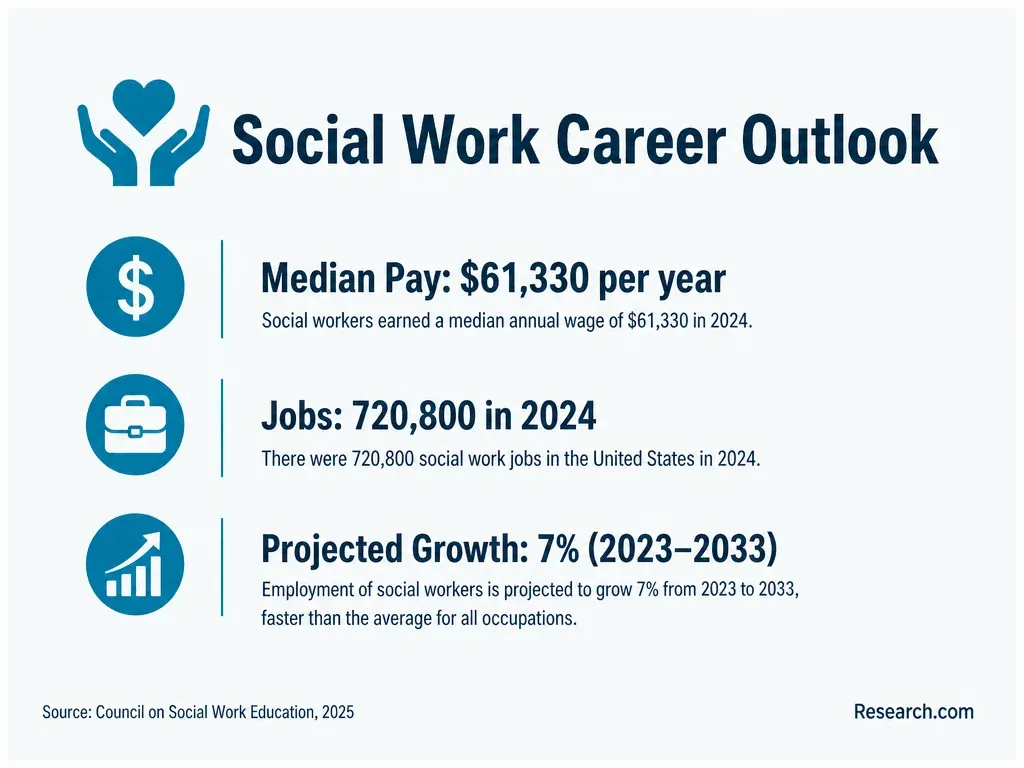
Salary depends on the actual occupation, employer, location, and responsibilities. The U.S. Bureau of Labor Statistics reports a May 2025 median annual wage of $61,780 for social workers overall and projects 6% employment growth from 2025 to 2035.
Those figures describe the broad social worker occupation, not a wage or growth projection for social work researchers, program evaluators, or holders of a particular degree. For practice roles, a guide to comparing social worker pay by location can provide context, but local job postings and their credential requirements are more useful for a specific research job search.
To test career fit, compare postings for the work you want to perform. Note whether employers ask for statistical analysis, interviewing, administrative-data experience, community partnership skills, an MSW, a doctorate, or a license. An MSW with evaluation experience may be enough for an agency role; a PhD may make more sense if the goal is to design an independent research agenda or compete for research-intensive faculty positions.
Other Things You Should Know About Social Work
Yes. Interviews can explain experiences behind measured outcomes, provided the study has a feasible sampling plan and appropriate consent and privacy protections.
Sometimes. A person may enter different programs or enrollment periods, but researchers must define those overlaps and account for repeated observations so they do not treat them as independent people.
There is no universal minimum. The appropriate size depends on the research question, expected outcome frequency, planned comparisons, likely missing data, and the precision needed for a useful conclusion.
State the question, eligibility rules, starting point, comparison, outcomes, follow-up period, data source, likely biases, and approvals needed. Describe a feasible alternative if access or follow-up falls through.
- Methodology Series Module 1: Cohort Studies - PMC https://pmc.ncbi.nlm.nih.gov/articles/PMC4763690/
- Read the Belmont Report | hhs.gov https://www.hhs.gov/ohrp/regulations-and-policy/belmont-report/read-the-belmont-report/index.html
- Matching Methods for Selection of Participants for Follow-Up | Education Resources Information Center https://eric.ed.gov/
- Cohort Studies: Design, Analysis, and Reporting | PubMed https://pubmed.ncbi.nlm.nih.gov/32658655/
- Full article: Control of confounding in the analysis phase | tandfonline.com https://www.tandfonline.com/doi/full/10.2147/CLEP.S129886
- Vulnerable Participants | Human Research Protection Program (HRPP) https://hrpp.research.virginia.edu/teams/irb-sbs/researcher-guide-irb-sbs/vulnerable-participants
- 6. Chapter 6: Sampling | Monash University Library https://openpub.libraries.rutgers.edu/irphabcd/chapter/chapter-6-sampling/
- 6 Cohort Studies - STAT 507 - Statistics Online https://online.stat.psu.edu/stat507/Lesson06.html
- Observational research methods - Cohort studies, cross sectional studies, and case-control studies - ScienceDirect https://www.sciencedirect.com/science/article/pii/S2211419X11001637