2027 Budgeting for the First Year After an MSW: Fees, Supervision, and Employment Gaps
Audited and Verified:
Our Editorial and Data Verification Process
Research.com uses government datasets, official education statistics and primary institutional information to support its career and degree guides. Our review process checks factual accuracy, occupational definitions, source dates and the requirements associated with the credentials discussed.
How This Article Was Fact-Checked
Our editorial team verifies salary estimates, employment projections, education requirements and program information against original data providers and official organizations. Salary figures are checked against the relevant occupational definitions and reporting periods. Information about licensure, accreditation and required in-person training is reviewed separately.
Fact-checked and verified on:

Co-Founder and Chief Data Scientist
Graduating with an MSW can bring several costs forward just as a student paycheck or financial aid ends. A licensing application, exam, and possible post-degree supervision may come due before steady employment begins.
This guide helps new US-based MSW graduates build a first-year budget, plan for a hiring gap, and compare offers by take-home pay and professional support - not salary alone. State rules and employer benefits differ, so the goal is a budget you can adjust using your own requirements and job offers.
Key Things You Should Know
- Budget for ordinary living costs and a separate cash reserve for time between graduation and your first paycheck; a two-month gap costs $6,100 under the illustrative $3,050-per-month budget below.
- Licensing, examination, and post-MSW clinical supervision costs depend on your state and employer. Confirm which costs the employer covers before accepting an offer.
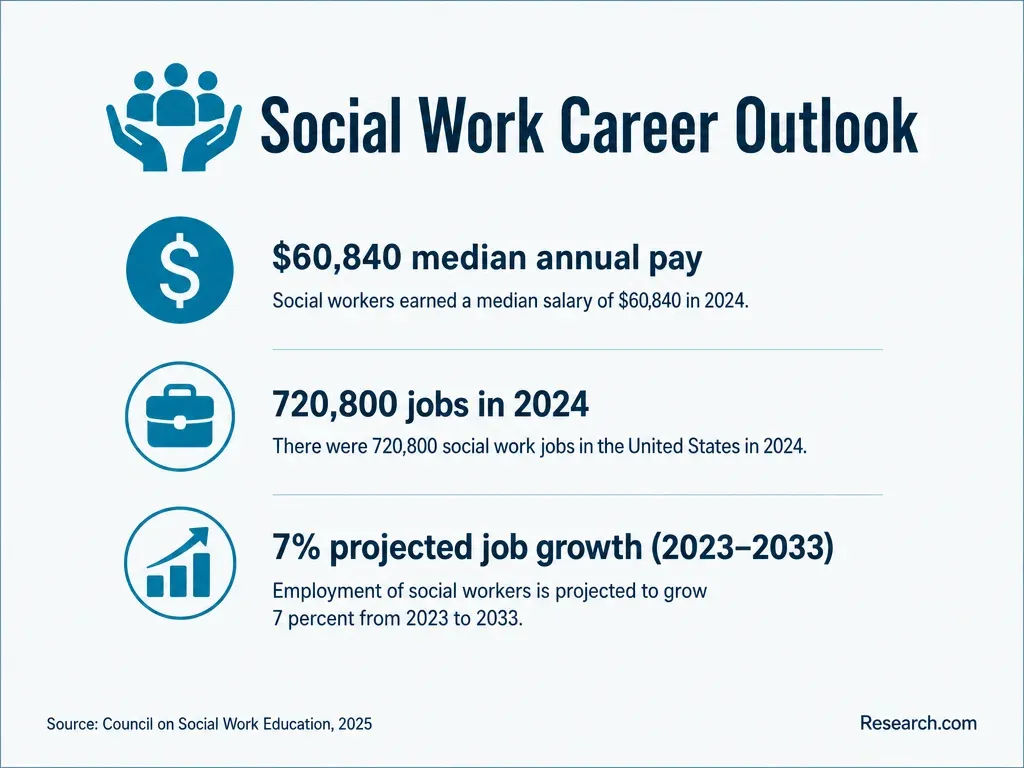
- US Bureau of Labor Statistics May 2025 median pay ranges from $59,550 for child, family, and school social workers to $67,880 for healthcare social workers; these occupation-wide medians are not starting salaries for MSW graduates.
How much should you budget for your first year after an MSW?
Start with a cash-flow budget, not a single estimate of "licensure costs." Your first-year total depends chiefly on local housing, how quickly paid work starts, loan payments, and whether clinical supervision is included in your job. The following example is a planning exercise, not a national average or a quote for any state.
The table separates recurring spending from one-time costs. Replace every figure with your own expenses and written fee estimates before deciding how much cash to hold at graduation.
| Illustrative expense | Assumption | First-year amount |
| Living costs | $2,700 per month for housing, food, transportation, insurance, and other essentials | $32,400 |
| Student loans | $200 per month after payments become due | $2,400 |
| Clinical supervision | $150 per month out of pocket | $1,800 |
| Licensing and exam costs | $600 set aside for applicable one-time charges | $600 |
| Illustrative first-year outlay | Assumes 12 months of each recurring cost | $37,200 |
In this example, two months without pay require $6,100 for recurring costs, plus any fees due during that period. That reserve is part of the $37,200 annual spending estimate, not another $6,100 to add to it. Actual loan due dates and supervision arrangements could change the timing substantially.
If you are still weighing the financial consequences of an MSW, a guide to affordable graduate social work education can help frame education costs. After graduation, however, money already spent on tuition is a sunk cost: the immediate decision is how to fund the transition to paid work.
What licensing and exam fees should new MSW graduates expect?
There is no single national post-MSW fee schedule. Depending on the state and license category, charges may include a board application, an ASWB examination if required, background checks or fingerprints, transcript delivery, a temporary permit, and later renewal. A failed exam or expired application can create additional costs. The $600 in the example budget is only a placeholder, not a prediction of what you will owe.
Before paying, identify your intended state license category and check the licensing board's current application, examination authorization, education, and fee instructions. Confirm whether an exam is required before initial licensure, at a later stage, or not for your route. Your MSW graduation date, exam eligibility, board approval, and license issuance are separate events; passing an exam does not itself authorize independent clinical practice.
Prior educational routes can affect what documentation a board reviews, but they do not replace its decision. If you are clarifying how a qualifying BSW relates to your MSW path, see BSW accreditation and program selection; use the state board, rather than a program description, to verify your own license eligibility.
How much does post-MSW clinical supervision cost?
For an MSW graduate pursuing independent clinical licensure, the out-of-pocket cost could be $0 when an employer provides qualifying supervision or a substantial recurring expense when supervision must be arranged privately. There is no reliable universal hourly price: rates, required frequency, eligible supervisors, and accepted formats vary. As an illustration - not a market quote - paying $100 per session for 48 sessions would cost $4,800.
Ask a prospective employer whether supervision occurs on paid time, who provides it, whether it remains available if your supervisor leaves, and whether you owe repayment if you resign. Before paying a private supervisor, get written confirmation of qualifications, documentation practices, cancellation terms, and how the arrangement meets your board's rules. A supportive manager or an MSW field instructor is not automatically an eligible post-degree clinical supervisor.
If you need to distinguish work duties from board-creditable hours, review questions about qualifying clinical social work experience, then confirm the applicable requirements with your state board. Budgeting for sessions that will not count is an especially expensive mistake.
Plan from the date school-based funding or your current job ends to the date your first paycheck clears, not merely to your anticipated start date. Board processing, agency hiring, background checks, and payroll cycles can all affect that interval. Under the example budget above, a two-month gap requires $6,100 for recurring expenses; licensing fees due before hiring would require additional cash on hand.
Use these steps to turn a vague emergency-fund goal into a workable transition plan:
- Record the end dates of wages, student health coverage, and aid, plus the due dates of rent, loans, and known application fees.
- Calculate one month of unavoidable expenses, then multiply by a gap length you can reasonably withstand; include dependents' costs where applicable.
- Ask hiring agencies about the expected start date, paid onboarding, first payroll date, and whether an offer depends on license issuance.
- If reserves fall short, arrange temporary qualifying work, request available payment flexibility before bills become overdue, and avoid assuming a pending offer is guaranteed income.
Graduates who completed an exploring shorter online MSW degree options search may have expected to enter the workforce sooner. Whatever the program length, a faster degree does not eliminate the post-graduation hiring and licensing interval; budget from your actual completion date.
Build two columns: expenses that continue whether or not you are employed, and expenses created by a particular job or licensure path. The first includes rent, utilities, food, health coverage, transportation, minimum debt payments, and caregiving. The second may include commuting and parking, professional liability coverage, association dues, continuing education, exam preparation, and private supervision. Check what an employer supplies before buying anything yourself.
Costs can also change abruptly when student discounts, campus services, or a family health-insurance arrangement end. A remote or hybrid job might reduce commuting but add equipment or private-space needs; verify reimbursement and confidentiality expectations rather than assuming it is cheaper.
For someone considering further study later, an MSW affordability duration and career outcome guide can inform education comparisons. It should not displace the first priority for a new graduate: funding monthly essentials before paying for optional credentials or courses.
Loan repayment changes both the amount you need each month and when you need it. Review each loan's servicer, balance, interest rate, and first due date; federal and private loans can have different terms. Do not assume every loan has the same post-graduation grace period. The example budget's $200 monthly payment is illustrative, not a standard MSW payment.
For federal loans, compare available repayment plans using Federal Student Aid and your servicer's current information. If you expect to pursue Public Service Loan Forgiveness, confirm that your employer, loan type, repayment arrangement, and qualifying payments meet the program's rules; a nonprofit job title alone is insufficient. For private loans or an imminent shortfall, contact the lender before missing a payment. Lower monthly payments can ease a hiring gap but may increase total interest or extend repayment, depending on the arrangement.
A graduate's debt may reflect whether they completed a full-length or shortened MSW sequence. If you are comparing those routes for a future education decision, understanding advanced standing versus standard admission explains the distinction. It does not change the terms of loans you have already borrowed.
Look first for positions whose duties and advertised qualifications match your current authorization. Depending on state law and employer policy, possibilities may include case management, care coordination, community outreach, housing or benefits navigation, program support, and some policy or evaluation roles. Schools, hospitals, and behavioral health agencies may impose additional credential or onboarding requirements even when a state license is not required for every task.
Read the duties rather than relying on a title: "social worker" may be regulated in your state, while a case-manager posting may accept several degrees. Ask who provides supervision, whether you may interact with clients before licensure, and whether the role's experience could count toward a later clinical application. Never assume ordinary employment hours qualify as clinical hours.
Returning immediately to school is generally a costly substitute for a paid transition role unless the new qualification serves a specific career goal. Even online MSW programs with broader entry criteria concern admission, not a shortcut to income or practice authorization for someone who already holds an MSW.
What financial assistance can help MSW graduates cover licensing and supervision costs?
Start with the employer because its contribution can remove a recurring expense. Ask about exam and application reimbursement, paid supervision, professional-development allowances, continuing education, and whether reimbursement requires you to stay for a specified period. Confirm whether payment is upfront or only after you submit receipts or pass an exam; reimbursement will not solve an immediate cash shortage if you must pay first.
Other possibilities depend on eligibility and availability: union or agency professional-development funds, state or local workforce programs, and loan-repayment programs tied to particular employers or service commitments. Check official terms, funding status, tax treatment, and any repayment obligation before relying on an award. MSW student scholarships generally should not be assumed available for post-graduation licensing bills.
If you are advising a prospective student rather than budgeting for your own completed degree, social work program comparisons for future students may help identify programs to investigate. A future student should ask separately about aid during enrollment and support for the transition after graduation.
Other Things You Should Know About Social Work
No single end date applies. Check the plan's coverage date before graduation and confirm when a new employer's plan begins. If there is a gap, compare your available coverage options before the student plan expires.
Possibly. Read any written reimbursement or retention agreement for repayment triggers, deadlines, and amounts before accepting the benefit. Ask how the terms apply if you leave because supervision or the position changes.
Tax treatment depends on how the payment is structured and applicable tax rules. Keep the agreement and receipts, review how the amount appears on your pay statement, and ask a qualified tax professional about your circumstances.
Contact both states' licensing boards before moving. Supervisor qualifications, documentation, and acceptance of experience can differ; hours accepted in one state are not automatically credited toward another state's license.
- Levels and Eligibility Requirements | North Carolina Social Work Certification and Licensure Board https://www.ncswboard.gov/levels-and-eligibility-requirements/
- Licensed Clinical Social Worker | floridasmentalhealthprofessions.gov https://floridasmentalhealthprofessions.gov/licensed-clinical-social-worker/
- The Role of Continuing Professional Training or Development in Maintaining Current Employment: A Systematic Review https://pmc.ncbi.nlm.nih.gov/articles/PMC10647344/
- NYS Social Work: LCSW License Requirements | nysed.gov https://www.op.nysed.gov/professions/licensed-clinical-social-worker/license-requirements
- Pages - Frequently Asked Questions https://www.njconsumeraffairs.gov/sw/Pages/FAQ.aspx
- Supervision FAQs | Texas Behavioral Health Executive Council https://bhec.texas.gov/tbhec/supervision-faqs/
- How occupational licensing matters for wages and careers | Brookings https://www.brookings.edu/articles/how-occupational-licensing-matters-for-wages-and-careers/
- LCSW Career Roadmap: Steps to Licensure & Salary | New Mexico Highlands University https://online.nmhu.edu/resources/article/how-to-become-a-lcsw/
- Pathway Social Work Licensure in CA | USC Suzanne Dworak-Peck School of Social Work https://dworakpeck.usc.edu/pathway-to-social-work-licensure
- Social Worker Salary: BSW vs. MSW Pay Differences | CU Online https://online.campbellsville.edu/social-work/bsw-vs-msw-salary-guide/