2027 Moving a Social Work License to Minnesota: Endorsement, Records, and Board Verification
Audited and Verified:
Our Editorial and Data Verification Process
Research.com uses government datasets, official education statistics and primary institutional information to support its career and degree guides. Our review process checks factual accuracy, occupational definitions, source dates and the requirements associated with the credentials discussed.
How This Article Was Fact-Checked
Our editorial team verifies salary estimates, employment projections, education requirements and program information against original data providers and official organizations. Salary figures are checked against the relevant occupational definitions and reporting periods. Information about licensure, accreditation and required in-person training is reviewed separately.
Fact-checked and verified on:

Co-Founder and Chief Data Scientist
An out-of-state social work license does not automatically authorize you to practice in Minnesota. If you are relocating, taking a Minnesota job, or planning to serve clients there remotely, endorsement may provide a route to a Minnesota license - but the board must review your education, license history, and qualifications for the level you request.
This guide explains what records to gather, how the four Minnesota license levels differ, and which questions to settle before you commit to a start date. It is written for licensed social workers, particularly experienced clinicians whose supervision records may determine their options.
Key Things You Should Know
- Endorsement is a Minnesota Board of Social Work application and review, not an automatic transfer of an out-of-state license.
- Minnesota has four license levels - LSW, LGSW, LISW, and LICSW - and an out-of-state title alone does not establish which one you qualify for.
- Plan to document your degree, license history, examination and supervised experience as applicable, and the required criminal background check; wait for Minnesota practice authorization before starting covered work.
How do I transfer a social work license to Minnesota by endorsement?
You do not transfer the existing license itself. You apply to the Minnesota Board of Social Work for a new Minnesota license by endorsement, identifying the level you seek and supplying evidence that your qualifications meet the board's requirements. Keep your original license active if your current jurisdiction or employment requires it; Minnesota issuance does not renew or replace it.
Use this sequence to avoid collecting the wrong records or accepting work before you are authorized:
- Identify the Minnesota license level and practice privileges your intended job requires.
- Review the board's current endorsement application and eligibility instructions for that level.
- Request official education and licensing records from the organizations that issued them; assemble examination and supervision documentation if applicable.
- Submit the application, complete the board-directed background-check process, and respond to any requests for clarification.
- Confirm that Minnesota has issued the appropriate license - or another authorization the board expressly grants - before practicing under it.
If the job you want requires a different qualification, comparing social work degrees before enrollment may help you evaluate an education route. It cannot substitute for the board's decision on your existing credentials.
Who qualifies for Minnesota social work licensure by endorsement?
Endorsement is intended for applicants licensed to practice social work in another jurisdiction who can establish the qualifications Minnesota requires for the license sought. The board evaluates the actual licensing requirements and your record - not merely whether your current credential has a similar name. Education, examination, supervised experience where relevant, license standing, and disclosures can all affect the determination.
Before applying, note every state where you have held a social work license, including expired or inactive licenses, and identify any disciplinary orders or practice restrictions. An unrestricted license is not a guarantee of endorsement; a past concern should be disclosed and documented as the application requires rather than assumed to be disqualifying or irrelevant. Ask the board which pathway applies if your original jurisdiction used substantially different licensing requirements.
If you lack the degree required for the Minnesota level you want, another state's license may not resolve that gap. For someone without qualifying social work education, online bachelor of social work program options are an education decision, not an endorsement shortcut.
How do I send out-of-state license verification to the Minnesota board?
Follow the Minnesota board's current instructions for verification from each jurisdiction it requires you to report. Typically, the issuing licensing authority - not the applicant - must provide official confirmation. A screenshot of a public license lookup or a wallet card may help you check your own records, but do not assume it satisfies the board's verification requirement.
Contact each issuing board early. Ask how it sends verification to Minnesota, whether it charges a fee, and whether its record includes your original issue date, current status, license level, and disciplinary history. Supply the name and license number used in that jurisdiction, then track the request separately from your Minnesota application. If records are archived or your name changed, ask what supporting identification both boards need.
License verification and clinical-experience evidence are different records. A licensing board may confirm that you hold a clinical credential without supplying the supervisor attestations Minnesota needs to evaluate your experience. If those files are incomplete, guidance on social work clinical hour requirements and completion planning can help you identify records to seek; Minnesota decides what experience it accepts.
Minnesota's levels distinguish bachelor's-level from graduate-level social work preparation. Submit official transcripts in the form and through the delivery channel the board currently accepts, generally from the degree-awarding institution or its authorized transcript service. Check that the record shows the awarded social work degree, institution, and conferral date; an unofficial copy or an MSW admission letter is not proof of degree completion.
Check the board's current rules on qualifying social work education, including program accreditation or recognized equivalency, for your degree and the level sought. Do not assume a counseling, psychology, human services, or other adjacent degree meets a social work degree requirement. Applicants with international education should ask the board what credential evaluation and program evidence it requires before ordering reports.
Academic field education belongs to the degree record; it is not automatically post-degree supervised practice for independent licensure. If you have not completed the required degree and are evaluating schools, MSW programs offering help finding practicum sites address an educational concern, not a way to replace missing endorsement records.
They may be. Minnesota evaluates examination and supervised-practice qualifications for the specific license level requested. Do not assume that passing an exam in another state, holding an MSW, or working for many years waives a Minnesota requirement. Ask the board whether it needs an official examination-score transfer, evidence of an accepted equivalent, or additional records.
For LISW or LICSW applicants, the decisive issue can be whether documented experience meets Minnesota's applicable standards - not simply the total hours on a résumé. Locate supervision plans, signed supervisor records, dates, practice descriptions, and evidence of clinical client work if seeking clinical licensure. Minnesota determines whether the supervisor, work, and documentation qualify. BSW/MSW field placement hours should not be presented as interchangeable with post-degree supervised experience.
If your goal is independent psychotherapy, a graduate clinical concentration is useful preparation but does not itself grant that authority. Clinical social work master's curriculum options concern education; endorsement still turns on the board's licensing criteria and your documented record.
Use the Minnesota Board of Social Work's current endorsement instructions and application system. Complete every license-history and conduct disclosure accurately, submit the required fee, and arrange for third-party documents to reach the board through its accepted channels. Keep copies of requests and confirmations, but protect any sensitive personal information in transit.
Follow the board's specific criminal background-check instructions, including its directions for identity information, fingerprints, payment, and any required scheduling. Do not order an unrelated employer or volunteer background check and assume it will count. A background check is one part of the review; completion of fingerprinting does not mean a license has been approved.
If the board identifies a missing qualifying degree, resolve that issue before treating another application as a workaround. Comparing MSW GPA and prerequisite policies may be useful if you must pursue a new graduate degree, but admission to a program does not establish Minnesota licensure eligibility.
Budget for more than Minnesota's application charge. The total depends on the license level, how many jurisdictions must verify your history, transcript-provider charges, background-check costs, and whether additional documentation is needed. Check the board's current fee schedule and each record issuer's charges before paying; fees and processing practices can change.
Common costs to check are:
- Minnesota application and license fees, as currently listed by the board
- Official transcript and examination-score delivery charges, if applicable
- Out-of-state board verification fees
- Background-check and fingerprinting charges under the board's instructions
There is no dependable universal processing time. Delays often arise while third parties send records, background-check results are pending, or the board requests detail about supervision or discipline. Apply well ahead of a proposed start date and ask the employer what duties, if any, you can perform without the Minnesota license. If a new degree is genuinely necessary, comparing MSW tuition against professional goals is a separate, potentially much larger financial decision.
How do I renew and maintain a Minnesota social work license?
Once licensed, follow the Minnesota board's renewal schedule and continuing-education requirements for your license level, including any applicable topic, documentation, and supervision obligations. Confirm the expiration date on your own license and the rules that apply to your first renewal; do not carry over another state's cycle or assume courses approved there automatically qualify in Minnesota.
Keep your contact information current, retain continuing-education records, and monitor board notices about renewal and practice rules. If you also hold an out-of-state license, maintain each credential separately and check each jurisdiction's rules before providing services to clients there. An additional degree is generally not a substitute for renewal or continuing education.
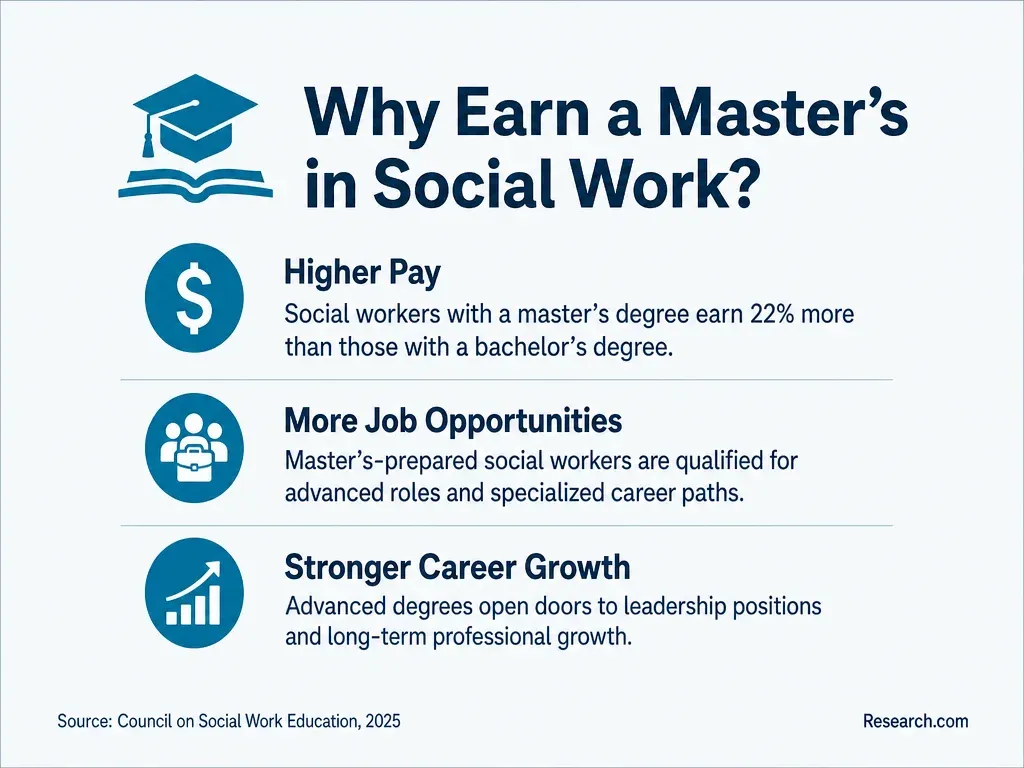
When deciding where to maintain active licenses, weigh actual client locations, employer requirements, fees, and opportunities - not salary comparisons alone. Comparing pay locations for master's-prepared social workers may inform a career decision, but it cannot establish your authorization to practice.
Other Things You Should Know About Social Work
Do not rely on compact participation alone. Verify whether compact privileges are operational, whether Minnesota and your home state participate under the applicable rules, and whether you personally hold an issued privilege. Otherwise, obtain the Minnesota authorization your work requires.
Contact the employer and prior licensing board for retained supervision records, and ask the Minnesota board what alternative documentation it will consider. Do not recreate or sign an attestation on a supervisor's behalf.
Not necessarily. School positions can have separate state education-agency credential and employer requirements. Check the exact job posting and the Minnesota authority responsible for school personnel qualifications.
Usually the issue is documenting the connection between names. Follow the board's instructions for reporting former names and supplying supporting documentation, and use the identifying details each transcript or licensing board requests.
- NYS Social Work: LCSW License Requirements | nysed.gov https://www.op.nysed.gov/professions/licensed-clinical-social-worker/license-requirements
- Apply for Standard Social Work License by Endorsement | mn.gov https://mn.gov/boards/social-work/applicants/applyforlicense/endorsement.jsp
- Licensure by Endorsement | ca.gov https://www.rn.ca.gov/applicants/lic-end.shtml
- Minnesota Statutes 2025, Section 148E.055 | mn.gov https://www.revisor.mn.gov/statutes/cite/148E.055/pdf
- License Info and Clinical Hours | umn.edu https://cehsp.d.umn.edu/departments-centers/departments/social-work/license-information
- How to Become a Licensed Clinical Social Worker (LCSW) | Saint Mary's University of Minnesota https://www.smumn.edu/blog/how-to-become-a-social-worker/
- Getting licensed in another state or province | Association of Social Work Boards https://www.aswb.org/licenses/how-to-get-a-license/getting-licensed-in-another-state-or-province/
- Licensure | socialworkers.org https://naswmn.socialworkers.org/Professional-Development/Licensure