2027 Advanced Standing MSW Tuition Savings vs Reduced Paid Work Time
Audited and Verified:
Our Editorial and Data Verification Process
Research.com uses government datasets, official education statistics and primary institutional information to support its career and degree guides. Our review process checks factual accuracy, occupational definitions, source dates and the requirements associated with the credentials discussed.
How This Article Was Fact-Checked
Our editorial team verifies salary estimates, employment projections, education requirements and program information against original data providers and official organizations. Salary figures are checked against the relevant occupational definitions and reporting periods. Information about licensure, accreditation and required in-person training is reviewed separately.
Fact-checked and verified on:

Co-Founder and Chief Data Scientist
An advanced standing MSW can eliminate coursework that qualified BSW graduates have already completed. But a shorter program may also compress classes and field education into a schedule that leaves less time for paid work. For BSW graduates weighing an offer - or deciding whether to apply - the useful comparison is not tuition alone.
This guide shows how to estimate credits saved, earnings forgone, and field-related costs; compare schedules and aid; and decide whether the faster route fits your household budget and career plans.
Key Things You Should Know
- Advanced standing generally reduces required MSW coursework for eligible BSW graduates, but savings depend on the school's actual credit requirements and price per credit - not the advertised program length.
- In an illustrative comparison, 24 fewer credits at $800 per credit save $19,200 in tuition; losing 20 paid hours a week at $25 an hour for 40 weeks would cost $20,000 in gross wages.
- Compare incremental lost earnings against the traditional MSW schedule: both routes can require field education, and online classes do not necessarily make placement hours flexible.
What is an advanced standing MSW, and how long does it take?
An advanced standing Master of Social Work is an accelerated entry route for applicants whose qualifying BSW education has already covered the generalist foundation. Students move into the MSW's specialized coursework and field education rather than repeat the full traditional or foundation sequence. The degree awarded is an MSW; "advanced standing" describes the entry route, not a separate professional license.
Full-time advanced standing study may fit into roughly a year, while part-time options can extend across additional terms. Neither timeline is universal: credit requirements, summer starts, course sequencing, and placement availability determine the actual finish date. A shorter calendar can also mean more commitments in each week.
If your bachelor's degree is not a qualifying BSW, compare traditional MSW admission instead. For someone still planning undergraduate study, online social work bachelor's education pathways may be relevant, but earning a BSW solely to access a shorter later MSW requires its own cost comparison.
How much tuition can advanced standing MSW students save?
Tuition savings equal the required credits avoided multiplied by the applicable per-credit charge when both routes use the same rate. Adjust that figure for different tuition rates, flat-rate terms, mandatory fees, and scholarships tied to particular enrollment patterns. Compare two offers using the school's written degree plans, not a general claim that advanced standing is "half the cost."
The following example demonstrates the calculation; its credit counts and price are hypothetical, not a quotation from a university.
| Illustrative cost item | Traditional MSW | Advanced standing MSW |
| Required credits | 60 | 36 |
| Tuition at $800 per credit | $48,000 | $28,800 |
| Tuition difference | $19,200 less for advanced standing |
That $19,200 is tuition savings only. Add each route's mandatory fees, books, technology, field-placement travel, parking, screening, and any required campus visits. A faster route may reduce semesters of fees while increasing short-term transportation or caregiving costs. When comparing shorter online Master of Social Work pathways, request the total billed amount and a term-by-term schedule; a short calendar alone does not establish a lower price.
Do tuition savings outweigh lost income from reduced work hours?
Sometimes - but the answer depends on how much more work you would give up under advanced standing than under your realistic alternative. Both advanced standing and traditional MSW students may need to reduce paid hours for field placements. Counting all lost wages against only the advanced standing route exaggerates its disadvantage.
Start with the tuition-and-fee difference, then subtract additional net earnings lost because of the faster schedule and any additional childcare, travel, or benefit costs. This illustrative comparison uses gross wages for simplicity; a household budget should use estimated take-home pay and account for benefits.
| Illustrative advanced standing scenario | Additional gross wages forgone | Result before other costs and aid |
| 10 more paid hours lost weekly × $25 × 40 weeks | $10,000 | $9,200 ahead against $19,200 tuition savings |
| 20 more paid hours lost weekly × $25 × 40 weeks | $20,000 | $800 behind against $19,200 tuition savings |
The example assumes the traditional route would let you keep those additional work hours during the same period. If it would not, the wage difference shrinks. Conversely, losing employer health coverage or needing paid childcare could change the result substantially. Earlier graduation might allow earlier access to an MSW-required job, but treat that as a scenario - not guaranteed income - and account for the time the traditional route would take to finish. Advanced standing and traditional MSW completion planning is useful when the two options have different term lengths or field schedules.
Advanced standing is generally intended for graduates of qualifying BSW programs, commonly those accredited by the Council on Social Work Education (CSWE). Schools may also set limits on how recently the BSW was earned and require particular grades, GPA, references, or evidence of preparation. An applicant's service experience - or a bachelor's degree in psychology, sociology, or human services - does not by itself replace the qualifying social work education.
Ask admissions staff to confirm your advanced standing track eligibility in writing, including how they evaluate your BSW program, graduation date, and transcripts. Admission to the university or a traditional MSW track is not the same decision. If your record does not meet one school's criteria, MSW programs with flexible admission criteria may offer other application options; check whether that flexibility applies to advanced standing or only to traditional admission.
Field education is a major scheduling constraint even when advanced standing removes foundation coursework. Students complete school-approved learning activities at an agency, often alongside field seminar, supervision, orientation, and documentation. The school and agency - not the student's preferred work calendar alone - determine acceptable hours, learning tasks, and site arrangements.
Before accepting an offer, obtain the placement schedule for your entry term and ask whether local agencies offer evening or weekend hours. Also ask when placement matching begins and what happens if a site cannot accommodate your availability. MSW programs offering help finding practicum sites can be worth comparing when your job or caregiving schedule leaves little room to find a suitable agency independently.
A paid job can count as an employment-based placement only if the program approves the arrangement and its educational learning objectives, field instruction, and evaluations. Ordinary work hours and prior volunteer service do not automatically qualify. MSW field education also is not a substitute for any post-degree supervised clinical experience a state may require.
Online delivery may remove commuting to class without changing an agency's placement hours. Asynchronous lectures can help a working student, but live skills labs, group meetings, field seminar, and occasional campus visits may still occupy fixed times. Full-time advanced standing can minimize elapsed time while concentrating workload; part-time study may protect more weekly paid hours while adding terms of fees and delaying graduation.
Compare formats against your actual weekly calendar, including paid shifts, field travel, caregiving, and study time. Ask programs for a sample schedule covering the busiest term, not merely a description of how lectures are delivered. A guide to choosing an online social work degree can help frame delivery questions, but the program must confirm its own live-session, placement, residency, and part-time policies.
Compare net cost after confirmed grants, scholarships, assistantships, and employer support - not after loans, which must generally be repaid. Submit the Free Application for Federal Student Aid (FAFSA) when appropriate and ask each school which awards advanced standing students can receive, whether summer enrollment qualifies, and whether an award requires full-time study or a particular placement.
Employer tuition assistance can be valuable if you remain eligible while reducing hours. Check reimbursement caps, required grades, payment timing, and any obligation to stay after graduation. Ask the field office about paid placements or stipends, but do not budget for either without a confirmed offer. A planning the cost of an online MSW comparison is most useful when you replace advertised prices with your own credits, fees, aid terms, and lost-work estimate.
Borrowing can cover some billed and eligible living expenses, but it does not turn lost wages into savings. Before enrolling, model the cash-flow gap for each term and the debt balance you could manage if graduation or placement is delayed.
CSWE programmatic accreditation is an important check on whether an MSW program meets recognized social work education standards. It is distinct from an institution's accreditation and from a state licensing board's decision about an individual applicant. Confirm the exact MSW program's CSWE status and the status relevant to your expected graduation cohort; also ask the school about state authorization and placement availability where you live.
Accreditation does not establish that an individual student will obtain a license or that every program offers equally workable field support. For a target state and license category, check the board's education requirements, examination rules if applicable, and any post-degree supervision requirements. A review of social work master's education requirements for licensing can help identify questions to bring to the board and program. An MSW alone does not grant independent clinical practice authority.
Advanced standing graduates receive an MSW and can pursue roles in settings such as schools, hospitals, behavioral health agencies, and community organizations, subject to employer requirements and state rules. The route does not create a different salary scale from a traditional MSW. Duties and eligibility depend on the position, experience, any required license or school qualification, and the supervision available.
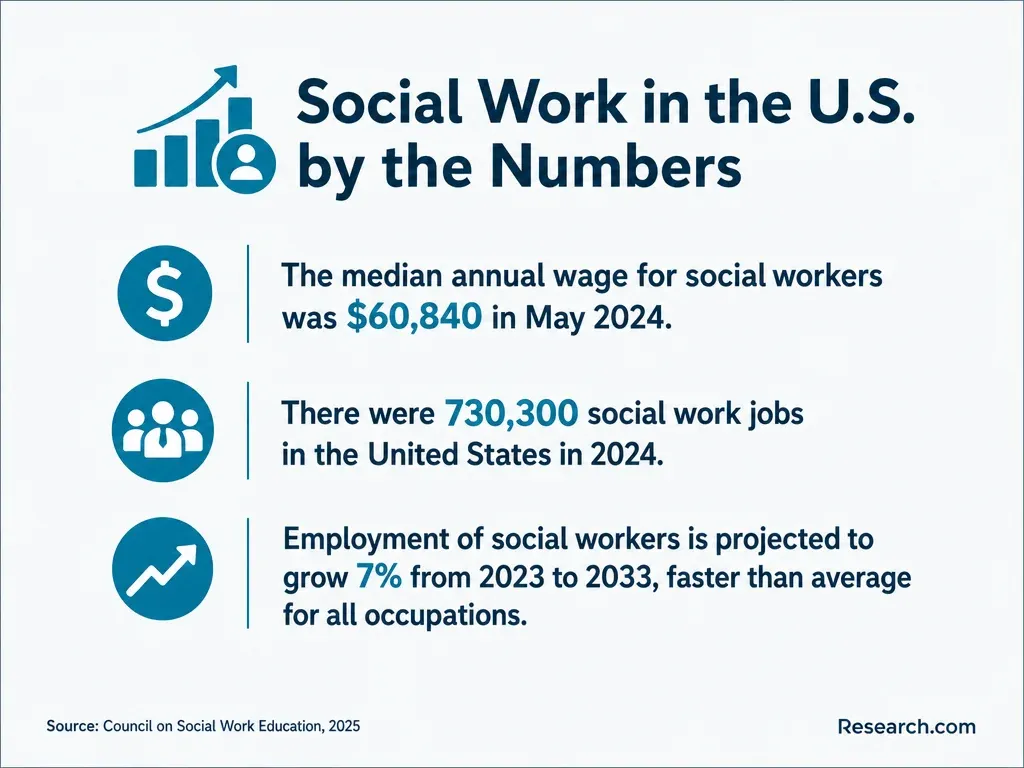
These U.S. Bureau of Labor Statistics figures are occupation-wide medians from May 2025, not starting salaries or promised pay for MSW graduates. They provide context for evaluating a possible career change, not a reliable basis for assuming an immediate raise.
| BLS social work occupation | Median annual wage, May 2025 | Example work setting |
| Child, family, and school social workers | $59,550 | Family services or schools |
| Healthcare social workers | $67,880 | Hospitals or healthcare systems |
| Mental health and substance abuse social workers | $60,280 | Behavioral health services |
If your intended role is independent clinical practice, factor in the state-specific path after graduation rather than pricing the MSW as the final step. In particular, questions about qualifying clinical social work experience concern post-degree supervision, not the MSW field placement that shapes your student work schedule.
What is the job outlook for social workers with an MSW?
The U.S. Bureau of Labor Statistics projects employment growth from 2025 to 2035 of 6% for social workers overall, 4% for child, family, and school social workers, 8% for healthcare social workers, and 10% for mental health and substance abuse social workers. Those are occupational projections, not forecasts of openings reserved for MSW graduates or guarantees of employment in a particular city.
Use the outlook as context for your target setting, then inspect local postings for degree, license, schedule, and experience requirements. Social work master's roles and employment settings can help you identify positions to investigate. For the tuition-versus-work decision, a realistic local job offer and its pay range are more useful than applying a national median to your expected first-year earnings.
Other Things You Should Know About Social Work
Typically, the award is an MSW, but confirm how your institution records the degree and track on its diploma and transcript.
Ask the program whether deferral is permitted, for how long, and whether your admission, scholarship, and degree requirements would remain unchanged. Get the terms in writing before declining other options.
That depends on program policy, course sequencing, and placement capacity. Ask for a revised degree plan showing any added credits, fees, or delay before making the change.
Refund, withdrawal, aid-return, and loan rules depend on the school and timing. Request the applicable policies and calculate what you would still owe before the term begins.
- Types of Financial Aid: Grants, Work-Study, and Loans | studentaid.gov https://studentaid.gov/understand-aid/types
- The Federal Work-Study Program - FSA Partner Connect https://fsapartners.ed.gov/knowledge-center/fsa-handbook/2025-2026/vol6/ch2-federal-work-study-program
- College Student Employment - COE https://nces.ed.gov/programs/coe/indicator/ssa/college-student-employment
- Curriculum by Plan of Study - School of Social Work - UNC Charlotte https://socialwork.charlotte.edu/master-social-work-msw/curriculum-program-handbook/
- Workstudy FAQs | Costs & Financial Aid | University of Houston https://www.uh.edu/one-stop/financial/undergraduate/types-aid/work-study/faq/
- Tuition in Detail - One Stop Student Services https://onestop.utk.edu/billing-payments/tuition-detail/
- MSW Advanced Standing Option | Portland State University https://www.pdx.edu/social-work/msw-advanced-standing-option
- The Difference Between the Advanced Standing and Traditional MSW Program https://onlinemsw.fsu.edu/blog/online-msw-traditional-vs-advanced-program
- NASFAA's Financial Aid Glossary | bscc.edu https://www.bscc.edu/students/financial-aid/glossary-of-financial-aid-terms
- What to Expect in the Pitt MSW Field Practicum and Placement Process https://msw.pitt.edu/articles/pitt-msw-field-practicum-and-placement-what-to-expect/