# 1 position

Audited and Verified:
Our Editorial and Data Verification Process
Research.com uses government datasets, official education statistics and primary institutional information to support its career and degree guides. Our review process checks factual accuracy, occupational definitions, source dates and the requirements associated with the credentials discussed.
How This Article Was Fact-Checked
Our editorial team verifies salary estimates, employment projections, education requirements and program information against original data providers and official organizations. Salary figures are checked against the relevant occupational definitions and reporting periods. Information about licensure, accreditation and required in-person training is reviewed separately.
Fact-checked and verified on:

Co-Founder and Chief Data Scientist

Reviewed by Karolina Broda
Fact-Checker and Data Verification
Choosing welding training in Belleville means weighing shop time, total cost, and the kind of work you want to do - not just comparing program names. The U.S. Bureau of Labor Statistics projects 2.4% national employment growth for welders, cutters, solderers, and brazers from 2025 to 2035, making preparation for specific employers and welding processes especially important. This guide explains local training routes, credentials, costs, and career prospects. It also accompanies the Best Welder Trade Schools in Belleville for 2027 ranking, created by the Research.com team of data scientists to help students identify programs worth considering.
A welding trade-school program teaches you to make and inspect welds safely using industrial equipment. Expect supervised shop practice alongside instruction in drawings, measurement, metal preparation, and welding processes. The central question is not whether a course says "welding," but whether you will practice the materials, positions, and processes used in your intended job.
Southwestern Illinois College is a public-college option to investigate from Belleville; compare its current welding offerings with registered apprenticeships and employer-sponsored training. A shorter certificate can suit someone seeking an initial shop job, while a longer program may provide broader fabrication or technical coursework. A paid apprenticeship can be a better fit if you want to learn while working in a particular trade, though entry depends on a sponsor's openings and selection process. For readers exploring quick schooling to make good money, welding deserves a reality check: finishing a short course is different from passing the weld test for a well-paid position.
Ask each provider for its current curriculum and supervised shop hours. Two credentials with the same name may offer very different amounts of time under the hood.
Training can lead to work in fabrication shops, manufacturing, construction, structural steel, equipment repair, or maintenance. Those settings demand different abilities: a fabrication shop may emphasize repeatable production welds and blueprint reading, while field construction may add travel, outdoor work, and stringent position tests. The U.S. Bureau of Labor Statistics describes welding work across both manufacturing and construction.
For a Belleville resident, the workable job market may extend beyond the city into the surrounding Illinois and St. Louis-area labor markets. That broadens possible employers but also changes commuting costs and, for construction roles, the likelihood of traveling between worksites. Review actual postings before enrolling: their requested processes and schedules are more useful for choosing classes than a general promise of "welder jobs."
The U.S. Bureau of Labor Statistics reports a $53,750 national median annual wage in May 2025 for welders, cutters, solderers, and brazers. Half of workers in that occupation earned less and half earned more. It covers experienced workers and several related roles, so it should not be treated as a new graduate's expected pay or a Belleville wage quote.
Before estimating a return on training, compare pay in current Belleville-area job postings for the work you could actually qualify to perform. Ask whether the stated rate depends on a weld test, overtime, shift work, travel, or membership in an apprenticeship. A paid training route can improve your finances while you learn even if the eventual job rate is similar; an unpaid full-time course may require you to give up earnings.
Completion time depends on the credential and schedule, not on a universal welding-school requirement. A focused certificate can get you into entry-level applications sooner than a broader diploma or associate-degree program, but a shorter course may leave less time to practice difficult positions or multiple processes. Part-time attendance stretches the calendar while potentially allowing you to keep working.
Registered apprenticeships combine paid work with related instruction over a longer period; their duration and required hours are set by the registered program, not by a Belleville-wide rule, according to the U.S. Department of Labor's Apprenticeship.gov. Ask a school for the current catalog length, required contact hours, and actual shop hours. If a degree fast track appeals to you, do not assume accelerating classroom work can replace the supervised practice needed to pass a welding performance test.
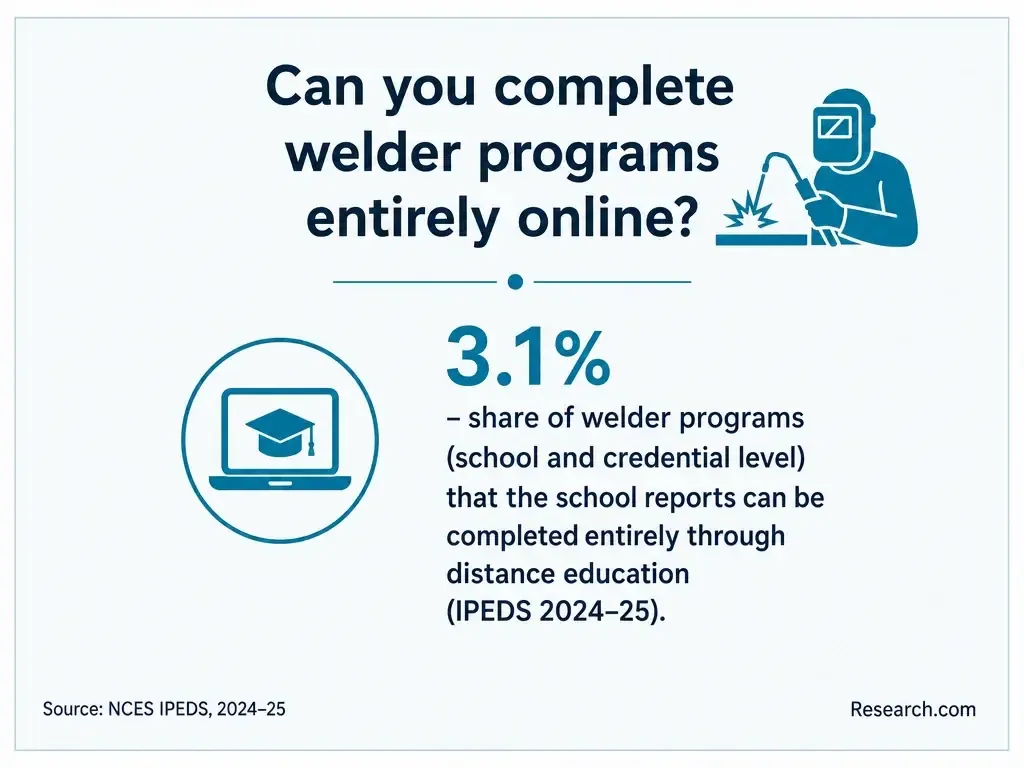
On-campus or worksite training is essential for learning to weld. Theory - such as safety rules, symbols, and blueprint interpretation - may be taught remotely, but setting a machine, controlling a weld pool, and receiving feedback on a finished joint require equipment and in-person practice. A hybrid schedule is useful only if its required shop sessions are accessible from Belleville.
Compare formats by asking where practical sessions occur, how often equipment is available, whether missed shop time can be made up, and whether the course includes supervised practice in the processes employers request. The convenience associated with open admission colleges online should not be mistaken for an online route to welding proficiency. A fully remote course may help with theory, but it is not equivalent to shop training or an employer's hands-on test.
There is no reliable single "average cost" that covers every Belleville welding pathway: a college program, a short course, and a paid apprenticeship charge or offset costs differently. Get a current, itemized quote from Southwestern Illinois College and any other provider you are considering. For a public-college option, confirm the tuition category that applies to your residence rather than assuming the lowest published rate applies to you.
The figures worth comparing are total cost to become job-ready, not tuition alone. Your estimate should include mandatory fees, books, tools, consumables, welding PPE, transportation to shops or worksites, and any separately charged performance test. Add earnings you would forgo while studying; subtract grants, eligible aid, or wages paid during training. Federal Student Aid notes that aid eligibility depends on the student and program, so ask the financial-aid office about the specific welding credential rather than assuming every short course qualifies.
Compare the resulting cost with likely entry pay and your chance of finishing, then consider debt and how long you expect to use the training. Search results for a cheapest online college bachelor degree answer a different cost question; they cannot tell you what protective gear, shop fees, and travel will cost for welding.
A school may award a welding certificate, diploma, or, for a qualifying academic program, an associate degree. A registered apprenticeship instead leads to its sponsor's completion credential and documented work-based training; an employer course may provide only an internal record of training. Verify the exact credential in the current catalog or apprenticeship standards before applying.
A school credential and a welding certification are not the same thing. The American Welding Society's Certified Welder program assesses performance through a practical test for specified welding procedures. An employer may administer its own qualification test instead. Ask whether testing is included, which processes and positions it covers, and whether the resulting record matches the jobs you want. Institutional accreditation concerns the school; it does not by itself certify your welds or guarantee employment.
Entry requirements differ by provider and pathway. Ask a school about its current application, academic-placement rules if applicable, and any safety prerequisites before committing. For a registered apprenticeship, the sponsor sets its selection criteria and may require an application, assessment, interview, or ability to travel to worksites; the U.S. Department of Labor's Apprenticeship.gov advises applicants to check each opportunity's requirements.
Do not confuse open admission to a school with an immediate place in a particular welding class or apprenticeship. Check start dates, shop capacity, required PPE on day one, and whether an employer or worksite has additional entry conditions. If you have prior shop experience, ask whether demonstrated skills can shorten training or earn credit; obtain the decision in writing before budgeting for a shorter route.
Useful welding instruction connects a drawing to a safe, acceptable finished joint. Look for supervised practice in applicable processes such as shielded metal arc welding, gas metal arc welding, or gas tungsten arc welding; metal preparation and fit-up; weld symbols; inspection; and safe handling of heat, fumes, electricity, and compressed gases. The right mix depends on the work you want: production fabrication, for example, may call for different practice than structural field welding.
Ask to see the current course sequence and shop setup. How many positions and materials will you practice? Who evaluates defective welds and coaches retesting? Does the curriculum teach the procedure behind a qualification test, rather than merely offering a certificate at the end? These details reveal more about job readiness than a broad course title.
Illinois does not generally require a statewide occupational license solely to work as a welder. Check the Illinois Department of Financial and Professional Regulation for any separate regulated occupation you intend to enter. Welding for a particular employer, construction contract, or code-governed project can still require documented qualification under the applicable procedure or standard. The American Welding Society distinguishes its voluntary Certified Welder performance credential from government licensure.
That distinction should shape your program choice. Ask the target employer or apprenticeship sponsor which weld tests it accepts and whether the school offers preparation or testing for them. Do not pay extra for a credential solely because it sounds official: confirm that it applies to the process, position, and work you plan to pursue.
Start with the job you want, then work backward to its weld tests and training needs. A Belleville applicant seeking a shop role should compare practical access, instruction, cost, and placement support at Southwestern Illinois College with paid apprenticeships or employer training. A longer program is worth considering when its additional skills serve your goal; the shortest route is not automatically the cheapest route to a job you can qualify for.
Use these questions when speaking with admissions staff and apprenticeship coordinators. Request written answers so that similarly named programs can be compared fairly.
Verify institutional accreditation through the school and recognized accreditor, and check current authorization where applicable. Treat a claim of "industry recognized" as a prompt to identify the actual credential and employer that recognizes it. Rankings and broad affordability searches - including results for cheapest phd programs online - cannot substitute for that welding-specific check. A major red flag is a provider that will not specify shop hours, total charges, or what its advertised certification actually tests.
Entry-level routes include production welding, fabrication assistance, and construction-related work, depending on demonstrated skills and employer requirements. With experience, a welder may move into more demanding processes or positions, field work, inspection-related roles, supervision, or a specialized trade. Those advances can require additional training, employer qualification, experience, or credentials; an initial certificate does not confer them automatically.
Choose training for the first role you can realistically enter while preserving room to advance. If you want to fabricate in a shop, prioritize repeated practice and drawing interpretation. If you want construction work, investigate a relevant registered apprenticeship and its worksite requirements. If you already have documented welding experience, ask employers whether a direct skills test is more useful than repeating an introductory course.
The U.S. Bureau of Labor Statistics projects 2.4% national employment growth from 2025 to 2035 for welders, cutters, solderers, and brazers. That projection describes the occupation across the United States, not the number of openings in Belleville. Hiring will also reflect replacement needs, employers' production plans, and the particular weld skills applicants can demonstrate.
Use the outlook as context, not as a guarantee of local demand. Before selecting a program, review current postings within a commute you would accept and note recurring processes, shift requirements, and testing expectations. If attractive jobs are farther away or demand specialized qualifications, include travel or additional training in your decision about whether a local course is worth the investment.
Education is a consequential investment. Research.com created its ranking to help readers compare welding programs against other programs serving the same occupation and location, rather than against unrelated schools. The team examines student outcomes, earnings, costs, and relevant quality indicators; readers should still verify current program details directly before enrolling.
Best-program scores consider completion and full- and part-time retention; earnings one year after completion and relative to annual attendance cost; tuition, attendance cost, debt, and federal loan default rates; and accreditation, occupation-relevant recognition, and student support. Occupation-relevant programmatic accreditation or industry recognition receives 20% of the score, institutional accreditation 10%, and student support 10%. An entropy-based method distributes the remaining 60% across outcomes, earnings, and costs, giving more weight to indicators that differ more among programs. Only programs with completions reported to IPEDS are eligible. Consequently, an unlisted apprenticeship or employer training program is not necessarily unavailable or inferior.
The team uses the following sources to check institutional, program, cost, outcome, and occupation-specific information. Some sources concern other trades; their inclusion in the broader research process does not make an allied-health credential relevant to welding.
The ranking is a starting point for comparing reported results, not a substitute for checking shop access, the current price, or whether a program teaches the weld tests required by your target employer. Most-affordable-program rankings use only tuition, attendance cost, median debt, and federal loan default rate, with entropy-based weights; accreditation and other quality indicators are not included in that score. Further details appear in Research.com's ranking methodology.
# 1 position
# 2 position
No. It is a public-college option to compare with registered apprenticeships and employer training. Availability, selection criteria, and credentials differ by provider.
No. Remote lessons can cover theory, but learning and demonstrating welds requires in-person equipment and supervised practice.
Illinois does not generally license people solely for working as welders. An employer or project may still require a specific practical qualification test.
No. A school certificate documents completion of its program; an American Welding Society Certified Welder credential involves a specified practical performance test.
It may be if you want wages and worksite experience while training and can secure a place. A school program may offer a more accessible starting point or a different range of shop practice. Compare each route against your target job and full cost.


