# 1 position
Most Affordable Pharmacy Technician Schools & Training in St. Cloud for 2027
Audited and Verified:
Our Editorial and Data Verification Process
Research.com uses government datasets, official education statistics and primary institutional information to support its career and degree guides. Our review process checks factual accuracy, occupational definitions, source dates and the requirements associated with the credentials discussed.
How This Article Was Fact-Checked
Our editorial team verifies salary estimates, employment projections, education requirements and program information against original data providers and official organizations. Salary figures are checked against the relevant occupational definitions and reporting periods. Information about licensure, accreditation and required in-person training is reviewed separately.
Fact-checked and verified on:

Co-Founder and Chief Data Scientist

Reviewed by Karolina Broda
Fact-Checker and Data Verification
Choosing an affordable pharmacy technician program means comparing more than tuition: you need training that fits Minnesota's registration rules and your route into work. The U.S. Bureau of Labor Statistics reports a May 2025 national median wage of $45,750 for pharmacy technicians, but that is not a starting-pay estimate. This guide explains costs, credentials, hands-on training, and local job options. It also accompanies the Most Affordable Pharmacy Technician Trade Schools in St. Cloud for 2027 ranking, created by the Research.com team of data scientists to help students make an informed choice about programs worth considering.
Key findings about pharmacy technician degrees in St. Cloud
- Lowest ranked cost is not necessarily lowest job-ready cost: compare fees, practical-training travel, and possible debt alongside tuition.
- Minnesota registration is a separate step from graduation: confirm the Minnesota Board of Pharmacy's current technician training and registration requirements before paying a deposit.
- Use wages as a benchmark, not a promise: the national median for pharmacy technicians was $45,750 in May 2025; St. Cloud entry-level offers may differ (U.S. Bureau of Labor Statistics).
Table of Contents
- Most Affordable Pharmacy Technician Schools & Training in St. Cloud for 2027
- What can I expect from a pharmacy technician trade school program in St. Cloud?
- Where can I work with a pharmacy technician trade school training in St. Cloud?
What can I expect from a pharmacy technician trade school program in St. Cloud?
Expect instruction in medication names, dosage calculations, prescription processing, inventory, patient privacy, and the limits of a technician's role under pharmacist supervision. A useful program pairs that instruction with dispensing-system practice or supervised work experience. Ask how students obtain an externship and whether its schedule and location are workable from St. Cloud.
Compare a school-based certificate or diploma with employer-provided training before enrolling. The school route may suit someone who wants structured instruction and help arranging practice; paid employer training may better suit someone who can secure a position and wants to limit upfront costs. Neither route should be assumed to satisfy Minnesota's requirements without checking the Minnesota Board of Pharmacy. If you are comparing a short occupational credential with easy college degrees, judge the options by the work you actually want and the credential it requires, not by perceived difficulty.
Where can I work with a pharmacy technician trade school training in St. Cloud?
Potential workplaces include community pharmacies, hospital pharmacies, clinics with pharmacy services, and long-term-care pharmacy operations. The work differs: retail roles emphasize prescription intake and customer interaction, while hospital roles can involve medication distribution systems and preparation under pharmacist supervision (U.S. Bureau of Labor Statistics). Ask prospective training sites which settings their externships actually cover. A placement limited to retail experience may be less useful if your goal is hospital pharmacy.
The U.S. Bureau of Labor Statistics reports a $45,750 national median annual wage for pharmacy technicians in May 2025. A median covers experienced and newly hired workers across settings; it is neither a St. Cloud wage nor an expected first offer. Before taking on training debt, compare current local postings by setting, shift, certification preference, and pay. An offer's hours and benefits matter as much as its stated hourly rate.
There is no single completion time: schedules, course loads, and supervised-practice arrangements differ by provider. Employer training also follows an employment schedule rather than a school calendar. Request a written timeline that separates coursework, lab work, any externship, and the steps required by the Minnesota Board of Pharmacy. An accelerated course saves time only if it still provides the practical preparation and regulatory eligibility you need.
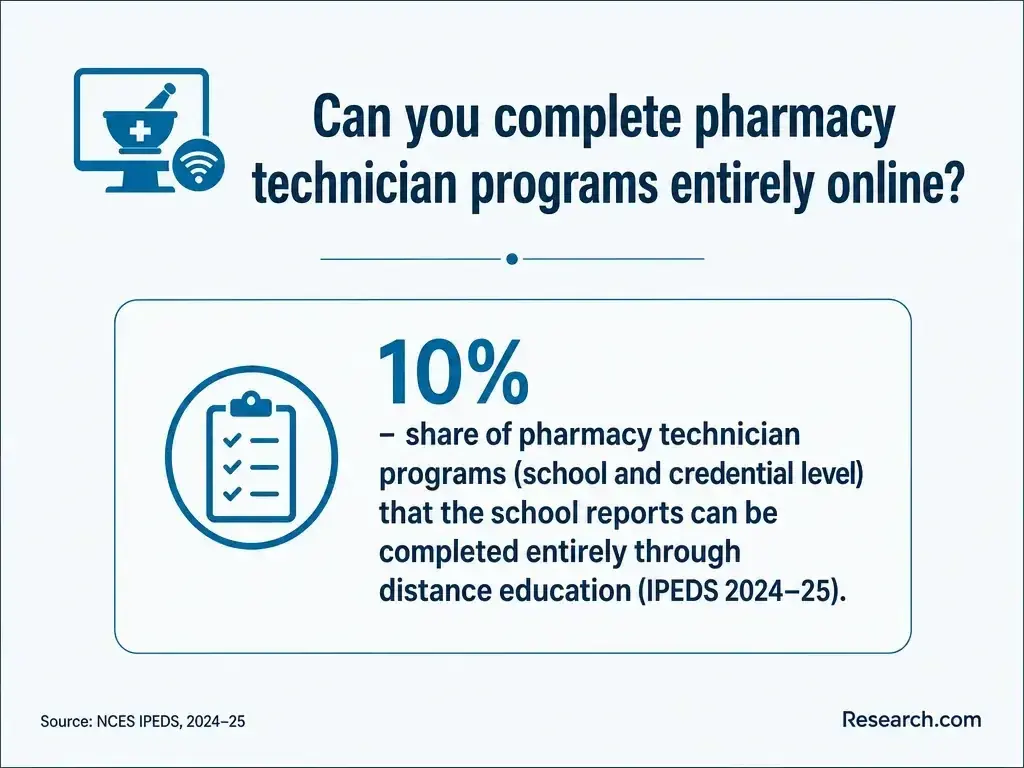
Online instruction can cover terminology, calculations, and pharmacy law, but it cannot by itself demonstrate every hands-on dispensing and workplace skill. A campus or hybrid program may provide supervised labs; either format may still require travel to a pharmacy for practical training. The distinction matters if you live outside St. Cloud or work irregular shifts.
Before choosing a remote program, obtain the location and scheduling rules for every in-person component and ask how the provider documents training for Minnesota registration. A directory of accredited non-profit online colleges can help you investigate institutions, but institutional accreditation alone does not establish that a particular pharmacy technician program meets state requirements.
A reliable St. Cloud program average is not established here; available prices may cover different credentials and exclude different expenses. For a useful comparison, request each provider's total cost to become job-ready, not just advertised tuition. That includes mandatory fees, books or software, a uniform if required, background checks, certification-exam and registration fees if applicable, and travel to labs or externships.
Subtract confirmed grants, scholarships, or employer payments, and account for earnings you may forgo while training. Ask whether a specific program qualifies for federal or Minnesota aid rather than assuming every short course does (Federal Student Aid). A low-price program with difficult-to-reach practical training can cost more overall. Lists of online schools with national accreditation are not substitutes for an itemized program quote or a Minnesota eligibility check.
A school may award a certificate or diploma; the exact award depends on the program. That school credential is distinct from Minnesota pharmacy technician registration and from optional national certification. The Pharmacy Technician Certification Board's Certified Pharmacy Technician credential requires applicants to meet its eligibility rules and pass the PTCE; completing a school program alone does not award certification (Pharmacy Technician Certification Board).
Ask for the exact credential name and whether the training qualifies under the Board's current rules. Also ask whether any credits transfer if you later change programs; do not assume that a short occupational certificate will transfer automatically.
Schools set their own admissions rules, which may include an education prerequisite, an application, and checks needed for workplace placement. Employers and externship sites can impose additional screening. Request admissions requirements and placement requirements separately: being accepted into a course does not necessarily mean you can enter its practical-training site.
If applying through an employer instead, ask when you must register with the Minnesota Board of Pharmacy and how the employer documents required training. Check the Board's current rules before relying on an admissions adviser's general description.
Core skills include reading prescriptions, pharmacy calculations, handling inventory, using dispensing technology, protecting patient information, and recognizing when a question must go to a pharmacist (U.S. Bureau of Labor Statistics). The practical question is how students apply those skills: compare supervised lab exercises, simulated prescriptions, and experience at an actual pharmacy. Ask who assesses accuracy and how errors are corrected. A similarly named credential is not evidence of equally strong hands-on preparation.
Minnesota requires pharmacy technicians to register with the Minnesota Board of Pharmacy. Board training requirements also apply; check the current registration instructions, training deadline, and acceptable training routes before choosing a school or accepting a trainee position (Minnesota Board of Pharmacy). Do not treat registration, a school certificate, and national certification as interchangeable.
National certification may be requested or valued by an employer, but it is a separate credential with its own eligibility and exam rules (Pharmacy Technician Certification Board). Institutional accreditation concerns the school; pharmacy technician programmatic accreditation, where held, concerns the training program. Neither automatically completes Board registration or grants permission to work.
Start with your intended workplace and schedule, then compare the ranking's affordability information with what each program actually delivers. Rasmussen University-Minnesota is one provider a reader may investigate, but verify whether the specific pharmacy technician program, format, and practical placement you want are currently available at a workable location. A listing for an institution is not proof that every program is offered at every site.
These questions help expose the most costly mismatches before enrollment:
- What is the complete price after required fees, materials, checks, travel, and any exam or registration charges?
- How does this training meet the Minnesota Board of Pharmacy's current requirements, and who documents completion?
- Where, when, and under whose supervision will I practice pharmacy tasks?
- What are the program's completion and placement figures, their reporting period, and the number of students counted?
- Which costs can aid or an employer cover, and what would I owe if I withdraw?
A common mistake is choosing the lowest tuition without checking practical placement or eligibility. Another is using broad best majors for making money comparisons to estimate technician pay; use occupation-specific wages and realistic entry-level offers instead. Whether training pays off depends on completion, aid, debt, foregone earnings, and the wages available to you over time - not the provider's ownership type or rank alone.
Training can lead to entry-level technician work in retail or other pharmacy settings, followed by experience with more specialized workflows, inventory, or lead-technician responsibilities. An employer may prefer additional certification for particular roles; advancement is not automatic (U.S. Bureau of Labor Statistics; Pharmacy Technician Certification Board). If you want a pathway with a different scope of practice, compare the actual duties and entry rules before paying for technician training. A 1 year online masters degree is not a substitute for the occupation-specific training and Minnesota registration needed for technician work.
National employment of pharmacy technicians is projected to grow 6.4% from 2025 to 2035, according to U.S. Bureau of Labor Statistics employment projections. That signals demand across the occupation, not a forecast of openings in St. Cloud or a placement guarantee. Check current local vacancies by pharmacy setting and shift before committing to training. If nearby openings require experience or certification, ask whether the program's placement relationships and exam preparation address that gap.
Most Affordable Pharmacy Technician Schools & Training in St. Cloud for 2027
How do we rank schools?
Education is a substantial investment. To make local comparisons more useful, the Research.com team evaluates programs against others in the same occupation and geography, checks multiple data sources, and limits the ranking to programs with completions reported to IPEDS. The most affordable ranking scores tuition, cost of attendance, median student debt, and federal loan default rate; it uses an entropy-based method that gives more weight to measures that vary more across programs. Accreditation and other quality indicators are not part of this affordability score.
The team uses the following sources across its trade-program ranking work. Some cover institutional costs and outcomes; others provide occupation-specific context and do not necessarily apply to pharmacy technician training:
- IPEDS database - program completions and institutional data.
- National Center for Education Statistics - education data and definitions.
- College Scorecard database - available costs, debt, and outcomes.
- Peterson's database - institutional information.
- Commission on Accreditation of Allied Health Education Programs (CAAHEP) - accreditation context for applicable allied-health occupations.
- Accrediting Bureau of Health Education Schools (ABHES) - accreditation context for applicable health-education providers.
- Commission on Dental Accreditation (CODA) - dental-program accreditation context, not pharmacy technician accreditation.
- Dental Assisting National Board (DANB) - dental-assisting credential context, not pharmacy technician certification.
- National Center for Construction Education and Research (NCCER) - construction-training context, not pharmacy technician training.
- Apprenticeship.gov Partner Finder - information on potential work-based training alternatives.
IPEDS does not capture every employer-training route or noncollege provider. A program's absence from the ranking does not establish that it is unavailable, unapproved, or poor quality. Use the ranking to narrow your cost comparison, then verify current program availability, Minnesota registration eligibility, and practical training directly. Research.com explains its broader process on its methodology page.
# 2 position
Rasmussen University-Minnesota - Pharmacy Technician/Assistant.
certificate or diplomaFrequently asked questions about pharmacy technician programs in St. Cloud
Is the cheapest listed program the best value?
Not necessarily. Compare total required costs, practical training, Minnesota eligibility, aid, and the risk of paying for a program you cannot finish.
Can I become a pharmacy technician through employer training instead?
Potentially. Ask the employer how its training meets current Minnesota Board of Pharmacy rules and whether the position is paid while you train.
Will an online certificate let me work in Minnesota?
Not by itself. Confirm practical-training arrangements and Board registration requirements; an online certificate and permission to work are separate matters.
Is national certification the same as Minnesota registration?
No. Registration is handled by the Minnesota Board of Pharmacy; national certification has separate eligibility and examination requirements (Minnesota Board of Pharmacy; Pharmacy Technician Certification Board).
What should I request before paying a deposit?
Get the full cost and refund terms, a training schedule, practical-placement details, the exact credential awarded, and written information on how the program addresses Minnesota requirements.
- U.S. Bureau of Labor Statistics - Pharmacy Technicians
Used to verify salary, employment outlook, and typical education requirements.
https://www.bls.gov/ooh/healthcare/pharmacy-technicians.htm - NCES College Navigator (IPEDS)
Used to verify programs offered and institutional accreditation.
https://nces.ed.gov/collegenavigator/ - PTCB - Certified Pharmacy Technician (CPhT)
Professional certification reference for graduates of this occupation.
https://www.ptcb.org/credentials/certified-pharmacy-technician - Rasmussen University-Minnesota - official website
Official school website (programs, tuition, admissions).
https://rasmussen.edu/