# 1 position


Audited and Verified:
Our Editorial and Data Verification Process
Research.com uses government datasets, official education statistics and primary institutional information to support its career and degree guides. Our review process checks factual accuracy, occupational definitions, source dates and the requirements associated with the credentials discussed.
How This Article Was Fact-Checked
Our editorial team verifies salary estimates, employment projections, education requirements and program information against original data providers and official organizations. Salary figures are checked against the relevant occupational definitions and reporting periods. Information about licensure, accreditation and required in-person training is reviewed separately.
Fact-checked and verified on:

Co-Founder and Chief Data Scientist

Reviewed by Karolina Broda
Fact-Checker and Data Verification
Choosing an affordable sonography program means looking beyond tuition: you need supervised scanning experience and a credible route to certification. The U.S. Bureau of Labor Statistics projects 13.9% national employment growth for diagnostic medical sonographers from 2025 to 2035, making training quality worth checking carefully. This guide explains Philadelphia-area pathways, costs, credentials, and career prospects. It also features a Most Affordable Medical Sonographer Trade Schools in Philadelphia for 2027 ranking, created by the Research.com team of data scientists to help students make an informed choice about which programs are worth considering.
Diagnostic medical sonographers use ultrasound equipment to produce images that clinicians interpret. A credible entry-level program combines anatomy, patient care, image acquisition, equipment operation, and supervised clinical scanning. Watching demonstrations or completing online coursework alone does not develop the practical competency the job requires (U.S. Bureau of Labor Statistics).
The main choice is between a direct-entry associate degree program and a shorter certificate designed for applicants who already have relevant healthcare preparation. A certificate's shorter schedule is useful only if you meet its prerequisites and its training leads to the certification pathway you intend to use. Employer-based clinical training can supplement an eligible educational route, but an ordinary paid job is not automatically a substitute for required supervised education (American Registry for Diagnostic Medical Sonography, ARDMS).
Philadelphia's hospitals and outpatient imaging sites make clinical-site location a practical selection issue. Ask where placements occur, who arranges them, whether travel beyond the city is possible, and whether clinical shifts fit your work schedule. For applicants primarily seeking speed, lists of best 6 month certifications that pay well can provide a comparison, but should not be mistaken for a direct-entry sonography timeline.
Sonographers work in hospitals, physicians' offices, outpatient diagnostic centers, and other medical settings (U.S. Bureau of Labor Statistics). In Philadelphia, a hospital placement may expose a student to inpatient or emergency cases, while an outpatient site may offer a more predictable examination schedule. Neither setting is automatically the better first job: compare the examinations you will perform, supervision, shift expectations, and the credentials an employer requests.
Clinical placement is also a chance to test a specialty. General abdominal, obstetric and gynecologic, and vascular imaging involve different examinations and, potentially, different certification expectations. Ask whether a program's clinical rotations give you substantial practice in the area where you hope to apply.
A verified Philadelphia-specific wage figure is needed to estimate local pay reliably; the national figure should not be relabeled as a city salary. The U.S. Bureau of Labor Statistics reports a $96,590 national median annual wage for diagnostic medical sonographers in May 2025. Half of workers in that national occupation earned less and half earned more. The figure includes experienced workers, so it is not an expected starting offer.
For a local comparison, look up the latest Bureau of Labor Statistics occupational wage estimate for the Philadelphia-Camden-Wilmington metropolitan area and confirm its reference year. Then compare actual offers by specialty, shift differential, benefits, and commuting costs. The metro area crosses state lines; a metro wage estimate does not describe Philadelphia employers alone.
Direct-entry associate degree training commonly takes about two years of full-time study; certificate length varies, particularly when prior healthcare education or clinical experience is required (U.S. Bureau of Labor Statistics; ARDMS). Published program length may not include time spent completing prerequisites, waiting for a clinical placement, or preparing for certification exams.
There is no single Philadelphia-wide number of clinical clock hours that makes every sonography program equivalent. Request each program's scheduled classroom, lab, and supervised clinical hours, plus its attendance and scan-competency requirements. If you must keep working, compare the actual clinical shift calendar, not just whether the school advertises part-time coursework.
Some anatomy, terminology, and image-analysis coursework can be delivered online. Transducer handling, patient positioning, equipment use, and supervised examinations require in-person practice. A hybrid format can reduce classroom commuting, but it cannot remove the need for labs and clinical placements (U.S. Bureau of Labor Statistics; ARDMS).
Before choosing an online option, get the school's written explanation of where hands-on training occurs and which certification eligibility route graduates can pursue. An affordable college online comparison may help you think about remote-course costs, but an inexpensive online course is not, by itself, sonographer training. For Philadelphia students, an out-of-area clinical site can erase savings in commuting time and travel expense.
There is no defensible single Philadelphia average here without a consistent, current set of program-specific prices covering the same credential and residency status. A school's tuition figure may exclude expenses essential to finishing clinical training. Request a written, itemized estimate for your own enrollment year before treating any program as affordable.
The categories below show why two similarly priced programs can have different total costs. Ask schools which items are included and which you will pay separately.
| Cost category | What to verify |
| School charges | Tuition by term or credit; mandatory lab, technology, and clinical fees; resident-rate eligibility. |
| Clinical readiness | Uniforms, required health screening, immunizations, background checks, and supplies. |
| Career entry | Certification examination and application charges; any preparation materials. |
| Time and travel | Transport to assigned clinical sites, parking, childcare, and earnings lost while attending required shifts. |
Complete the federal aid application if the program participates in eligible aid, and ask the school about grants, payment plans, and applicable Pennsylvania workforce-training assistance (Federal Student Aid; Pennsylvania Department of Labor & Industry). Compare borrowing against a realistic starting-pay scenario, not the national occupational median. A shorter program can still cost more overall if its fees, travel demands, or financing costs are higher.
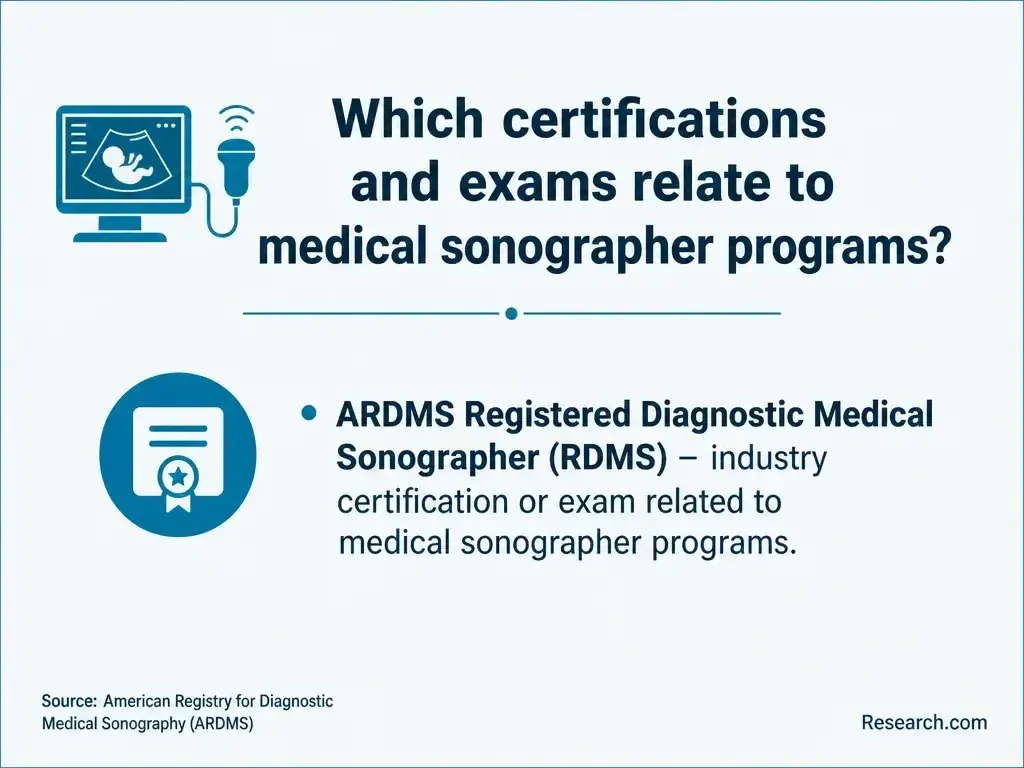
The award depends on the program: a direct-entry pathway may award an associate degree, while a qualifying postsecondary pathway may award a certificate. A school credential and a professional certification are different. ARDMS certification requires meeting an applicable eligibility prerequisite and passing the required examinations; completing a program does not itself confer certification (ARDMS).
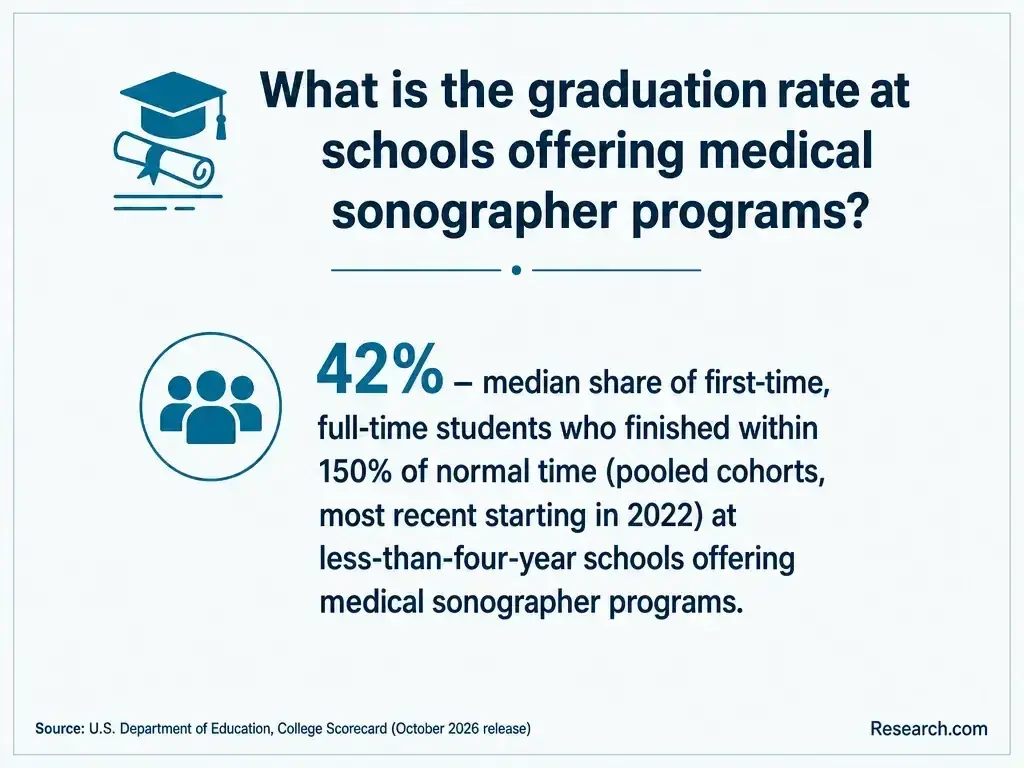
Ask admissions staff to name the exact school award, the program's accreditation status, and the ARDMS prerequisite they expect graduates to meet. Verify those statements with the accreditor and certifying organization. An institutional accreditor evaluates the school; CAAHEP accreditation addresses an eligible sonography program. Neither should be confused with state school authorization or an individual's professional certification (CAAHEP; ARDMS). Searches for an easiest bachelor degree to get answer a different education question and do not establish eligibility to scan patients.
Requirements vary by provider and pathway. Direct-entry applicants may need secondary-school preparation, prerequisite science courses, and a competitive program application. Clinical entry can also require health documentation, immunizations, and background screening. A shorter certificate may require prior healthcare education or experience; check its stated prerequisites rather than assuming "certificate" means beginner-friendly (institutional admissions requirements; ARDMS).
Ask when prerequisites must be finished, whether previous coursework transfers, whether prior clinical learning receives credit, and whether clinical placement is guaranteed or separately selected. If a school advertises advanced standing, obtain a written course-by-course evaluation and confirm that the remaining training still supports your intended certification eligibility.
Entry training covers anatomy and physiology, ultrasound physics, instrumentation, image optimization, patient communication, infection control, and documentation. In supervised labs and clinical settings, students learn to position patients, obtain diagnostic-quality images, recognize when additional views are needed, and work within a sonographer's role rather than independently diagnosing disease (U.S. Bureau of Labor Statistics; ARDMS).
Compare specialty coverage with your intended job. A program focused on general sonography should not be assumed to provide equivalent vascular or cardiac clinical preparation. Ask for a rotation schedule, competency checklist, and recent examples of the examinations students perform under supervision.
Pennsylvania does not generally require a separate state occupational license for diagnostic medical sonographers. That does not mean every employer accepts an uncredentialed applicant: employers may require or prefer professional certification, and requirements can differ by role and specialty (Pennsylvania state occupational-licensing information; U.S. Bureau of Labor Statistics).
ARDMS certification involves an applicable education-and-experience prerequisite and required examinations, including ultrasound physics and a specialty examination where applicable (ARDMS). Before paying a deposit, identify the certification your target employers request and have the school document how its specific program supports that eligibility. State school authorization, institutional accreditation, programmatic accreditation, certification, and occupational licensure are separate checks; none automatically substitutes for another.
Use the affordability ranking as a shortlist, not a final decision. A lower price is valuable only if the training fits your entry qualifications, provides sufficient supervised scanning, and leads toward the credential employers seek. Compare programs using the same anticipated start date and your own commuting and work constraints.
These checks address the most expensive mistakes before enrollment:
Do not assume that a broad education comparison - whether most affordable phd programs or another credential category - answers these occupation-specific questions. For this investment, practical training and a verifiable route to sonography work are the decisive tests.
An appropriately trained graduate may seek general diagnostic medical sonography roles, then build experience in areas such as abdominal or obstetric and gynecologic imaging. Vascular and cardiac imaging are related paths, but their training and employer credential expectations should be checked separately. With experience, some sonographers move into lead, clinical-instruction, or department-support roles (U.S. Bureau of Labor Statistics; ARDMS).
Additional specialty certification can support progression; it is not a substitute for initial hands-on competence. If you are comparing graduate dual degree programs with occupational training, keep the decision tied to your immediate goal: entry into patient-facing ultrasound work requires the appropriate clinical preparation, not simply more credentials.
The U.S. Bureau of Labor Statistics projects 13.9% national employment growth for diagnostic medical sonographers from 2025 to 2035. This supports considering the occupation, but it does not predict the number of Philadelphia openings or guarantee a job after training.
For a local decision, review current Philadelphia-area postings by specialty, requested certification, shift, and experience level. Compare those requirements with a program's clinical rotations and reported outcomes. A program that prepares students for the examinations and work settings appearing in local vacancies is a stronger fit than one selected on national growth alone.
Investing in training is a consequential decision. Research.com created this ranking to help readers compare affordable options against other programs in the same occupation and location, rather than against unrelated schools. The team checks multiple education and industry sources to improve the ranking's quality, credibility, and accuracy.
For this most affordable ranking, scores use tuition, cost of attendance, median student debt, and federal loan default rate. Weights are assigned through an entropy-based method, which gives more weight to measures that vary more across programs. Accreditation and other quality indicators do not contribute to the affordability score. Only programs with completions reported to IPEDS are included; absence from the ranking does not mean another training provider is unavailable or unsuitable.
The team used the following data sources when creating the ranking. Some are broader trade-education sources rather than sonography-specific authorities:
Use the ranking to narrow your cost comparison, then verify each program's clinical placements, certification eligibility, and current price directly. Research.com explains its approach further on its methodology page.
# 1 position
# 2 position
Diagnostic Medical Sonography/Sonographer and Ultrasound Technician
Delivery mode: On Campus (May Include Online Courses)
28.03
/ 100
Final score
Accreditation
Institutional accreditation from Middle States Commission on Higher Education.
Saint Joseph's University - Philadelphia received a Research.com Affordability Score of 28.03/100.
# 3 position
Diagnostic Medical Sonography/Sonographer and Ultrasound Technician
Delivery mode: On Campus (May Include Online Courses)
28.03
/ 100
Final score
Accreditation
Institutional accreditation from Middle States Commission on Higher Education.
Saint Joseph's University - Philadelphia received a Research.com Affordability Score of 28.03/100.
Compare each eligible program's total cost after grants, not tuition alone. Include prerequisites, clinical travel, required health checks, supplies, exam fees, and income you may give up while training. Confirm certification eligibility before choosing the lowest quote.
Not through online coursework alone. Sonography requires in-person scanning practice and supervised clinical experience. Ask a hybrid program where those components occur and how its training meets your intended certification prerequisite (ARDMS).
It can be for an applicant who meets that certificate's entry requirements and an applicable certification pathway. Some certificates are designed for people with prior healthcare preparation, so verify both admissions and post-completion eligibility (ARDMS).
Pennsylvania does not generally require a separate occupational license for diagnostic medical sonographers. Employers may still request professional certification; check the requirements for the positions you want (Pennsylvania state occupational-licensing information; U.S. Bureau of Labor Statistics).
No. CAAHEP accredits eligible programs; ARDMS certifies individuals who meet its applicable prerequisites and pass required examinations. Verify the status of your specific program and your intended examination route (CAAHEP; ARDMS).