# 1 position


Audited and Verified:
Our Editorial and Data Verification Process
Research.com uses government datasets, official education statistics and primary institutional information to support its career and degree guides. Our review process checks factual accuracy, occupational definitions, source dates and the requirements associated with the credentials discussed.
How This Article Was Fact-Checked
Our editorial team verifies salary estimates, employment projections, education requirements and program information against original data providers and official organizations. Salary figures are checked against the relevant occupational definitions and reporting periods. Information about licensure, accreditation and required in-person training is reviewed separately.
Fact-checked and verified on:

Co-Founder and Chief Data Scientist

Reviewed by Karolina Broda
Fact-Checker and Data Verification
Choosing an affordable marketing associate degree in Tempe means looking beyond tuition: a low-priced program may cost more if its credits do not fit your goal. The U.S. Bureau of Labor Statistics projects 7.0% national growth for market research analysts and marketing specialists from 2025 to 2035, although that occupation often requires more than an associate degree. This guide helps prospective students and working adults compare costs, coursework, transfer options, and career fit. The Research.com team of data scientists created a Most Affordable Marketing Associate Degree Programs in Tempe for 2027 ranking to help students make an informed choice about which programs are worth considering.
Expect a combination of general education, business fundamentals, and marketing work: understanding customers, communicating a value proposition, planning campaigns, and interpreting results. The most important distinction is whether the degree is designed chiefly for transfer or for entering work sooner. Degree titles alone do not establish that distinction; the required courses and receiving institution's credit rules do.
The comparison below shows how commonly awarded associate degree types can serve different marketing goals. Individual programs may use these labels differently, so treat the catalog as the final authority.
| Degree type | Typical emphasis | Best fit | Question to verify |
| Associate of Arts (AA) | General education and broadly transferable business coursework | Students prioritizing an established transfer pathway | Which marketing and business courses count toward the intended next program? |
| Associate of Science (AS) | General education with potentially more quantitative or technical coursework | Students seeking transfer with an interest in analytics | Will the receiving institution accept the specific math and statistics courses? |
| Associate of Applied Science (AAS) | Applied business and marketing skills | Students prioritizing near-term employment | Which credits transfer, and does the program include portfolio-quality work? |
Tempe students can also compare nearby and online associate options rather than assuming a program must have a Tempe address. If considering Bryan University or the University of Advancing Technology, verify in each current catalog whether a marketing-specific associate degree is offered; an institution's presence in the city does not establish that it offers this particular degree.
Entry-level opportunities may be found in the Phoenix-area businesses that serve Tempe: retailers, hospitality operators, healthcare organizations, technology firms, agencies, and small businesses. Marketing work can involve customer outreach, event coordination, email production, social media scheduling, sales support, or reporting. These employers may use different job titles for similar duties, so search by skills as well as by "marketing associate."
A degree is most useful for career entry when it produces evidence of work: a campaign brief, audience research, a content calendar, and a report explaining results. Ask whether coursework includes client projects, internships, or other employer-facing assignments. Such opportunities vary by program and are not guaranteed simply because a degree is described as applied.
There is no single reliable salary for all Tempe marketing associate degree graduates. Pay varies by role, experience, employer, and whether a position requires further education. For context, the U.S. Bureau of Labor Statistics reports a $78,760 national median annual wage in May 2025 for market research analysts and marketing specialists. BLS says these positions typically require a bachelor's degree, so the figure should not be used as an expected entry-level associate-degree salary.
For a more relevant personal estimate, identify Phoenix-Mesa-Chandler-area postings for roles you could plausibly qualify for at graduation, note their stated pay and experience requirements, and compare those with your current earnings. Use that estimate - not a national occupational median - when deciding how much debt the degree could reasonably support.
Many associate degrees are designed around roughly two years of full-time study and about 60 semester credits, but the current catalog determines the actual credit requirement and course sequence. Working adults may need longer if required classes are not offered every term or if an internship must fit around a job. An accelerated calendar is valuable only if its workload allows you to finish.
If speed is the deciding factor, do not use comparisons about the quickest online bachelor's degree for working adults as a shortcut for assessing an associate program. Request a term-by-term associate degree plan showing prerequisites, course availability, transfer-credit evaluation, and your likely completion date.
Online study can make lectures, reading, discussions, and campaign assignments easier to schedule around work. On-campus study may offer more immediate access to instructors, classmates, employer events, and local project partners. Hybrid study can combine those benefits, but its travel requirements must be stated clearly.
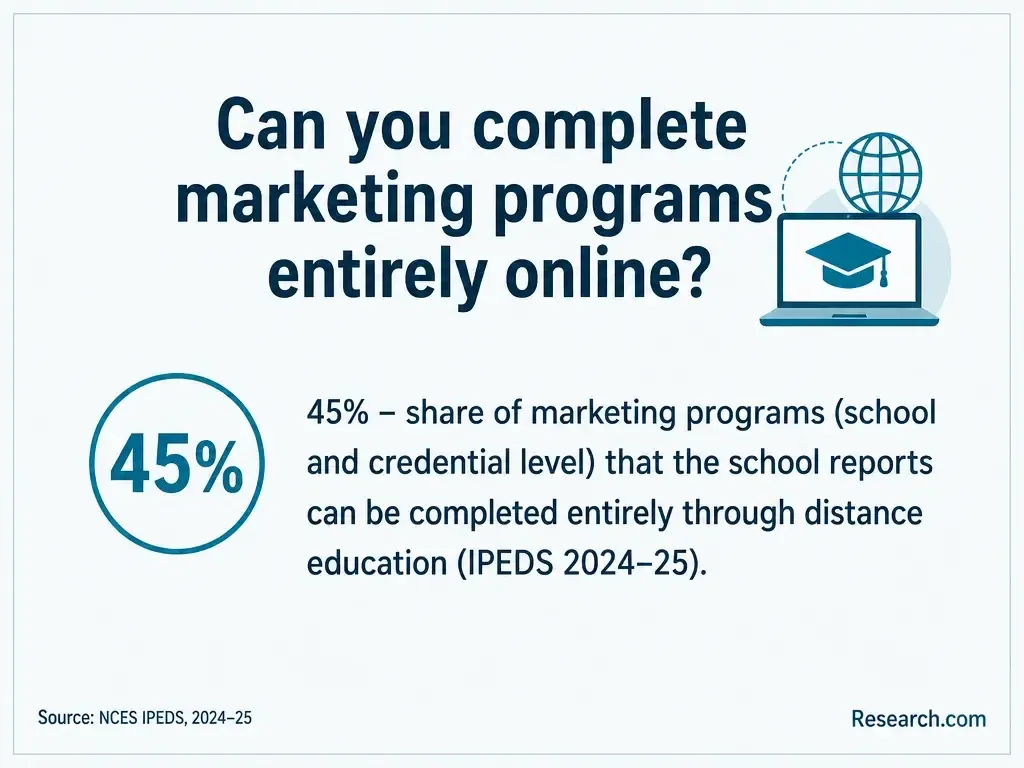
Marketing does not ordinarily require clinical placements or licensed practice hours. Even so, an online label does not tell you whether presentations, proctored assessments, internships, or group projects require attendance at set times or locations. Directories such as best trade colleges online cannot substitute for checking a marketing associate program's actual delivery schedule, software access, support, and transfer rules.
No defensible Tempe-wide average applies equally to resident-rate, private, hybrid, and online marketing associate programs. Published tuition can also change before 2027. Ask each school for a written estimate covering every term through completion, not merely its advertised per-credit price.
Compare tuition and mandatory fees with textbooks, marketing or analytics software, a suitable computer, internet access, and transportation for any required campus or employer visits. Include living expenses and earnings you may give up by reducing work hours. Then subtract grants, scholarships, and confirmed employer assistance; treat loans as financing to repay, not as a price reduction. A lower-cost program may be the poorer investment if unavailable courses delay completion or its credits do not serve your intended next step.
Eligible students at eligible institutions may use federal grants, work-study, or federal loans after completing the Free Application for Federal Student Aid (FAFSA), subject to program and individual eligibility rules (Federal Student Aid). Institutional scholarships, Arizona-based assistance, and employer tuition benefits may also help, but availability and renewal conditions differ. An online associate degree is not automatically aid-eligible because its school advertises flexible study.
Compare each school's aid offer against its full cost of attendance and ask which awards are grants rather than repayable loans. A list of the best cheap online universities that accept fafsa can help frame an aid search, but confirm that the specific associate program and your enrollment status qualify before counting on federal funding.
Requirements depend on the institution and may include a high school diploma or recognized equivalent, an application, transcripts, and steps to determine math or writing placement. A placement process may affect which courses you take first without necessarily preventing admission. Ask whether prior college coursework or assessed prior learning can reduce the credits you must pay for and complete.
Before paying an enrollment deposit, confirm the exact degree title, admission requirements for the marketing pathway, the current catalog year, and whether any courses have prerequisites. If you plan to transfer, obtain a written explanation of how completed and planned credits will be evaluated; admission to one institution does not guarantee acceptance of every course elsewhere.
Marketing associate curricula commonly combine writing, quantitative reasoning, and other general education with introductory marketing, business communication, consumer behavior, digital channels, and basic data interpretation. The mix matters: an analytics-minded student should check for statistics and spreadsheet-based projects, while someone seeking campaign production should look for writing, design collaboration, and measurement assignments.
Review actual course descriptions rather than relying on titles such as "digital marketing." Ask what tools students use, whether assignments produce portfolio samples, and whether an internship or client project is required, optional, or unavailable. For transfer-oriented degrees, check that general education and major courses satisfy the intended receiving institution's requirements under applicable Arizona transfer agreements (AZTransfer).
An associate program may offer focused electives or projects rather than a formally named specialization. Possible emphases include digital advertising, social media content, sales support, customer research, or marketing analytics. Verify whether the emphasis appears in the degree requirements and whether its courses fit within the normal credit total; extra courses can raise cost and delay completion.
Choose a focus based on work you want to demonstrate, not a fashionable label. For example, a student interested in analytics needs practice defining a question and interpreting results, while a student interested in content needs writing samples and evidence of revision. Employer-issued platform certifications may complement these skills, but they are generally optional and do not replace an associate degree or guarantee a job.
Start with your intended first job or transfer destination, then compare programs against that outcome. An affordability ranking identifies cost signals; it cannot tell you whether a course sequence, schedule, or portfolio opportunity fits your circumstances. Claims about the easiest way to get a bachelor's degree are likewise no substitute for confirming how a particular associate degree's credits transfer.
Use these checks before committing, especially when two programs have similar advertised tuition:
A common mistake is treating accreditation, a low sticker price, or a ranking position as proof that credits will transfer or that a desired job will follow. Marketing roles generally do not require an Arizona occupational license, so focus regulatory checks on legitimate institutional accreditation and any specific employer or transfer requirements rather than searching for a marketing license (Arizona occupational licensing information; U.S. Department of Education).
A realistic first step may be marketing assistant, sales support specialist, social media coordinator, or customer-service work with campaign responsibilities. Titles and entry requirements vary; some analyst and specialist positions expect additional education or substantial experience. Over time, demonstrable results, stronger research skills, and responsibility for budgets or projects may support progression into more specialized roles.
For someone already working, the associate degree may be most valuable if it adds measurable skills without requiring an extended break from employment. Do not use articles about what type of master's degree makes the most money to forecast a marketing associate graduate's return: compare attainable roles, your present earnings, total degree cost, and the experience employers request.
The U.S. Bureau of Labor Statistics projects 7.0% national employment growth from 2025 to 2035 for market research analysts and marketing specialists. That signals demand for research and measurement skills, but it is neither a Tempe-specific forecast nor a count of openings accessible with an associate degree. Competition, job titles, and educational requirements can differ substantially across Phoenix-area employers.
Tempe's position within the larger Phoenix-area labor market gives students a wider commuting radius to consider, but travel time can change the value of a job or internship. Before enrolling, sample current local postings and separate roles you can pursue with an associate degree and a portfolio from roles requiring more experience. Give particular attention to employers' expectations for writing, spreadsheets, campaign tools, and interpreting performance data, including work that uses AI-assisted tools responsibly.
Investing in education is a consequential decision, so Research.com designed its affordability ranking to help readers compare programs against relevant options in the same occupation and location. Only programs with completions reported to the Integrated Postsecondary Education Data System (IPEDS) are eligible. That coverage rule does not mean a program absent from the ranking is unavailable or low quality.
The most affordable ranking scores tuition, cost of attendance, median student debt, and federal loan default rate. An entropy-based method assigns more weight to cost-and-debt measures that differ more across eligible programs. Accreditation, student support, completion, and earnings are not part of this affordability score; readers should check them separately before enrolling. Research.com also maintains distinct best-program rankings that consider outcomes, earnings, costs, accreditation, and support, but those weights should not be confused with this ranking.
The Research.com team draws on the following sources across its program-ranking work. Occupation-specific sources in the list - for example, dental or construction organizations - provide context where relevant; their inclusion does not make them marketing accrediting bodies or marketing affordability-score inputs.
The ranking is a cost-screening tool, not a determination of program fit or an estimate of any individual's eventual bill. Readers can review further details on Research.com's methodology, then confirm current prices, degree requirements, and aid directly with each institution.
# 1 position
# 2 position
Digital Marketing
Delivery mode: Online
54.77
/ 100
Final score
Accreditation
Institutional accreditation from Higher Learning Commission.
University of Advancing Technology earned a Research.com Affordability Score of 54.77/100.
# 3 position
Marketing, Other
Delivery mode: Online
54.77
/ 100
Final score
Accreditation
Institutional accreditation from Higher Learning Commission.
University of Advancing Technology earned a Research.com Affordability Score of 54.77/100.
There is no universal cheapest choice: your residency classification, aid, fees, pace, and required travel affect the final cost. Use the affordability ranking as a shortlist, then request a personalized full-program estimate.
An AA or AS often suits a planned transfer; an AAS often emphasizes applied career preparation. Compare the actual courses and confirm credit acceptance rather than choosing by initials alone.
Some programs may offer online coursework, but required meetings, assessments, projects, or internships vary. Obtain the current delivery and attendance requirements in writing.
Marketing roles generally do not require a state occupational license. Employers may still ask for particular skills, experience, or optional platform certifications.
It may be if its coursework supports an attainable job or transfer goal and its net cost fits your finances. Weigh completion likelihood, time away from work, debt, and realistic earnings - not an occupational median alone.