2027 Questions to Ask Before Enrolling in an Online Physics Degree

Co-Founder and Chief Data Scientist
Choosing an online physics degree is a high-stakes decision because the subject is math-heavy, lab-based, and often tied to graduate study or technical careers. The U. S. Bureau of Labor Statistics projects employment for physicists and astronomers to grow 7% from 2023 to 2033, which makes program quality and career fit especially important.
This guide is for prospective students comparing online options, transfer pathways, costs, lab formats, and career outcomes. You will learn what to ask schools before enrolling so you can choose a program that fits your goals, budget, and schedule.
Key Things You Should Know
- Accreditation, lab access, transfer-credit rules, and graduate-school preparation matter more than whether the physics degree is delivered online or on campus.
- National cost benchmarks are rising: College Board's 2024 pricing report lists average published tuition and fees at $11,610 for in-state public four-year colleges and $43,350 for private nonprofit four-year colleges.
- The strongest career outcomes often require pairing physics with applied skills such as programming, data analysis, engineering methods, instrumentation, technical writing, or teacher licensure.
What should you look for in an accredited online physics degree program?
An accredited online physics degree should meet the same academic standards you would expect from a campus-based bachelor's program. Accreditation is the first question to ask because it affects financial aid eligibility, credit transfer, graduate school admission, and employer confidence.
Start with institutional accreditation from an accreditor recognized by the U.S. Department of Education or the Council for Higher Education Accreditation.
Physics programs themselves are not commonly accredited by a specialized physics accreditor in the same way engineering programs may be ABET-accredited, so you should focus on the institution's accreditation, the department's academic rigor, faculty qualifications, and evidence that the curriculum prepares students for their intended next step.
If you are comparing an online degree in physics, ask admissions and the physics department the following questions before you apply:
- Is the institution currently accredited, and where can I verify that status?
- Is the degree title the same as the campus version, or is it an online-only variation?
- Does the program include calculus-based physics, modern physics, electromagnetism, quantum mechanics, thermodynamics, and upper-division lab or research work?
- How are labs completed: at home, through remote instrumentation, through simulations, during short campus residencies, or at approved local sites?
- Will the degree satisfy prerequisites for physics, engineering, astronomy, medical physics, education, or data-focused graduate programs?
- What percentage of credits may transfer, and are there expiration rules for older math or science courses?
- Can online students access faculty advising, tutoring, undergraduate research, career services, and recommendation letters?
Be cautious if a school cannot clearly explain lab requirements, avoids direct answers about accreditation, or advertises the degree mainly as "fast" without showing upper-level physics depth. A legitimate program should be transparent about workload, course sequencing, faculty support, and limits of the online format.
How does an online physics degree compare to a traditional on-campus program?
An online physics degree can be academically comparable to an on-campus program when it uses the same curriculum, qualified faculty, rigorous assessments, and credible lab experiences. The biggest differences are usually scheduling flexibility, lab delivery, peer interaction, and access to equipment-intensive research.
The table below summarizes the practical trade-offs. Use it to decide whether online learning matches how you study, how much lab access you need, and what you plan to do after graduation.
| Factor | Online physics degree | On-campus physics degree | Best fit |
| Schedule | Often asynchronous or hybrid, with set exam and lab deadlines | Fixed class, lab, and office-hour schedules | Online works well for working adults and students with family responsibilities |
| Labs | May use home kits, simulations, remote instruments, local lab partners, or short residencies | Uses campus labs, equipment rooms, and supervised lab sections | Campus is usually stronger for students seeking equipment-heavy research experience |
| Faculty access | Virtual office hours, discussion boards, email, and video meetings | In-person office hours, informal department contact, and lab mentorship | Either can work if the program offers proactive advising |
| Research opportunities | Possible, but more dependent on faculty design and student initiative | Often easier to join labs, seminars, and departmental projects | Campus may be better for PhD-bound students unless the online program has strong research pathways |
| Networking | Requires intentional participation in virtual cohorts, internships, and professional groups | More natural peer and faculty interaction | Online students should prioritize programs with cohort activities and career support |
Online is a strong option if you need flexibility and can stay organized in a math-intensive program. Campus may be the better option if your goal is a research PhD, advanced experimental work, or a highly mentored undergraduate research experience. Hybrid programs can offer a useful middle ground by combining online coursework with in-person lab intensives.
What careers can you pursue with an online bachelor's in physics?
A bachelor's in physics can lead to technical, analytical, education, and research-support roles, but it is important to understand what the degree does and does not qualify you for. Many jobs with the title "physicist" require a master's degree or PhD, while bachelor's graduates often start in applied roles that use quantitative reasoning, experimentation, modeling, or technical problem-solving.
The table below shows common career directions for physics graduates and what to investigate before choosing a program. It is not a salary guarantee; it is a planning tool for matching coursework and experience to a realistic path.
| Career direction | Typical work | What to build during the degree | Important caution |
| Research or laboratory assistant | Run experiments, maintain instruments, collect data, document results | Upper-level labs, instrumentation, Python or MATLAB, research experience | Advancement into independent research often requires graduate study |
| Data analyst or scientific programmer | Model systems, clean data, write scripts, support technical teams | Programming, statistics, computational physics, machine learning basics | A portfolio may matter as much as the degree title |
| Engineering-adjacent technical role | Support testing, quality assurance, product development, or systems analysis | Mechanics, electronics, CAD exposure, lab documentation, internships | Some engineering roles require an engineering degree or licensure path |
| Secondary physics teacher | Teach physics or physical science in middle or high school | Education coursework, student teaching, state-approved licensure preparation | Teacher certification requirements vary by state |
| Graduate or professional school pathway | Prepare for physics, astronomy, engineering, medical physics, or related graduate programs | Advanced math, research, strong faculty recommendations, GRE if required | Prerequisite expectations vary by graduate department |
If your goal is a licensed engineering role, compare physics with a mechanical engineering degree before enrolling. Physics can be excellent for theory, modeling, and analytical flexibility, but engineering degrees are often more directly aligned with design, systems, and licensure-oriented engineering jobs.
What core courses and specializations are typically offered in online physics programs?
Most online physics bachelor's programs are built around the same foundation as campus programs: calculus, calculus-based physics, laboratory methods, and upper-division theory. The exact mix matters because a lighter curriculum may be fine for teaching or technical support but insufficient for competitive graduate physics programs.
Before enrolling, review the full degree map rather than just the program summary page. A solid curriculum usually includes these components:
- Math foundation: calculus I through III, differential equations, linear algebra, and sometimes probability or numerical methods.
- Introductory physics sequence: calculus-based mechanics, electricity and magnetism, waves, optics, and thermodynamics.
- Upper-division theory: classical mechanics, electrodynamics, quantum mechanics, statistical mechanics, and modern physics.
- Laboratory and methods courses: experimental physics, electronics, instrumentation, measurement uncertainty, and scientific writing.
- Computational preparation: programming for scientific applications, data analysis, numerical modeling, and simulation tools.
- Capstone or research experience: senior project, independent study, applied research, or a culminating lab-based project.
Specializations vary widely. Some programs emphasize astronomy, materials science, computational physics, physics education, applied physics, or engineering physics. If a school advertises a concentration, ask how many upper-level electives are actually offered online each year. A specialization is only useful if the courses are available often enough for you to graduate on time.
Current technology trends make computational skills especially valuable. AI tools can help with coding, simulation, literature review, and data visualization, but they do not replace the need to understand physical assumptions, units, error analysis, and mathematical reasoning. Employers and graduate faculty will still expect you to explain your work, not just generate an output.
What math and science background do you need to get into an online physics degree?
Physics is one of the most math-dependent undergraduate majors, so admissions requirements are only part of the story. Even if a school admits students with limited preparation, you should ask whether you are ready for the first calculus-based physics course.
A typical bachelor's pathway assumes that students are prepared for college algebra, trigonometry, and calculus. Transfer students may be expected to have completed introductory physics, calculus I or II, chemistry, or general education requirements, depending on the program level they enter.
Use the following readiness checklist before enrolling. It will help you avoid paying for courses that you are not yet prepared to complete successfully:
- Can you work comfortably with algebraic manipulation, functions, logarithms, trigonometry, vectors, and unit conversions?
- Have you taken or placed into calculus, or does the program include a realistic pre-calculus pathway?
- Do you understand basic mechanics concepts such as force, energy, momentum, and rotational motion?
- Are you comfortable learning programming if the program requires Python, MATLAB, Mathematica, or similar tools?
- Can you commit regular weekly time to problem sets, not just lectures and readings?
- Have you confirmed whether older math and science credits will transfer or need to be retaken?
If you are not calculus-ready, that does not automatically mean physics is the wrong choice. It may mean you should start with community college math courses, a bridge program, or part-time enrollment. The mistake to avoid is beginning upper-level physics before rebuilding the math foundation that supports it.
How long does an online physics degree take and how is it structured?
A full bachelor's degree in physics typically requires about 120 semester credits, although the exact number varies by school. The timeline depends on transfer credits, math placement, course availability, lab scheduling, and whether you study full time or part time.
The table below outlines common enrollment patterns. Use it to estimate your likely pace, but confirm the actual rotation of upper-level physics courses because some are offered only once per year.
| Student profile | Typical structure | Approximate planning issue | Best fit |
| First-time full-time student | General education, calculus sequence, introductory physics, upper-level physics, capstone | Usually follows a four-year plan if courses are passed in sequence | Students who can carry a heavy math and lab workload |
| Transfer student with an associate degree | Completes upper-division physics, advanced math, labs, and remaining general education | Time depends on whether calculus and physics credits transfer cleanly | Students who planned prerequisites carefully at community college |
| Part-time working adult | Takes one to three courses per term, often including summer courses | May need a longer timeline because physics courses are sequential | Students balancing employment, caregiving, or military service |
| Accelerated student | Uses transfer credits, heavier course loads, and year-round enrollment | Acceleration is limited by prerequisites and lab availability | Students with strong preparation and substantial prior credit |
Physics is difficult to compress because calculus, mechanics, electromagnetism, quantum mechanics, and lab work build on one another. A program that promises extreme speed should be examined carefully. Ask whether acceleration comes from genuine transfer credit, shorter terms, competency-based progress, or simply an unrealistic workload.
What does an online physics lab experience look like and is it equivalent to in-person?
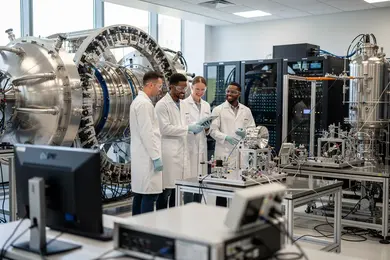
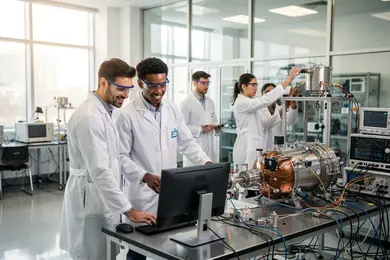
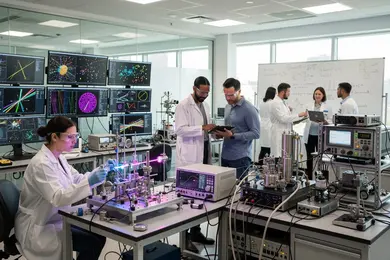
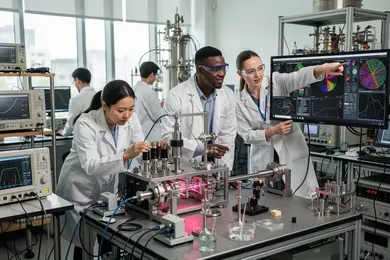
Online physics labs can be credible when they require students to make measurements, analyze uncertainty, write lab reports, and connect data to physical models. Equivalence depends less on the label "online" and more on whether students do authentic experimental work and receive meaningful feedback.
Schools may use several lab models. Each has strengths and limitations, so ask which format is used in each required course rather than assuming all labs work the same way.
| Lab model | How it works | Strength | Limitation |
| Home lab kits | Students receive or purchase equipment for mechanics, circuits, optics, or measurement activities | Hands-on and flexible | Equipment complexity is limited |
| Remote instrumentation | Students control real lab equipment online or analyze data from live systems | Can provide access to advanced instruments | Less tactile experience with setup and troubleshooting |
| Simulation-based labs | Students model systems and test variables in a virtual environment | Useful for visualization and conceptual learning | Should not be the only lab method in a rigorous program |
| Local site labs | Students complete approved labs at a partner institution or workplace | Can provide in-person equipment access | Requires coordination and approval |
| Campus residencies | Students travel for intensive lab sessions | Strong for equipment-heavy experimental work | Adds travel cost and scheduling constraints |
Before enrolling, request sample lab syllabi and ask how lab reports are graded. A strong online lab should include raw data, uncertainty analysis, experimental design, troubleshooting, and written interpretation. A red flag is a program that treats labs as short quizzes, videos, or demonstrations with little original student measurement.
How much does an online physics degree cost and what financial aid is available?
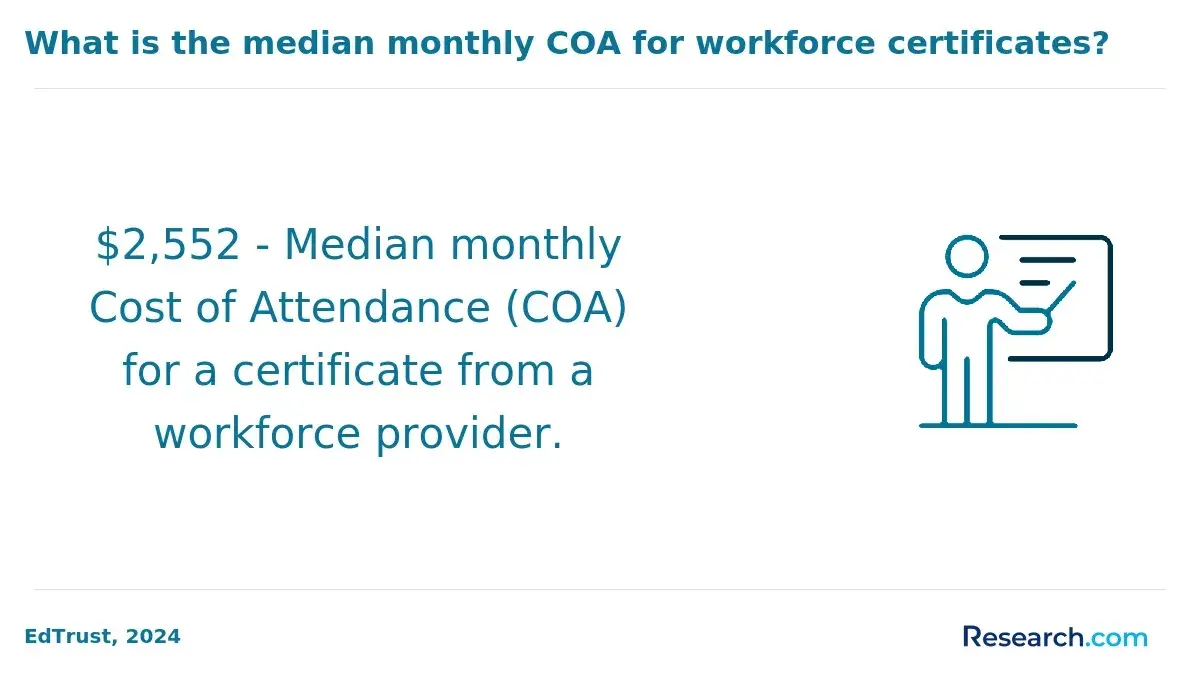
The cost of an online physics degree depends on tuition, fees, transfer credits, residency status, textbooks, lab kits, technology, travel for residencies, and time away from work. Do not compare programs by tuition alone; physics may include added costs for calculators, software, lab materials, proctoring, or occasional campus visits.
Recent national pricing benchmarks can help you judge whether a quoted tuition rate is relatively low, moderate, or high. College Board's 2024 report lists these average published tuition and fee figures for full-time undergraduates:
- $11,610 for in-state students at public four-year colleges
- $30,780 for out-of-state students at public four-year colleges
- $43,350 for students at private nonprofit four-year colleges
Online programs may charge different rates from campus programs, and some public universities offer online students the same tuition regardless of residency. Ask for a full cost-of-attendance estimate, not just per-credit tuition. If you are comparing science-related online options with different lab requirements, such as an online dietitian degree, pay close attention to practicum, lab, and professional-preparation costs because they can change the real price of completion.
Financial aid can reduce upfront cost, but borrowing should be evaluated carefully. For the 2024-25 award year, the maximum federal Pell Grant is $7,395, and the fixed interest rate for federal Direct Subsidized and Unsubsidized Loans for undergraduates is 6.53%. Those figures matter because a lower sticker price is not always the lowest long-term cost if you need to borrow heavily or extend your time in school.
Before accepting an offer, complete these cost-control steps:
- Ask for a written estimate that includes tuition, mandatory fees, lab materials, software, books, proctoring, and travel.
- Confirm how many transfer credits will apply to the major, not just to elective credit.
- Compare the total cost to your likely career path, especially if graduate school will be necessary.
- Prioritize scholarships, grants, employer tuition assistance, military benefits, and payment plans before loans.
- Ask whether failed or repeated sequential courses delay graduation and add cost.
What salary ranges and job outlook can physics graduates expect in the United States?
Physics salary outcomes vary widely because graduates enter different fields: research, education, engineering support, software, data analysis, government labs, defense, manufacturing, healthcare technology, and graduate school. The degree can be valuable, but the payoff depends on how well you pair physics with marketable skills and experience.
The U.S. Bureau of Labor Statistics reported a median annual wage of $166,290 for physicists in May 2024, and its 2024 Occupational Outlook Handbook projects 7% employment growth for physicists and astronomers from 2023 to 2033. This is useful context, but it should not be read as the expected salary for every bachelor's graduate because many physicist positions require graduate education.
The table below explains how to interpret career outcomes realistically. It separates common bachelor's-level directions from advanced roles that often require further education.
| Path | Typical entry point | Education expectation | How to strengthen your outcome |
| Physicist or research scientist | Research assistant, graduate student, lab staff | Master's or PhD often required for independent research roles | Complete undergraduate research, advanced labs, and strong math coursework |
| Data, analytics, or computational role | Junior analyst, scientific programmer, modeling assistant | Bachelor's may be sufficient if paired with coding and portfolio evidence | Build projects in Python, statistics, visualization, and numerical methods |
| Technical industry role | Test technician, quality analyst, systems support, instrumentation associate | Bachelor's may qualify, but employer requirements vary | Add internships, electronics, CAD exposure, and documentation skills |
| Teaching | High school physics or physical science teacher | Bachelor's plus state-approved teacher licensure | Choose a program that supports education coursework and student teaching |
| Graduate school | Master's or PhD student in physics, engineering, astronomy, or applied science | Strong undergraduate preparation required | Prioritize rigorous upper-level courses, recommendations, and research fit |
A smart salary strategy is to choose electives and experiences that point toward a specific market. Physics plus coding can support analytics and simulation work; physics plus electronics can support instrumentation; physics plus education coursework can support teaching; physics plus research can support graduate study.
How can you evaluate and compare different online physics degree programs effectively?
The best way to compare online physics programs is to move beyond rankings and ask whether each program fits your academic readiness, career goal, budget, and need for flexibility. A highly ranked program may still be a poor fit if it lacks the lab format, course schedule, or advising you need.
Use the following comparison process before submitting applications or deposits. It is designed to reveal hidden problems that are easy to miss on marketing pages:
- Verify institutional accreditation through an official accreditor or federal database.
- Download the full degree plan and mark every prerequisite sequence, especially calculus and upper-level physics.
- Ask how each required lab is delivered and whether any travel, local placement, or special equipment is required.
- Confirm whether the degree prepares students for your intended next step, such as graduate school, teaching licensure, analytics, engineering-adjacent roles, or technical industry jobs.
- Request transfer-credit evaluation before enrolling, especially for calculus, chemistry, physics, and general education courses.
- Compare total cost, not just tuition, and include repeated-course risk if you will study while working full time.
- Ask about faculty access, tutoring, research opportunities, internship support, and career placement services for online students.
- Review course rotation schedules so you know whether upper-level classes are available when you need them.
- Speak with an advisor in the physics department, not only a general admissions representative.
- Look for red flags such as vague lab descriptions, unclear accreditation language, aggressive enrollment pressure, or promises of guaranteed jobs.
It also helps to compare physics with adjacent paths if your career goal is still flexible. For example, students who prefer research organization, archives, data stewardship, or academic information services may find that an online library science master's better fits their long-term plan than another technical bachelor's degree.
Your final choice should answer three questions clearly: Can I complete the program successfully, can I afford it without unreasonable debt, and does it move me toward a specific career or graduate-school goal? If any answer is uncertain, ask more questions before enrolling.
Other Things You Should Know About Physics
It can be respected if it comes from an accredited institution and includes rigorous coursework, credible labs, and evidence of technical skill. Employers usually care about what you can do, so internships, research, programming projects, and lab experience strengthen the degree.
Some entry-level lab or technical roles are available with a bachelor's degree, but many physicist and research scientist positions require a master's degree or PhD. Ask programs how they prepare students for graduate admissions if that is your goal.
They may be enough if they involve real measurement, uncertainty analysis, strong lab reports, and upper-level experimental work. Graduate programs vary, so students aiming for research-intensive graduate study should ask target departments whether the online lab format will be viewed as adequate.
To succeed in an online physics degree in 2027, students should be proficient in software like MATLAB and Python for simulations, have strong internet research skills, and be able to navigate virtual lab environments. Technical competency ensures effective participation in online coursework and enhances learning experiences.
References
- Virtual Labs vs Hands-on Labs: How to Know Which is Right for Your Online Science Lab https://www.scienceinteractive.com/blog/2023/virtual-labs-vs-hands-on-labs-how-to-know-which-is-right-for-your-online-science-lab/
- Physics Degree Online - Edubrain https://edubrain.ai/blog/physics-degree-online/
- Where Can I Find a Physics Online Course for Credit? 5 Great Options - Prereqcourses https://www.prereqcourses.com/physics-online-course-for-credit/
- What is Introductory Physics with Lab like in college? https://talk.collegeconfidential.com/t/what-is-introductory-physics-with-lab-like-in-college/1715897
- 2025 Best Online Degrees in Physics https://www.onlineu.com/degrees/physics
- Admissions : Online Tuition | Full Sail University https://www.fullsail.edu/admissions/tuition-online
- Physics Major Jobs: Career Options & Salaries https://www.physicsforums.com/threads/physics-major-jobs-career-options-salaries.854130/