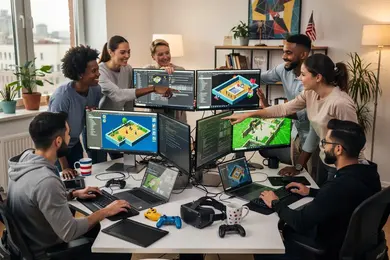
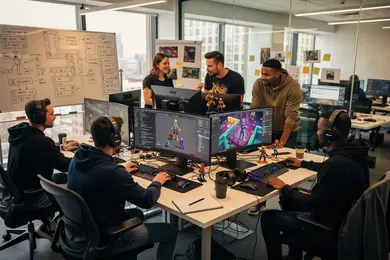
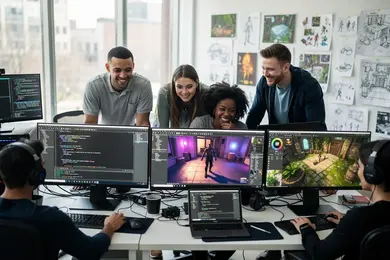
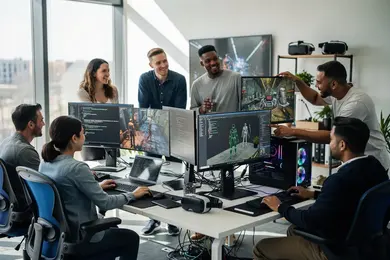
2027 Online Game Programming and Development Degrees With Game Physics Coursework

Co-Founder and Chief Data Scientist
Choosing an online game programming degree is really a decision about skills, portfolio value, cost, and career fit. The U. S. game audience remains large: the Entertainment Software Association reported in 2024 that 190.6 million people in the U. S. play video games. That demand supports a broad ecosystem of studios, simulation firms, education technology companies, and interactive media teams. This guide is for students comparing online programs with game physics coursework and explains curriculum, accreditation, admissions, cost, career outcomes, and how to choose a program that matches your goals.
Key Things You Should Know
- Game physics coursework usually combines calculus-based motion, collision detection, rigid body dynamics, numerical methods, and real-time engine implementation, so strong math and programming preparation matter.
- Online programs can work well for self-directed students, but portfolio support, engine access, capstone structure, and accredited institutional status are more important than the online label itself.
- The U.S. Bureau of Labor Statistics reported a 2024 median annual wage of $133,080 for software developers, but game roles vary widely by studio size, location, specialization, portfolio quality, and experience.
What are online game programming and development degrees with game physics coursework?
Online game programming and development degrees are college programs that teach students how to build interactive software, with a focus on video games, simulations, real-time 3D systems, and game engines. Game physics coursework is the part of the curriculum that teaches how movement, gravity, collisions, particles, vehicles, projectiles, constraints, and object interactions behave inside a game world.
These degrees are usually offered as associate, bachelor's, or master's programs. A bachelor's degree is the most common option for students who want full preparation for programming-heavy roles, while associate programs may fit students seeking transfer pathways or entry-level technical exposure. Master's programs are more useful for students who already have a computing background and want advanced specialization in rendering, simulation, AI, tools engineering, or technical direction.
The strongest programs do not treat game physics as a standalone theory class. They connect the math to implementation in engines such as Unity, Unreal Engine, or custom C++ frameworks. That distinction matters because employers typically want evidence that you can debug real-time systems, optimize performance, and ship working prototypes, not just explain formulas.
This kind of degree tends to fit students who enjoy both creative projects and technical problem-solving. It may not be the best fit if you mainly want to write game stories, create character art, or design user interfaces without much coding. Students who lean more toward visual production may want to compare game development with adjacent options such as online graphic design programs, where the emphasis is usually on visual communication, branding, typography, and digital media rather than physics engines or gameplay systems.
The table below shows how common degree levels differ. Use it to match the credential to your starting point and the level of technical depth you need.
| Degree level | Typical focus | Best fit | Limitations to consider |
| Associate degree | Programming basics, introductory game design, math foundations, engine exposure | Students testing the field or planning to transfer into a bachelor's program | May not provide enough depth for competitive programming roles without additional projects |
| Bachelor's degree | Computer science, game systems, physics, graphics, algorithms, software engineering, capstone portfolio | Students seeking the broadest preparation for game programmer, tools programmer, or simulation developer roles | Usually requires the largest time and cost commitment |
| Master's degree | Advanced graphics, AI, simulation, engine architecture, research or technical leadership | Students with prior computing preparation who want specialized or senior technical pathways | Not usually necessary for entry-level game programming roles if the portfolio is strong |
| Certificate or bootcamp | Specific tools, engines, or production workflows | Career changers who already have coding experience or degree holders filling skill gaps | May not replace an accredited degree for employers that screen by education level |
How do online and campus game development programs compare?
Online and campus game development programs can lead to similar outcomes when the curriculum, faculty, projects, and support systems are strong. The main difference is how students access collaboration, labs, mentoring, and production feedback. Online programs usually require more self-management, while campus programs may offer more spontaneous peer interaction and easier access to specialized hardware.
For many students, the better question is not whether online or campus is "better," but which format supports the way they learn and build a portfolio. A student with work or family responsibilities may benefit from online flexibility, while a student who wants daily studio-style collaboration may prefer campus-based production courses.
The table below compares the decision factors that matter most when evaluating format. It can help you look beyond convenience and focus on academic and career value.
| Factor | Online program | Campus program | Best choice when |
| Scheduling | Often asynchronous or hybrid, with flexible project deadlines | Usually fixed class times and in-person lab expectations | Online fits working students; campus fits students who want a set routine |
| Collaboration | Relies on version control, video meetings, discussion boards, and remote team tools | Often includes in-person teams, labs, critiques, and studio sessions | Campus may help students who thrive on frequent face-to-face feedback |
| Hardware and software | Students may need a capable computer and stable internet connection | Labs may provide high-end workstations, VR equipment, or motion capture access | Campus can be better for hardware-heavy interests such as VR or advanced simulation |
| Portfolio development | Can be strong if courses require shipped prototypes and capstone projects | Can be strong if students work in teams and get faculty critique | Either format works if the program produces polished, public-facing projects |
| Networking | Depends on virtual events, alumni channels, online showcases, and internships | May include local studio visits, student clubs, game jams, and in-person recruiting | Campus has an advantage when the school is near a strong game or tech market |
Online education has also become more accepted in technical fields because software teams increasingly use remote collaboration tools. For game development, this means students should expect to use Git-based workflows, issue trackers, cloud storage, video reviews, and engine collaboration features. Those tools mirror many professional production environments.
Still, online study is not automatically easier. Before enrolling, students should be honest about whether they can meet weekly coding deadlines, troubleshoot software independently, and ask for help early. A flexible program can become risky if it lacks live support, structured feedback, or team production experience.
What accreditation matters for game programming degrees?
Accreditation matters because it affects financial aid eligibility, credit transfer, graduate school options, and employer confidence. For most students, the first requirement is institutional accreditation from a recognized accrediting agency. Program-specific accreditation can be helpful, especially when the degree is housed in computer science, engineering, or technology, but it is not always available for game development majors.
Accreditation is not the same as a ranking, marketing badge, or industry partnership. A school can advertise impressive software tools or game studio connections and still require careful verification. Students should confirm accreditation through official institutional pages and recognized accreditation databases before applying.
The table below explains the main accreditation and quality signals to review. It is designed to help you separate formal academic recognition from useful but non-accrediting indicators.
| Quality signal | What it means | Why it matters |
| Institutional accreditation | The college or university is reviewed by a recognized accreditor | Often required for federal financial aid, credit transfer, and graduate admission |
| ABET accreditation | Some computing, engineering, and technology programs meet ABET standards | Can be valuable for technically rigorous programs, though many game degrees do not have it |
| State authorization | The school is approved to offer online education to students in particular states | Important for online learners because eligibility can vary by student location |
| Industry partnerships | The program may collaborate with studios, engine vendors, or technology employers | Useful for projects and networking, but it does not replace accreditation |
| Portfolio and outcomes evidence | The school shows student projects, placement support, internships, or alumni work | Helps evaluate practical value beyond the course catalog |
A common mistake is assuming that a game-specific school name or flashy student demo reel is enough. Demos are helpful, but they should be evaluated alongside accreditation, faculty qualifications, student support, cost transparency, and transfer policies. The same verification mindset applies across online education fields, whether you are comparing game programming degrees or researching the best library science programs.
If a school is vague about accreditation, avoids direct answers about transfer credits, or pressures you to enroll quickly, treat that as a red flag. Strong programs make their academic status, tuition, curriculum, and student expectations easy to understand.
Which admissions requirements do these programs usually have?
Admissions requirements vary by school and degree level, but online game programming programs usually look for evidence that applicants can handle math, coding, and project-based coursework. Bachelor's programs may accept beginners, while master's programs often expect previous coursework in programming, data structures, discrete math, or computer science.
Applicants should pay close attention to math placement. Game physics relies on vectors, matrices, calculus, numerical approximation, and coordinate systems. Students who enter underprepared may still succeed, but they may need bridge courses or extra study time before advanced physics or graphics courses.
Most programs ask for a combination of academic records and readiness materials. The exact list varies, but applicants commonly see requirements like these:
- High school transcript, GED record, or prior college transcript showing completion of prerequisite coursework
- Minimum GPA requirement, which may be higher for transfer or graduate applicants
- Math placement, college algebra, precalculus, calculus, or discrete math preparation depending on the program level
- Programming background in languages such as C++, C#, Java, Python, or JavaScript, especially for upper-division transfer or graduate applicants
- Statement of purpose explaining career goals, technical interests, and reasons for choosing game development
- Portfolio, GitHub repository, game prototype, or creative work sample for programs that evaluate project readiness
- English proficiency documentation for applicants whose prior education was not in English
Students without a programming background should not assume they are automatically excluded. Some bachelor's programs start with introductory computing, but it is wise to complete a basic programming course before enrolling. That preparation helps you evaluate whether you actually enjoy debugging, logic, and iterative problem-solving.
Transfer students should ask whether previous math, physics, art, or computer science credits apply to the major rather than only to general education. A program may accept many credits toward total graduation requirements but still require most game programming courses to be completed in residence.
What game physics courses are included in the curriculum?
Game physics coursework teaches students to turn physical concepts into real-time interactive systems. The goal is not to create a perfect scientific simulation in every case. Instead, students learn how to balance realism, performance, gameplay feel, stability, and player experience.
Because game physics sits between math and software engineering, the curriculum usually builds in stages. Students first learn programming and math foundations, then apply those foundations to engine systems, gameplay mechanics, and optimization problems.
The table below summarizes courses and topics commonly found in programs with meaningful game physics preparation. It shows what each topic contributes to the final portfolio and technical skill set.
| Course or topic | What students learn | Why it matters in games |
| Calculus and linear algebra | Vectors, matrices, derivatives, integrals, transformations, and coordinate systems | Supports motion, camera systems, collision math, animation, and 3D graphics |
| Classical mechanics for games | Velocity, acceleration, forces, momentum, friction, springs, projectiles, and constraints | Helps create believable movement and object interaction |
| Collision detection and response | Bounding volumes, ray casting, contact resolution, spatial partitioning, and hit detection | Controls whether objects touch, bounce, slide, trigger events, or block movement |
| Rigid body dynamics | Mass, torque, rotation, inertia, joints, and constraint solvers | Supports vehicles, destructible objects, physics puzzles, and environmental interaction |
| Numerical methods | Time steps, integration, error, stability, and approximation | Prevents simulations from exploding, jittering, or behaving unpredictably |
| Game engine programming | Physics APIs, entity-component systems, engine architecture, and debugging tools | Turns theory into playable systems inside a production workflow |
| Performance optimization | Profiling, memory use, multithreading basics, level-of-detail strategies, and frame-rate constraints | Helps games stay responsive on target hardware |
Artificial intelligence is also reshaping game development education. AI tools can assist with code suggestions, testing, animation workflows, and procedural content, but they do not replace the need to understand algorithms, debugging, and physics constraints. Students interested in the broader AI side of interactive systems can compare a game programming path with an applied artificial intelligence bachelor, especially if they want to work on agents, machine learning systems, simulation, or automation beyond games.
A strong curriculum should require students to build several working artifacts, not just complete exams. Good portfolio projects might include a 2D platformer with tuned movement, a 3D physics puzzle, a vehicle prototype, a projectile system, or a small multiplayer demo with server-authoritative collision logic.
How long does an online game programming degree usually take?
An online game programming degree usually takes two to four years, depending on the credential, transfer credits, course load, and whether the program runs on semesters, quarters, or accelerated terms. A full-time bachelor's degree commonly requires about 120 credits, while associate degrees often require about 60 credits. Master's programs vary more widely because some are designed for working professionals and others are research-oriented.
Time to completion is not just about the number of courses. Game development classes often require long project cycles, debugging, team coordination, and iteration. A student taking three technical courses at once may spend far more time than a student taking three lecture-based general education classes.
The table below provides a practical comparison of timeline options. Use it to think through the trade-off between speed, workload, and portfolio quality.
| Enrollment path | Typical pace | Advantages | Trade-offs |
| Full-time bachelor's | Often about four academic years without transfer credit | Faster completion, steady peer cohort, more continuous project development | Harder to balance with full-time work |
| Part-time bachelor's | Often five or more years depending on course load | More manageable for working adults and caregivers | Longer timeline and possible sequencing delays for advanced courses |
| Transfer pathway | May shorten completion if credits apply well | Can reduce cost and avoid repeating general education courses | Major-specific credits may not transfer cleanly |
| Accelerated program | Shorter terms or heavier course loads | Can help motivated students finish faster | May reduce time for portfolio polish, internships, and experimentation |
| Master's program | Often one to three years depending on pace | Useful for specialization after a computing background | May be too advanced without strong prerequisites |
Before choosing an accelerated option, ask how often physics, engine, and capstone courses are offered. Some programs advertise fast completion but schedule advanced courses only once per year, which can delay students who miss a prerequisite sequence.
A practical strategy is to leave room for internships, game jams, open-source contributions, or independent prototypes. Employers often evaluate what you can build, so finishing slightly later with stronger work may be more valuable than rushing through with weak portfolio evidence.
How much do online game development degrees cost?
The cost of an online game development degree depends on tuition, fees, technology requirements, books, software, hardware, transfer credits, and enrollment pace. Online tuition can be lower than campus attendance in some cases, but students should not assume that online automatically means inexpensive.
College Board's 2024 pricing data reported average published tuition and fees of $11,610 for in-state students at public four-year institutions and $43,350 at private nonprofit four-year institutions for the 2024-25 academic year. These figures are not specific to game programming, but they give students a useful benchmark when comparing whether a quoted online tuition rate is low, typical, or unusually high.
When comparing costs, look at the full education budget rather than tuition alone. Game programming students may need a higher-performance computer than students in text-heavy majors, and some courses may require paid software, cloud services, peripherals, or testing devices.
- Tuition charged per credit, per term, or as a flat program rate
- Online learning, technology, lab, graduation, portfolio, or proctoring fees
- Required computer specifications, graphics card needs, storage, headset, drawing tablet, controller, or VR equipment
- Software and engine costs, even if major engines are free for students or small projects
- Textbooks, digital course materials, cloud computing, asset libraries, and version control tools
- Travel costs for optional residencies, showcases, competitions, internships, or commencement
- Lost income or reduced work hours if the program requires intensive full-time study
Students can reduce cost by transferring general education credits, starting at a community college, using employer tuition assistance, applying for federal aid, and choosing a program with transparent course sequencing. However, the cheapest option is not always the best value if it lacks advanced programming depth, faculty feedback, or portfolio production.
A common cost mistake is comparing only tuition per credit. A lower per-credit price can become less attractive if fewer credits transfer, required fees are high, or the curriculum forces students to buy expensive hardware. Ask each school for a total estimated cost to graduation based on your transcript and location.
What jobs can you get with a game programming degree?
A game programming degree can lead to roles in game studios, simulation companies, software firms, education technology, defense contractors, entertainment technology, AR/VR teams, and interactive media departments. The most direct jobs involve building gameplay systems, tools, engines, physics features, AI behavior, user interfaces, or networked experiences.
Students should understand that "game developer" is not one single job. Some developers write gameplay code, while others build tools for artists, optimize rendering, implement physics, maintain build pipelines, or work on backend services. A physics-heavy curriculum can be especially useful for technical roles that require spatial reasoning, math, and real-time performance.
The table below outlines common career options and how game physics coursework may support them. It is not a guarantee of eligibility, but it helps connect curriculum choices to job functions.
| Role | Typical responsibilities | How game physics coursework helps |
| Gameplay programmer | Builds player movement, combat, interaction systems, cameras, and mechanics | Supports responsive motion, collisions, projectiles, and tuned feel |
| Physics programmer | Develops or customizes simulation systems, constraints, vehicles, ragdolls, and collision behavior | Directly applies mechanics, numerical methods, and engine-level debugging |
| Engine programmer | Works on low-level systems, performance, memory, rendering integration, and platform support | Uses math and optimization skills to keep systems stable and fast |
| Tools programmer | Creates editor tools, workflows, automation, import pipelines, and debugging interfaces | Helps build tools that expose physics settings and diagnostics for designers |
| Simulation developer | Builds training, visualization, engineering, medical, defense, or education simulations | Requires physically plausible behavior and strong technical modeling skills |
| AR/VR developer | Creates immersive applications for headsets, training systems, games, or interactive experiences | Relies on spatial interaction, motion, collision, and performance constraints |
Students who enjoy statistics, machine learning, and backend analytics may also consider combining game programming with data-focused coursework. Player behavior analysis, live operations, matchmaking, personalization, and game economy balancing can overlap with skills taught in a data science degree online, especially for students interested in technical roles outside traditional gameplay programming.
To prepare for employment, students should build a portfolio that shows finished systems and explains technical decisions. A short playable demo with clean documentation can be more convincing than a long list of unfinished prototypes. Include source control history, a concise readme, performance notes, and a description of what you personally built if the project was team-based.
What salary can game programmers and developers expect?
Salary expectations for game programming graduates should be grounded in broader software labor data because public wage datasets usually do not isolate every game-specific job title. The U.S. Bureau of Labor Statistics reported a 2024 median annual wage of $133,080 for software developers. This figure is useful because many game programmers compete in the broader software market, but it should not be read as a guaranteed game industry salary.
Game compensation varies by region, studio size, platform, specialization, union or nonunion status, remote-work policy, and experience level. Physics programmers, engine programmers, and senior technical specialists may command different pay than entry-level gameplay programmers or QA-focused technical roles. Location also matters because major U.S. game and technology markets often have higher salaries and higher living costs.
The table below uses broader occupational categories to provide salary context. It helps students understand nearby labor markets without implying that every graduate will enter the same role.
| Occupational reference point | 2024 U.S. median annual wage | How to interpret it for game programming |
| Software developers | $133,080 | Most relevant benchmark for programming-heavy roles, including gameplay, engine, tools, and simulation work |
| Computer programmers | $98,670 | Useful for coding roles that are less design- or architecture-focused, though this category has different labor trends |
| Special effects artists and animators | $99,060 | Helpful context for technical art and interactive media roles, but not a direct match for physics programming |
Job outlook also depends on which occupational category you target. BLS projections for software developers, quality assurance analysts, and testers show much stronger growth than projections for traditional computer programmers, reflecting demand for software systems, cloud services, cybersecurity, AI-enabled tools, and digital products. For students, this means a game programming degree is usually more flexible when it includes general software engineering skills, not only game-specific tools.
To improve salary resilience, students should build transferable skills: C++, C#, Python, algorithms, data structures, software architecture, debugging, testing, math, performance profiling, and collaborative development. These skills can support jobs in games, simulation, robotics-adjacent software, AR/VR, education technology, or general software development.
How do you choose the best online game programming program?
The best online game programming program is the one that matches your target role, budget, learning style, and technical readiness. A student aiming for physics or engine programming should prioritize math depth, C++ or systems programming, real-time simulation, and performance optimization. A student aiming for general gameplay programming may value broader engine experience, team projects, scripting, and portfolio feedback.
Start by defining your outcome before comparing schools. If you do not know whether you want gameplay, tools, technical art, simulation, or AI-related work, choose a program with broad computing foundations rather than a narrow software-tool curriculum.
Use this sequence to evaluate programs in a practical way:
- Confirm institutional accreditation and state authorization for your location before reviewing marketing claims.
- Map the curriculum to your target role, especially math, data structures, algorithms, game physics, engine programming, and capstone requirements.
- Ask how online students receive feedback on code, prototypes, team projects, and portfolio pieces.
- Review faculty experience in software engineering, games, simulation, graphics, AI, or interactive media.
- Check whether the program teaches transferable programming skills instead of only one commercial tool.
- Request a personalized transfer credit and total cost estimate before enrolling.
- Look for required portfolio projects, internships, game jams, showcases, or employer-connected capstones.
- Compare student support, tutoring, career services, technical help, and access to remote collaboration tools.
The table below summarizes important questions to ask admissions advisors. These questions help reveal whether the program is technically serious, transparent, and aligned with your career goals.
| Question to ask | Why it matters |
| Which courses specifically cover collision detection, rigid body dynamics, numerical methods, and real-time implementation? | Confirms that game physics is more than a brief topic inside a general design course |
| What programming languages are used in upper-division courses? | Shows whether the program develops transferable software skills |
| Do online students complete team-based capstone projects? | Indicates whether students practice production workflows used in industry |
| Can I see examples of student technical portfolios? | Helps evaluate the quality and complexity of completed work |
| How many of my credits apply to the major, not just electives? | Clarifies whether transfer credits will actually shorten the degree |
| What career services are available to fully online students? | Shows whether support extends beyond campus learners |
Several red flags should make you pause. Be cautious if a program promises a game job, avoids discussing accreditation, has few programming requirements, lacks visible faculty expertise, provides no portfolio expectations, or pushes enrollment before giving a written cost estimate. Also be careful with programs that focus heavily on game design concepts but provide limited math or coding if your goal is programming.
This degree is most likely to be worth considering if you want a technical career and are willing to build a portfolio beyond minimum class assignments. It may be less suitable if you dislike math, want a purely creative role, or need the fastest low-cost credential regardless of depth. In those cases, a certificate, art-focused degree, computer science degree, or self-directed portfolio path may be a better fit.
Other Things You Should Know About Game Programming & Development
Most online bachelor’s programs in game programming and development require about 120 semester credits, including 30 to 45 credits in major courses. Game physics classes usually appear as 3-credit upper-division courses in physics, mathematics, and engine programming, with a capstone or final project often required in 2027.
Yes, at least some college-level math is usually needed. Linear algebra, calculus, trigonometry, and numerical methods are especially useful for motion, collisions, 3D transformations, cameras, and simulation stability.
A game programming portfolio should showcase complete projects, demos, or prototypes. Include a variety of game genres, coding samples, and detailed documentation of your development process. Highlight your skills in game physics by demonstrating realistic simulations, and ensure your portfolio showcases your problem-solving abilities and creativity.
References
- Comprehensive Guide Online Game Development Bachelor’s Degree https://www.computerdegreesonline.org/game-development-bachelors-degree/
- How to Choose the Best Platforms to Start Game Development https://favtutor.com/articles/best-platforms-for-game-development/
- GAME:IT Advanced Game Design Course Curriculum | STEM Fuse https://www.stemfuse.com/product/GAMEIT-Advanced
- Game Development Degrees: What You Need to Know https://www.ivywise.com/ivywise-knowledgebase/gaming-majors/
- Bachelor of Science inGame Design and Development Online or On Campus https://www.albany.edu/cehc/programs/bs-game-design-and-development
- Admissions Criteria https://ed.wum.edu.pl/pl/admissions-criteria
- How important is colledge degree in game development? https://discussions.unity.com/t/how-important-is-colledge-degree-in-game-development/484055
- The REAL Salary of a Game Developer in 2023 - Simple Programmer https://simpleprogrammer.com/game-developer-salary/
- Online Game Development Courses | Learn from Top Game Devs https://www.cgspectrum.com/courses/game-development
- The best game development software to learn how to make a video game https://www.creativebloq.com/3d/video-game-design/the-best-game-development-software-including-unreal-engine-5-unity-6-and-gamemaker-which-is-right-for-you