2027 Women's Health NP Program Guide for Nurses in New Jersey: MSN Options and Clinical Planning
Audited and Verified:
Our Editorial and Data Verification Process
Research.com uses government datasets, official education statistics and primary institutional information to support its career and degree guides. Our review process checks factual accuracy, occupational definitions, source dates and the requirements associated with the credentials discussed.
How This Article Was Fact-Checked
Our editorial team verifies salary estimates, employment projections, education requirements and program information against original data providers and official organizations. Salary figures are checked against the relevant occupational definitions and reporting periods. Information about licensure, accreditation and required in-person training is reviewed separately.
Fact-checked and verified on:

Co-Founder and Chief Data Scientist
For a New Jersey RN, choosing a women's health nurse practitioner (WHNP) program is not just a choice between online and campus classes. The program must prepare you for the right national certification, support supervised clinical experiences you can complete, and meet New Jersey's advanced practice requirements.
This guide explains the MSN routes available to nurses at different starting points, how to evaluate clinical-placement promises, and what to confirm about time, cost, and authorization before enrolling.
Key Things You Should Know
- The pathway has three distinct checkpoints: complete a WHNP-focused graduate program, qualify for national WHNP certification, and obtain New Jersey advanced practice nurse certification.
- An MSN alone does not authorize NP practice. Online coursework does not remove in-person clinical requirements. Ask who secures and approves New Jersey sites and preceptors before choosing a program.
- Compare total credits, required clinical experiences, travel, and time away from work - not tuition per credit alone. A shorter advertised schedule may depend on placement availability.
What Is a Women's Health Nurse Practitioner in New Jersey?
A WHNP is an advanced practice nurse educated to assess, diagnose, and manage health needs within a women's health population focus. Depending on preparation, setting, and authorized scope, work may include preventive and reproductive care, contraception, gynecologic concerns, prenatal and postpartum care, and coordination with other clinicians. The role is not limited to one age group or one type of clinic.
WHNP, family nurse practitioner (FNP), and certified nurse-midwife are different preparation and certification pathways. A WHNP program does not automatically prepare a nurse to serve as a general primary care FNP or attend births as a nurse-midwife. Nurses considering FNP programs with shorter completion timelines should compare the population and duties they want to practice, not just program length.
New Jersey uses the designation advanced practice nurse (APN) in its regulatory process. A nurse's permitted activities depend on state law, certification, and any applicable prescribing requirements - not the WHNP title by itself.
What Are the Requirements to Become a Women's Health NP in New Jersey?
The starting point is an RN license, followed by graduate education that specifically prepares the nurse for WHNP practice. An experienced labor-and-delivery or gynecology RN brings valuable knowledge, but employment does not replace graduate-level assessment, diagnosis, and supervised NP clinical education. Likewise, an MSN in education or leadership is not an NP qualification.
The route differs by prior credential. A BSN-prepared RN can seek an MSN WHNP track. An ADN-prepared RN may need a bridge that awards the necessary graduate degree and includes WHNP preparation; admission to a general RN-to-MSN program is not enough. An already-certified NP changing population focus should request an individual course and clinical gap review from a WHNP program rather than assume earlier hours transfer.
A certificate in a different NP specialty does not confer WHNP eligibility. For example, short PMHNP certificate pathways for nurses prepare for a different population focus and role. Before applying, ask the WHNP program to identify the credential it awards and the national WHNP exam for which graduates are prepared.
Which MSN Programs Prepare Nurses for Women's Health NP Certification?
Look for an MSN with an explicitly named women's health nurse practitioner track, not an MSN that merely offers women's health electives. Vanderbilt University, the University of Cincinnati, and the University of South Alabama have offered WHNP graduate pathways; degree awards, admissions status, delivery formats, and eligibility for New Jersey residents must be confirmed directly with each school for the intended entry term. A familiar university name is not evidence that its current track is open or suitable for your location.
The following distinctions prevent a costly application to the wrong program.
| Pathway | Who it may fit | What must be confirmed |
| MSN WHNP track | RN meeting the program's graduate-entry requirements | WHNP curriculum, supervised clinical plan, certification eligibility, and New Jersey enrollment authorization |
| RN-to-MSN route with WHNP track | ADN- or diploma-prepared RN, if the school admits that background | Bridge coursework, final degree, and whether WHNP specialization is actually available |
| Postgraduate WHNP certificate | Graduate-prepared nurse who needs a new population focus | Individual gap analysis, required additional clinical work, and certification eligibility |
| WHNP DNP pathway | RN seeking doctoral-level NP preparation | Whether the program includes initial WHNP preparation rather than a nonclinical DNP concentration |
For an ADN-prepared applicant, ADN-prepared RN graduate study options can help identify possible bridges. The decisive check remains whether a particular bridge includes a WHNP track and leads to an acceptable certification pathway.
Online generally describes classroom delivery, not the entire WHNP program. Supervised patient care occurs at approved sites, and a school may also require live classes, simulation, skills assessments, or campus visits. Campus-based study may simplify access to faculty and local networks but can require regular travel and still leave students responsible for some placement work.
For a New Jersey nurse balancing shifts or caregiving, the useful comparison is the actual weekly schedule: live-session times, clinical days, travel, and how far ahead sites must be approved. Clinical hours may need to follow a preceptor's weekday schedule even when lectures are asynchronous. Discussions of fast-track psychiatric NP MSN study can illustrate why an online or accelerated label is not a substitute for checking specialty-specific clinical demands.
Ask each school whether it finds sites, supplies leads, or expects students to secure a preceptor; what happens if a proposed New Jersey site is rejected; and whether enrollment is permitted from your state. Get the response for your cohort in writing.
WHNP preparation typically combines advanced health assessment, pathophysiology, and pharmacology with population-focused study in reproductive and gynecologic health, preventive care, pregnancy-related care, and clinical decision-making. Exact courses, sequencing, and required supervised hours are set by the program and applicable certification standards; compare published plans rather than assuming all MSN tracks have the same clinical content.
Clinical planning should begin before the first rotation. Ask how the program evaluates sites and preceptors, documents direct patient care, assures appropriate patient and case exposure, and handles a placement that falls through. RN employment, simulation, and volunteer service should not be counted as replacement WHNP clinical hours unless the responsible program and credentialing requirements expressly allow a particular experience.
A post-MSN DNP pathway in systems leadership serves a different purpose: it should not be mistaken for initial supervised WHNP preparation. For an NP role, population-focused coursework and clinical evaluation remain central.
Admission policies belong to the school, not to New Jersey as a single statewide WHNP admissions standard. Programs commonly review RN licensure, nursing education and transcripts, academic performance, references, and a statement of goals. Some require a BSN, particular prerequisite coursework, clinical experience, an interview, or additional checks before placement; others offer a bridge for eligible ADN-prepared RNs.
Check entry requirements separately from clinical eligibility. A nurse may be academically admissible but need site-required immunizations, background screening, or documentation before beginning patient care. Applicants comparing nursing school eligibility comparisons should not assume general admissions information predicts entry into a WHNP track.
Send admissions your license status, degree transcript, and intended state of clinical practice. Ask for a written determination of track eligibility and a current degree plan, particularly if your RN education was outside a conventional BSN route.
There is no dependable single completion time or price for WHNP study. Total credits, bridge requirements, full- or part-time enrollment, course sequencing, and clinical-site availability all affect the finish date. A postgraduate certificate may avoid repeating some graduate coursework, but only after the receiving school evaluates prior courses and supervised preparation.
Request a term-by-term estimate and a complete cost sheet from each program. Tuition is only one part of the comparison.
- School charges: tuition by credit or term, mandatory fees, technology, simulation, and any continued-enrollment charges.
- Clinical expenses: screening, health documentation, travel, parking, and possible lodging for distant requirements.
- Career-transition expenses: books, certification and state application fees, and earnings lost when clinical schedules reduce paid RN hours.
Budget-conscious NP education pathways can provide comparison points, but verify that any lower-priced option actually offers WHNP preparation and accepts your clinical location. An advertised per-credit price is not a total program quote.
First, complete a WHNP educational pathway that meets the eligibility requirements of the National Certification Corporation (NCC), which awards WHNP-BC certification. Then apply for and obtain national certification under NCC's current rules. Finally, apply to the New Jersey Board of Nursing for APN certification, the state's advanced practice authorization. Graduation, NCC certification, and New Jersey authorization are separate events.
Confirm the Board's current application, RN-license, education, certification, and prescribing requirements before making an employment start-date commitment. New Jersey's rules for prescribing, including any required joint protocol, must be checked separately from the general decision to certify an APN. An employer may also require credentialing and orientation before patient care begins.
Do not substitute another NP credential for WHNP-BC. Even short-format family NP certificates for graduate nurses lead toward a different population-focus certification; a nurse changing to WHNP needs the education and clinical experiences required for that focus.
WHNPs may work in obstetrics-gynecology practices, reproductive health clinics, health systems, community clinics, and other ambulatory settings whose services fit their preparation and authorized scope. Compare positions by actual patient population, appointment volume, procedural expectations, physician and referral access, prescribing arrangements, and orientation - not job title alone.
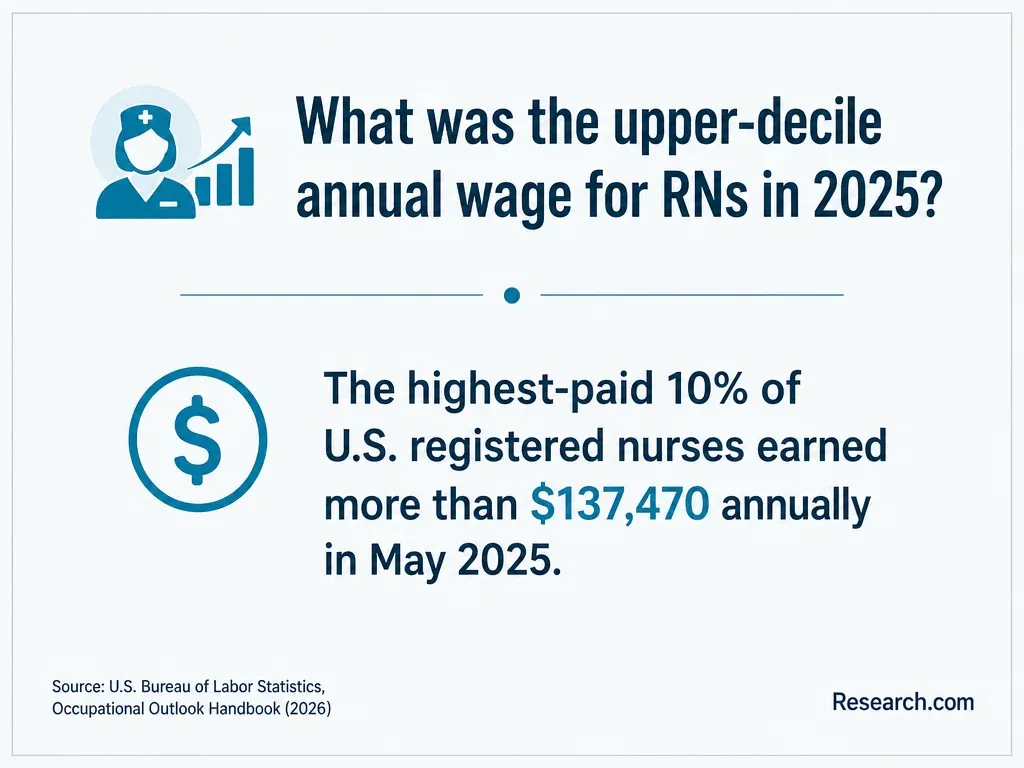
The U.S. Bureau of Labor Statistics reports wages for nurse practitioners as an occupation, not a separate New Jersey WHNP wage series. That occupational figure cannot predict a WHNP offer: location, employer, experience, hours, and duties matter. Ask prospective employers for the salary range and benefits tied to the specific position, and weigh them against tuition and any reduction in RN earnings during school.
Compensation comparisons across specialties need the same caution. A nurse also considering comparing budget-friendly psychiatric NP programs should make the specialty decision based on desired practice and qualifying education, rather than assume that a different NP track guarantees higher pay.
How Can Nurses Choose an Accredited Women's Health NP Program?
Start with the intended outcome: eligibility for WHNP-BC certification and New Jersey APN certification. Check the institution's accreditation, the nursing program's applicable accreditation, the WHNP track's current status, and authorization to enroll a New Jersey resident. Institutional accreditation, nursing accreditation, state enrollment authorization, and professional certification eligibility answer different questions.
Before paying a deposit, request answers you can compare across schools:
- Does this exact degree or certificate track prepare graduates to apply for NCC's WHNP-BC exam?
- How many supervised clinical hours and what patient experiences does my degree plan require, and who approves New Jersey sites and preceptors?
- What live classes, campus visits, simulation sessions, and clinical scheduling constraints apply to my entry term?
- What is my written estimate of total charges and likely time to completion, including any bridge or gap coursework?
- Whom can I contact if a clinical placement is delayed, and how could that change my enrollment or costs?
If a DNP is under consideration instead of an MSN, online DNP program length comparisons are useful only after confirming that the specific DNP includes initial WHNP preparation. Choose the route that meets the credential and clinical requirements for your goal with a schedule and total cost you can sustain.
Other Things You Should Know About Nursing
Potentially, but a New Jersey credential alone does not establish authority to treat a patient located in another state. Confirm the rules where the patient is located, plus employer policy and any prescribing requirements.
Yes. NCC certification and New Jersey nursing credentials have their own maintenance requirements and deadlines. Check both organizations' current instructions rather than assuming one renewal covers the other.
A postgraduate WHNP certificate may be an option. The receiving school must assess prior coursework and clinical preparation, then determine the additional population-focused study needed for NCC eligibility.
Some employers offer tuition assistance, but coverage, grade requirements, repayment obligations, and eligibility for clinical time vary. Obtain the written policy before including assistance in your budget.
- Pages - Advanced Practice Nurse Certification https://www.njconsumeraffairs.gov/nur/Pages/APN-Certification.aspx
- Nursing MSN Advanced Practice/Nurse Practitioner | Fairleigh Dickinson University https://www.fdu.edu/program/msn-nursing/
- Women's Health Nurse Practitioner MSN | Duke University School of Nursing https://nursing.duke.edu/academic-programs/msn-master-science-nursing/womens-health-nurse-practitioner
- Post-Graduate Certificate Women's Health Nurse Practitioner | CU Anschutz Nursing https://nursing.cuanschutz.edu/degrees-programs/graduate-programs/pgc/whnp
- MSN-WHNP Program (BSN to MSN) - Nursing | Herzing University https://www.herzing.edu/nursing/msn-whnp-program
- Women's Health (WHNP) | famu.edu https://nursing.famu.edu/graduate-programs/msn-womens-health.php
- MSN | Nurse Practitioner Programs | Graduate Studies | Pre-Health Advising https://www.monmouth.edu/graduate/ms-nursing/
- Clinical Rotations FAQ - Online Nursing Programs https://online.nursing.georgetown.edu/academics/family-nurse-practitioner-fnp/admitted/clinical-placement-faq/
- Master's Tracks | NYU Rory Meyers College of Nursing https://nursing.nyu.edu/academics/masters/masters-tracks
- Graduate Admission Requirements | Seton Hall University https://www.shu.edu/nursing/graduate-admission-requirements.html