2027 Switching from General Business to Organizational Leadership During a BS in Business Administration: Credits and Timing
Audited and Verified:
Our Editorial and Data Verification Process
Research.com uses government datasets, official education statistics and primary institutional information to support its career and degree guides. Our review process checks factual accuracy, occupational definitions, source dates and the requirements associated with the credentials discussed.
How This Article Was Fact-Checked
Our editorial team verifies salary estimates, employment projections, education requirements and program information against original data providers and official organizations. Salary figures are checked against the relevant occupational definitions and reporting periods. Information about licensure, accreditation and required in-person training is reviewed separately.
Fact-checked and verified on:

Co-Founder and Chief Data Scientist
Switching from general business to organizational leadership can be straightforward - or it can leave you with extra courses and a later graduation date. The difference depends less on how many credits you have earned than on where those credits fit in the new degree plan.
If you are already pursuing a BS in Business Administration, this guide explains how to compare degree audits, identify scheduling risks, and estimate the cost of changing direction before you submit a concentration or major-change request.
Key Things You Should Know
- A switch within the same BS in Business Administration often preserves the business core, but general-business electives may not satisfy organizational leadership requirements.
- Accepted credits and credits applied to the new degree are different: in an illustrative 120-credit plan, 90 earned credits could leave 45 credits to complete if only 75 fulfill the new requirements.
- Request a revised degree audit and a term-by-term schedule before switching; prerequisites, course availability, and residency rules can delay graduation even when the remaining credit count looks manageable.
Can you switch from general business to organizational leadership during your degree?
Usually, yes, if your institution offers organizational leadership as an approved concentration, major, or separate degree and you meet its change-of-program rules. General business commonly means a broad set of business electives. Organizational leadership generally emphasizes leading teams, managing change, and understanding how organizations work. Those labels do not establish that two schools award the same credential.
First, confirm what would change on your transcript and diploma. Moving between concentrations within one BS in Business Administration is different from changing to a separate BS in Organizational Leadership: the latter may have a different core, graduation requirements, or academic home. Ask your adviser whether there is a declaration deadline, minimum grade requirement, or approval process, and which catalog will govern your revised plan.
If your main reason for switching is to finish sooner, compare the approved audit with the remaining general-business path before filing paperwork. A program advertised among fastest bachelor's-level business study options is not necessarily faster for a student whose existing credits fit the current concentration better.
How many credits transfer when changing to organizational leadership?
If you stay at the same school, previously earned credits usually remain on your transcript; the decisive question is how many apply to the revised degree. If you change schools, the receiving institution also decides which credits it will accept. In either case, separate general education, business core, leadership requirements, unrestricted electives, and credits that satisfy none of the new requirements.
This hypothetical audit illustrates why a student can retain every earned credit yet need more coursework after switching. The figures are an example, not a program policy or a graduation estimate.
| Illustrative 120-credit plan | General business | Organizational leadership |
| Credits already earned | 90 | 90 |
| Earned credits applying to this plan | 75 | 69 |
| Credits still needed to reach 120 applicable credits | 45 | 51 |
The additional six credits in this example represent a change in applicability, not erased academic work. Actual remaining coursework may be greater if required courses, minimum grades, upper-division credits, or residency rules are still unmet.
Request a side-by-side official degree audit from your adviser or registrar. For each course that moves to an elective or stops applying, ask whether an approved substitution or transfer-credit appeal is possible. If you are considering another institution, send transcripts and course descriptions to its transfer office; a preliminary estimate is not a final graduation plan. Use the resulting remaining-course totals, not credits accepted alone, to evaluate price duration and outcomes of business administration degrees.
Will switching majors delay your business administration graduation date?
Not necessarily. A switch may fit your existing timeline if you have room for leadership electives and can take the required courses in the terms you need them. It may delay graduation if a required course has a prerequisite, is offered infrequently, or cannot replace a course already completed for general business.
Count terms, not just credits. A student missing one course offered only in the fall could wait longer than a student missing several courses available every term. Ask an adviser to map both paths through graduation, including prerequisites, upper-division requirements, the capstone, and the last term in which each course is scheduled. Confirm whether a change affects your catalog year or financial-aid eligibility.
If speed is the main priority, leadership bachelor's degrees with accelerated pacing provide options to investigate, not a promise about your completion date. An accelerated calendar helps only if your credits apply and the required sequence is available at a pace you can sustain.
In a concentration change, the accounting, economics, finance, marketing, and other business-core courses may stay in place while leadership courses replace general-business electives. Depending on the catalog, those courses might address organizational behavior, leadership communication, team development, conflict resolution, change management, or ethics. A separate organizational leadership degree could replace more of the business core.
Compare required course titles and descriptions. "Leadership" does not automatically mean HR training, and a project-management course does not establish eligibility for a professional certification. If your target job involves schedules, budgets, and project delivery rather than team development, compare the actual coursework with aid and tuition at online project management schools before choosing the broader leadership route.
Ask whether a current business elective can fulfill a leadership requirement through an approved substitution. Do not rely on a similar-sounding course title: the department responsible for the requirement must approve the match.
No, if your current school offers a suitable concentration, minor, or elective sequence. Staying may preserve your existing catalog rights and avoid a new transfer evaluation. If it offers no formal leadership option, ask whether approved electives can support your goals while you finish the current degree. That route may be more efficient, although it will not create an official concentration on your transcript.
Transferring can make sense when another school's curriculum better matches your goal and its written evaluation shows an acceptable cost and completion date. Compare the applicable credits at each school, required credits taken there, course schedules, and aid offers. Application charges are a smaller consideration, but online universities with no application charge may be useful when you are exploring alternatives without committing to transfer.
Both formats exist, but availability depends on the specific institution and whether leadership is a concentration or a separate degree. Neither "online" nor "accelerated" tells you when you must attend or how quickly required courses rotate.
Before switching formats, request the upcoming leadership-course schedule and check for live meetings, group projects, presentations, proctored exams, campus visits, and internship or capstone requirements. A working student may find asynchronous lectures helpful but still need predictable time for team assignments. If remaining employed is essential, compare ways to study business administration without leaving your job against the obligations of the specific leadership courses you would take.
Start with recognized institutional accreditation and confirm that it covers the institution awarding the degree. Then check the exact degree name, whether organizational leadership is an official concentration, and which school or department owns the program. Business-specific accreditation from AACSB, ACBSP, or IACBE has its own scope; do not assume it covers a leadership program simply because the university also has an accredited business school.
For a student already enrolled elsewhere, the strongest comparison is a written, student-specific transfer evaluation paired with a course schedule and total-cost estimate. Published ranked US college pathways in online business can help you identify schools to examine, but rankings cannot determine whether your accounting course satisfies a particular requirement or whether a leadership capstone will be offered when you need it.
There is no reliable single price for switching. Your incremental cost is the tuition and required fees for additional courses under the new plan, plus any costs caused by staying enrolled longer. If both concentrations require the same courses and you switch before taking electives, the change may add no credits; if completed electives no longer apply, the difference can be substantial.
Ask each school for a cost estimate based on your revised audit, not its advertised full-program price. Include per-credit or per-term tuition, mandatory and technology fees, books, travel if required, and the effect of an extra term on work and household finances. Confirm aid eligibility with the financial-aid office before dropping or replacing courses; employer reimbursement may have separate approval and payment rules.
Use affordable business education options online to identify potential comparisons, then price only the courses you would actually need at each institution. A lower published tuition rate may not save money if fewer of your existing credits satisfy its degree.
Organizational leadership coursework can support applications for team-coordination, training, HR-support, operations, and project-coordination roles when paired with relevant experience. It does not, by itself, make a new graduate a manager. Match the role to evidence you can show: facilitating a team process, documenting a training need, improving a workflow, or communicating a recommendation to stakeholders.
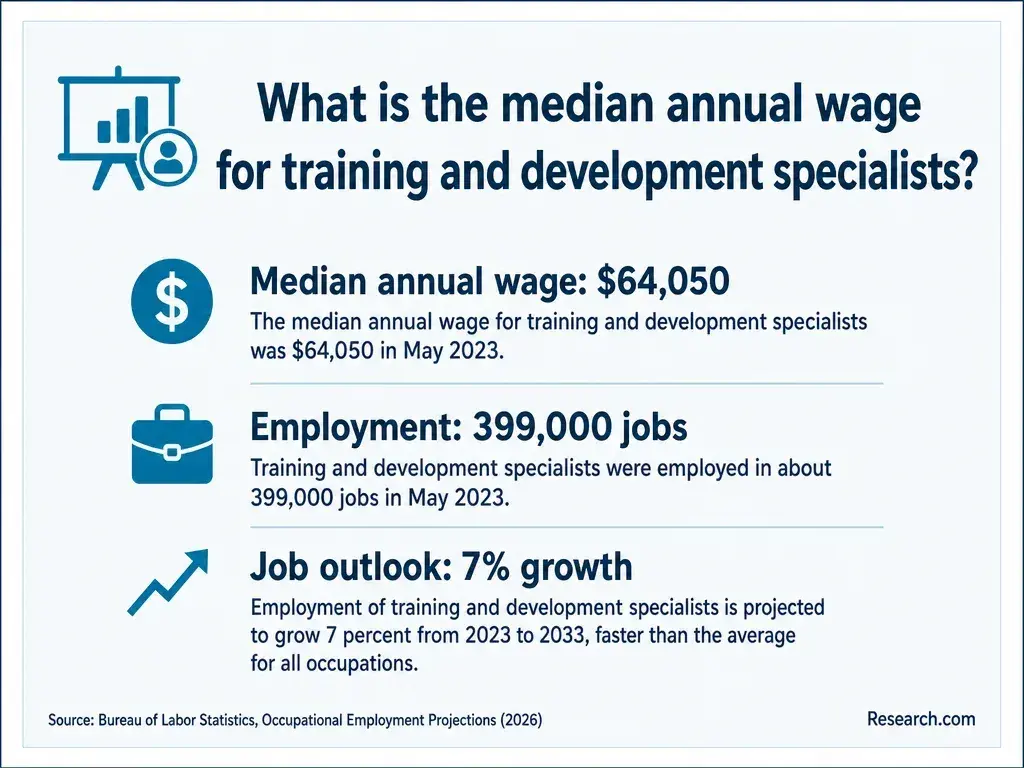
For context, the US Bureau of Labor Statistics reports a May 2025 median annual wage of $69,280 for training and development specialists and projects 11% employment growth from 2025 to 2035. That is an occupation-wide figure, not an expected starting salary for organizational leadership graduates. Job postings and your work history are better guides to whether you meet an employer's entry requirements.
If your experience and target jobs center on procurement, logistics, or inventory, a function-specific pathway may be more useful than a leadership concentration. Compare the coursework and cost of affordable supply chain programs and salary outlook with the leadership option rather than treating all business-related degrees as interchangeable.
Do organizational leadership graduates need licenses or certifications?
Organizational leadership itself generally is not a licensed occupation. Requirements depend on the specific job and employer. An HR certification, project-management credential, or profession-specific license is separate from a bachelor's degree and has its own eligibility rules; a leadership course or concentration does not award one automatically.
Before paying for another credential, examine the jobs you want and identify whether they require it, prefer it, or primarily ask for demonstrated experience. If your immediate obstacle is an unfinished bachelor's degree, completing an applicable degree plan may matter more than adding a certificate. An accelerated business college program guide can help you investigate completion formats, but verify your personal credit evaluation and course sequence before assuming a faster program is the better choice.
Other Things You Should Know About Business Administration
Not always. Some schools record concentrations on the transcript rather than the diploma. Ask the registrar how your institution documents the completed credential.
It may provide a setting for an approved assignment, but employment does not automatically earn academic credit. Get faculty approval before using workplace materials and follow employer confidentiality rules.
Ask your adviser whether you can change declarations under your current catalog and whether any completed electives would stop satisfying degree requirements. Obtain the revised audit before making the change.
Possibly, subject to your school's declaration and catalog policies. Check whether leadership courses would count toward general-business electives so a second change does not create avoidable extra coursework.
- Recommended Course Sequence | Texas Higher Education Coordinating Board https://www.highered.texas.gov/data-submission-reporting/recommended-course-sequence/
- Financial Aid Standards for Satisfactory Academic Progress | ucla.edu https://catalog.registrar.ucla.edu/Policies-and-Regulations/Administrative-Policies/Financial-Aid-Standards-for-Satisfactory-Academic-Progress
- BAS Organizational Leadership | Waldorf University https://waldorf.edu/degree-programs/bas/bas-organizational-leadership/
- Degree Requirements Glossary - CourseLeaf CIM - Penn State https://cim.psu.edu/user-guides/program-management/glossary/
- Credit for Prior Learning - The City University of New York https://www.cuny.edu/academics/academic-policy/credit-prior-learning/
- Organizational Leadership | Phoenix College https://www.phoenixcollege.edu/degrees-certificates/business-entrepreneurialism-and-management/organizational-leadership-5731-ccl
- Academics: College of Management and Human Potential: Undergraduate: BS in Business Administration https://academics.waldenu.edu/catalog/management-human-potential/undergraduate/bachelor-science-business-administration
- Program: Management B.S., with Organizational Leadership Concentration - University of South Florida https://cloud.usf.edu/catalog/undergrad/management-bs-with-organizational-leadership-concentration
- How to Change Your Major - Spartan Central - UNC Greensboro https://spartancentral.uncg.edu/registration-degree-planning/degree-planning/how-to-change-your-major/
- IX. Transfer Credits and Credit for Prior Learning | sunyocc.edu https://catalog.sunyocc.edu/content.php