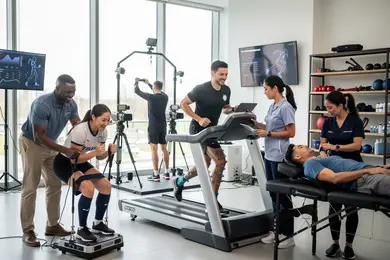
2027 Sports Science Degree Completion Programs for Working Adults

Co-Founder and Chief Data Scientist
Many working adults face the challenge of finishing a sports science degree while balancing job, family, and financial obligations. Unlike generic undergraduate programs, tailored completion programs recognize prior learning-such as military or professional experience-through generous credit transfer policies.
Accredited institutions offer flexible scheduling formats including evening and online classes, essential for those working full time. Graduates from accredited sports science completion programs earn a median salary 15% higher than peers without degrees, reflecting stronger career outcomes and licensure opportunities.
This article explores how to navigate program structure, accreditation, credit policies, costs, and outcomes to choose a path aligned with professional goals and life demands.
Key Things to Know About Sports Science Degree Completion Programs for Working Adults
- Maximize credit for prior learning by submitting military transcripts and professional certifications-over 60% of Sports Science completion programs award up to 30 transfer credits for ACE-approved training.
- Choose programs recognized by employers and licensure boards-accreditation by CAATE or recognition by state health departments ensures credentials meet industry standards and support career advancement.
- Access financial aid designed for working adults through employer tuition reimbursement and state grants-these often cover up to 75% of tuition costs, reducing the financial burden significantly.
What Are Sports Science Degree Completion Programs, and Who Are They Designed For?
Sports science degree completion programs are tailored for adults who began but did not finish a traditional four-year degree, offering an accelerated pace and flexible schedules-including evening, weekend, or online options-to suit working adults balancing multiple responsibilities.
These programs emphasize credit-for-prior-learning policies, allowing transfer of previously earned college credits or recognition of military training and professional experience, which shortens time to graduation. Such online sports science degree completion options for adult learners ensure accessibility without sacrificing quality.
- Structural Features: Completion programs prioritize flexibility through part-time enrollment and targeted coursework building on prior knowledge. Unlike graduate programs, their focus is on completing a bachelor's degree rather than advanced study.
- Target Audiences:
- Adults with some college credits but no degree-aiming to finish their education.
- Military veterans with ACE-credited training-streamlining their path to a degree.
- Working professionals pursuing career advancement that requires formal credentials.
- Career changers seeking foundational coursework combined with practical application in sports science.
- Legitimacy and Scope: Data from the National Student Clearinghouse, American Association of State Colleges and Universities, and Lumina Foundation's adult learner research validate the importance of these programs in adult higher education.
- Key Considerations: Prospective students should assess credit transfer maximization, accreditation status, alignment with employer and licensure standards, and availability of financial aid tailored to working adults.
For those exploring related fields, resources on the online DNP may provide additional guidance on flexible degree programs designed for adult learners.
How Do Sports Science Degree Completion Programs Differ From Traditional On-Campus Degree Programs?
Sports science degree completion programs for working adults are designed with flexibility and practicality in mind-key features that set them apart from traditional on-campus degrees. These programs accommodate busy professionals balancing careers and family while maintaining academic rigor.
- Scheduling Formats: Completion programs offer evening, weekend, online, or hybrid courses. In contrast, traditional programs typically require attendance during weekday daytime hours on campus.
- Pacing Options: Students in completion programs may choose self-paced enrollment or join accelerated cohorts to finish their degrees faster. Traditional programs generally require full-time, semester-based study.
- Residency Requirements: Many completion tracks minimize or remove on-campus residency obligations, enabling students to complete most work remotely. Traditional degrees often mandate regular physical presence on campus.
- Asynchronous Coursework: Degree completion pathways provide a higher proportion of asynchronous classes, allowing students to access materials and complete assignments on their own schedules, unlike the synchronous, scheduled classes common in traditional education.
- Structural Accommodations: Rolling or multiple start dates allow flexible entry, and streamlined advising helps students maximize credit transfers-including military and professional training credits-which are more generously applied than in conventional programs.
- Enrollment Trends: Data from the National Center for Education Statistics (NCES) and IPEDS highlight a steady rise in enrollment in degree completion programs, reflecting their growing appeal to those seeking credentials without interrupting work full time.
While the degree awarded-usually a Bachelor of Science or Bachelor of Arts in Sports Science-is equivalent in both models, the completion pathway is uniquely structured to limit disruption to employment and personal life. This makes it an accessible route for career changers, military veterans leveraging ACE credit recommendations, and mid-career professionals aiming for credential-gated promotions.
Prospective students should carefully evaluate programs based on how well they recognize prior learning, accreditation status, and available financial aid options for working adults. For those considering alternative credential paths, looking at related fields like online nurse practitioner programs can provide insight into managing education while maintaining career and family commitments.
What Prior Credits and Experiences Count Toward a Sports Science Degree Completion Program?
Before enrollment, obtaining official transcripts from all previous institutions and requesting a pre-admission credit evaluation is critical to clarify eligible credits and their application to your degree path.
Beware of schools that impose arbitrary transfer credit limits without valid academic reasoning, and consult the American Association of Collegiate Registrars and Admissions Officers (AACRAO) guidelines to identify fair credit transfer practices.
- Transfer Credits: Most sports science degree completion programs accept transfer credits from regionally accredited colleges or universities. Credits from nationally accredited or unaccredited institutions may not transfer or might be accepted with restrictions, depending on the school's policies and the accreditation status of the originating institution.
- Military Training Credits: Veterans and active-duty service members can often convert military training into academic credit using evaluations based on the American Council on Education (ACE) recommendations. Programs that disregard ACE evaluations limit these valuable credits, so checking institutional policies on military credit acceptance is essential.
- Professional Certifications: Certifications in related fields-such as personal training or health coaching-may qualify for academic credit if they align with sports science curricular outcomes and the institution's evaluation process.
- Prior Learning Assessment (PLA): Through PLA, learners submit portfolios documenting relevant work experience and skills to earn credit. Research by the Council for Adult and Experiential Learning (CAEL) indicates that effective PLA usage can reduce degree completion time by at least one semester, potentially lowering educational costs significantly.
- Credit-by-Examination: Exams like CLEP and DSST allow learners to demonstrate subject mastery and earn course credit. Many schools accept such exams as substitutes for general education or foundational sports science requirements, though acceptance varies.
A professional who recently completed a sports science degree shared how navigating credit policies felt like 'decoding a maze.' He described lengthy waits for transcript reviews and the anxiety of uncertain credit approvals.
Despite these hurdles, he emphasized that assembling a thorough prior learning portfolio and persistently communicating with advisors made a decisive difference. 'Once my military and certification credits were recognized, the path became clearer, and my graduation felt truly earned,' he said, highlighting the importance of proactive credit management for working adults.
What Is the Minimum GPA Requirement for Sports Science Degree Completion Programs?
Admissions to sports science degree completion programs often mandate a minimum cumulative GPA from prior college work-commonly ranging between 2.0 and 2.5 on a 4.0 scale-to uphold academic standards. Yet, many adult-focused programs, acknowledging the varied paths of working adults, adopt more flexible criteria beyond strict GPA cutoffs.
- Gpa Thresholds: While a 2.0 GPA is typical, some programs require at least 2.5 to ensure students are prepared for rigorous coursework.
- Conditional Admission: Applicants slightly below GPA requirements may qualify for provisional acceptance combined with tailored academic support such as tutoring or probationary periods to facilitate success.
- Open Admission: Certain programs waive GPA mandates entirely-especially for adults with professional experience or military veterans who hold ACE-credited training credits-valuing practical expertise over academic history.
- Holistic Review: Many institutions accredited by bodies including the Higher Learning Commission assess GPA alongside factors like years of relevant experience, recommendation letters, and personal statements to provide a nuanced evaluation.
- Academic Forgiveness: Students returning with low past GPAs should explore fresh-start policies that reset GPA calculations after a set absence, offering a renewed path forward.
- Pre-Admission Evaluation: Prospective students are encouraged to seek formal pre-admission academic reviews to realistically gauge eligibility before investing in applications.
Those aiming to meet the minimum GPA requirement for sports science degree completion programs should strategize credit transfer and academic planning carefully. Additionally, working adults can explore financial aid and scheduling options that accommodate their careers.
For tailored guidance on leveraging professional experience and credit transfer, exploring resources such as online LPN programs may offer helpful insights into flexible adult education pathways.
How Are Sports Science Degree Completion Programs Structured Around Full-Time Work Schedules?
Degree completion programs in sports science frequently accommodate adults working 40 or more hours weekly by offering flexible scheduling options such as evening cohorts, weekend intensives, fully asynchronous online courses, and hybrid formats combining virtual and face-to-face learning. These designs enable students to integrate studies with career and family demands effectively.
A typical credit load recommended per term is 6 to 9 credits-manageable enough to maintain momentum while balancing other commitments.
Many programs use a cohort model where students start and proceed through courses together as a fixed group. This approach helps build reliable schedules set months in advance, promotes accountability, and fosters peer support-essential elements for working adults needing to coordinate coursework with shifting work shifts and personal obligations.
Data from the National Student Clearinghouse Research Center reveals that students in cohort-based sports science completion programs consistently show higher retention and graduation rates than those enrolled in traditional formats. The structured community environment contributes significantly to these improved outcomes.
Prospective students should inquire about institutional policies regarding course cancellations, options for making up missed work due to job conflicts, and the availability of dedicated success advisors. These advisors play a crucial role in assisting students to manage scheduling difficulties and remain on track for graduation.
- Scheduling Flexibility: Multiple delivery formats accommodate diverse working schedules.
- Credit Load: 6-9 credits per term balance study and work life.
- Cohort Model: Ensures predictable timelines, peer engagement, and accountability.
- Completion Outcomes: Cohort programs demonstrate higher persistence and graduation rates.
- Institutional Support: Ask about cancellation policies, make-up options, and access to success advisors.
Reflecting on her experience, a professional who completed a sports science degree expressed how the program's structure was vital for her success.
She appreciated that cohort schedules were set well ahead, allowing her to arrange work and family responsibilities without surprises. When unforeseen work demands arose, her dedicated advisor helped negotiate extensions, preventing setbacks. She noted, 'Being part of a fixed group created a support system-everyone was going through the same challenges,' which kept her motivated.
This community aspect changed her perception of balancing full-time employment with ongoing education, making the journey both manageable and rewarding.
Is Online or Hybrid Delivery Available for Sports Science Degree Completion Programs?
Sports Science degree completion programs increasingly rely on varied delivery methods designed to accommodate working adults. These include synchronous sessions-live, real-time classes via video conferencing that offer immediate interaction but require stable internet and consistent scheduling.
Asynchronous learning provides recorded lectures accessible anytime, perfect for those juggling unpredictable hours or living across time zones, though it demands strong self-discipline. Hybrid models combine online coursework with mandatory in-person sessions, ideal for hands-on learning crucial in sports science fields.
Recent data from the 2023 NCES Integrated Postsecondary Education Data System reveals about 65% of adult learners enroll in fully online programs, while roughly 25% choose hybrid options. The COVID-19 pandemic significantly accelerated the capacity of institutions to offer robust remote learning environments, expanding quality options in various disciplines, including sports science.
- Faculty Credentials: Programs should employ qualified instructors whose expertise matches or exceeds that of on-campus faculty.
- Student Support: Reliable access to virtual advising, tutoring, and tech assistance is essential for online learners' success.
- Accreditation: Confirm that online programs have identical regional or national accreditation to ensure transferability and employer credibility.
- Class Sizes: Lower student-to-faculty ratios often yield better engagement and personalized attention in virtual settings.
Choosing between fully online, hybrid, or in-person formats depends on personal learning preferences, work demands, and location. Prospective students should ask enrollment advisors about credit transfer policies, hands-on lab opportunities, and support tailored to working adults to align program selection with career and lifestyle goals.
How Long Does It Take to Complete a Sports Science Degree Completion Program?
Completion time for a sports science degree completion program varies depending on the number of prior credits and individual circumstances. Students entering with around 60 transfer credits often finish in two to three years when studying part-time, although some accelerated options shorten this to as little as 18 months.
Those with 90 credits-commonly earned through prior associate degrees or military training formally assessed by ACE-may complete remaining coursework within one to two years.
Several factors strongly influence these timelines:
- Credit Recognition: The extent of prior learning assessment (PLA) and transfer credits accepted can significantly reduce remaining degree requirements. Military training evaluated by ACE is a common example that expedites completion.
- Enrollment Pace: Accelerated or full-time study leads to faster graduation than part-time enrollment, which is often necessary for working adults balancing other responsibilities. Flexible scheduling is crucial for this group.
- Program Requirements: Internships, capstone projects, or field experiences have fixed minimum durations. These elements cannot be compressed, acting as fixed time blocks irrespective of academic speed.
- Financial Impact: Graduating sooner lowers total tuition and reduces lost income by enabling earlier career advancement and higher salary potential-making faster completion a financially strategic choice.
- Data Transparency: Prospective students should request written average time-to-degree data specific to their credit profile, rather than relying on marketing claims typically aimed at highly credit-advantaged students under ideal conditions.
Evaluating these variables helps adults realistically plan their education, ensuring the program aligns with career goals, financial needs, and life demands.
What Accreditation Should a Sports Science Degree Completion Program Hold?
Institutions holding regional accreditation-granted by agencies such as the Higher Learning Commission (HLC), the Middle States Commission on Higher Education, and SACSCOC-offer sports science degree completion programs widely recognized by employers, graduate schools, and the federal student aid system.
This accreditation supports smoother credit transfer and better financial aid eligibility, both essential for working adults navigating academic advancement.
- National Accreditation: Conversely, national accreditation from entities like the Distance Education Accrediting Commission (DEAC) is often considered less rigorous. Programs with only national accreditation may face limited credit transferability and pose challenges for acceptance by employers or graduate programs. This distinction is critical when evaluating accredited sports science degree completion programs for career growth.
- Programmatic Accreditation: While sports science degrees rarely require engineering or business accreditations such as ABET, ACBSP, or AACSB, related fields might hold specialized accreditation-for example, social work programs might be accredited by CSWE. These accreditations can affect professional licensure, job prospects, and graduate admissions, so candidates should verify if programmatic accreditation aligns with their career path.
- Risks of Unrecognized Accreditation: Many degree completion programs operate under unrecognized accreditation or claim national accreditation without proper validation. Enrolling in these can harm reputation and financial investment-especially if credentials are unaccepted by licensing boards or employers. It is vital to confirm accreditation through the U.S. Department of Education's Database of Accredited Postsecondary Institutions and Programs (DAPIP) independently rather than relying on institutional marketing.
Adults seeking to optimize credit for prior learning should prioritize regionally accredited programs to ensure eligibility for federal aid and career advancement. For those balancing education and work, options like the 4-week medical assistant program online offer accelerated paths that align with these priorities.
How Much Do Sports Science Degree Completion Programs Cost, and What Financial Aid Is Available?
Costs for sports science degree completion programs vary widely by institution type and delivery format. Public regional universities typically charge between $300 and $500 per credit hour for in-state adult learners.
Private nonprofit institutions can range from $600 to $1,200 per credit, while for-profit schools often fall in the middle but include mandatory fees from $200 to $500 per term. These fees usually cover technology, student services, and materials. Some programs require residencies or intensives, which could add several hundred dollars in travel and lodging expenses, increasing the total cost of attendance.
Financial aid options for working adults pursuing sports science completion degrees help offset tuition costs. Pell Grants may be accessible even for part-time adult students who meet income eligibility.
Employer tuition reimbursement programs offer a vital resource to reduce expenses when aligned with coursework. Military-affiliated students should explore benefits through the GI Bill and MyCAA programs, supporting veterans and military spouses.
Many institutions provide scholarships targeting non-traditional adult learners based on professional experience or academic history. Completing the FAFSA remains essential-adult learners file independently in most cases, streamlining application for aid.
Tax advantages, such as the Lifetime Learning Credit and the employer-provided educational assistance exclusion under IRS Section 127, can benefit those paying out-of-pocket. Consulting a tax professional is strongly recommended to optimize these savings based on individual tax circumstances.
- Credit Transfer: Maximizing prior college credits and ACE-credited military training can significantly reduce total tuition, though policies vary by institution.
- Employer Reimbursement: Eligibility for tuition reimbursement requires aligning program choices with employer requirements, offering potentially substantial cost reductions.
- Net Tuition Comparison: Sticker price often misrepresents actual out-of-pocket expense-analyzing net cost after aid, fees, and required expenses is crucial for evaluating programs.
For working adults weighing program options, understanding these financial components is critical. Detailed cost comparisons considering credit transfer savings, employer reimbursement, and financial aid availability provide a realistic picture of affordability relative to long-term career goals in sports science.
To explore top-ranked accelerated degree options that align with busy schedules, consider checking the best RN to BSN programs, which offer insights into flexible learning pathways suitable for career changers and professionals balancing work and study.
What Career Outcomes Can Working Adults Expect After Completing a Sports Science Degree?
Completing a bachelor's degree in sports science substantially enhances earning potential-often providing a 15% to 30% wage increase compared to individuals with some college but no degree. This elevated salary trajectory is supported by median earnings data from the College Scorecard and aligns with findings from Georgetown University's Center on Education and the Workforce.
Graduates frequently gain access to a range of roles including athletic training, rehabilitation, fitness coordination, sports management, and health promotion.
- Promotion Eligibility: Degree completion unlocks opportunities for advancement into supervisory and managerial positions typically unavailable without a bachelor's credential.
- Credential-Gated Roles: Licensure and certifications for positions such as athletic trainers and exercise physiologists usually require a completed bachelor's, making the degree essential for entry into these professions.
- Experienced Professional Advantage: Adult learners often enter the job market with substantial professional experience, allowing them to secure higher-level roles immediately after graduation rather than starting at entry level.
- Salary Premium Growth: Beyond an initial pay increase, the degree supports long-term financial growth and career stability over time.
- Career Goal Alignment: Prospective students should verify that their chosen program meets the accreditation and licensure requirements relevant to their target roles-whether for management promotion, licensed practice, or graduate education-to ensure their degree delivers the desired career outcomes.
How Do Employers View a Sports Science Degree Completed Through a Completion Program?
Employers generally prioritize the accreditation and reputation of the institution awarding a degree rather than the path a student followed to finish their sports science degree.
Research from the Society for Human Resource Management (SHRM) and the National Association of Colleges and Employers (NACE) reveals that hiring managers focus on whether the credential stems from a recognized, accredited program-not on how much credit was earned through prior learning or the speed of completion.
The diploma from an accredited institution for sports science completion programs typically does not differentiate between graduates who followed traditional timelines and those in completion formats. This means candidates should present their degree straightforwardly on resumes, listing only the institution and degree title.
When discussing education in interviews, highlighting the program's adult-focused or accelerated approach can demonstrate valuable skills like discipline and time management.
Specific employers-such as federal agencies adhering to OPM qualification standards or professions regulated by state licensing boards-may scrutinize the degree completion method more closely. Prospective students working in regulated fields should confirm acceptability of such credentials with licensing bodies or HR departments before enrolling.
In most private-sector roles within sports science, demonstrated professional experience, relevant skills, and strong references weigh more heavily than the mode of degree completion. This positions sports science completion degrees as fully legitimate credentials that support career growth without carrying a stigma.
- Credential Recognition: Same diploma awarded regardless of completion style, preserving diploma legitimacy.
- Resume Presentation: List degree as granted, with optional interview discussion of program format to emphasize soft skills.
- Employer Scrutiny: Federal or licensed roles may require verification of credential pathways to ensure compliance.
- Private Sector Hiring: Experience and competencies usually overshadow concerns about completion methods in sports science fields.
What Graduates Say About Sports Science Degree Completion Programs for Working Adults
- Westin: "Completing my sports science degree while working full-time was a game-changer-especially because the program's flexible scheduling formats allowed me to study evenings and weekends without losing professional momentum. The accreditation standards were a huge factor in my decision since I wanted a credential that employers truly respect, which you don't always get with generic programs. Plus, the generous credit transfer policies meant my previous coursework counted, significantly reducing both time and cost."
- Peter: "Reflecting on my journey through the sports science completion program, I appreciate how the structured approach balances academic rigor with real-life obligations. The cost considerations stood out too-this wasn't just affordable tuition but smart financial aid opportunities tailored for working adults. Ultimately, what impressed me most was the career outcomes-graduates find themselves well-positioned for roles that demand both expertise and practical experience, which is exactly what I needed for my professional growth."
- Andrew: "From a professional perspective, what differentiates a high-quality sports science completion program is the attention to structural features designed specifically for adult learners. The sequential course design and modular learning help accommodate unpredictable schedules-something crucial for me. Beyond that, understanding the program's accreditation made me confident in the degree's value when I pivoted careers, and the clear credit transfer policies meant no wasted effort or money on redundant classes."
Other Things You Should Know About Sports Science Degrees
Many sports science degree completion programs are designed with credit transferability in mind. Students who complete these programs often can apply their earned credits toward related graduate degrees such as kinesiology, physical therapy, or sports management. However, it is crucial to verify that the program is regionally accredited and recognized by graduate institutions to ensure seamless credit acceptance.
Networking remains a critical component within sports science degree completion programs-especially for working adults seeking career advancement. These programs often connect students with industry professionals through virtual events, internships, and alumni groups. Leveraging these networks can facilitate job opportunities, mentorships, and insights into emerging trends in sports performance and rehabilitation.
Military veterans have specific pathways to enroll in sports science degree completion programs thanks to benefits like the GI Bill and VA educational assistance. Many institutions accept military training as credit toward degree requirements, accelerating completion times. Veterans should consult the program's veteran services office to maximize benefits and ensure smooth enrollment and credit evaluation processes.
References
- WSG University https://study.gov.pl/wsg-university-7
- ESSA's career guide for Accredited Exercise Scientists https://www.essa.org.au/Web/Web/Resources/Tools-and-templates/ESSA-AES-Guide.aspx
- What Jobs Can You Do With Sports Science? | Oxford College https://www.oxfordcollege.ac/news/what-jobs-can-you-do-with-sports-science/
- 136 Sport Sports Science Scholarships available https://www.hotcoursesabroad.com/study/international-scholarships/all/qn/sports-science/sport/all/cid/qid/b9/1172/nty/scholarship.html
- What can you do with a sports science degree? https://www.wlv.ac.uk/news-and-events/wlv-blog/2024/may-2024/what-can-you-do-with-a-sports-science-degree.php
- Bachelor of Sport and Exercise Science https://www.unisc.edu.au/study/courses-and-programs/bachelor-degrees-undergraduate-programs/bachelor-of-sport-and-exercise-science
- What can I do with a sports science degree? | TEG London https://www.teg.london/what-can-i-do-with-a-sports-science-degree/
- 10 Online Bachelor’s in Sport and Exercise Science 2026 https://www.collegevaluesonline.com/10-online-bachelors-in-sport-exercise-science/
- 8 Rewarding Careers for Aspiring Exercise and Sport Scientists https://www.sacredheart.edu/news-room/news-listing/8-rewarding-careers-for-aspiring-exercise-and-sport-scientists/
- Academic Program Accreditation: Setting Your Students Up for Success https://acsm.org/academic-program-accreditation/