2027 RN-to-MSN Outcomes for Nurses with a Non-Nursing Bachelor's Degree: Completion Rates, Certification Results, and Data Gaps
Audited and Verified:
Our Editorial and Data Verification Process
Research.com uses government datasets, official education statistics and primary institutional information to support its career and degree guides. Our review process checks factual accuracy, occupational definitions, source dates and the requirements associated with the credentials discussed.
How This Article Was Fact-Checked
Our editorial team verifies salary estimates, employment projections, education requirements and program information against original data providers and official organizations. Salary figures are checked against the relevant occupational definitions and reporting periods. Information about licensure, accreditation and required in-person training is reviewed separately.
Fact-checked and verified on:

Co-Founder and Chief Data Scientist
If you are an RN with a bachelor's degree outside nursing, an RN-to-MSN program may offer a route to graduate study without first earning a BSN. The difficult part is judging outcomes: published completion and certification figures rarely isolate students with your educational background. This guide explains what those figures can - and cannot - show, how program structure affects your chances of finishing, and which questions to ask before committing time and money.
Key Things You Should Know
- There is no standardized, publicly reported national completion or certification-pass rate specifically for RN-to-MSN students with non-nursing bachelor's degrees.
- Compare three separate results: completion among entrants, certification-exam participation among eligible graduates, and first-time passes among test takers.
- An existing RN license is essential for a postlicensure RN-to-MSN pathway; a non-nursing bachelor's degree alone does not establish RN or advanced practice eligibility.
What Is an RN-to-MSN Pathway for Nurses With a Non-Nursing Bachelor's Degree?
This pathway is for an already-licensed RN - often educated through an associate degree or diploma program - who also holds a bachelor's degree in another field. The school evaluates both credentials, assigns any required upper-division nursing work, and then admits the student to graduate nursing study under its progression rules.
Programs do not all award the same credentials along the way. Some confer a BSN before the MSN; others award only the MSN. That distinction matters if you leave before finishing or apply for a job that specifically requires a BSN. Nurses whose main question is how an associate degree feeds into graduate admission can also examine ADN-to-MSN admission requirements.
Can Nurses With a Non-Nursing Bachelor's Degree Enroll in RN-to-MSN Programs?
Yes, if a particular program accepts their nursing credential, RN license, and non-nursing bachelor's degree. Other schools require a BSN regardless of prior degrees. Ask whether the school offers a designated non-nursing-bachelor's route or instead expects you to complete an RN-to-BSN program first.
If you are not yet an RN, this postlicensure route is not your entry point: compare prelicensure ADN, accelerated BSN, or explicitly designated direct-entry graduate programs. If you are an RN but want a BSN before deciding on graduate study, examine BSN completion pathways with alternative practice experiences, checking each school's actual practice requirements.
What Are the Admission Requirements for Non-Nursing Bachelor's RN-to-MSN Programs?
Requirements vary by school and MSN track. Expect review of your RN license, nursing-program transcript, bachelor's transcript, GPA, and any required statistics or science coursework. An APRN track may also require specific RN experience. Admissions staff should confirm whether older courses, online labs, and courses from your first degree satisfy their rules.
Request a written degree audit showing which credits apply to the bridge, which nursing courses remain, when you can enter graduate coursework, and what happens if you stop before the MSN. A separate BSN-to-MSN route may be simpler if your employer will fund BSN completion first; compare that option using less expensive MSN pathways after a BSN. Neither route should be presumed shorter until the school evaluates your records.
RN-to-MSN programs build on an RN license; they do not ordinarily provide initial RN preparation or NCLEX eligibility. Bridge courses address nursing knowledge the school requires before graduate work. The MSN then follows its named track, such as education, leadership, informatics, or an advanced practice population focus.
That track determines what outcomes are meaningful. A leadership MSN may have no national certification exam tied to graduation. A family nurse practitioner track requires relevant advanced practice coursework and supervised clinical preparation before graduates can seek certification under the certifier's rules. For that route, investigate who secures clinical sites; online FNP programs with preceptor support can be a starting point, but confirm the support offered at your location.
There is no reliable single completion time for this subgroup. Duration depends on accepted prior coursework, bridge requirements, graduate-track credits, course sequencing, enrollment intensity, and clinical-site availability. A published "time to degree" may describe a full-time student who starts graduate courses immediately - not an RN who first needs bridge courses.
Ask for a term-by-term plan showing the earliest feasible graduation date and the pace available to working RNs. Compare that plan with any advertised accelerated family NP study options; a short specialty-phase schedule does not necessarily include prerequisite or bridge work. Also ask what happens to the schedule if a required course or clinical placement is unavailable for one term.
Compare the cost to finish your specific degree plan, not the advertised graduate tuition rate alone. Bridge and graduate credits may be billed differently. Add mandatory fees, books, technology, clinical travel, required campus visits, certification expenses where relevant, and income lost if you reduce work hours.
Ask financial aid staff how undergraduate-versus-graduate course classification affects your aid package and whether employer tuition assistance covers bridge courses. Federal aid eligibility depends on your circumstances and enrollment; employer reimbursement may require a passing grade or continued service. When comparing APRN tracks, affordable online advanced practice nursing routes are useful only if their full costs and clinical arrangements fit your plan.
Delivery mode alone does not establish better completion or certification outcomes. An online student may still need scheduled live classes, simulation, campus visits, and supervised in-person clinical work. Online programs can be practical for employed RNs, but local placement access and scheduling support may matter more than where lectures occur.
Compare outcomes for the same track and reporting period where possible, and ask whether online and campus students share courses, assessments, faculty, and clinical-placement support. For a psychiatric-mental health NP goal, an online mental health NP affordability guide can help frame a comparison, but lower tuition or online delivery is not evidence of equivalent clinical access or exam results.
Check the institution's accreditation, the nursing program's applicable accreditation and scope, and any state requirements affecting enrollment or clinical placements where you live. Confirm that the exact MSN track - not merely the university - provides the education required for your intended certification or state-regulated role. The program, certifying body, and relevant state board answer different parts of that question.
For example, finishing a non-APRN MSN does not make someone eligible for FNP certification. An RN with such a degree may need additional population-focused education, potentially through online FNP certificate routes after an MSN. Obtain written confirmation of eligibility for your intended credential and practice state before enrolling.
No standardized public dataset isolates completion and certification outcomes for RN-to-MSN entrants who hold non-nursing bachelor's degrees. Schools may publish broader MSN completion rates, track-level graduation figures, or APRN exam pass rates, but those populations can differ substantially. A school-wide result cannot establish this subgroup's likelihood of graduating or passing.
The table shows why denominators matter. Its figures are hypothetical, not results from a program.
| Measure | Hypothetical result | What it does - and does not - show |
| Completion within the stated period | 18 of 24 entrants: 75% | Includes all defined entrants; depends on the reporting window and treatment of transfers or leaves. |
| Exam participation | 10 of 18 graduates | Shows who tested; it does not explain why the other eight did not. |
| First-time certification pass rate | 9 of 10 test takers: 90% | Describes first-time test takers, not all entrants or graduates. |
Request the entry cohort, track, study format, reporting years, counts behind each percentage, completion window, and whether the certification result is first-time or eventual passage. Ask separately how many eligible graduates applied for certification and how many ultimately earned it. Small cohorts make percentages especially unstable.
Do not combine unrelated outcomes: a DNP practice-hour requirement, for example, is not an MSN certification result. When evaluating later study, doctoral nursing projects and practice-hour requirements need their own definitions and evidence.
What Careers, Salaries, and Job Outlook Follow an RN-to-MSN Degree?
Career outcomes depend on the MSN track and prior experience. Education graduates may pursue teaching or staff-development work; leadership graduates may seek management roles; appropriately prepared APRN graduates can pursue certification and state authorization for their population-focused role. The MSN alone guarantees none of those jobs or credentials.
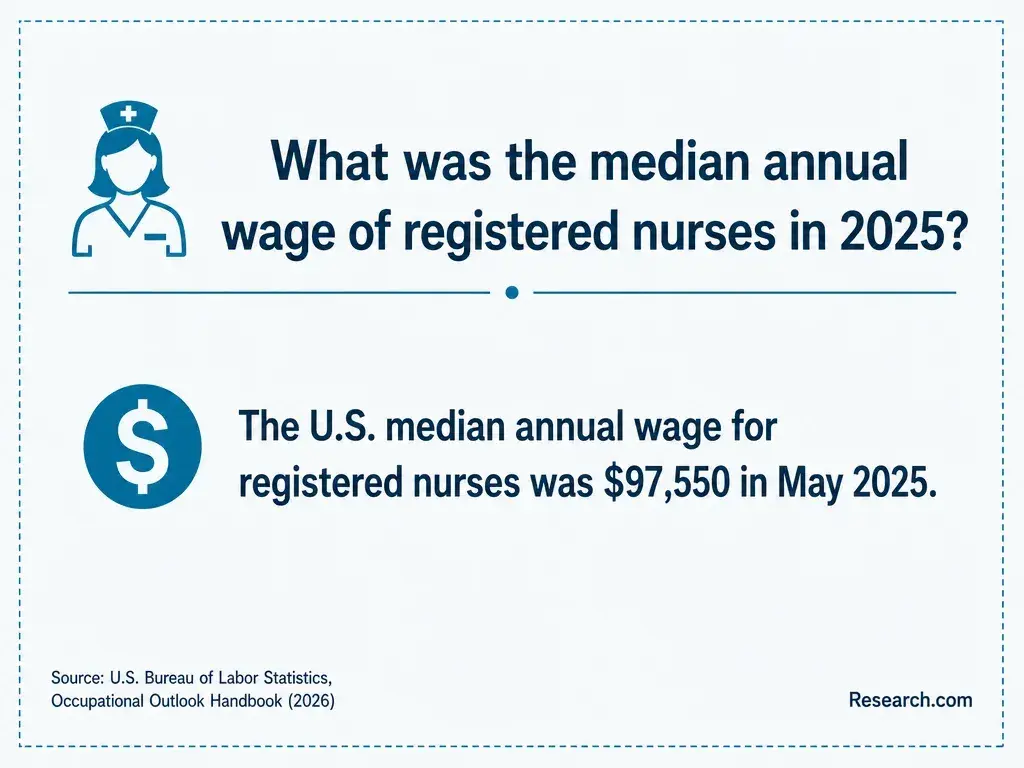
Use U.S. Bureau of Labor Statistics wage and employment projections for the specific occupation you intend to enter, not as an estimated salary for every MSN graduate. A registered nurse's occupational median, for example, cannot establish an NP graduate's pay or the return on this degree. Compare local job requirements with your current experience before assigning an expected salary increase.
For some nurses, the better next step is employer-supported training or a BSN rather than an MSN. Others may eventually consider accelerated Doctor of Nursing Practice programs, but a doctorate should answer a defined practice or leadership goal - not compensate for missing RN experience or unclear MSN outcomes.
Other Things You Should Know About Nursing
Yes. A school may request syllabi to evaluate course equivalencies, particularly for sciences or statistics. Keep official transcripts as well; only the receiving school can decide how courses apply.
Possibly. Ask about leave limits, readmission, course expiration, and whether your MSN track will still be available when you return. Get the policy for your entry cohort in writing.
Do not assume so. Graduate clinical experiences generally need program approval, appropriate supervision, documented objectives, and evaluation. Ask the track director before relying on your workplace as a site.
Keep your degree audit, transcripts, course descriptions, and, if applicable, verified clinical-hour and population-focus documentation. Certifying bodies, state boards, and future programs may request different evidence.
- for Less than 2-year institutions - IPEDS Data Collection System https://surveys.nces.ed.gov/ipeds/public/survey-materials/faq
- Student Cohorts And Subgroups In IPEDS | ed.gov https://nces.ed.gov/ipeds/use-the-data/student-cohorts-and-subgroups
- National Center for Education Statistics (NCES) | IES https://ies.ed.gov/national-center-education-statistics-nces
- FACTORS FOR SUCCESSFULLY PASSING CERTIFICATION EXAMS: A SYSTEMATIC REVIEW - PMC https://pmc.ncbi.nlm.nih.gov/articles/PMC8649701/
- Enrollment Statuses | Administrative Portal https://gsadminportal.princeton.edu/handbooks/dgs-handbook-2024-2025-section-3-academics/enrollment-statuses
- Accelerated BSN vs. Direct-Entry MSN: Which Is Right for You? | School of Nursing https://nursing.gwu.edu/accelerated-bsn-vs-direct-entry-msn-which-right-you
- BSN vs MSN: Which Nursing Degree Is Right for Your Career Goals? | Nevada State University https://nevadastate.edu/son/rn-bsn/bsn-vs-msn-which-nursing-degree-is-right-for-your-career-goals/
- Resumption of Study | Pace University New York https://catalog.pace.edu/graduate/academic/academic-policies-general-regulations/disruption-normal-academic-progress/resumption-studies/
- Nursing Student Success Rates | Research College of Nursing https://researchcollege.edu/programs/student-achievement-info/
- Yearly Progress and Completion | nscresearchcenter.org https://nscresearchcenter.org/yearly-progress-and-completion/