2027 Questions to Ask Before Accepting a Vascular Access Nurse Position
Audited and Verified:
Our Editorial and Data Verification Process
Research.com uses government datasets, official education statistics and primary institutional information to support its career and degree guides. Our review process checks factual accuracy, occupational definitions, source dates and the requirements associated with the credentials discussed.
How This Article Was Fact-Checked
Our editorial team verifies salary estimates, employment projections, education requirements and program information against original data providers and official organizations. Salary figures are checked against the relevant occupational definitions and reporting periods. Information about licensure, accreditation and required in-person training is reviewed separately.
Fact-checked and verified on:

Co-Founder and Chief Data Scientist
A vascular access offer can sound appealing until you learn that "PICC team" also means overnight call, difficult-access consults across several units, and limited backup. For an RN considering this specialty - or comparing two offers - the details of scope, training, staffing, and compensation matter more than the job title. This guide explains what vascular access nurses do and gives you specific questions to ask before accepting a position, so you can judge whether the role supports safe practice and fits your career goals.
Key Things You Should Know
- Ask which devices you will place and maintain, who determines device choice, and how your employer validates competence; an RN license alone does not authorize every procedure.
- Get the orientation plan, supervised case opportunities, independent-practice criteria, staffing model, and on-call expectations in writing before accepting.
- Compare the complete offer - not just base pay. The U.S. Bureau of Labor Statistics reports an RN-wide median of $93,600 for May 2024, not a vascular-access-specific salary.
What does a vascular access nurse do each day?
Vascular access nurses help patients obtain and maintain appropriate access to the bloodstream for treatment or blood sampling. Depending on the employer, a shift may include assessing a patient with difficult venous access, discussing device options with the care team, placing an ultrasound-guided peripheral IV or peripherally inserted central catheter (PICC), evaluating an existing line, documenting care, and teaching patients or staff.
"Vascular access nurse" is not a standardized job description. One team may focus on insertions; another may handle dressing changes, troubleshooting, surveillance, and consultation throughout a hospital.
Ask for a typical shift and the written list of procedures - not just the team's name. If your longer-term interest is education or systems work rather than direct procedures, post-master's DNP programs for non-bedside goals represent a different career decision, not a prerequisite for this role.
What education and nursing degree are required for vascular access nursing?
These positions generally recruit licensed RNs; employers set their own degree and experience requirements. An ADN, nursing diploma, or BSN may provide a route to RN licensure, but no particular degree by itself establishes proficiency in ultrasound-guided access or PICC placement. Some employers prefer a BSN or prior infusion, critical care, emergency, oncology, or procedural experience.
For an experienced ADN-prepared RN, a BSN may help meet an employer's hiring or advancement policy, but it should not replace hands-on specialty training. If an offer depends on completing a BSN, ask about the deadline and tuition assistance; RN-to-BSN capstone and practice requirements can affect how feasible study is alongside call and full-time work.
What RN licensing requirements apply to vascular access nurses?
Ask the employer which active, unencumbered RN license or practice privilege the position requires and where you will physically practice. State nurse practice laws, applicable facility policies, orders, training, and documented competency all affect what you may do. A multistate license, where applicable, does not override a state's practice rules or an employer's procedural requirements.
Clarify licensing early if the job covers facilities across state lines. Also separate academic advancement from practice authority: ADN-to-MSN bridge programs may be relevant to a later career goal, but enrollment or graduation does not substitute for the RN authorization and employer-approved competencies this job requires.
Ask whether the employer requires, prefers, or pays for a specialty credential. The Vascular Access Certification Corporation awards the VA-BC credential; the Infusion Nurses Certification Corporation awards the CRNI credential.
They have different eligibility and examination requirements, so check the relevant certifier's current handbook before planning an application. Neither credential replaces RN licensure, employer orientation, or authorization for a particular procedure.
A useful offer spells out whether certification affects hiring, promotion, reimbursement, study time, or renewal support. If your goal is management or another graduate-level role, compare that goal separately with comparing online BSN-to-MSN program costs; an MSN is not a substitute for a vascular access specialty credential.
Core work can involve vessel and patient assessment, aseptic technique, ultrasound use, device selection discussions, insertion or maintenance within authorized scope, complication recognition, escalation, patient education, and accurate documentation.
The exact procedures vary substantially. Ask whether the role includes peripheral IVs, midlines, PICCs, implanted-port access, central-line maintenance, or device removal, and how each skill is validated.
Pay particular attention to decisions made before insertion: who evaluates anticipated treatment, vessel preservation, contraindications, and alternatives, and who must approve a plan? A nurse should have a clear route to escalate an unsafe request. Even fast-track DNP study options do not establish procedural competence; observed performance and employer requirements remain decisive.
Orientation is the strongest test of whether an employer expects safe progression or immediate independent coverage. Ask the manager and a working team member these questions, then compare their answers:
- Which procedures will I learn first, who will supervise them, and how is competence documented?
- Will I see an appropriate range of patients and devices before taking independent assignments or call?
- What happens if I need more supervised practice than the planned orientation allows?
- Who provides real-time help with an unsuccessful attempt, an urgent consult, or a suspected complication?
For a new graduate or an RN changing specialties, a calendar-length promise is less useful than defined skills, supervised opportunities, and a clear escalation plan. Budget comparisons for psychiatric nurse practitioner study on a budget address a separate advanced-practice pathway; they should not distract from whether this employer will provide the clinical onboarding the vascular access job demands.
Hospital vascular access teams may cover multiple units and urgent consults. Outpatient infusion centers may emphasize scheduled treatment and line maintenance. Home infusion and other mobile services can add travel, independent scheduling, and coordination with remote clinicians. A job title alone will not tell you how often you insert devices versus troubleshoot or teach.
Ask where patients are seen, how many sites the role covers, what support is present after hours, and whether travel time is paid. If you are comparing vascular access with an advanced-practice career, comparing post-master's FNP study options concerns a distinct role with different education, certification, and state authorization requirements.
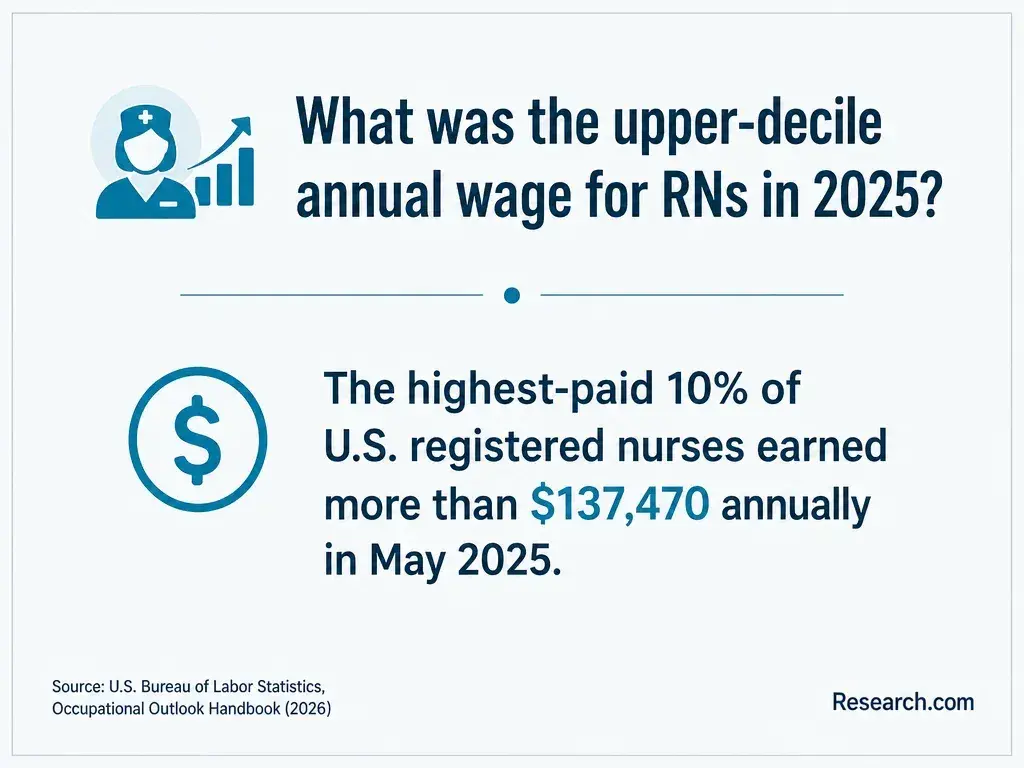
There is no separate Bureau of Labor Statistics wage series for vascular access nurses. The BLS reports a May 2024 median annual wage of $93,600 for registered nurses overall. That figure includes many specialties and settings; it is not an expected vascular access offer or a starting salary.
Request a written breakdown of base rate, shift differentials, on-call pay, callback minimums, overtime rules, mileage or travel reimbursement, certification support, and benefits.
Compare expected hours and obligations alongside annual compensation: a higher base rate may be less attractive if call is frequent or travel is unpaid. Before financing a different career path, such as budget planning for online NP programs, evaluate that separate investment rather than assuming this RN offer requires another degree.
The BLS projects 5% employment growth for registered nurses from 2024 to 2034, but it does not publish a separate projection for vascular access nurses. RN-wide growth therefore cannot tell you how many specialty positions a particular employer will fund or whether a local team is expanding.
Ask whether the opening is a replacement or a new position, how consult volume is measured, and whether vacancies have increased call or workload. Those answers offer more direct evidence about the position than a national projection. Likewise, shorter online mental health NP master's programs prepare nurses for a different occupation; its labor market should not be used to judge vascular access openings.
How can you evaluate a vascular access nurse position?
Use the interview to test whether the promised autonomy is matched by training and backup. Request the job description, orientation outline, call policy, and compensation terms, then speak with someone who currently covers the assignment. A strong offer gives you a way to decline or escalate a procedure outside your competence without being left alone with the problem.
Compare offers in this order: safe scope and backup, supervised orientation, sustainable workload and schedule, then total compensation and advancement. If an employer cannot explain how independent practice is approved - or expects call before training is complete - ask for a revised plan before accepting.
If your actual goal is advanced practice rather than vascular access nursing, a guide to accelerated family nurse practitioner study may help frame that separate decision; it does not resolve shortcomings in a vascular access offer.
Other Things You Should Know About Nursing
Possibly, if an employer hires new graduates and provides sufficient supervised orientation. Ask whether you will begin with general RN practice, join a residency, or enter the specialty team directly.
They overlap but are not identical. Vascular access emphasizes obtaining and maintaining an appropriate device; infusion nursing may encompass a broader range of therapies and care throughout treatment. Employer duties determine the overlap.
It may. Positioning patients, moving equipment, and working across units can be physically demanding. Ask about typical tasks, available assistance, and any stated physical requirements.
Ask the hiring manager to reconcile them against written policies, particularly for call, orientation, and independent procedures. Do not rely on an informal assurance for a condition that determines whether you can safely accept the job.
- APRN Practice FAQ - Texas Board of Nursing https://www.bon.texas.gov/faq_practice_aprn.asp.html
- Fact Sheet #22: Hours Worked Under the Fair Labor Standards Act (FLSA) | U.S. Department of Labor https://www.dol.gov/agencies/whd/fact-sheets/22-flsa-hours-worked
- Fact Sheet: Premium Pay (Title 5) | U.S. Office of Personnel Management https://www.opm.gov/policy-data-oversight/pay-leave/pay-administration/fact-sheets/premium-pay-title-5/
- Section 10 Compensation Discrimination | U.S. Equal Employment Opportunity Commission https://www.eeoc.gov/laws/guidance/section-10-compensation-discrimination
- Reducing Risks and Improving Vascular Access Outcomes | nih.gov https://pmc.ncbi.nlm.nih.gov/articles/PMC7410015/
- Frequently Asked Questions | Washington State Board of Nursing https://nursing.wa.gov/practicing-nurses/frequently-asked-questions
- Summary of Recommendations | Infection Control https://www.cdc.gov/infection-control/hcp/intravascular-catheter-related-infections/summary-recommendations.html
- Peripherally Inserted Central Catheter (PICC) Line Placement | nih.gov https://www.ncbi.nlm.nih.gov/books/NBK573064/
- Equipment | ucsd.edu https://medschool.ucsd.edu/education/training-facilities/simulation-center/equipment/index.html
- Compensation - Human Resources - Johns Hopkins University https://hr.jhu.edu/compensation/