2027 Post-Master's Pediatric Primary Care NP Certificates for Nurses in Idaho: Entry Routes and Clinicals
Audited and Verified:
Our Editorial and Data Verification Process
Research.com uses government datasets, official education statistics and primary institutional information to support its career and degree guides. Our review process checks factual accuracy, occupational definitions, source dates and the requirements associated with the credentials discussed.
How This Article Was Fact-Checked
Our editorial team verifies salary estimates, employment projections, education requirements and program information against original data providers and official organizations. Salary figures are checked against the relevant occupational definitions and reporting periods. Information about licensure, accreditation and required in-person training is reviewed separately.
Fact-checked and verified on:

Co-Founder and Chief Data Scientist
An Idaho nurse with a graduate degree may not need another full degree to prepare for pediatric primary care practice. The right route depends on whether the nurse is already an NP, holds a non-APRN master's degree, or needs graduate nursing preparation first. A post-master's certificate can fill a defined education and clinical gap, but online coursework does not eliminate supervised pediatric placements. This guide explains how to evaluate entry routes, Idaho clinical access, certification eligibility, and total cost before committing to a program.
Key Things You Should Know
- A post-master's pediatric primary care NP certificate is for nurses who already hold an eligible graduate nursing degree; an MSN in education or leadership does not automatically provide transferable NP coursework.
- Expect a school-specific review of prior courses and supervised hours. Confirm the pediatric primary care clinical requirement, Idaho site approval, and preceptor arrangements in writing before enrolling.
- The usual credential target is the Pediatric Nursing Certification Board's CPNP-PC certification. A school certificate, national certification, and Idaho APRN authorization are three distinct steps.
What Is a Post-Master's Pediatric Primary Care NP Certificate?
A post-master's pediatric primary care nurse practitioner certificate is graduate education for an already graduate-prepared nurse who wants to qualify for the pediatric primary care NP population focus. It typically combines any missing advanced-practice courses with pediatric-specific coursework and faculty-supervised direct patient care. It is not an initial RN program, a new master's degree, or permission to practice as an NP upon graduation.
The starting credential changes the amount of preparation needed. This comparison shows why two applicants to the same certificate may receive very different study plans.
| Starting point | Likely educational question | Key limitation |
| Certified NP in another population focus | Which prior advanced courses and clinical competencies will the school accept? | Existing NP certification does not extend to pediatric primary care. |
| MSN or DNP in a non-APRN specialty | How much NP foundational and pediatric preparation remains? | A graduate nursing degree alone does not establish NP eligibility. |
| RN without a graduate nursing degree | Which graduate NP route meets the entry requirement? | A post-master's certificate is generally not the starting route. |
If the intended patients are families across the lifespan rather than a pediatric population, shorter postgraduate family nursing preparation may be worth comparing. Family NP and pediatric primary care NP education lead to different population-focus certifications; choose based on the role sought, not the shortest advertised schedule.
What Are the Admission Requirements for Pediatric Primary Care NP Certificates?
Schools commonly require an active RN license, a graduate nursing degree from an acceptable institution or program, transcripts, and evidence of previous clinical and advanced-practice preparation. Some also request an existing APRN credential, practice experience, references, or an interview. Requirements vary: a program that accepts certified NPs adding a population focus may not accept a nurse whose MSN was entirely nonclinical.
Ask the program for a written, individualized gap analysis covering advanced health assessment, pathophysiology, pharmacology, prior supervised hours, and pediatric competencies. Supply syllabi and clinical-hour records as well as transcripts; a course title or years of pediatric RN employment may not establish equivalence. Also confirm that the school will enroll an Idaho resident and arrange or approve clinical education in Idaho.
Prelicensure entrance tests are usually beside the point for this graduate-level decision. Lists of nursing schools with alternative admission assessments address a different entry stage; ask the certificate program about its own graduate admissions criteria instead.
How Do Idaho Nurses Become Licensed as Pediatric Primary Care NPs?
Idaho practice requires more than completing the certificate. The sequence is to finish an eligible pediatric primary care NP educational track, meet the national certifier's examination requirements, obtain pediatric primary care NP certification, and apply to the Idaho Board of Nursing for the applicable APRN license or recognition. The board - not the school or certifier - determines whether an individual may practice in Idaho. Confirm its current RN-license, application, verification, and prescribing requirements before applying.
An RN license, including any applicable interstate RN privilege, should not be mistaken for APRN authority. Likewise, a postlicensure undergraduate option such as online RN-to-BSN programs with applied assignments can advance RN education but does not replace graduate NP preparation, national certification, or Idaho APRN authorization.
Verify both the institution's recognized institutional accreditation and the nursing program's applicable accreditation, commonly through the Commission on Collegiate Nursing Education (CCNE) or the Accreditation Commission for Education in Nursing (ACEN). Check the accreditor's listing for the specific nursing program and award level; accreditation of a university or another nursing degree is not proof that a particular certificate meets certification requirements.
Then obtain direct confirmation from the school that its pediatric primary care NP track is designed to meet the Pediatric Nursing Certification Board's education requirements and that Idaho residents may enroll and complete approved clinical work. Accreditation, state authorization to enroll students, certification eligibility, and Idaho licensure are separate checks. If comparing certificate tuition with lower-cost master's nursing pathways after a BSN, do not trade away the correct population focus or verifiable credential eligibility for a lower advertised price.
A typical plan addresses pediatric health assessment, growth and development, health promotion, prevention, common childhood conditions, clinical decision-making, and care coordination with children and families. The school may also require advanced pathophysiology, pharmacology, and health assessment if earlier graduate work does not satisfy its standards. Courses and supervised clinical experiences must prepare the student for pediatric primary care, not merely document general pediatric familiarity.
The distinction matters when comparing specialties: fast-track psychiatric NP MSN study prepares for a different NP role and cannot substitute for pediatric primary care coursework. Ask faculty to map the proposed courses and clinical experiences to the certification exam's current eligibility and content requirements.
"Online" usually describes coursework, not pediatric patient-care hours. An Idaho student may need a school-approved clinic, a qualified preceptor, a site agreement, faculty oversight, and a schedule that provides appropriate pediatric primary care encounters. Some schools secure placements; others expect students to propose sites. Placement assistance is not the same as a guaranteed site.
Before paying a deposit, get written answers to the issues most likely to delay an Idaho placement:
- Who finds the preceptor, approves the site, and completes any affiliation agreement - and by what deadline?
- Which patient ages, visit types, settings, preceptor credentials, and direct-care hours will count?
- Are campus visits, live online sessions, simulation days, or weekday clinical shifts required?
- What happens if a proposed site declines, a preceptor withdraws, or a rural area has too few eligible encounters?
General preceptor-provided FNP program comparisons can illustrate different placement-support models, but FNP placement claims do not establish that a pediatric certificate will place students in Idaho. Current RN employment, simulation, and previously completed NP hours count toward the new track only if the program and relevant credentialing requirements accept them.
There is no dependable Idaho-wide certificate length or price. The school's gap analysis determines how many courses and supervised experiences remain; course sequencing and clinical-site availability determine whether the student can follow the advertised pace. An already-certified NP may have a different plan from a graduate nurse who has never completed NP foundational courses.
Request a term-by-term degree audit and a total-cost estimate, not just a per-credit tuition quote. Include required fees, books, travel or campus visits, clinical compliance expenses, certification and licensing charges, and any reduced earnings during weekday clinicals. Compare budget-conscious NP education pathways only after checking that each option admits someone with your credentials and prepares for pediatric primary care certification.
The principal national certification for this route is the Pediatric Nursing Certification Board's Certified Pediatric Nurse Practitioner-Primary Care (CPNP-PC) credential. Consult PNCB's current candidate requirements for the accepted educational program, supervised clinical preparation, application evidence, and examination. A school-issued certificate is an academic award; CPNP-PC is professional certification; Idaho APRN authorization is the state practice credential.
Do not substitute a family NP credential or a pediatric acute care credential for pediatric primary care certification without checking the exact position and Idaho requirements. Short-format FNP program comparisons may be useful if the intended job actually requires family NP preparation, but speed alone cannot make an FNP track equivalent to a pediatric primary care track.
After obtaining the required certification and Idaho APRN authority, graduates may seek pediatric primary care positions in outpatient pediatric practices, community clinics, and other settings serving children and adolescents. Work may include preventive visits, assessment of common conditions, family education, and coordination with specialists. Employers can require additional experience, credentialing, onboarding, and demonstrated competence; the certificate does not guarantee a position or immediate independent readiness.
For an RN who has not yet earned a graduate nursing degree, associate-degree RN to MSN options represent a different starting point. Verify that the eventual graduate track - not just the bridge - provides pediatric primary care NP preparation. For an experienced NP seeking only a new population focus, repeating an entire MSN may be unnecessary if an eligible certificate covers the documented gaps.
What Are Pediatric Primary Care NP Salaries and Job Prospects in Idaho?
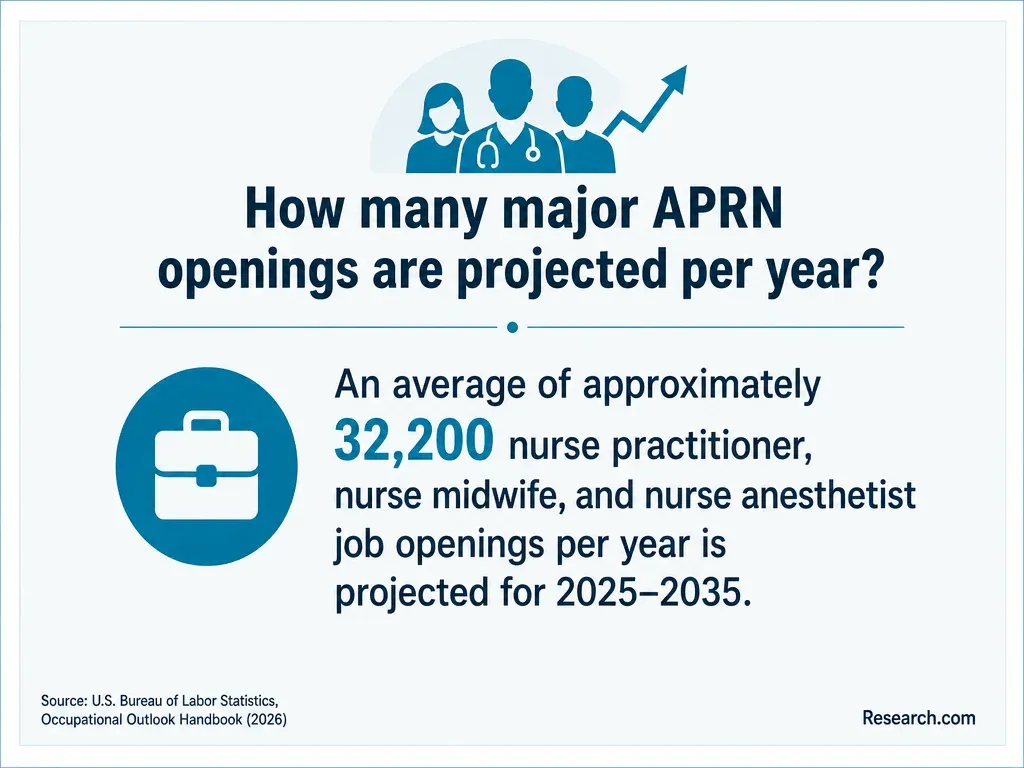
The U.S. Bureau of Labor Statistics reports nurse practitioner wages and employment projections for the occupation as a whole, not separate Idaho salaries or forecasts for pediatric primary care NPs or post-master's certificate graduates. An occupation-wide median cannot predict an offer from an Idaho pediatric clinic. Local compensation depends on the employer, location, experience, schedule, benefits, and scope of the position; pediatric openings may be fewer or distributed differently than NP openings overall.
Use current Idaho job postings and actual offers to test the financial decision. Compare expected compensation and benefits against the certificate's full cost and any income lost during clinicals. If a longer doctorate is also under consideration, online DNP timelines for working nurses can help frame the additional time commitment - but a DNP title alone does not establish pediatric NP eligibility or a salary increase.
Other Things You Should Know About Nursing
Often, yes, but arrange time off for supervised clinical shifts and any required live or on-site sessions. Ask for the actual term schedule before assuming full-time work will remain feasible.
It may strengthen an application and clinical readiness, but it does not automatically replace graduate NP courses or supervised NP clinical hours. The receiving program evaluates documented prior preparation.
Do not assume Idaho authorization is sufficient. Check the patient's state requirements and the employer's credentialing rules before providing cross-state care.
Yes. National certification and Idaho nursing credentials have separate maintenance requirements. Check PNCB and the Idaho Board of Nursing for the applicable renewal rules and deadlines.
- Fees, Expenses, and Aid | University of Idaho Catalog https://catalog.uidaho.edu/student-services/fees-expenses/
- Identifying Preceptors and Clinical Sites | Frontier Nursing University https://frontier.edu/identifying-preceptors-clinical-sites/
- Clinicals - School of Nursing | Innovative Learning https://www.purdue.edu/hhs/nur/students/graduate/programs/pediatric-nurse-practitioner/clinicals.html
- Course Equivalency & Credit Substitution (Graduate Programs) | Current Students https://students.nursing.uw.edu/policies/policy-1-8-course-equivalency-credit-substitution-graduate-programs/
- Roles of Preceptors, Students, and Faculty in PreL Clinical Education (Policy PREL-01) - School of Nursing https://www.boisestate.edu/nursing/student-resources/son-student-policy-manual/section-3-son-undergraduate-programs-policies/section-3-1-pre-licensure-track-policies/roles-of-preceptors-students-and-faculty-in-prel-clinical-education-policy-prel-01/
- Post Master's Certificate - Pediatric Primary Care Nurse Practitioner | Herzing University https://www.herzing.edu/nursing/post-masters-certificate-pnp
- Post-Master's Certificate in Pediatric Primary Care Nurse Practitioner | Drexel University Catalog https://catalog.drexel.edu/graduate/collegeofnursingandhealthprofessions/pediatricprimarycarepractitionercert/
- Nurse Practitioner Scope of Practice Laws | KFF https://www.kff.org/state-health-policy-data/state-indicator/nurse-practitioners-scope-of-practice-laws/
- Best Idaho Post-Master's Certificate Programs in Nursing | RegisteredNursing.org https://www.registerednursing.org/post-masters-certificate/idaho/