2027 PhD in Nursing Programs for Nurses in Texas: BSN, MSN, and DNP Entry Routes and Research Fit
Audited and Verified:
Our Editorial and Data Verification Process
Research.com uses government datasets, official education statistics and primary institutional information to support its career and degree guides. Our review process checks factual accuracy, occupational definitions, source dates and the requirements associated with the credentials discussed.
How This Article Was Fact-Checked
Our editorial team verifies salary estimates, employment projections, education requirements and program information against original data providers and official organizations. Salary figures are checked against the relevant occupational definitions and reporting periods. Information about licensure, accreditation and required in-person training is reviewed separately.
Fact-checked and verified on:

Co-Founder and Chief Data Scientist
A Texas nursing PhD can prepare an experienced nurse to conduct research, teach, and build evidence for better care - but the right program depends on more than its degree title. BSN-, MSN-, and DNP-prepared applicants may face different course plans, funding arrangements, and expectations for independent research. This guide explains the entry routes, identifies Texas universities to investigate, and shows how to assess faculty fit, time, cost, and career outcomes before applying.
Key Things You Should Know
- A nursing PhD is a research doctorate, not a route to initial RN licensure or, by itself, APRN certification.
- BSN, MSN, and DNP entry are possible, but each school determines eligible credentials, required coursework, and whether prior doctoral work reduces requirements.
- Compare at least three factors before applying: an available research mentor, a feasible study schedule, and written funding terms that cover the dissertation period.
What are PhD in Nursing programs in Texas?
Texas nursing PhD programs prepare scholars to formulate research questions, select and defend methods, analyze evidence, and complete a dissertation. Graduates may study issues such as symptom management, health disparities, nursing workforce conditions, or care delivery. Coursework and research training - not additional bedside clinical hours - are the defining features.
These are postlicensure academic programs. A person seeking an initial RN license needs a qualifying prelicensure route first; someone with a prior non-nursing degree might instead investigate comparing GPA requirements in accelerated BSN programs. A PhD application becomes relevant once the applicant has the nursing credentials and research goal the doctoral program requires.
What are the BSN, MSN, and DNP entry routes to a Texas nursing PhD?
Entry credential affects the likely course plan, but it does not determine research readiness on its own. Schools may use different names for these routes and may not offer all three.
The comparison below shows the main question each applicant should resolve with the program before applying.
| Entry credential | Potential advantage | Point to verify |
| BSN | Can begin research training without first earning an MSN. | Whether the school accepts BSN applicants and requires additional graduate-level foundations or a longer plan. |
| MSN | Prior graduate coursework may support a focused research proposal. | Which methods or theory courses count and whether the MSN specialty aligns with the intended study. |
| DNP | Practice-improvement experience can help identify a consequential research problem. | Whether any credits apply; a DNP project does not automatically replace PhD research or a dissertation. |
An RN whose highest nursing degree is below the required entry credential should ask about eligibility rather than assume a bridge is mandatory. For nurses still weighing bachelor's completion, RN-to-BSN education for working registered nurses addresses a different, earlier step; completion alone does not guarantee PhD admission.
Which Texas universities offer accredited PhD in Nursing programs?
Several Texas universities are established places to investigate nursing research doctorates. "Accredited PhD" needs careful interpretation: verify the university's institutional accreditation and the exact doctoral award in its current catalog. Do not assume that CCNE accreditation of a school's BSN, MSN, or DNP programs separately accredits its PhD.
Use this shortlist to begin a faculty and program search, not as a ranking or confirmation of admissions for a particular term.
| University | Location or system | What to check in the current catalog |
| The University of Texas at Austin | Austin | Nursing PhD entry options and faculty research areas |
| UTHealth Houston, Cizik School of Nursing | Houston | Doctoral curriculum, research mentoring, and attendance requirements |
| The University of Texas Medical Branch | Galveston | PhD admission routes and research expectations |
| UT Health San Antonio | San Antonio | Exact degree title, faculty availability, and progression rules |
| The University of Texas at Arlington | Arlington | Current PhD format and required campus activities |
| Texas Woman's University | Texas campuses | Campus or cohort arrangements and available research mentors |
Confirm each institution and degree in official accreditation and university records before paying an application fee. If you currently hold an LVN license rather than RN preparation, RN bridge programs building on LPN experience address a separate licensing step; a research doctorate does not substitute for it.
The distinction is the work the degree prepares you to do. A PhD centers on generating and testing knowledge through sustained research, usually culminating in a dissertation. A DNP centers on applying evidence to practice, systems, or leadership problems, generally culminating in a practice-focused scholarly project. Either degree may support teaching or leadership, but their research training and final deliverables differ.
Choose a PhD if your intended job involves designing studies, obtaining research funding, publishing original findings, or mentoring future researchers. Choose a DNP if your principal goal is leading practice change and evaluating its implementation. Nurses focused on the latter can compare accelerated DNP program comparisons, while checking that a shorter schedule still meets their professional aims.
Neither degree title alone establishes eligibility for a nurse practitioner role. That depends on the completed population-focused preparation, certification requirements, and applicable state authorization.
Typical preparation includes research design, quantitative and qualitative methods, statistics, nursing theory, research ethics, scholarly writing, and dissertation seminars. Particular courses and examinations vary. A strong program match is more specific than a shared interest in "mental health" or "community care": it includes a faculty member who works on a related question, relevant methodological expertise, and a realistic way to obtain approved data.
For example, a nurse interested in psychiatric care might study treatment access or outcomes rather than train for psychiatric prescribing. Lower-tuition psychiatric nursing graduate programs serve a different decision if the goal is PMHNP preparation.
Before proposing a study, identify its population, likely design, data source, and foreseeable barriers. Employer records are not automatically available for dissertation use. Institutional permission, privacy safeguards, and an appropriate institutional review board determination may be necessary before accessing or collecting data.
Requirements vary by university and entry route. Programs commonly evaluate prior nursing education, academic performance, a statement of research interests, recommendations, a résumé or CV, and an interview or faculty match. Some require an active RN license; others specify additional conditions for international credentials or particular study arrangements. Do not assume that a GRE score, publication, thesis, or prior methods course is universally required.
Admissions reviewers need evidence that your proposed direction is researchable, not just that you care about the topic. Explain the question you want to investigate, why existing evidence is insufficient, what preparation you bring, and which faculty member's work is relevant. Ask whether that person expects to accept students in your intended term.
If your immediate objective is graduate clinical, educator, or leadership preparation rather than independent research, exploring less expensive MSN pathways after a BSN may be more direct. Confirm the actual credential and role preparation before changing course.
Plan for several years rather than a fixed completion date. Entry route, full- or part-time enrollment, course sequencing, examinations, dissertation approvals, data access, and analysis can all change the timeline. A DNP does not guarantee a shorter PhD, and an advertised minimum duration may not reflect the time needed for a feasible dissertation.
Compare written estimates for tuition per credit, mandatory fees, required credits, travel and lodging, health insurance, and continuing enrollment during the dissertation. Then compare support: a scholarship, tuition waiver, paid assistantship, and stipend are distinct benefits, each with possible eligibility, work, and renewal conditions. Add forgone earnings if a program requires reducing paid work.
For a nurse whose goal is advanced clinical practice rather than research, nurse practitioner education on a budget is a more relevant cost comparison. PhD tuition should be judged against the research career it supports, not against the cost of an unrelated credential.
Delivery varies by school and cohort. Online coursework can still involve scheduled live meetings, research-team work, campus visits, examinations, or an in-person dissertation defense. Conversely, campus-based study may provide easier access to faculty meetings, seminars, and research assistantships. Confirm the published format for your entry term rather than relying on a general "online" label.
Working nurses should request a sample term schedule and ask how often required meetings occur, whether attendance can be remote, and what happens if clinical shifts conflict. Also ask whether a proposed advisor can supervise research at your location and whether you can lawfully and ethically access the data there.
If remote study is chiefly a way to earn PMHNP clinical preparation sooner, online MSN-PMHNP completion timelines concern a different pathway. Online PhD coursework does not supply NP clinical training.
A nursing PhD can support applications for research faculty, nurse scientist, research director, and some academic leadership roles. The work may include designing studies, seeking grants, publishing findings, teaching, and supervising student research. Hiring also depends on publications, methods expertise, funding history, teaching experience, and the employer's needs; the doctorate is not a job guarantee.
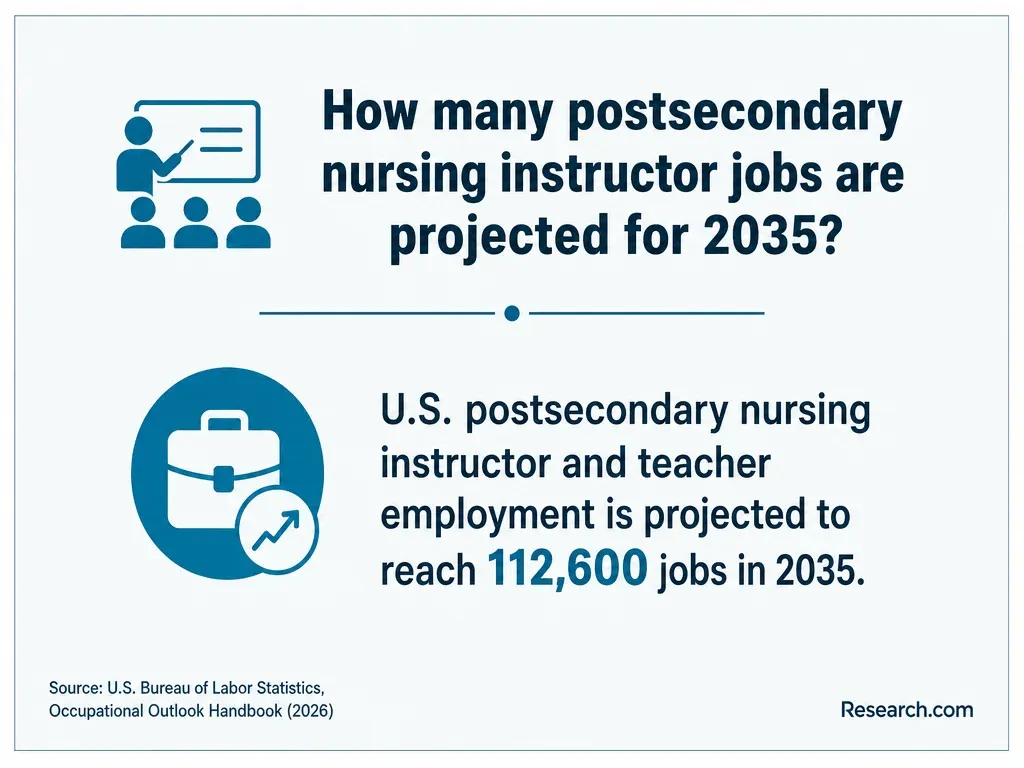
Salary comparisons require a named occupation. U.S. Bureau of Labor Statistics wages for nursing instructors and teachers, postsecondary, describe that occupation - not all PhD graduates. A nurse scientist may instead be paid under a university, health-system, or grant-funded job classification. Compare actual postings for rank, contract length, research time, and funding expectations rather than applying an RN or NP median wage to every PhD career.
An experienced APRN who mainly wants a new psychiatric population focus may find PMHNP certificate completion timelines more pertinent than a research doctorate. The receiving program and certifying body must determine whether prior preparation qualifies.
How do accreditation, licensure, and research fit guide program selection?
First, confirm that the institution is appropriately accredited and that its current catalog lists the exact nursing PhD you intend to pursue. Check nursing-program accreditation claims against the accreditor's stated scope rather than assuming accreditation of one degree extends to another. Verify RN or APRN license requirements separately with the program and the relevant nursing regulator; the PhD itself grants neither license.
Then test research fit. Read potential advisors' recent work, ask whether they are accepting students, and discuss the methods and data your question would require. Request written answers about advisor assignment, funding duration, dissertation milestones, and what support remains if a study site or dataset becomes unavailable. A prestigious institution without suitable supervision may be a poorer choice than one where your project is feasible.
If you want to lead systems improvement rather than produce original dissertation research, systems-focused DNP study options may align more closely with the work. Confirm each program's actual project, practice-hour, and attendance requirements before treating it as an alternative.
Other Things You Should Know About Nursing
Possibly, but employment does not grant research access. Obtain required organizational permission and review of privacy, data-use, and human-subjects protections before collecting or analyzing records.
Usually not. A focused research interest helps demonstrate fit, but questions often change as students review evidence and work with advisors. Check the program's proposal expectations.
Many universities have a process, but available supervisors and funding can limit your options. Ask for the program's written advisor-change policy before committing.
No universal requirement applies. A postdoctoral appointment may help build a publication record or specialized methods expertise for a research-intensive career, but its value depends on the role you seek.
- DAPIP | Homepage - Office of Postsecondary Education (OPE) https://ope.ed.gov/dapip/
- Ph.D. Funding | Brown University https://graduateschool.brown.edu/financing-support/phd-funding
- PhD in Nursing | The University of Texas at Tyler https://www.uttyler.edu/academics/programs/nursing-phd.php
- An Overview of Graduate Funding | Graduate Programs https://grad.humanecology.wisc.edu/an-overview-of-graduate-funding/
- Doctor of Nursing Practice - Doctor of Philosophy Bridge | Texas Christian University Catalog https://graduate.catalog.tcu.edu/colleges/harris/dnp/philosophybridge
- Paying for Graduate School - The University of Alabama https://graduate.ua.edu/applicants/funding/
- PhD in Nursing - Academic Catalog - UTHealth Houston https://catalog.uth.edu/nursing/programs/graduate-programs/nursing-phd/
- Types of Funding - Graduate College - University of Illinois https://grad.illinois.edu/funding/types-funding
- BSN Entry to DNP Application Requirements | ucsf.edu https://nursing.ucsf.edu/programs/doctoral-programs/bsn-entry-dnp-advanced-nursing-focus/bsn-entry-dnp-application
- Doctor of Philosophy (PhD) - School of Nursing https://nursing.utexas.edu/academics/graduate/phd