2027 Paying for an Online BS in Business Administration: An Employer Requiring a Business Case for Sponsorship
Audited and Verified:
Our Editorial and Data Verification Process
Research.com uses government datasets, official education statistics and primary institutional information to support its career and degree guides. Our review process checks factual accuracy, occupational definitions, source dates and the requirements associated with the credentials discussed.
How This Article Was Fact-Checked
Our editorial team verifies salary estimates, employment projections, education requirements and program information against original data providers and official organizations. Salary figures are checked against the relevant occupational definitions and reporting periods. Information about licensure, accreditation and required in-person training is reviewed separately.
Fact-checked and verified on:

Co-Founder and Chief Data Scientist
Your employer may support an online BS in Business Administration - but only if you can explain why paying for it serves the organization, not just your career. That case depends on your current responsibilities, a credible completion budget, and business skills you can put to work. This guide shows employees and aspiring managers how to connect coursework to workplace needs, estimate the employer's commitment, and propose outcomes without promising a promotion or invented savings. It also helps you decide when a shorter, more targeted credential is the stronger request.
Key Things You Should Know
- Ask for a defined contribution, such as payment for approved courses or reimbursement up to your employer's cap - not an open-ended commitment to the entire degree.
- Build the case around a documented work problem, relevant courses, an approved application plan, and measures the employer can review; a projected return is not a proven saving.
- Check the remaining degree requirements and the benefit policy before proposing a budget: accepted transfer credits may not satisfy business-core or residency requirements.
What Is an Online BS in Business Administration?
An online BS in Business Administration is an undergraduate degree combining general education with business subjects such as accounting, management, marketing, operations, and quantitative analysis. "Online" describes delivery, not necessarily self-paced study: classes may still have scheduled meetings, group assignments, proctored exams, or fixed deadlines.
For an employer request, the important distinction is between broad preparation and a specific workplace need. A BS may make sense if your next role requires a bachelor's degree and broader responsibility across functions. If the gap is confined to one task, employer training or a focused certificate may cost less and produce usable skills sooner. Compare business administration colleges for working professionals against your actual work schedule, rather than relying on an "online" label.
How Much Does an Online Business Administration Degree Cost?
There is no reliable single price for your completion plan. Schools may charge by credit, course, or term, and a transfer evaluation determines how much study remains. An employer-facing estimate should separate the school's charges from expenses you would pay and time the organization might contribute.
The table identifies costs to request in writing before you calculate a proposed sponsorship amount. It also shows why tuition alone can understate the commitment.
| Cost component | What to verify | Why it matters to the proposal |
| Remaining tuition | Applied transfer credits, required courses, and billing method | Determines the likely education charge |
| Required extras | Fees, books, software, proctoring, and any travel | Clarifies which expenses the employer would cover |
| Time and financing | Course sequence, work-hour adjustments, payment dates, and borrowing | Reveals cash-flow and staffing effects beyond tuition |
Request an official degree audit and itemized school estimate, then compare the same remaining-credit assumptions across schools. A faster program is not automatically cheaper: additional terms, required courses, or reduced work hours can change the total. Business bachelor's rankings focused on completion speed can help identify options, but your audit and employer benefit rules should control the cost comparison.
How Can You Build a Business Case for Employer Sponsorship?
Write the proposal for the person authorized to approve the expense. Start with a business need they already recognize - such as inconsistent purchasing reports or a need for stronger budget analysis - and show why the proposed education is an appropriate response. If the need is limited to supervising a team, compare the full BS with employer training or accelerated online organizational leadership school choices before asking the organization to fund a broader curriculum.
A concise proposal should make the commitment and its limits reviewable. Use this sequence to turn a personal education goal into a decision the employer can evaluate:
- Define the need: Name the current task or target internal role, who owns the decision, and the skill or degree requirement you cannot already meet.
- Match learning to work: Identify relevant required courses and a feasible assignment you could apply at work, subject to faculty approval, employer permission, and data-access rules.
- State the full request: Attach the degree audit, itemized estimate, proposed course load, payment schedule, and any request for study time during work hours.
- Propose evidence: Agree on an existing baseline and reviewable outputs - such as a documented process map or more consistent reporting - without claiming the degree alone will cause improved results.
- Offer a review point: Propose an initial approved course or term before the employer commits to later funding, and confirm who can authorize each stage.
For example, a proposal might say: "I request funding for the approved courses in my next term. I will apply the operations coursework to a purchasing-process review, with my supervisor's permission, and present a process map and recommendations for review. I will not use restricted records in coursework without authorization." That is a testable commitment, not a claim of future savings.
Read the benefit policy before submitting. Eligibility, annual or lifetime caps, grade thresholds, reimbursement timing, covered fees, required service after payment, and repayment if you leave can determine whether the arrangement is workable. Ask payroll or benefits staff about tax treatment rather than assuming every payment is tax-free. If the employer pays only after grades post, show how you will cover tuition when it is due.
Verify the institution's current accreditation with the institution and its recognized accreditor. Then check whether any claimed business accreditation - such as AACSB, ACBSP, or IACBE - actually covers the relevant business unit or program. Institutional accreditation and business-specific accreditation have different scopes; neither guarantees a promotion or that your employer will approve tuition assistance.
Ask the benefits administrator whether the school, degree, and online format meet the company's policy. If application charges are your responsibility, you can also compare accredited schools with no application charge; confirm each school's current accreditation and fee policy before applying.
Federal student aid, school grants and scholarships, and employer benefits may reduce different parts of the bill. Submit the FAFSA to establish eligibility for applicable federal aid, then ask each school how its awards interact with employer payments. Checking FAFSA eligibility at online business administration schools is a starting point, not a guarantee that you qualify for a grant or that a particular expense will be covered.
Compare net cost after confirmed grants and employer support with cash needed upfront. Reimbursement may arrive after tuition is due; a loan can bridge that gap but adds borrowing costs and repayment obligations. Ask the financial-aid office how enrollment intensity, satisfactory academic progress, withdrawals, and outside education benefits affect your package. Do not count an unapproved employer contribution as available funding.
Curricula vary, but common subjects include financial and managerial accounting, economics, finance, marketing, management, operations, statistics, and business communication. For a sponsorship request, name the required courses that address your documented skill gap and explain what you could responsibly apply - not merely what sounds relevant in a catalog.
For example, an employee helping coordinate hiring might benefit from organizational behavior and HR coursework, but should compare the general degree with HR degree coursework and entry requirements if the intended role is specifically in HR. Check prerequisites, elective availability, and whether a proposed concentration is officially awarded. A workplace project may require separate faculty approval and employer permission; enrollment alone does not authorize access to company data.
Admission rules depend on the institution and whether you are entering as a first-year, transfer, or returning student. Schools may request prior transcripts and may evaluate mathematics, accounting, or other preparation separately from general admission. An accepted course can become an elective without satisfying a business-core requirement.
Before asking for a funding commitment, request a written evaluation of your previous coursework and an official degree audit. Use credit and eligibility rules for business administration admission to prepare questions, then ask the school which requirements remain and who approves substitutions or transfer appeals. The institution - not your employer - decides how credits apply to graduation.
Your timeline depends on applicable transfer credit, course load, prerequisites, required-course availability, and any residency rules. Build the schedule from the school's degree audit rather than an advertised completion time. Ask whether courses run every term and whether group work, live sessions, or exams would conflict with peak work periods.
A faster schedule may help the employer use your skills sooner, but it may also require reduced working hours or increase the risk of withdrawing from a course. Compare accelerated study schedules for business majors with a part-time plan that your supervisor can support through busy seasons. Include a contingency for a missed required course or a temporary change in work duties.
The strongest sponsorship case usually connects the degree to responsibilities at your current organization: moving from administrative support into operations coordination, from customer-facing work into sales operations, or from purchasing support into a broader procurement role. Those moves still depend on openings, demonstrated performance, and employer requirements. A business degree does not itself confer a management title.
Identify the tasks in the role you want, then compare them with your work evidence and the proposed curriculum. If your goal is specifically procurement or supply chain work, online supply chain programs balancing cost and completion time may be a more direct funding proposal than a general business BS. Ask your manager which qualification the organization actually values for the target position.
What Salary and Job Outlook Can Business Graduates Expect?
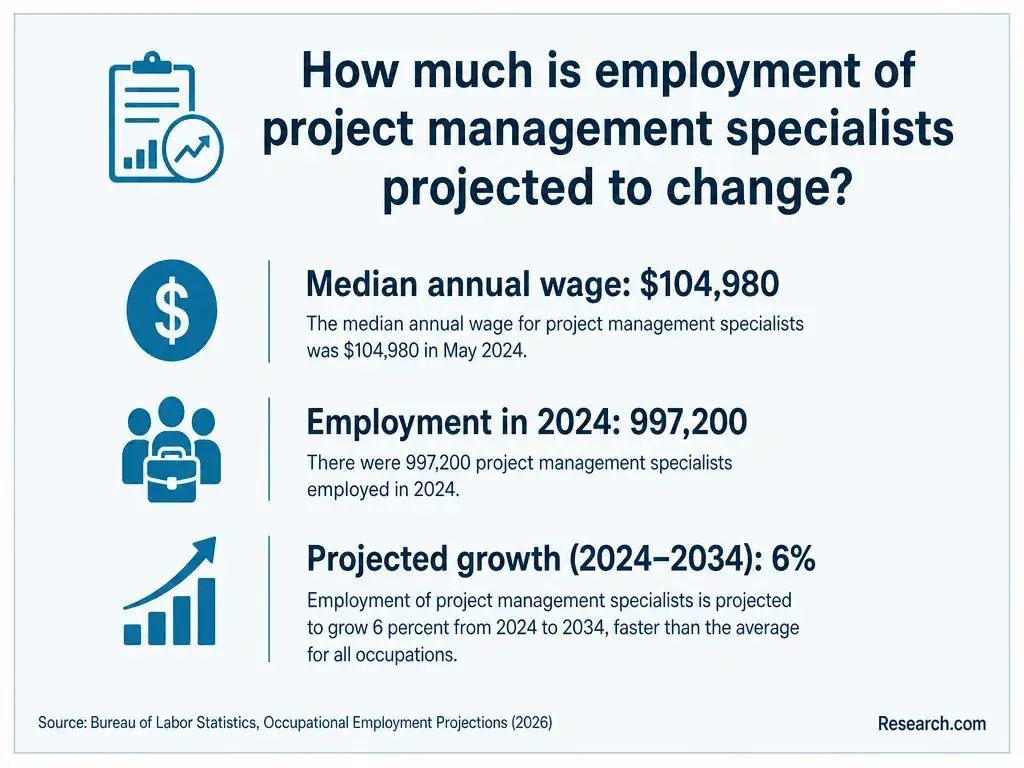
Salary data can provide context, but it cannot establish the financial return on your employer's sponsorship. The U.S. Bureau of Labor Statistics reports a May 2025 median annual wage of $102,320 for project management specialists. That is an occupation-wide median, not a starting salary for business graduates or evidence that your employer will pay you more after graduation.
For a credible internal case, use your employer's actual pay bands, job postings, and advancement requirements where available. If project work is the specific objective and a bachelor's degree is not required for your next step, budget-conscious project management degrees or targeted training may warrant comparison. Do not present an external occupational wage as a saving to the employer or a guaranteed return to yourself.
Other Things You Should Know About Business Administration
Check the written education-benefit policy or ask HR who controls eligibility and approvals. Then discuss the business need and scheduling implications with your manager before submitting a formal request.
Not automatically. Check company confidentiality and intellectual-property rules, obtain any required permission, and use public or appropriately anonymized material if you later build a portfolio.
Ask which skill or qualification it would fund instead. A course, certificate, or supervised work assignment may address the immediate need; you can revisit degree sponsorship if broader responsibilities emerge.
Review the triggering events, repayment amount, service period, and treatment of layoffs or role changes before signing. If the obligation is unclear, request a written explanation from benefits staff.
- Employer-offered educational assistance programs can help pay for college | Internal Revenue Service https://www.irs.gov/newsroom/employer-offered-educational-assistance-programs-can-help-pay-for-college
- School-Determined Requirements - FSA Partner Connect https://fsapartners.ed.gov/knowledge-center/fsa-handbook/2026-2027/vol1/ch1-school-determined-requirements
- AACSB Global Standards for Business Education https://www.aacsb.edu/educators/global-standards
- Tuition Costs | Bursar - Queens College | The Center for Excellence in Teaching, Learning & Leadership https://www.qc.cuny.edu/br/tuition-costs/
- How Many Hours of Work Per Online Course Credit | ASU Online https://asuonline.asu.edu/newsroom/online-learning-tips/discover-weekly-number-hours-online-students-study/
- Tuition & Fees - UF Online - University of Florida https://ufonline.ufl.edu/tuition/tuition-fees/
- Tuition & Costs | New Jersey Institute of Technology https://www.njit.edu/admissions/tuition-costs
- Employer Tuition Reimbursement: How It Works and How to Pay for College | Winston-Salem State University https://ramsonline.wssu.edu/blog/employer-education-benefits/
- Making the Case for Employer Sponsorship | The University of Chicago Booth School of Business https://www.chicagobooth.edu/why-booth/stories/employer-sponsorship
- How to use a skills gap analysis in the workplace | University of Phoenix https://www.phoenix.edu/workforce-solutions/workforce-resources/posts/skills-development/how-to-use-a-skills-gap-analysis-in-the-workplace.html