
2027 Paralegal Certificate Programs With Accessibility Support: Questions Before Enrollment

Co-Founder and Chief Data Scientist
A paralegal certificate program may look accessible on paper but still require timed exams, software, or an internship that creates barriers for you. Before enrolling, you need to know how the school handles those requirements - not just whether it has a disability services office. This guide is for prospective paralegal students comparing certificate programs. It explains which accessibility questions to ask, how to check program quality and cost, and when a different credential or delivery format may be the better choice.
Key Things You Should Know
- Ask how accommodations apply to required classes, legal research tools, exams, and internships; a general accessibility statement does not answer those questions.
- Check institutional accreditation separately from American Bar Association (ABA) paralegal program approval. Neither makes a graduate a professionally certified paralegal.
- Compare the full cost against your likely entry route: the U.S. Bureau of Labor Statistics reports $62,890 in May 2025 as the median annual pay for paralegals and legal assistants, not a guaranteed starting salary.
What Are Paralegal Certificate Programs With Accessibility Support?
These programs teach legal-support skills while offering a process for students with disabilities to request access to coursework and required activities. A paralegal certificate is an educational award from a school. It is not a professional certification from a credentialing organization, an attorney license, or permission to give legal advice independently.
"Certificate" can describe different offerings: an undergraduate credit-bearing program, a post-baccalaureate program for students who already have a degree, or noncredit continuing education.
Their admission rules, academic credit, and potential financial aid eligibility can differ. Ask the school which type it offers and whether its accessibility process covers every required part of that specific program.
If you already have a degree and want legal knowledge for your current profession rather than paralegal training, compare a full legal studies master's versus a graduate certificate. Neither route, nor a paralegal certificate, qualifies you to practice law as an attorney.
Which Accreditation Should Paralegal Certificate Programs Have?
Check two separate claims. Institutional accreditation concerns the school and should be verified through the school's recognized accreditor or U.S. Department of Education records.
ABA approval applies to a qualifying paralegal education program, not to the institution as a whole. Verify any advertised approval against the ABA's current directory using the exact program name and campus or delivery arrangement.
ABA approval can matter if an employer or your own selection criteria favor it, but a program without approval is not automatically illegitimate. Compare its curriculum, instructor qualifications, practical work, and employer requirements in your area. Conversely, do not assume ABA approval establishes that every digital platform or accommodation will work for you.
A school may hold institutional accreditation while a particular certificate is noncredit or outside the scope of an ABA-approved paralegal program. Ask the admissions office to identify the precise credential you would earn, then confirm its status rather than relying on a statement about the school generally.
What Accessibility Services Should Paralegal Students Expect?
Students should expect an established way to request disability-related accommodations and discuss access to required activities. Depending on the institution, applicable obligations may arise under the Americans with Disabilities Act and, for recipients of federal funding, Section 504 of the Rehabilitation Act.
An accommodation is determined through the school's process; it does not necessarily eliminate essential course requirements or guarantee a student's preferred arrangement. Ask the disability services office how its process works in practice.
The following questions expose barriers that a broad promise of "accessible learning" may miss:
- What documentation is requested, when should I apply, and how are approved accommodations communicated to instructors?
- Can I test required course pages, legal research databases, document templates, and exam software with my assistive technology before enrollment?
- How are accessible readings, captioning or interpreting, alternative formats, and exam accommodations arranged, and how much advance notice is needed?
- If an internship is required, who coordinates accommodations with the placement site, and what happens if a site cannot provide access?
- Who resolves an access problem during a course, and is there an appeal or grievance process?
Request answers about the actual required tools, not just the learning management system. Legal research, document production, and client-file exercises may use separate platforms. Do not assume that software listed in a course description includes student access or hands-on assignments; ask for a current syllabus or demonstration when available.
Do Paralegal Certificate Programs Require State Licensing?
There is no general U.S. state license that every paralegal certificate student must obtain before enrolling or working as a paralegal. Requirements and protected titles can vary by state, however, and education requirements for particular roles should not be confused with a nationwide licensing rule. California, for example, sets statutory qualifications for people working as paralegals.
Check the rules where you intend to work, especially if a school claims its certificate satisfies a state requirement. Ask which requirement it means and whether other conditions, such as supervised experience or continuing education, apply. A paralegal normally works under an attorney's supervision and cannot independently perform legal work reserved for licensed professionals.
Should You Choose an Online or Campus-Based Paralegal Program?
Choose the format that makes required work accessible and feasible, not simply the one labeled "flexible." Online classes may have live meetings, proctored exams, campus visits, or an in-person internship; campus classes may offer more direct help with technology but require regular travel.
The comparison below shows where to investigate before choosing:
| Decision factor | Online program | Campus-based program |
| Schedule | May be asynchronous or require live attendance | Usually requires scheduled travel and class attendance |
| Accessible materials | Depends on every required digital tool and file | Depends on both physical access and digital materials |
| Practical work | Placement may still be local and in person | Placement may require travel beyond campus |
Before committing, request the course timetable, exam rules, residency requirements, and internship policy. If you need predictable access to assistive technology, find out whether you can use your own setup during exams and practical exercises.
Confirm who finds an internship placement and whether remote work or an existing job can satisfy the requirement; do not assume either is permitted.
What Courses Do Paralegal Certificate Programs Include?
Common subjects include legal research and writing, civil litigation, contracts, ethics, and document preparation. Some programs add electives in areas such as family law, real estate, or business organizations. A course title alone does not show how much accessible, hands-on practice you will get.
Review syllabi for research assignments, drafting feedback, citation practice, and instruction in confidentiality and attorney supervision. Ask whether required databases, e-discovery tools, and document formats work with your assistive technology.
If an instructor mentions an AI tool, clarify whether it is demonstrated, available to students, permitted in assignments, or assessed; those are different levels of training.
For someone aiming at human resources or workplace-policy work rather than a traditional paralegal role, online legal studies degrees emphasizing human resources law offer a different curriculum to compare. A legal studies degree is not a substitute for attorney licensure.
What Are the Admission Requirements for Paralegal Certificates?
Requirements depend on the credential. One school may admit applicants with a high school diploma to an undergraduate certificate; another may require a bachelor's degree for its post-baccalaureate certificate.
A program may also require prior college coursework or specific general education courses. Confirm the published requirements for the certificate itself, not for a similarly named degree.
Ask whether application materials, prerequisite courses, and placement tests are accessible and what the accommodation-request timeline is. Keep admissions decisions separate from accommodation planning: you can ask how the process works without assuming that disclosing a disability is a standard application requirement.
If you already hold a bachelor's degree and are considering a non-JD graduate route instead, personal-statement-free legal studies application options may help you compare admissions burdens. Check each program's current requirements before applying.
How Long Do Paralegal Certificate Programs Take and Cost?
Length varies with prerequisites, course sequencing, enrollment pace, and any internship. Ask for a term-by-term completion plan based on your eligibility and schedule. A short advertised timeline may assume full-time attendance or courses offered only at particular times.
Compare the total amount you would need to pay, not just advertised tuition. Include mandatory fees, books, database or technology charges, required equipment, travel, and internship expenses. Ask whether accessible versions of required materials are available without an additional charge and who supplies any specialized software.
Do not assume federal financial aid covers a certificate because the school participates in aid programs. Ask the financial aid office whether the specific program is eligible, particularly if it is noncredit. Request a written, itemized cost estimate and ask what happens financially if accommodation delays or course availability extend your enrollment.
If your goal is broader graduate-level legal knowledge rather than paralegal preparation, compare that estimate with legal studies master's programs with affordable tuition. Compare total costs and intended career use; a lower advertised price alone does not establish better value.
What Careers and Salaries Can Paralegal Certificates Lead To?
A certificate may help you pursue paralegal or legal assistant work involving research, drafting, file organization, and case preparation under attorney supervision. Hiring standards differ by employer, and some positions favor an associate or bachelor's degree, experience, or particular practice-area skills. A certificate does not guarantee a job or a starting wage.
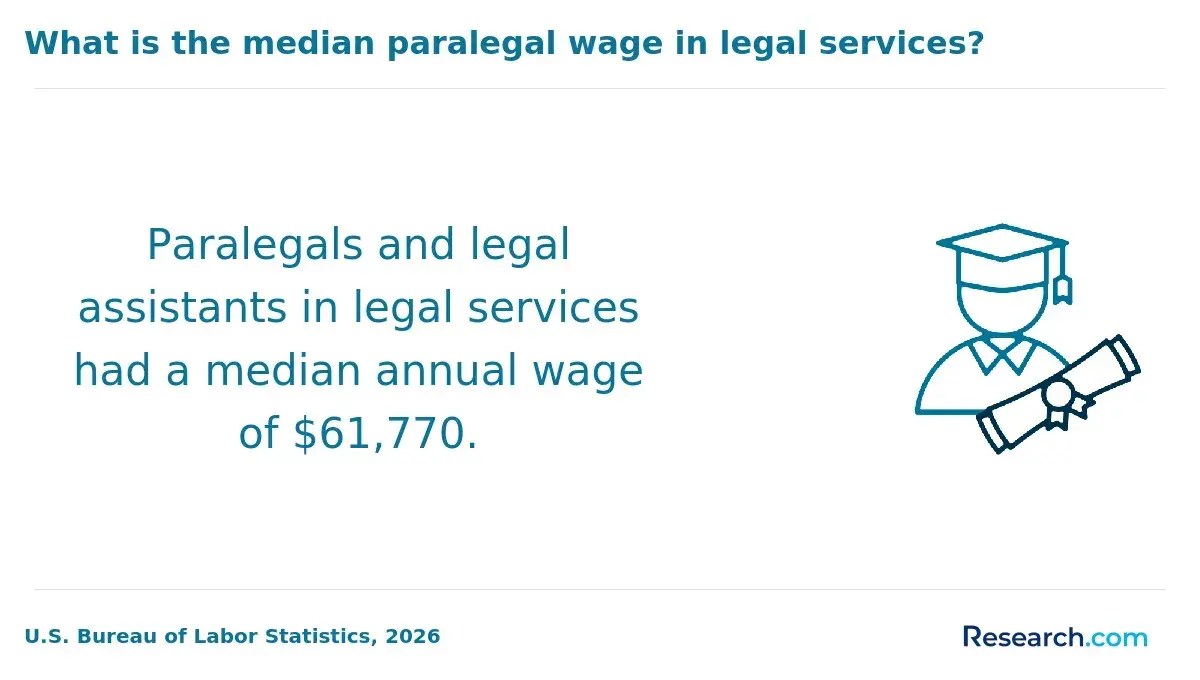
The U.S. Bureau of Labor Statistics reports median annual pay of $62,890 in May 2025 for the combined paralegals and legal assistants occupation. It projects 0% growth for 2025-2035 but about 40,800 openings per year, largely reflecting workers leaving or changing occupations.
These occupation-wide figures are not outcomes for certificate graduates or a prediction of your local starting pay.
When evaluating a school's career claims, ask for documented placement methods, the period measured, and whether results cover your exact certificate. Assess whether its practical assignments and placement support will help you demonstrate skills to employers - not merely whether its marketing names desirable job titles.
How Can You Compare Paralegal Programs and Professional Certifications?
First decide which gap you need to close. A school-issued certificate provides education; professional certification is a separate credential awarded under an organization's eligibility and examination rules. For example, the National Association of Legal Assistants awards the Certified Paralegal credential.
Completing a course does not automatically grant that credential, and professional certification is not universally required for paralegal employment.
Before paying a deposit, compare your finalists using the same evidence: exact credential and prerequisites; institutional accreditation and any ABA program approval; accessible required tools and accommodation procedures; live-class, exam, and placement schedules; itemized total cost; and the practical work you can show an employer.
Then check any professional certification body's current eligibility rules independently rather than accepting a school's claim of automatic eligibility.
If your intended work centers on business-law knowledge outside a paralegal position, shorter pathways through a business law master's provide another route to evaluate. They generally demand a different academic commitment and do not qualify graduates to practice law. Favor the route that addresses your actual job goal without paying for coursework or scheduling obligations you do not need.
Other Things You Should Know About Law & Paralegal
Not simply to apply. If you need an accommodation for an application activity, contact the appropriate admissions or accessibility office about its process. You can also ask about future course access before deciding whether to enroll.
Ordinarily, a certificate identifies the credential awarded, not a student's accommodations. Ask the school to show you its credential and transcript policies if this concerns you.
Schools generally are not required to provide personal services or devices for individual everyday use. Ask which course-related accessible materials, equipment, and services the institution provides and which items you would need to arrange yourself.
Not automatically. A professional certification organization has its own accommodation-request process and deadlines. Review those rules early, even if your school has already approved accommodations.
References
- Auxiliary Aids and Services for Postsecondary Students with Disabilities | U.S. Department of Education http://www.ed.gov/laws-and-policy/individuals-disabilities/auxiliary-aids-and-services-for-postsecondary-students-with-disabilities
- Students with Disabilities Face Financial Aid Barriers | ncd.gov https://www.ncd.gov/report/students-with-disabilities-face-financial-aid-barriers/
- Software Overview | Section508.gov https://www.section508.gov/test/software/
- Guidance on Web Accessibility and the ADA https://www.ada.gov/resources/web-guidance/
- Myths and Facts Surrounding Assistive Technology Devices and Services - Individuals with Disabilities Education Act https://sites.ed.gov/idea/idea-files/myths-and-facts-surrounding-assistive-technology-devices-and-services/
- DAPIP | Homepage - Office of Postsecondary Education (OPE) https://ope.ed.gov/dapip/
- Test Accommodations FAQ - Disability Resource Center https://drc.calpoly.edu/content/resources/testaccommodations
- Prospective Students | umich.edu https://studentaccessibility.umich.edu/prospective-students
- Determining if Captions, Transcripts or Audio Descriptions Are Needed for Video or Audio - UWM Digital Accessibility https://uwm.edu/digital-accessibility/documentation-guides/video-audio/audio-and-video-captioning-transcripts-and-audio-descriptions/
- Disability & Accessibility Services - The City University of New York https://www.cuny.edu/about/administration/offices/student-affairs/programs-services/disability/


