2027 Online Post-Master's FNP Certificates for Nurses in Wisconsin: Coursework and Clinical Requirements
Audited and Verified:
Our Editorial and Data Verification Process
Research.com uses government datasets, official education statistics and primary institutional information to support its career and degree guides. Our review process checks factual accuracy, occupational definitions, source dates and the requirements associated with the credentials discussed.
How This Article Was Fact-Checked
Our editorial team verifies salary estimates, employment projections, education requirements and program information against original data providers and official organizations. Salary figures are checked against the relevant occupational definitions and reporting periods. Information about licensure, accreditation and required in-person training is reviewed separately.
Fact-checked and verified on:

Co-Founder and Chief Data Scientist
An online post-master's family nurse practitioner (FNP) certificate can help a Wisconsin nurse with a graduate degree prepare for a new advanced practice role - but online classes do not eliminate supervised patient-care requirements. The right program depends on your existing coursework, whether you already practice as an APRN, and whether the school can approve clinical experiences where you live.
This guide explains the coursework and placement questions to resolve before enrolling, then connects the certificate to certification, Wisconsin practice authorization, cost, and career fit.
Key Things You Should Know
- An FNP certificate adds family-across-the-lifespan preparation to an existing graduate nursing education; a non-APRN MSN or experience in another NP population focus does not automatically satisfy FNP requirements.
- Expect a school-specific review of the three advanced-practice science areas - pathophysiology, pharmacology, and health assessment - and supervised FNP clinical experiences. Credit and hour totals depend on the approved curriculum and documented prior work.
- Graduation is not authorization to practice: graduates must meet a certifying organization's FNP eligibility rules and Wisconsin's applicable advanced practice requirements before taking on the role.
What is an online post-master's FNP certificate in Wisconsin?
A post-master's FNP certificate is graduate-level preparation for a licensed nurse who already holds an MSN or another qualifying graduate nursing degree and wants to provide primary care across the lifespan. It is a school-issued academic award, not another master's degree, national board certification, or a Wisconsin practice credential. "Online" usually describes didactic instruction; patient-care training takes place at approved clinical sites, and a program may also require live classes or campus visits.
The starting point matters. An adult-gerontology or psychiatric NP needs a review of prior advanced practice coursework and new family-population competencies. A nurse with an MSN in education or leadership may need more foundational NP coursework and clinical preparation. A nurse seeking only a bachelor's degree is considering a different outcome; RN-to-BSN study without added bedside rotations does not prepare someone for FNP certification.
What are the admission requirements for Wisconsin post-master's FNP certificates?
Programs commonly review an active RN license, a graduate nursing transcript, academic standing, professional recommendations, and a résumé or statement of goals. Some specify prior clinical experience, an APRN credential, prerequisite grades, or eligibility to arrange clinical placements in Wisconsin. Admission to a university does not necessarily mean admission to its FNP track or approval of a proposed placement.
Ask the program for a written, individualized gap analysis before accepting an offer. Supply syllabi for advanced assessment, pharmacology, and pathophysiology; transcripts; and, if you are an APRN, records of supervised clinical hours and population-focus preparation. The school decides which prior work meets its curriculum. General lists of nursing schools with easier entry requirements cannot establish eligibility for a post-master's specialty track.
How many credits and clinical hours do Wisconsin FNP certificate programs require?
There is no credit or clinical-hour total that applies to every online post-master's FNP certificate available to Wisconsin nurses. Published totals may describe a standard curriculum, while an individual study plan can change after a faculty review of prior courses. Likewise, prior APRN employment is not automatically accepted as supervised FNP student clinical time. Obtain the credit-by-credit plan and its clinical-hour requirements for your entry term, then confirm that the completed track is designed to meet the FNP certifying organization's current educational criteria.
Compare hours by their purpose, not just their total. The distinctions below help identify a plan that looks short on paper but leaves an FNP preparation gap.
| Experience or record | What to verify | Why it matters |
| Prior graduate clinical hours | Population focus, supervision, documented competencies, and the receiving school's decision | Hours in another specialty may not cover family-across-the-lifespan care. |
| New FNP clinical hours | Direct patient-care expectations, approved settings, preceptors, and evaluation | These experiences must support the program's FNP outcomes and certification pathway. |
| Simulation or employment hours | Whether the program permits them for a specified requirement | Neither should be assumed to replace supervised FNP clinical encounters. |
Even an accelerated DNP program comparison should not be read as evidence that a shorter doctorate waives a separate FNP population-focus gap.
FNP coursework typically connects advanced health assessment, pharmacology, and pathophysiology to diagnosis and management in primary care. Specialty courses address health promotion, common acute and chronic conditions, evidence-based decisions, and care across the lifespan. Faculty assess whether prior graduate courses meet program standards or whether the student must take or update them.
Course titles alone are a weak comparison: inspect syllabi for the patient populations, clinical reasoning, prescribing preparation, and supervised assessments they cover. A psychiatric NP certificate is not interchangeable with FNP preparation; accelerated psychiatric NP certificate options serve a different population-focus decision.
Students complete supervised, faculty-evaluated patient care at sites the program approves, potentially in Wisconsin communities near home. A site's willingness to host a student is not enough: the school may require an affiliation agreement, an eligible preceptor, appropriate patient exposure, and permission to place students in that jurisdiction. Ask whether the school finds sites, helps evaluate student-proposed sites, or expects students to secure both sites and preceptors.
Before enrolling, get clear answers on placement lead times, required care settings and age groups, who evaluates your encounters, and what happens if a site falls through. Confirm whether live seminars, simulation, or campus visits add travel or time away from work. "Online" does not mean clinical shifts can always be scheduled around a full-time job. By contrast, systems-focused DNP study options may suit a leadership objective but should not be mistaken for FNP direct-care preparation.
Check institutional accreditation and the nursing program's accreditation status and scope with its stated accreditor, such as CCNE or ACEN. Then ask the program to confirm in writing that its specific post-master's FNP track, including your proposed Wisconsin clinical location, supports eligibility for the FNP certification examination you intend to take. Accreditation, permission to enroll a Wisconsin resident, and eligibility for Wisconsin practice authorization are related but separate questions.
Verify the precise award and population focus rather than relying on an institution-wide claim. That distinction also applies when considering accessible nursing practice doctorate pathways: the DNP label by itself does not establish that an FNP track is included.
Completion time depends on the faculty-approved course plan, course sequencing, available clinical placements, and whether you study full or part time. Ask for a term-by-term schedule showing when clinical courses start; an advertised minimum may assume prerequisites are accepted and a preceptor is ready when needed.
For a working nurse, estimate time using both coursework and site hours. As an illustration, not a program requirement, 600 clinical hours completed at 16 hours per week would take 37.5 clinical weeks, before breaks, cancellations, or travel. If you do not yet hold a qualifying graduate degree, online ADN-to-MSN program comparisons concern an earlier educational step, not a shortcut through a post-master's certificate.
Compare a written estimate based on your approved credit plan, not a school's lowest advertised tuition figure. Published tuition may be charged per credit and exclude clinical, technology, travel, and examination expenses. The figures below demonstrate the calculation only; they are not quoted Wisconsin program prices.
- Illustrative tuition: 24 credits × $900 per credit = $21,600.
- Additional costs to request: mandatory fees, books, compliance checks, travel, clinical-site expenses, certification examination fees, and applicable licensing costs.
- Potential added cost: another term of tuition or reduced earnings if course sequencing or placement delays completion.
Request the rate for your residency and enrollment status, plus the school's policy on extra courses identified in a gap analysis. Employer reimbursement may lower your personal cost, but verify eligibility and repayment conditions first. Cost-focused nurse practitioner study options are useful comparison points only when they lead to the same intended FNP preparation.
After completing an eligible FNP curriculum, graduates can apply under the current requirements of a national FNP certifying organization, commonly the American Nurses Credentialing Center or the American Academy of Nurse Practitioners Certification Board. The school should identify which examination pathways its graduates qualify for and provide the required educational documentation. Passing an examination and holding an academic certificate are distinct from obtaining Wisconsin authority to practice in the role.
Before accepting a position, confirm the Wisconsin Board of Nursing's applicable advanced practice requirements, license or credential status, prescribing requirements if relevant, and employer credentialing process. Rules can change; obtain the board's and certifier's current instructions rather than assuming another state's APRN approval transfers automatically. For a BSN-prepared nurse without a master's, affordable nursing master's study for BSN graduates addresses a different entry point and requires its own FNP-track check.
What careers, salaries, and job outlook can FNP graduates expect?
FNPs may work in primary care clinics, community health organizations, and other settings serving patients across the lifespan, subject to their credentials, Wisconsin law, employer privileges, and demonstrated competence. Evaluate offers by patient population, orientation, consultation support, scheduling, and whether the position actually calls for FNP rather than another NP focus.
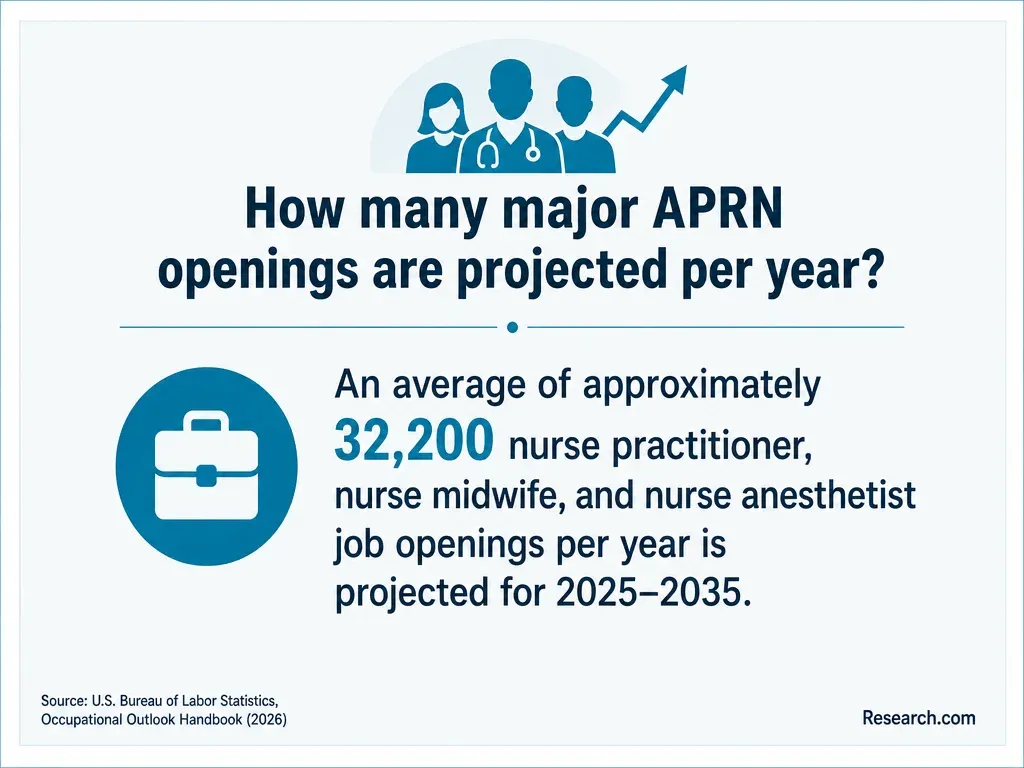
The U.S. Bureau of Labor Statistics reports nurse practitioner wages and employment projections for the occupation, not specifically for Wisconsin FNP certificate graduates. Its occupation-wide median is not an expected starting offer: location, experience, employer, and duties matter. Compare local postings and actual offers with the total cost of preparation rather than assuming the certificate produces a particular raise. If your intended work is primarily psychiatric care, cost-focused online psychiatric NP options warrant a separate population-focus comparison.
Other Things You Should Know About Nursing
Yes. Follow the issuing organization's current renewal cycle and continuing-competence requirements; also maintain any Wisconsin credentials required for your practice.
Not necessarily. Employer privileges and insurer enrollment can involve separate documentation and effective dates. Ask the hiring organization when you may provide and bill for services under its arrangements.
No. Prescribing depends on applicable Wisconsin and federal requirements, your credentials, and employer policies - not the certificate alone. Confirm the permissions needed for the specific position.
Not automatically. Whether a DNP is worthwhile depends on your career goal, an employer's requirements, and what additional education would add beyond your existing graduate preparation.
- Advanced Practice Registered Nurse - Licensure by... - DSPS https://dsps.wi.gov/a-z-professions-list/advanced-practice-registered-nurse-aprn/licensure-by-examination/
- 001 - CR 25-012 Rule Text - Wisconsin Legislature https://docs.legis.wisconsin.gov/code/register/2025/837b/register/final/cr_25_012_rule_text/cr_25_012_rule_text/_67
- Nursing Certifications | Berkley School of Nursing https://nursing.georgetown.edu/blog/nursing-certifications/
- The Journey From Graduation to Practice for New Nurse Practitioners - ScienceDirect https://www.sciencedirect.com/science/article/pii/S1555415525003289
- Clinical Collaborations | Nell Hodgson Woodruff School of Nursing https://www.nursing.emory.edu/degrees-programs/simulation-and-clinical-experience/clinical-collaborations
- 4.1.21 Instructional Modalities and Distance Education | Illinois State https://policy.illinoisstate.edu/academic/4-1-21
- What Are the Differences Between the AANP and ANCC Exams? | Walden University https://www.waldenu.edu/online-masters-programs/master-of-science-in-nursing/resource/what-are-the-differences-between-the-aanp-and-ancc-exams
- Nursing Field Experience: Find a Preceptor and Site | Academics at Walden University https://academicguides.waldenu.edu/nursing-field/find-preceptor
- Family Nurse Practitioner Certificate | Academic Affairs https://uwm.edu/nursing/academics/family-nurse-practitioner/
- Post-Master's Certificate: Family Nurse Practitioner | Edgewood University https://www.edgewood.edu/academics/programs/family-nurse-practitioner-fnp-post-graduate-certificate/