Online MBA in Organizational Change: Curriculum and Workload for Working Parents

Co-Founder and Chief Data Scientist
An online MBA may fit around a job, but it does not automatically fit around school pickups, caregiving, and unpredictable evenings. For working parents interested in organizational change, the decision depends as much on course schedules and group-project demands as on the curriculum.
This guide explains what these programs teach, how to assess the weekly workload, and which costs and career benefits deserve scrutiny. You can use it to decide whether a change-focused MBA is manageable now - or whether a shorter qualification would better meet your goals.
Key Things You Should Know
- An organizational change MBA combines a broad business core with leadership and change-focused coursework; a single relevant elective is not necessarily a formal concentration.
- For working parents, required live meetings, group projects, residencies, and leave policies matter more than an "online" label.
- Ask for a sample course calendar before enrolling. The Bureau of Labor Statistics reports a $126,520 median annual wage for US management occupations in May 2025 - not an expected salary for graduates of this specialization.
What is an online MBA in organizational change?
It is a Master of Business Administration delivered primarily online that applies broad management training to changing how organizations operate. Students may study how to build support for a new strategy, redesign processes, communicate with stakeholders, and assess whether a change is working.
Schools may call this focus organizational change, change management, organizational leadership, or something similar. Those names do not guarantee the same curriculum. A formal concentration usually has defined course requirements; an elective or a change-related project may offer useful exposure without appearing as a concentration on the degree record. When comparing online MBA programs, check the catalog rather than relying on a program-page keyword.
The degree is best suited to someone who needs both general business fluency and the ability to lead change across teams. A parent seeking only a specific change-management method may find a focused course or employer training less disruptive.
How does an online MBA in organizational change differ from campus programs?
The management concepts can be similar, but the way students participate differs. Online courses may use recorded lessons and discussion boards, scheduled video meetings, or both. Campus programs generally require travel to class; some online programs still require visits or residencies.
For a working parent, asynchronous lectures can make study time easier to move around a household schedule. They do not make deadlines flexible, and a group assignment may still require an evening when every teammate is available. Campus study may provide more routine face-to-face contact, while an online cohort can offer connections across locations. Neither format guarantees particular recruiting access. Compare the actual course calendar, career services, and opportunities to work with classmates - not just the delivery label.
What does the curriculum include in an online MBA in organizational change?
There is no single curriculum shared by all schools. Most relevant programs pair an MBA management core with courses or electives on how organizations plan, communicate, and carry out change. The table separates those layers so you can judge how much of a program addresses your goal.
| Curriculum layer | What it may cover | Why it matters |
| MBA core | Accounting, finance, strategy, operations, marketing, and organizational behavior | Builds the business context needed to weigh the costs and effects of a proposed change. |
| Change-focused study | Organizational diagnosis, stakeholder communication, leadership, culture, and implementation | Develops management-level approaches to gaining support and navigating resistance. |
| Applied work | A capstone, simulation, or consulting-style project, if offered | Can let students test a recommendation against practical constraints; project access and requirements vary. |
Read course descriptions closely. A strategy course that briefly mentions implementation is not equivalent to sustained study of organizational change. Likewise, an MBA typically teaches leaders to use change frameworks; it is not automatically advanced training in organizational psychology, research methods, or a particular software platform.
It can be manageable when course intensity and household support match, but no universal weekly-hours estimate is reliable. Reading speed, quantitative preparation, assignment design, and the number of courses taken at once all change the workload. Deadlines may bunch together even when lectures are recorded.
Before committing, request a recent syllabus or sample weekly calendar and test it against a normal week and a disrupted one. These questions expose obligations that a "flexible" description may hide:
- Which activities require attendance at a set time, and are sessions recorded if childcare falls through?
- When do group projects typically require meetings, and can teams work across time zones?
- Are exams, residencies, or weekend events mandatory, and how much notice is given?
- Can students reduce their course load, pause enrollment, or return after a caregiving interruption without losing completed credits?
Discuss protected study blocks with anyone sharing caregiving responsibilities. If most available time depends on a child staying asleep or an employer never changing a shift, a slower pace may be more sustainable than an accelerated one. Ask whether the school offers academic support outside standard business hours, when you are most likely to need it.
Requirements are set by each school, not by the specialization as a whole. Applicants commonly need a bachelor's degree and may be asked for transcripts, a résumé, recommendations, and a statement of purpose. Professional experience expectations, interviews, and GMAT or GRE policies vary. A nonbusiness bachelor's degree does not, by itself, rule out admission; some programs offer foundation coursework or recommend preparation in accounting or quantitative subjects.
For a parent returning to school, application readiness also means checking whether the program's expected enrollment pace is realistic. If testing time or prerequisites are a barrier, compare official policies rather than assuming a waiver is available. A guide to online MBA programs with accessible admissions can help frame the search, but confirm current requirements directly with each school.
Completion time depends on required credits, course sequencing, and how many courses a student takes per term. Part-time study can protect family time but extends the period during which deadlines compete with work and caregiving. Accelerated study shortens that period while making each term more demanding.
Ask for a term-by-term plan at the pace you intend to follow. Check whether change-focused courses run every term, whether taking a break delays a required sequence, and whether there is a maximum time allowed to finish. Those details are more useful than a school's fastest advertised completion time.
There is no reliable single price for this type of MBA. Compare total program cost, not just advertised tuition: required credits, per-credit or per-term charges, mandatory fees, books and software, and any travel for required visits all matter. A lighter course load may also change costs if a school charges recurring term fees.
For a household budget, include childcare needed for live classes or travel and the risk of paying for a term you cannot complete. Ask when employer tuition reimbursement is paid, what grades or continued employment it requires, and whether the benefit covers fees. If borrowing, consider interest alongside the amount charged by the school. This online MBA tuition and total cost guide offers a framework for comparison; obtain a current, individualized cost breakdown before enrolling.
The strongest fit is often advancement from an existing role that already involves teams, projects, operations, or people management. A graduate might pursue broader responsibility in operations management, organizational development, internal change initiatives, or management consulting. Employers will still look for evidence that the candidate has delivered results, worked with stakeholders, and understands the relevant industry.
A functional switch is harder than expanding an existing role. Someone with project experience may be able to demonstrate transferable implementation skills; someone seeking a specialized HR position may also need direct HR experience. Healthcare professionals leading changes to care delivery or administration should compare general change coursework with healthcare administration study, which addresses a different operating context. Neither path substitutes for clinical qualifications.
If your employer can offer a change initiative to lead now, that experience may be more valuable than another credential alone. If you need only a framework for your current job, targeted training may be a lower-cost first step.
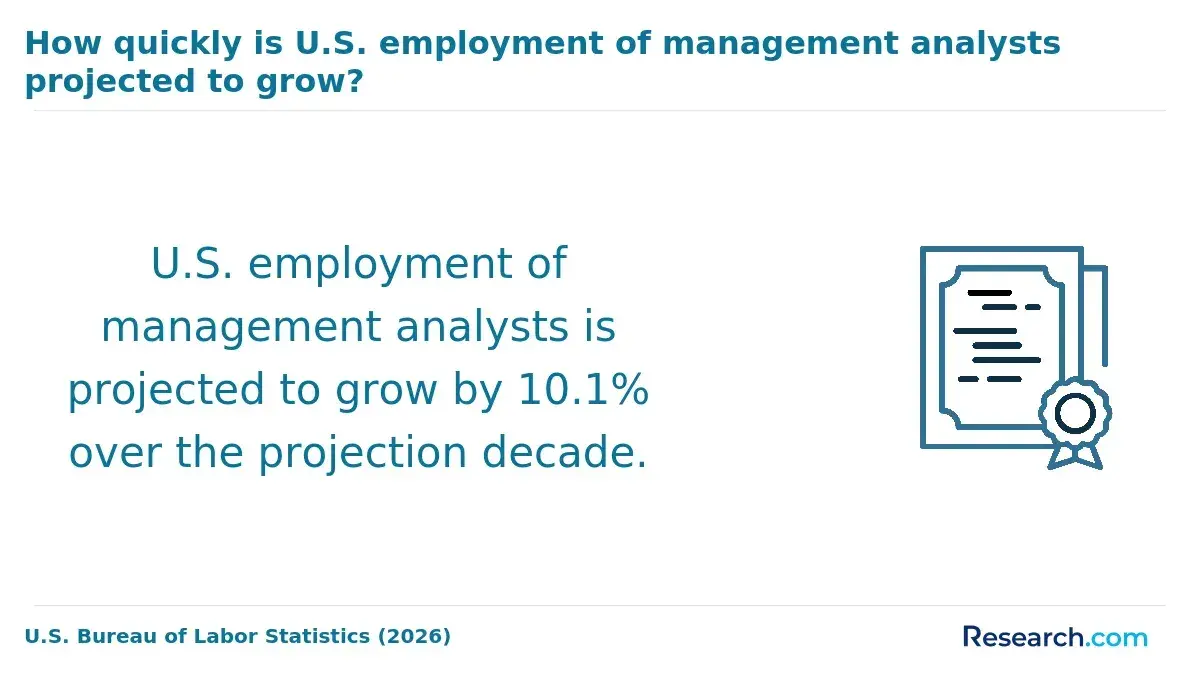
There is no single salary or employment projection for organizational change MBA graduates. The US Bureau of Labor Statistics reports a $126,520 median annual wage for management occupations in May 2025. That figure describes workers across many management jobs and experience levels; it should not be used as a starting-salary estimate or as evidence that the MBA caused higher pay.
BLS projects overall management employment to grow faster than the average for all occupations from 2025 to 2035. That broad outlook does not predict hiring for a particular change-management role. For a useful personal estimate, compare local postings for roles you could plausibly enter with your current experience, then assess whether the degree closes a stated skills gap.
How can you choose an accredited online organizational change MBA?
Start by verifying the institution's accreditation through the accreditor and the US Department of Education or CHEA. Then check separately whether its business school holds specialized accreditation, such as AACSB, ACBSP, or IACBE. Institutional accreditation and business-school accreditation are different claims; do not infer either from marketing language.
Once eligibility is clear, compare programs using the decision that matters most for your household: whether you can complete the actual coursework without sacrificing essential income or caregiving. Use a choosing online MBA programs resource to develop a shortlist, then verify each school's current catalog, schedule, costs, and policies. Give particular weight to the depth of change coursework, predictable deadlines, options after an interruption, and career support available to online students. A general MBA with workable scheduling may be a better choice than a named concentration whose required live sessions you cannot attend.
Other Things You Should Know About MBA
Often, but get your employer's permission before using confidential information. Ask the instructor whether you can anonymize details or use a public case instead.
Diploma and transcript wording varies by institution. Request a sample or written explanation from the registrar if the distinction matters to you.
No. An MBA is a graduate degree with a broad business core; a certification typically addresses a defined method or body of practice. Check the specific credential's requirements rather than assuming MBA coursework fulfills them.
Possibly, but schools may have separate admissions, course sequences, or enrollment rules. Ask about format changes before enrolling if a move or childcare change is foreseeable.
- Work Samples and Simulations | U.S. Office of Personnel Management https://www.opm.gov/policy-data-oversight/assessment-and-selection/other-assessment-methods/work-samples-and-simulations/
- Change Management: From Theory to Practice - PMC https://pmc.ncbi.nlm.nih.gov/articles/PMC9462626/
- Synchronous vs. Asynchronous Learning | Saint Leo University https://www.saintleo.edu/about/stories/blog/synchronous-vs-asynchronous-learning-for-course-delivery
- What are time management strategies for caregivers? | ua.edu https://socialwork.ua.edu/2025/01/22/what-are-time-management-strategies-for-caregivers/
- Organizational Change Management Frameworks | EWU https://online.ewu.edu/degrees/business/mba/organizational-leadership/management-frameworks/
- Full-Time MBA Curriculum - myRBS - Rutgers University https://myrbs.business.rutgers.edu/mba/full-time-curriculum
- MBA Academics & Curriculum - UCCS College of Business https://business.uccs.edu/programs/graduate/evening-mba/curriculum
- How Many Hours of Work Per Online Course Credit | ASU Online https://asuonline.asu.edu/newsroom/online-learning-tips/discover-weekly-number-hours-online-students-study/
- Considering Student Workload | CITT - University of Florida https://citt.it.ufl.edu/resources/course-design-basics/develop-and-implement/considering-student-workload/
- Flex MBA Curriculum - MBA Programs Chicago | UIC Business https://businessgraddegrees.uic.edu/mba-flex/curriculum/